
How donor-advised funds support discipleship ministries is ultimately a question of stewardship: how Christians can order their giving so that formation in Christ is sustained across seasons, not only in moments of urgency. A donor-advised fund, or DAF, can serve that purpose well when it is treated as a disciplined instrument for generosity rather than a holding tank for charitable intentions.
Discipleship ministries often do their most important work quietly—teaching Scripture, forming leaders, sustaining local churches, equipping parents, and discipling young believers over years. That long horizon creates a funding challenge. Donors can be eager to give, but giving patterns frequently swing with the news cycle, the calendar, or personal income volatility. A well-governed DAF can help align the donor’s resources with the ministry’s formation timeline, without losing moral clarity about what faithful giving is for.
Donor-advised funds are a stewardship tool, not a spiritual shortcut
What a DAF does and does not do
A DAF is a charitable account sponsored by a public charity. Donors contribute assets, receive an immediate charitable deduction (subject to IRS rules), and then recommend grants to qualified nonprofits over time. The fund’s sponsor has legal control, and the donor’s role is advisory—hence “donor-advised.” For many Christian households, that structure offers a practical way to give appreciated assets, separate the timing of a tax deduction from the timing of ministry grants, and cultivate a deliberate giving plan.
The limitation is moral as well as administrative: a DAF does not automatically convert saved money into given money. While most DAF dollars are eventually granted, the pace varies widely, and Christians genuinely disagree about whether large, long-ungranted balances represent wise patience or delayed obedience. The concern is not abstract. National philanthropic reporting has noted that DAF assets have grown quickly in recent years, alongside ongoing debate about payout expectations and accountability in the DAF ecosystem (The Chronicle of Philanthropy).
The biblical tension a DAF should sharpen, not dull
Scripture treats wealth as spiritually dangerous precisely because it tempts the heart toward control. Jesus’ warning that one cannot serve both God and money is not a call to financial naïveté; it is a call to undivided allegiance (Matthew 6:24). A DAF can either reinforce control—“we will give later, when conditions are perfect”—or it can become a structure of obedience—“we will set aside resources now, and we will distribute them steadily for gospel work.”
What this means in practice is that a DAF is best paired with a defined granting rhythm and a theology of discipleship that values slow, faithful formation. Discipleship is rarely efficient. It is often costly. A funding instrument should serve that reality.

Discipleship ministries need durable funding because formation takes time
Why short-term funding patterns undermine long-term discipleship
Most discipleship ministries are labor-intensive. Staff training, curriculum development, pastoral coaching, mentoring, and safeguarding practices cannot be turned on and off without damage. When giving arrives in spikes, ministries may overhire during strong quarters and retrench during lean ones, disrupting relationships that are central to discipleship. This is particularly acute for ministries serving students and young adults, where turnover is already high and trust must be rebuilt each year.
DAFs can support a different pattern: donors contribute larger amounts when income events occur, then grant steadily over time. The ministry receives consistent support, and the donor is not forced to decide between “give now” and “be prudent.” The prudence is expressed through consistency rather than delay.
Discipleship outcomes are real, but harder to measure well
Christian donors often ask for evidence of impact, and that instinct is sound. Yet discipleship resists simplistic metrics. Attendance counts can matter, but they are not maturity. Decisions recorded can matter, but they are not perseverance. The most responsible ministries tend to combine quantitative signals with qualitative assessment: leader evaluations, retention, follow-up, safeguarding compliance, and evidence of church integration.
Across our verification work at Most Trusted, we find that ministries that meet The Most Trusted Standard typically do two things simultaneously: they refuse to reduce spiritual formation to vanity metrics, and they still provide verifiable clarity about what they do, whom they serve, and how they evaluate whether their work is faithful and effective. That posture helps donors fund discipleship without turning it into a marketing exercise.
A DAF can strengthen the donor ministry relationship without entangling it
Reducing administrative friction for both sides
Discipleship ministries frequently operate with lean administrative capacity. When donors give through a DAF, grant payments are often consolidated and standardized, reducing the burden of processing complex asset gifts or irregular donation methods. The donor can give appreciated securities or other assets to the DAF, and the ministry receives a straightforward grant. This can be especially helpful for ministries that would otherwise be unable to receive non-cash gifts efficiently.
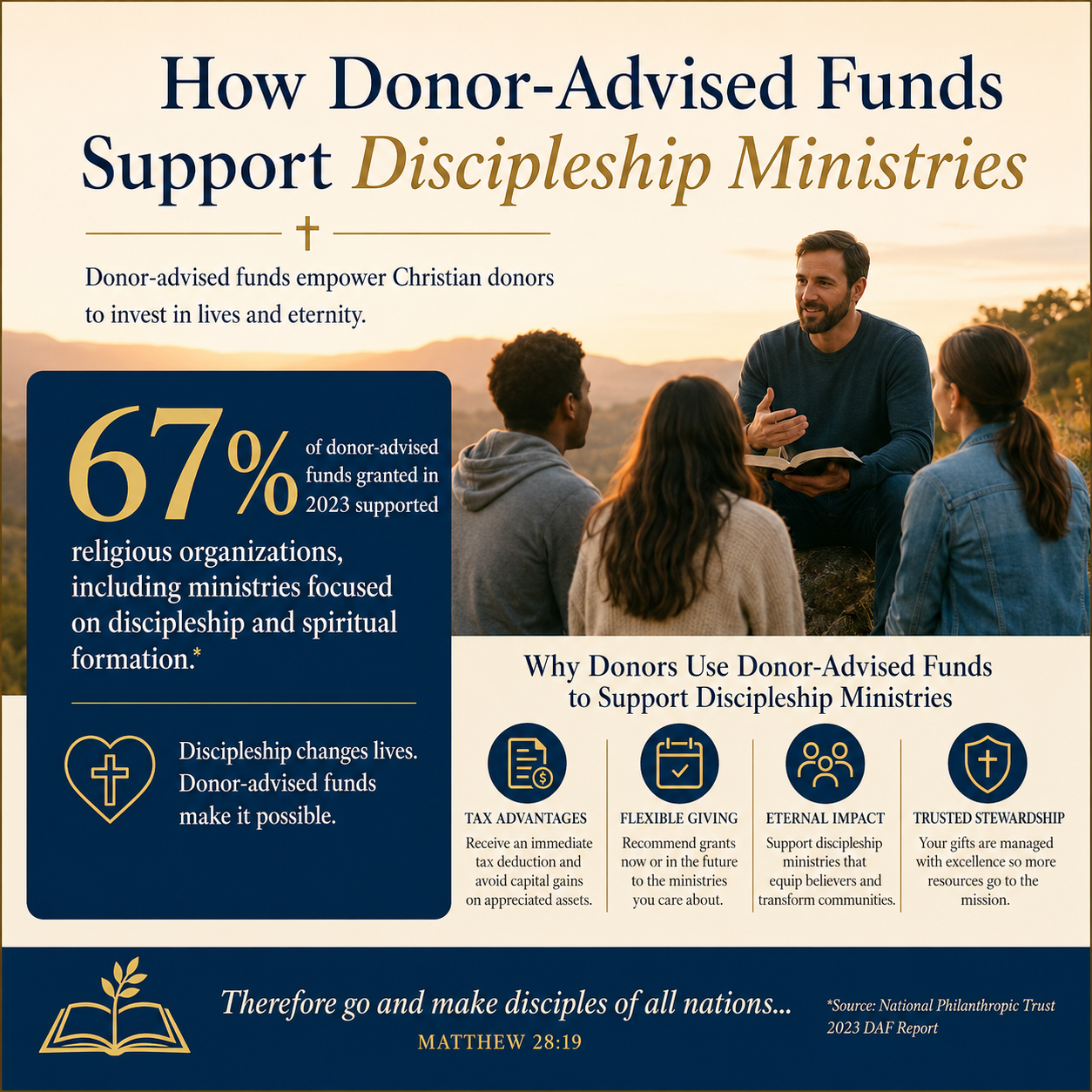
DAFs can also help donors avoid turning ministry support into a series of emotionally charged decisions. A grant schedule can be set and reviewed annually, supporting disciplined generosity rather than impulse.
Keeping accountability clear
Because DAF grants are routed through a sponsoring organization, some donors worry that accountability becomes murkier. That is a legitimate concern. The ministry still bears responsibility for governance, financial integrity, and transparency, but the donor may feel one step removed from the transaction. This is one place where careful verification matters.
We encourage donors to evaluate discipleship ministries on concrete, observable indicators—board governance, audited financials when appropriate for size, conflict-of-interest policies, doctrinal commitments, safeguarding practices where minors are involved, and meaningful reporting. The Most Trusted Standard was built to provide that kind of multi-criteria clarity, without collapsing faithfulness into a single ratio or slogan.
For donors who are surveying the broader landscape of Discipleship Ministries, the discipline is the same: choose ministries with a faithful theological center and governance that can bear the weight of trust.
Practical granting strategies that fit discipleship work
Granting patterns that sustain formation
A DAF becomes particularly effective for discipleship when donors use it to match how formation actually happens. Many ministries need stable staffing, predictable curriculum cycles, and the ability to plan cohorts, retreats, training pipelines, and follow-up care. Consider a few strategies that align with that reality:
- Multi-year commitments that give ministries planning confidence and reduce reactive fundraising.
- Monthly or quarterly grants that mirror payroll and program cadence rather than year-end surges.
- Capacity grants for leader development, safeguarding systems, or curriculum translation when those are clearly tied to mission.
- Matching grants that encourage broad-based support without forcing ministries into gimmicks.
- Designated project grants only when the project is truly strategic and does not distort priorities.
Discipleship ministries are sometimes pressured to chase restricted gifts because they are easier to “sell.” Donors should recognize the trade-off: too many restrictions can fragment a ministry’s work and leave core operations underfunded. A DAF can support a healthier balance by providing steady unrestricted support alongside occasional targeted grants.
Asset-based giving that increases generosity without increasing complexity
DAFs are often used for giving appreciated securities, which can allow donors to avoid capital gains taxes while increasing the charitable amount. For donors with complex assets, a DAF sponsor may also facilitate giving that would be burdensome for a small ministry to receive directly. The point is not financial cleverness; it is increasing what can be given to gospel work while maintaining order and compliance.
Those considering significant contributions should attend carefully to IRS guidance on charitable deductions and substantiation rules (Internal Revenue Service). Wise generosity honors both the spirit and the letter of lawful stewardship.
Verification matters because DAFs can distance donors from the details
The common risks donors should name plainly
DAFs can create a sense of cleanliness: the grant is processed, a receipt is generated, and the donor moves on. But discipleship ministries are not interchangeable, and not every organization using Christian language is governed with Christian seriousness. Risks worth naming include unclear doctrinal accountability, celebrity-driven leadership structures with weak boards, inadequate safeguarding, financial opacity, and outcomes reporting that is heavy on stories but thin on verifiable detail.
Christians also disagree about how much overhead is appropriate, and the field has had to reckon with the damage done by simplistic overhead obsession. The joint statement commonly known as “The Overhead Myth,” signed by major nonprofit evaluators, argued that overhead ratios alone are a poor measure of nonprofit performance (BBB Wise Giving Alliance). Discipleship ministries, in particular, may need to invest in training, evaluation, and safeguarding—costs that are ethically necessary even when they are not emotionally compelling.
What we look for when discipleship is the mission
Verification is not suspicion; it is a form of love for the church and for those served. Through Most Trusted’s work, we aim to help donors distinguish between ministries that deserve long-term confidence and those that require caution. The Most Trusted Standard examines a ministry’s Faith Foundation, Financial Integrity, Governance and Leadership, and Transparency and Effectiveness, because a credible discipleship ministry must be more than rhetorically orthodox. It must be structurally trustworthy.
Donors who are considering disciplined giving through a DAF often benefit from reviewing the practical considerations associated with How to Give to Discipleship Ministries, especially when deciding between restricted and unrestricted support, one-time gifts and multi-year commitments, and direct giving versus intermediary structures.
FAQs for How donor-advised funds support discipleship ministries
Are donor-advised funds appropriate for small, local discipleship ministries?
They often are, provided the DAF sponsor can grant to the ministry and the ministry is a qualified public charity. The donor’s experience is typically simpler, and the ministry receives a standard grant. The primary caution is relational: donors should not let the convenience of a DAF replace the due diligence and ongoing attentiveness that healthy ministry partnership requires.
Should Christians set a payout goal for their donor-advised fund?
Many should. Scripture commends readiness to share (1 Timothy 6:18) and warns against storing up treasure as an end in itself (Luke 12:15–21). A defined granting rhythm can keep the DAF from becoming a deferred-obedience account. The appropriate pace depends on a donor’s circumstances and the ministries’ needs, but the moral direction should be clear: funds set aside for charitable purposes should be put to work for charitable purposes in a timely, disciplined way.
Conclusion
Donor-advised funds support discipleship ministries best when they serve a mature vision of stewardship: giving that is deliberate, consistent, and accountable. Discipleship is patient work, often hidden from public applause, and it deserves funding that is equally patient without becoming passive. When donors pair a DAF with careful verification and a clear granting plan, they can strengthen gospel formation for the long haul while honoring the trust that Christian giving requires.



