

How to give to Discipleship Ministries is ultimately a question about what kind of formation a donor is funding. Discipleship work is slower than relief work, less photogenic than buildings, and harder to reduce to a single metric. Yet Scripture treats the making of mature disciples as central to the Church’s mission: Jesus’ commission is not only to gather converts, but to “make disciples… teaching them to observe all that I have commanded you” (Matthew 28:19–20).
For Christian donors, the tension is familiar. We want to fund work that bears spiritual fruit, protects people from spiritual abuse, and handles money with integrity. Discipleship ministries can be extraordinarily faithful and fruitful, and they can also drift into personality-driven models, unaccountable leadership, or inflated impact claims. Wise giving does not assume the best or the worst; it insists on verifiable clarity.
Begin with a theology of discipleship and a sober view of risk
Discipleship is not a niche program for especially motivated Christians. In the New Testament, growth in Christ is expected and communal: “And what you have heard from me… entrust to faithful men, who will be able to teach others also” (2 Timothy 2:2). Giving to discipleship ministries is one practical way donors participate in that chain of transmission—funding teaching, mentoring, spiritual formation, and leadership development that outlasts one event or one personality.
What this means in practice is that donors should evaluate discipleship ministries by more than enthusiasm, branding, or platform reach. Discipleship is inherently relational and formative; it shapes consciences, households, and communities. That is why failures in this category can carry uniquely deep harm. When a ministry forms people through coercive authority, manipulative fundraising, or unaccountable leaders, the damage is not merely financial. It can become spiritual injury that takes years to heal.
Discipleship is hard to measure, but not impossible to evaluate
Christians genuinely disagree about the best indicators of spiritual fruit. Some emphasize conversions, others emphasize perseverance, holiness, reconciliation, or local church strength. Serious donors should acknowledge that spiritual growth cannot be audited like inventory, and yet refuse the conclusion that discipleship ministries are beyond evaluation. A faithful ministry can articulate what it believes discipleship is, how its programs pursue it, and what evidence it uses to learn whether its approach is forming people over time.
Across our verification work at Most Trusted, the ministries that meet The Most Trusted Standard tend to make their theology and their governance visible. They do not hide behind vagueness. They name what they teach, who is accountable for teaching it, and how they guard against the distortions that arise when authority is concentrated and untested.
Spiritual authority requires stronger safeguards, not softer questions
Discipleship ministries often operate close to the center of a person’s life: conscience, family decisions, vocational direction, marriage, repentance, and forgiveness. That proximity heightens the need for clear policies around safeguarding, counseling boundaries, financial conflicts of interest, and grievance processes. Donors should treat these safeguards as part of ministry effectiveness, not as administrative overhead.

Choose a giving method that matches the ministry’s economic reality
Different ways of giving do more than change how quickly a donation is received. They shape a ministry’s planning horizon, its cost structure, and its temptation profile. Discipleship work often depends on staff stability and sustained relationships; that makes predictable funding disproportionately valuable compared to one-time surges.
Online giving is efficient, but donors should verify the path of funds
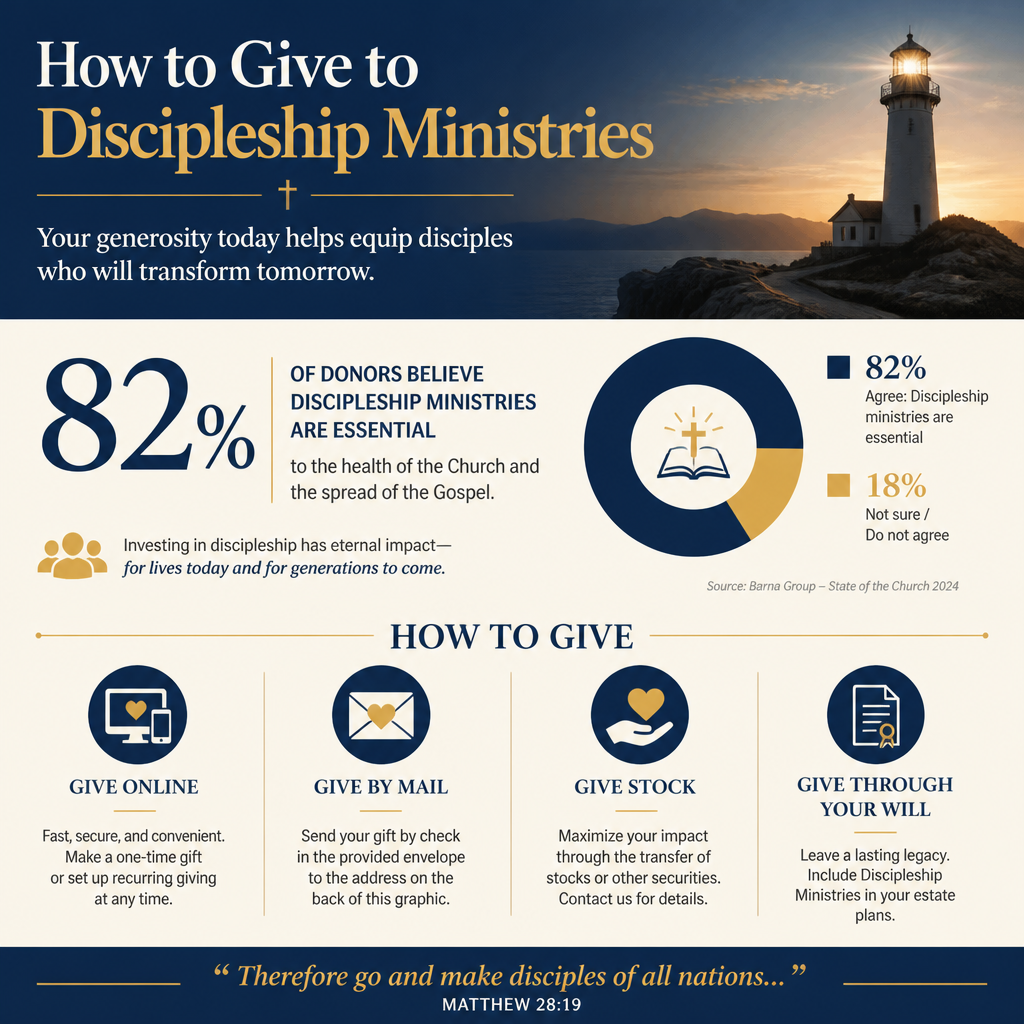
For many donors, online giving is the simplest path: debit card, credit card, ACH, or a donor portal. The harder question is whether the ministry’s systems and disclosures are mature. Donors should look for clear confirmation receipts, an explanation of whether gifts are tax-deductible, and an unambiguous statement about whether a gift is restricted to a specific program or used where most needed.
If the ministry relies heavily on credit cards, donors should remember that processing fees reduce the net gift. For larger donations, ACH transfers can reduce fees, and some ministries can provide wire instructions for major gifts. When a ministry cannot explain its giving options plainly, that is often a warning that its financial operations have not kept pace with its public presence.
Monthly giving funds formation better than episodic campaigns
Monthly support helps a discipleship ministry keep disciple-makers in place: trainers, mentors, curriculum developers, pastoral care staff, and evaluators. Sustained gifts reduce the need for constant fundraising appeals, which can quietly distort a ministry’s messaging toward what sells rather than what forms. For donors, monthly giving also encourages steady stewardship rather than reactive generosity driven by emotion or headlines.
Stock, donor-advised funds, and planned giving each have distinct strengths
Donating appreciated stock can be an especially tax-efficient way to give, because donors may avoid capital gains tax while supporting the ministry’s work. Donor-advised funds can be useful for donors who want to front-load giving in a high-income year while distributing grants over time. Planned giving can align with the Christian conviction that our assets are ultimately entrusted to us for stewardship, not possession.
Each method introduces practical considerations. Some smaller ministries are not equipped to receive complex assets or to process DAF grants cleanly. Donors should not assume capability; they should ask. A mature response is not defensive. It is a clear explanation of what the ministry can receive, how it handles liquidation, and what policies govern gift acceptance.
Apply The Most Trusted Standard to discipleship ministry due diligence
Christian donors do not need to become forensic accountants, but we do need a disciplined framework. Most Trusted evaluates ministries against The Most Trusted Standard, a 15-criteria framework across Faith Foundation, Financial Integrity, Governance and Leadership, and Transparency and Effectiveness. The purpose is not cynicism. It is confidence grounded in evidence.
For donors supporting discipleship ministries, several due-diligence questions matter disproportionately because of the category’s unique risks.
Faith foundation that is explicit and accountable
Discipleship ministries should state their doctrinal commitments in accessible language and show how those commitments are guarded. Donors should ask: Who has authority to define what is taught? Is there a theological review process for curriculum? Is the ministry anchored to the local church, or does it function as a parallel authority over believers? Some discipleship ministries serve churches by providing tools and training. Others operate as independent networks. Both can be faithful, but the independent model raises the stakes for governance and accountability.
We also recommend donors look for a posture of theological seriousness rather than novelty. Scripture warns against “different doctrine” that produces speculation rather than love (1 Timothy 1:3–5). A ministry does not need to be innovative to be effective, but it must be clear, orthodox in essentials, and humble about secondary matters.
Financial integrity that can withstand scrutiny
Financial stewardship is not a public relations concern; it is obedience. Donors should look for current financial statements, a credible outside audit when scale warrants it, and a board that can explain how budgets are built and monitored. When ministries insist donors should ignore financial questions as “unspiritual,” we consider that a serious red flag.
In the broader nonprofit field, major evaluators have warned against simplistic “overhead” thinking. Charity Navigator, Candid (formerly GuideStar), and BBB Wise Giving Alliance jointly argued that overhead ratios are a poor standalone measure of performance and can mislead donors away from necessary investments in staff and systems Charity Navigator. Discipleship ministries often require meaningful investment in training, safeguarding, and evaluation; donors should not penalize this when it is transparently explained and properly governed.
Governance and leadership that is not built on a single personality
Discipleship ministries sometimes grow around gifted communicators. That is not inherently wrong, but it can become structurally dangerous if a leader’s platform substitutes for accountable governance. Donors should ask: Is there an independent board with real authority? Are there term limits or mechanisms for evaluation? Are related-party transactions disclosed? Are leadership transitions planned, or unthinkable?
Healthy ministries tend to welcome these questions because they have already asked them internally. Unhealthy ministries treat accountability as hostility.
Transparency and effectiveness that describe real formation, not marketing outcomes
Discipleship is not best measured by impressions, downloads, or event attendance. Those may be useful reach metrics, but they are not formation metrics. Donors should look for evidence of engagement over time: mentoring structures, completion rates for multi-session training, downstream leadership development, and partnerships with local churches that can testify to sustained impact.
When a ministry does share statistics, donors should ensure they are specific and non-manipulative. For example, donor confidence improves when a ministry distinguishes between “people reached” and “people meaningfully engaged,” and when it can explain how it counts each category.
Give with confidence, and keep your relationship to the ministry appropriately ordered
Strong giving to discipleship ministries is both generous and bounded. Donors should not confuse financial support with spiritual authority. A ministry is not a donor’s church, and a donor is not a ministry’s overseer. The local church remains the ordinary center of Christian formation, even when parachurch discipleship organizations serve the Church well.
In practical terms, we recommend donors set clear intentions for their giving, ask questions that match the level of investment, and reassess periodically. When a ministry meets reasonable standards of theological clarity, accountable leadership, transparent finances, and credible evidence of formation, donors can give with real confidence and joy. For readers comparing options across the category, our work on Discipleship Ministries is designed to support disciplined, prayerful stewardship without surrendering to either naivete or cynicism.
Christian generosity is not a wager against reality. It is stewardship before God, who sees in secret and weighs not only the size of the gift but the faithfulness with which it is given (Matthew 6:1–4). When donors bring that seriousness to discipleship giving, they help fund the quiet, enduring work of forming saints for the life of the world.



