
How monthly giving supports discipleship ministries becomes clearest when we stop treating discipleship as an event and start treating it as formation over time. The ministries that make disciples are usually doing work that cannot be rushed: relationships that thicken, habits that are practiced, doctrine that is understood, and obedience that is learned in community.
Christian donors tend to feel this tension in their own lives. We want to fund visible impact, yet the fruit of discipleship often appears quietly and later. Monthly giving does not solve every funding challenge, but it aligns a donor’s stewardship with the patient, repetitive, embodied nature of Christian formation.
Discipleship is a long obedience and funding should match its time horizon
Formation is cumulative by design
Jesus did not produce disciples primarily through one-time experiences. He called people to follow him, kept them near, taught them repeatedly, corrected them, sent them, and received them back. The Great Commission is explicit that the church’s task is not only to proclaim but to teach believers to obey what Christ commanded (Matthew 28:19–20). That instructional, relational work carries a natural time horizon.
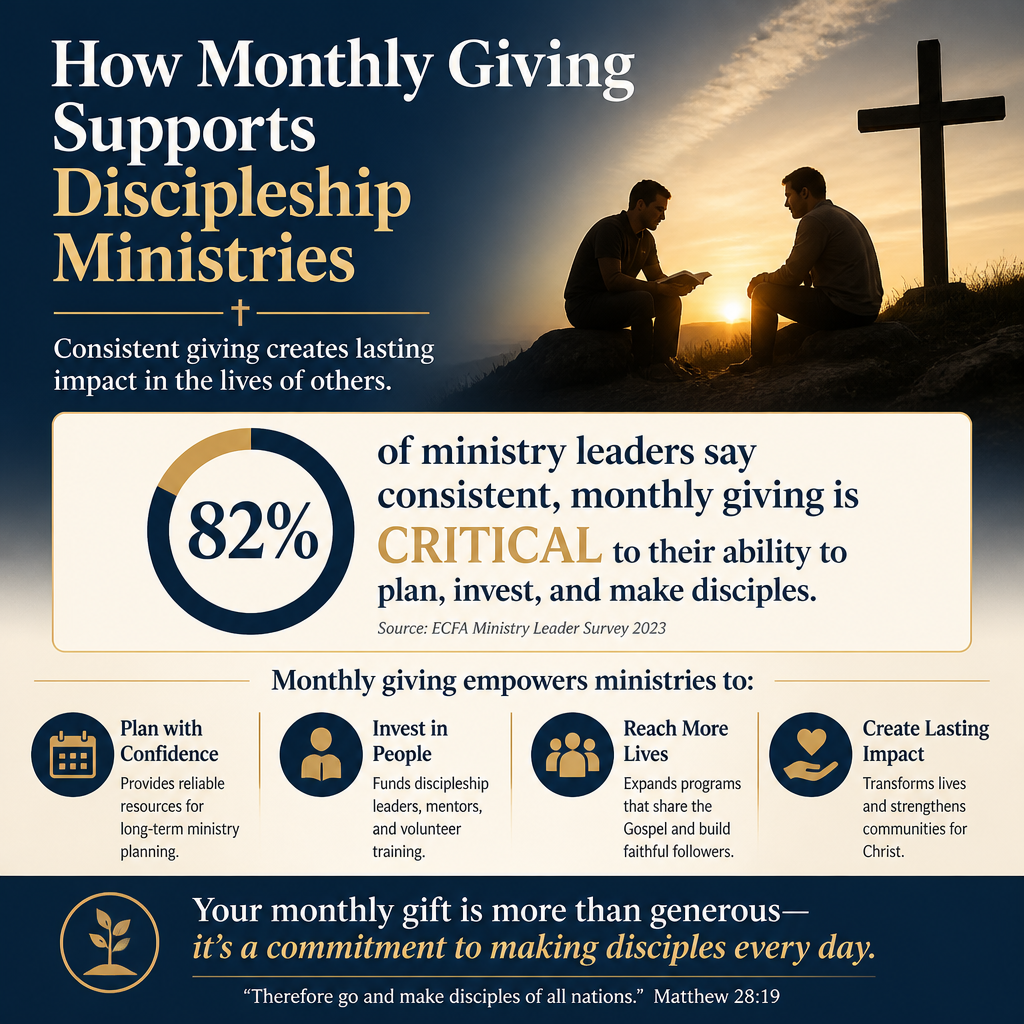
Monthly giving supports that horizon because it gives a ministry permission to plan for continuity. A discipleship ministry can design a pathway that assumes someone will still be present in six months: a small group semester that leads into pastoral coaching, a catechesis track, a mentoring model that pairs a new believer with a mature one, or a leadership pipeline that trains future elders and women’s ministry leaders.
Stability protects the ministry’s attention
When revenue is volatile, leaders spend disproportionate energy chasing the next gift rather than shepherding people. This is not a moral failure; it is a structural reality. A recurring base of support reduces the internal pressure to sensationalize outcomes, constantly relaunch programs, or prioritize the most marketable stories over the most necessary work.
For donors who care about the integrity of Christian formation, that matters. The aim is not merely ministry activity; it is faithfulness sustained over time.

Monthly giving sustains the unglamorous costs that make ministry real
Discipleship runs on people and presence
Many discipleship ministries are labor-intensive. They require trained staff, vetted volunteers, background checks, curriculum development, pastoral oversight, and the disciplined follow-up that keeps a struggling participant from disappearing. The most “spiritual” outcomes often depend on the most ordinary operational details: a mentor who shows up, a children’s worker who is trained, a counselor who has time, a coordinator who keeps appointments from falling through.
Monthly giving underwrites that steady presence. It is not as emotionally compelling as a single, large gift toward a visible project, but it often keeps the doors open for the conversations in which people repent, forgive, reconcile, and learn to pray.
It also supports evaluation that serves the mission
Discipleship outcomes are harder to quantify than meals served or beds provided. Christians genuinely disagree about how to measure spiritual growth without sliding into reductionism. Still, responsible ministries can track meaningful indicators: retention in community, completion of training tracks, leadership development, volunteer engagement, safeguarding incidents, and follow-up with participants.
Recurring support makes it more feasible to build modest, appropriate measurement into the ministry’s rhythm, rather than treating accountability as a luxury reserved for well-funded organizations.
Recurring support can interrupt the starvation cycle that weakens effectiveness
Underfunding creates predictable distortions
The nonprofit sector has had to reckon with what Stanford Social Innovation Review described as the “Nonprofit Starvation Cycle,” in which funders’ expectations push organizations to underinvest in administration and infrastructure, leading to fragility and underperformance Stanford Social Innovation Review. Discipleship ministries are not immune. When donors restrict giving to only the most visible “frontline” expenses, ministries may struggle to keep qualified staff, maintain safe systems, or support leaders who are burning out.
Monthly giving is not inherently unrestricted, but in practice it often functions that way: donors give to the mission, not to a one-time project line item. That kind of support helps a ministry invest in the capacities that protect long-term spiritual care.
Healthy overhead is not the enemy of faithful ministry
Some donors still carry the assumption that “overhead” is waste. The field has pushed back strongly against that narrative, including the “Overhead Myth” letter signed by Charity Navigator, GuideStar, and the BBB Wise Giving Alliance, which argues that overhead ratios are a poor proxy for performance and can incentivize harmful underinvestment Charity Navigator. For discipleship ministries, that warning is particularly relevant because training, supervision, safeguarding, and pastoral accountability are often classified as administrative costs even when they are central to faithful discipleship.
Monthly giving can help normalize funding that reflects reality: discipleship requires structures that keep ministry safe, consistent, and biblically responsible.
Monthly giving strengthens trust when paired with verification and transparency
Consistency is a donor’s stewardship, not blind loyalty
Recurring giving is sometimes criticized as “autopilot generosity.” That critique has merit when donors disengage from discernment. Christian stewardship calls for ongoing wisdom, not one-time intention. The question is not whether monthly giving is good in itself, but whether it is directed toward ministries that are worthy of sustained trust.
This is where Most Trusted’s work can serve donors. Across our verification work, we see that stable, recurring donor support has the best effect when it is joined to serious standards: clear Christian identity, responsible governance, credible financial reporting, and transparent communication about results and setbacks.
The Most Trusted Standard gives donors a practical way to test credibility
At Most Trusted, we evaluate ministries against The Most Trusted Standard, a 15-criteria framework that examines faith foundation, financial integrity, governance and leadership, and transparency and effectiveness. Donors do not need a postgraduate education in nonprofit accounting to ask meaningful questions. But they do need a framework that is both principled and concrete, especially when they commit to ongoing support.
What this means in practice is that recurring giving should be paired with recurring review. When donors support discipleship ministries monthly, we recommend checking for a few verifiable signals of health:
- Clear doctrinal commitments and accountability to a recognized church or theological authority
- Independent board governance with documented oversight
- Financial statements and an annual report that match the ministry’s public claims
- Safeguarding policies, especially when minors or vulnerable adults are involved
- Evidence of learning over time, including honest reporting of challenges
Donors who want a broader view of the category can also explore Discipleship Ministries as a giving focus, especially where ministries vary widely in theology, practices, and reporting maturity.
Monthly giving shapes the donor as much as it funds the ministry
Regular generosity disciplines desire
Scripture does not treat giving as merely transactional. It is formative. Jesus warned that money exerts spiritual gravity: “Where your treasure is, there your heart will be also” (Matthew 6:21). Monthly giving makes that dynamic harder to ignore. A recurring commitment forces donors to decide, again and again, what they will prioritize, what they will postpone, and what they will trust God to provide.
This is one reason monthly giving can be such a fitting support for discipleship ministries. It embodies the same pattern discipleship requires: repeated obedience, sustained attention, and the humility of small faithfulness rather than occasional intensity.
It also reduces the temptation to buy a story
One-time giving can drift toward the purchase of an emotional experience: a dramatic testimony, a compelling campaign, a single catalytic moment. There is nothing wrong with funding urgent needs. But discipleship is rarely dramatic in that sense. Monthly giving allows donors to participate in the slow work of God without demanding that every update feel like a revival.
For donors who want practical guidance on structuring their support, How to Give to Discipleship Ministries offers additional considerations that honor both generosity and discernment.
FAQs for How monthly giving supports discipleship ministries
Does monthly giving matter if a ministry already has major donors?
Yes. Major gifts are often designated for expansion, capital needs, or specific initiatives. Monthly donors typically provide flexible, predictable support that stabilizes core operations: staff retention, mentoring coordination, training, and follow-up. In discipleship work, those steady inputs often determine whether a promising program becomes a durable ministry or a short-lived experiment.
How can we tell whether a discipleship ministry will use monthly gifts responsibly?
Donors should look for governance and financial transparency that can be verified, not merely asserted. Practical indicators include an independent board, clear doctrinal accountability, published financials, safeguarding policies, and reporting that names both fruit and limitations. Our approach at Most Trusted is to evaluate ministries against The Most Trusted Standard so donors can give with confidence grounded in evidence and Christian conviction rather than marketing.
Monthly giving as a disciplined partnership in formation
How monthly giving supports discipleship ministries is not primarily a funding tactic. It is a way of aligning donor practice with the spiritual reality that disciples are formed over time. When recurring generosity is paired with serious discernment, it becomes a disciplined partnership: donors provide stability, ministries pursue faithfulness, and the church is better able to teach believers to obey all that Christ commanded.



