
What disability ministry sermons and teaching cover is not a secondary question for the church; it is a test of whether our doctrine of the imago Dei, our Christology, and our ecclesiology reach the people most likely to be treated as an appendix. For Christian donors, it is also a due-diligence question. A ministry’s public preaching and internal training reveal what it will protect, what it will ignore, and what it will quietly normalize when budgets tighten or difficult cases arise.
Disability ministry carries moral urgency, but it also carries real risk: sentimental storytelling, theological shortcuts about healing, and program models that unintentionally sideline disabled Christians from ordinary church life. The strongest ministries tend to treat preaching and teaching as a formative center, not promotional support. Across our verification work at Most Trusted, we see that teaching content often predicts whether a disability ministry will mature into durable, accountable service or drift into episodic compassion without long-term faithfulness.
Disability in the image of God and the doctrine of the church
Imago Dei as a nonnegotiable, not a slogan
Faithful disability ministry teaching begins where Scripture begins: with the created dignity of every person. Genesis grounds human worth in God’s image, not in productivity, independence, cognitive capacity, or communicative ease. When sermons treat disabled people primarily as objects of compassion, or as illustrations for others’ spiritual lessons, they can unintentionally weaken the very premise that justifies the ministry.
Strong preaching names the modern pressures that compete with biblical anthropology: utilitarian views of personhood, quality-of-life assumptions in medicine and public policy, and a consumer church culture that prizes efficiency. Donors should listen for whether a ministry’s teaching confronts those pressures with clarity and charity rather than adopting them unconsciously.
The church as a body, not a service provider
Paul’s language about the body in 1 Corinthians 12 does not permit a two-tier church where some are “served” and others “belong.” Disability ministry sermons that take ecclesiology seriously will emphasize mutuality: those who seem weaker are indispensable; honor is owed; gifts are distributed by the Spirit without respect to cultural status.
What this means in practice is that teaching should not only recruit volunteers. It should reshape congregational expectations: membership pathways, sacramental access, small-group life, and leadership development. When preaching treats disability ministry as an optional add-on, the congregation may applaud a program while leaving the church’s shared life unchanged.

Healing, suffering, and the hope of resurrection
Healing in the Gospels without triumphalism
Christians genuinely disagree about how to teach divine healing: the relationship between prayer, medical care, spiritual gifts, and God’s providence. Faithful disability ministry sermons and teaching cover this tension without embarrassment. The Gospels record real healings, and they also refuse a simplistic formula that collapses suffering into a lack of faith.
Donors should be alert to teaching that makes healing the primary point of disability ministry, as if disability were chiefly a problem to solve rather than a condition within which discipleship, friendship, and sanctification occur. A ministry can pray boldly for healing and still refuse manipulative promises, staged testimonies, or any approach that turns disabled bodies into platforms for others’ certainty.
Lament, endurance, and eschatological clarity
Scripture gives believers a vocabulary for grief that is not faithless: the Psalms teach lament, and Romans 8 locates suffering within a creation that groans for redemption. Disability ministry teaching should make room for honest sorrow about loss and limitation while also grounding hope in resurrection, not in a present-day demand for normalcy.
Done well, sermons will connect disability and chronic illness to the larger Christian story: a fallen world, Christ’s solidarity with weakness, and the coming restoration of all things. That eschatological frame protects families from two errors at once: despair that treats disability as ultimate, and triumphalism that treats disability as intolerable.
Inclusion that is more than access and more than sentiment
Access as justice, not as charity
Many churches have learned to think about disability primarily in terms of ramps, seating, and sensory-friendly environments. Those are important, but teaching must go further: access is not merely being “nice,” and it is not merely a legal concern. It is a form of neighbor-love that refuses to make participation in the worshiping community contingent on typical bodies and typical communication.
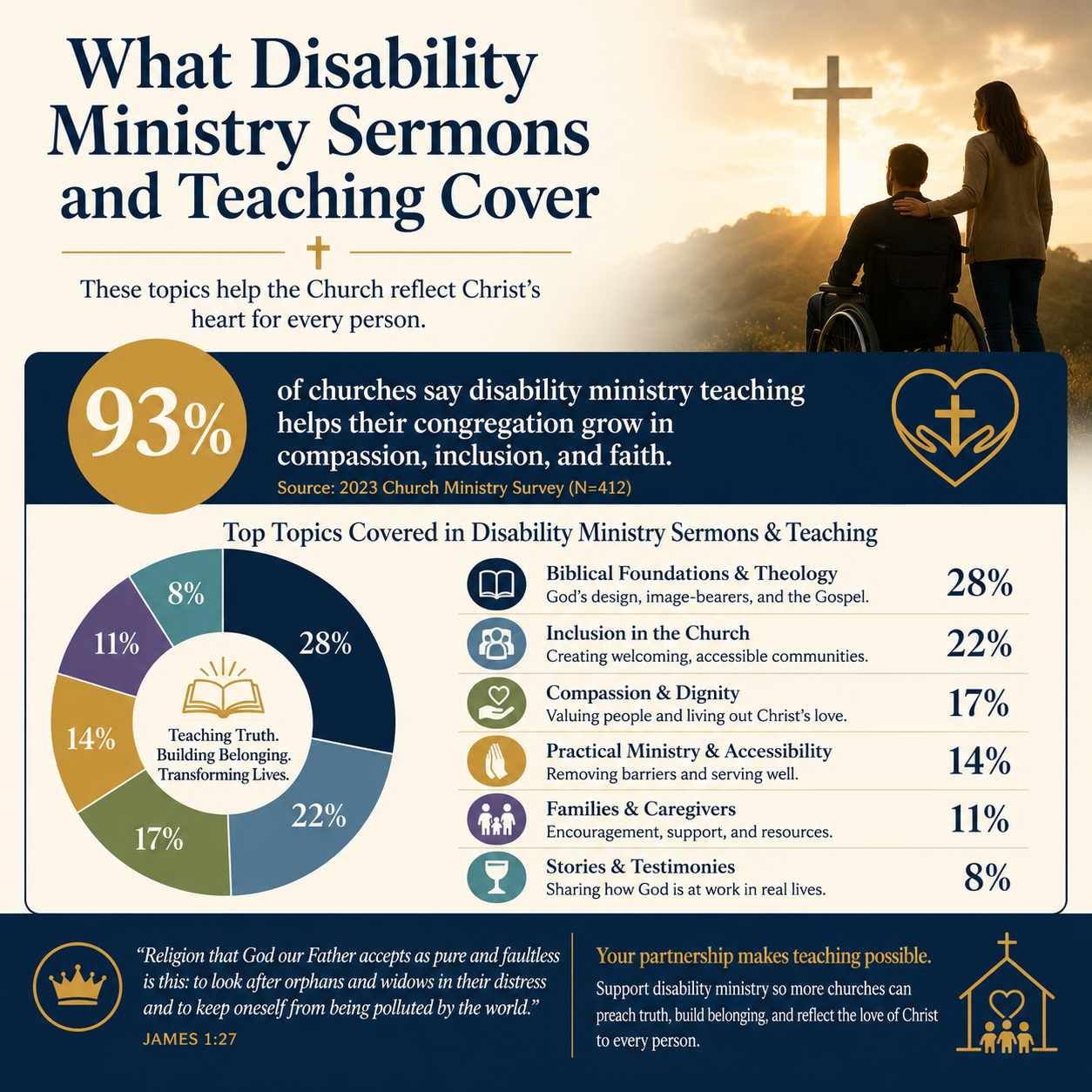
Concrete instruction helps. Strong ministries teach church leaders how to plan for accessibility across the full arc of church life—worship services, discipleship, pastoral care, and children’s ministry—so that disabled people are not treated as exceptions who require special permission to belong.
Belonging, agency, and the spiritual danger of inspiration narratives
One of the most common failures in disability-related storytelling is what disability advocates often call “inspiration” framing: presenting a disabled person primarily to make nondisabled people feel grateful, motivated, or spiritually stirred. The church can drift into this pattern without malice. Disability ministry teaching should explicitly address it, because it affects how volunteers speak, how donors perceive impact, and how disabled Christians experience the congregation.
Better sermons emphasize agency: disabled people as disciples with callings, preferences, and gifts, not as mascots for community virtue. They also address consent and dignity in testimony-sharing, especially when families are involved and when individuals have limited communication.
- Language that honors personhood without reducing someone to a diagnosis
- Practices that support participation in worship and sacraments with appropriate pastoral care
- Training that equips volunteers for consistency, safety, and relational maturity
- Guardrails against using disabled people as fundraising imagery or sermon illustrations without permission
- Pathways for disabled Christians to serve, lead, and be known beyond the disability ministry context
Care ethics, safeguarding, and the realities donors should ask about
Vulnerability and the church’s duty of protection
Disability ministry increases proximity to vulnerability: children with communication challenges, adults who rely on caregivers, families under sustained stress, and situations where boundaries can blur. Teaching that avoids safeguarding because it feels “bureaucratic” is not spiritually mature; it is naive. Christian love requires prudence. Churches are commanded to protect the weak, and leaders will give an account.
Donors should listen for whether sermons and training speak plainly about background checks, two-adult policies, incident reporting, mandatory reporting obligations, and appropriate physical assistance protocols. The absence of this teaching does not prove negligence, but it does raise the likelihood that the ministry’s culture will default to trust without verification.
Family systems, caregiver fatigue, and sustainable mercy
Disability ministry teaching should also form the congregation to understand family life under chronic pressure: therapy schedules, financial strain, sibling dynamics, social isolation, and the long horizon of care planning. The goal is not pity; it is solidarity expressed through durable support. Where churches reduce disability ministry to a monthly event, families are often left alone when crises erupt.
Many donors care about measurable outcomes, and rightly so. Yet the relevant outcomes in disability ministry often include stability, participation, and relational durability—categories that resist simplistic metrics. The Overhead Myth statement signed by GuideStar, BBB Wise Giving Alliance, and Charity Navigator cautions donors against treating overhead ratios as a proxy for impact, urging attention to governance, results, and transparency instead GuideStar.
How to evaluate teaching when you fund disability ministry
Content signals that correlate with integrity
For donors, the question is not merely whether sermons sound compassionate. The question is whether teaching is disciplined enough to shape practice and humble enough to submit to accountability. The ministries that meet The Most Trusted Standard tend to articulate a theology of disability that can sustain hard cases: situations without improvement, families that disappoint, conflicts over safety, and volunteers who burn out.
In our work, we encourage donors to ask for representative sermon links, volunteer training outlines, and safeguarding policies, then read them together. A ministry’s teaching should match its operational posture: financial clarity, board oversight, and public reporting. When teaching is strong but governance is weak, a ministry can still drift into avoidable harm.
Questions donors can ask without playing gotcha
Wise donors do not interrogate ministries as adversaries, but neither do we fund in the dark. A well-led disability ministry will usually welcome serious questions, because it knows that trust grows through candor. Exploring the wider ecosystem of Disability Ministries can help donors compare theological emphases and program models across organizations rather than treating any single approach as inevitable.
These questions are especially clarifying:
- How does your preaching address healing without implying that lack of healing signals lack of faith?
- What training do volunteers receive on boundaries, communication, and safeguarding?
- How do disabled Christians participate in ordinary church life beyond specialized programs?
- How do you measure faithfulness and effectiveness in ways that respect dignity?
- What governance and financial practices ensure that compassion is matched by accountability?
Disability ministry can also intersect with contested questions about education, residential models, and guardianship. The strongest teaching will not pretend those debates are simple. It will help the church think Christianly—patiently, truthfully, and with attention to those most affected.
FAQs for What disability ministry sermons and teaching cover
Should disability ministry sermons focus more on inclusion or on healing?
Scripture requires both truth and love: we pray for healing because God is able, and we practice inclusion because the church is obligated to honor the dignity and belonging of every member of Christ’s body. Teaching that centers healing to the exclusion of belonging often produces shame and disappointment. Teaching that centers inclusion without eschatological hope can reduce the gospel to social welcome. Faithful preaching holds these together without collapsing one into the other.
What teaching materials should a donor ask to see before funding a disability ministry?
Representative sermons, volunteer training outlines, safeguarding policies, and any pastoral care guidance for families are the most revealing starting points. Donors should also ask how leaders ensure theological consistency across campuses or partner churches, and whether disabled Christians have meaningful input into program design and evaluation. These materials do not replace a full review, but they often disclose whether a ministry’s compassion is paired with disciplined accountability.
Teaching that forms a church worthy of trust
What disability ministry sermons and teaching cover ultimately determines whether a ministry is building a culture of belonging under the Lordship of Christ or merely operating a compassionate program. Donors should expect theological seriousness and operational responsibility in equal measure, because the people served deserve both. Within The Theology Behind Christian Disability Ministry, the most credible ministries are those whose teaching can carry the weight of real lives—and whose governance, finances, and reporting are strong enough to deserve the church’s confidence.



