
What Christian inclusion means in disability ministry is not a branding question. It is a discipleship question: whether the church will recognize and receive the image of God where modern society often assigns burden, inconvenience, or invisibility.
For Christian donors, inclusion is also a stewardship question. The ministries we fund do not only deliver services; they shape the church’s imagination about weakness, dignity, belonging, and power. Disability ministry exposes whether our giving reinforces a world that measures worth by productivity, or whether it bears witness to the kingdom where the “weaker” members are treated as indispensable (1 Corinthians 12:22–23).
Inclusion begins with theology before it becomes programming
Christian inclusion cannot be reduced to access ramps, sensory kits, or a line item in the budget. Those tools matter, but they are downstream from a doctrinal claim: every person, regardless of cognitive, physical, psychiatric, or developmental disability, is a full bearer of God’s image (Genesis 1:27). The church does not “include” image-bearers as a favor. We receive one another as gifts entrusted by God.
The New Testament deepens this claim by locating belonging in union with Christ rather than in social usefulness. Baptism and the Lord’s Supper are not rewards for self-sufficiency; they are signs of grace given to the needy. A disability ministry’s posture toward those who require support is therefore a test of whether grace is actually central or only confessed.
Imago Dei is nonnegotiable, even when capacity is contested
Christians genuinely disagree about where to draw certain lines in practice: what constitutes informed consent, how to weigh guardianship, and how to approach cases involving profound intellectual disability. Those debates are real, and they require careful pastoral ethics. But they do not touch the foundational truth that human dignity is not graded by IQ, independence, or communication ability.
Weakness is not an exception to the gospel
Paul’s testimony that Christ’s power is made perfect in weakness (2 Corinthians 12:9) is not a slogan for suffering. It is an interpretive key for the church’s life together. Inclusion means we resist the unspoken assumption that “normal” Christians minister and “disabled” Christians receive. The body of Christ is built up through mutual dependence.

Inclusion is more than access, but never less than access
In disability ministry, inclusion is often first experienced as an obstacle removed: a bathroom door widened, a classroom adapted, a sermon made intelligible, a volunteer trained to communicate patiently. These are not optional courtesies. They are concrete ways of honoring a neighbor.
At the same time, a ministry can provide access without providing belonging. A family can attend a service and still be isolated, treated as a disruption, or quietly pressured to leave when needs become visible. Christian inclusion insists that the goal is not merely entry into a room, but membership in a people.
Belonging requires shared life, not parallel tracks
Many churches have learned to build “special needs programs” that function like segregated spaces. Some segregation is warranted for safety and appropriate support, especially for children with significant sensory or behavioral needs. But it becomes spiritually deforming when it communicates that certain people belong only under supervision and never in ordinary fellowship.
Wise disability ministries make room for both: environments tailored for support, and pathways into the ordinary rhythms of church life—worship, small groups, service, and leadership—at a pace that respects each person’s abilities and vulnerabilities.
Families experience the church through its reliability
For many caregivers, the question is not whether the church has compassionate intentions. It is whether the church will still be there next month. The stressors are often chronic: medical complexity, financial strain, respite scarcity, and the cumulative fatigue of being “the exception” everywhere else.
Verifiable evidence suggests the burden of disability in American households is widespread, even if congregations do not always see it. The U.S. Centers for Disease Control and Prevention reports that 1 in 6 children ages 3–17 have one or more developmental disabilities based on parent report in national surveys (CDC). Inclusion in disability ministry therefore cannot be treated as niche ministry for a rare population; it is ordinary pastoral care for a significant share of families.
Christian inclusion names real tensions without abandoning conviction
Disability ministry forces the church to address hard questions that simplistic narratives avoid. Some disabilities involve unpredictable behaviors that affect other children’s safety. Some adults with disabilities are vulnerable to exploitation, and “inclusion” without safeguards can become negligence. Some families request accommodations that stretch volunteer capacity. Churches also face the moral tension of protecting caregivers from collapse while not making caregiving the family’s solitary burden.
Christian inclusion does not pretend these are easy. It insists that difficulty does not absolve responsibility, and that safety and dignity are not competing values when approached with wisdom.
Healing narratives must not erase the person
Many donors are shaped by sincere confidence that God heals. Scripture supports that confidence. Yet disability ministry has had to reckon with a painful pattern: when healing is framed as the only acceptable outcome, people with disabilities can become projects rather than members. Prayer becomes performative, and disappointment becomes spiritualized as a lack of faith.
The Gospels show Jesus healing, but they also show Jesus restoring persons to community and dignity. Christian inclusion holds both truths: we pray for healing without implying that someone’s life is on hold until it arrives.
Protection and participation must be held together
Policies around volunteers, toileting assistance, transportation, and one-on-one support are not bureaucratic clutter. They are moral commitments. A church that welcomes vulnerable people without clear safeguards can unintentionally create conditions for abuse.
We recommend donors ask whether a ministry’s inclusion practices include both hospitality and risk management: background checks, reporting pathways, documented supervision standards, and training that treats safeguarding as part of discipleship.
What donors should look for in inclusive disability ministries
Donors often ask how to discern whether a ministry’s commitment to inclusion is substantive rather than aspirational. Our team at Most Trusted evaluates Christian nonprofits against The Most Trusted Standard, examining faith commitments, financial integrity, governance and leadership, and transparency and effectiveness. Inclusion shows up across all of these areas, not only in program descriptions.
Inclusion in disability ministry becomes credible when it can be verified: clear goals, consistent practices, accountable leadership, and honest reporting about what is working and what remains hard.
Signals of seriousness that can be verified
- Documented training for volunteers and staff that addresses disability awareness, communication, de-escalation, and safeguarding.
- Stable staffing and support structures that reduce turnover and dependency on a single charismatic leader.
- Caregiver partnership that treats parents and guardians as experts in their loved one’s needs, not as obstacles to programming.
- Clear inclusion pathways into worship, relationships, and service, not only attendance.
- Transparent metrics that report outputs and outcomes without treating people as numbers.
Transparency about costs is part of inclusion
Disability ministry is often more expensive per participant than other church programs because it requires training, lower ratios, specialized materials, and in some cases professional oversight. Donors sometimes recoil from the costs, or they pressure ministries to appear “efficient” by under-resourcing support.
Yet the sector has had to learn that simplistic efficiency metrics distort good work. The “Overhead Myth” statement, signed by leading nonprofit evaluators, argues that administrative costs alone are a poor measure of nonprofit performance and can drive unhealthy behavior (Charity Navigator). In disability ministry, underfunding training and supervision is not frugality; it is risk.
Inclusion must be ecclesial, not merely charitable
Christian donors rightly celebrate ministries that provide respite, therapies, job coaching, supported living, and adaptive technologies. These can be works of mercy and justice. But Christian inclusion in disability ministry has a distinctively ecclesial dimension: the person with a disability is not primarily a client. He or she is a brother or sister, a co-worshiper, and, in many cases, a servant with gifts the church needs.
This is where disability ministry quietly confronts donor assumptions. Many of us were formed by a donor-beneficiary model in which giving flows one way. The New Testament’s vision of the church is different: the members who seem weaker are indispensable, and honor is given where the world withholds it (1 Corinthians 12:22–24). Inclusion means the church expects to be changed by those it welcomes.
Vocation and spiritual agency are part of dignity
Adult disability ministry often stalls at “participation” without ever pursuing agency: opportunities to contribute, serve, lead, and be spiritually responsible within one’s capacities. Some individuals will need ongoing support to do so, but support is not the enemy of agency. It can be the condition that makes agency possible.
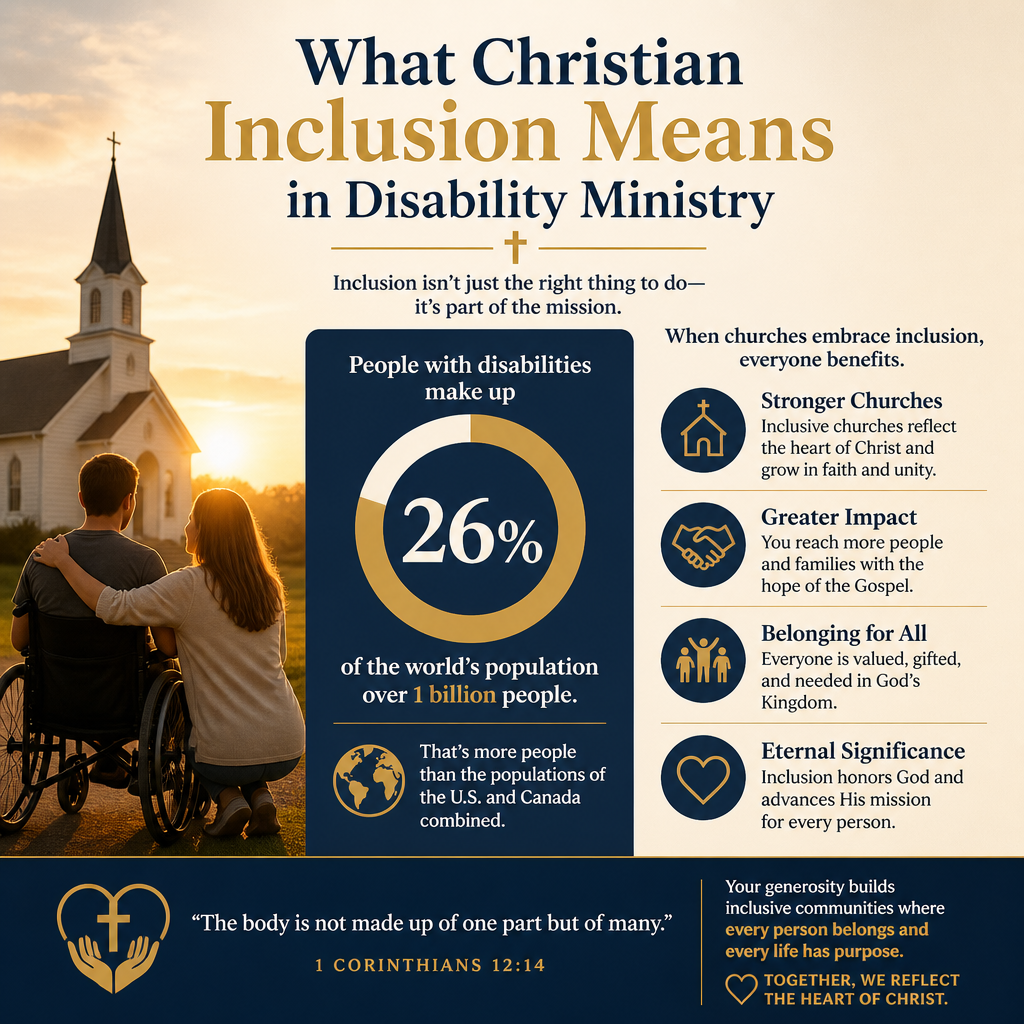
Research also suggests that disability is common across adulthood, not only in childhood. The CDC reports that 1 in 4 U.S. adults live with a disability (CDC). Donors who care about the long-term health of the church should expect disability inclusion to be woven into adult discipleship, not only children’s programming.
Churches and nonprofits have different roles, and both matter
Some of the most effective disability ministries are embedded in local churches. Others are nonprofit organizations serving multiple congregations or communities, sometimes because specialized expertise is hard for any single church to sustain. Each model has trade-offs. Church-based models can offer deeper belonging; nonprofit models can offer scale, training infrastructure, and continuity across congregational transitions.
For donors, this is a reason to compare ministries on clarity of mission, theological fidelity, and accountable execution. Engagement with Disability Ministries across the wider Christian landscape can also help donors understand which approaches tend to mature into durable, safe, and spiritually serious work.
FAQs for What Christian inclusion means in disability ministry
Is inclusion the same as integration in Sunday services?
No. Integration into a primary service can be a meaningful expression of belonging, but Christian inclusion is broader: receiving people as members of the body with genuine relationships, spiritual agency, and appropriate support. In some cases, separate environments are necessary for safety, sensory regulation, or specialized teaching. The moral question is whether separation serves the person’s dignity and growth, or whether it functions as exclusion under another name.
How can donors evaluate disability ministries without reducing people to metrics?
Good evaluation distinguishes between outcomes that can be measured and realities that must be discerned. Donors can ask for evidence of safeguarding, training, caregiver partnership, and financial transparency while also paying attention to theological posture: whether the ministry speaks of people with disabilities as image-bearers and co-members of the church. At Most Trusted, our verification work against The Most Trusted Standard is designed to help donors give with confidence by examining both integrity and effectiveness without treating ministry as a mere production system.
A mature definition of inclusion is accountable love
What Christian inclusion means in disability ministry is ultimately whether love takes institutional form: whether welcome becomes practices, whether compassion becomes competence, and whether dignity is protected when it is costly. Ministries that treat inclusion as accountable love will tell the truth about limits, train people carefully, and still refuse to let the vulnerable be alone.
For donors, the opportunity is to fund work that strengthens the church’s witness: a community where those the world overlooks are honored, where families are not abandoned to private strain, and where the grace proclaimed on Sunday becomes credible on Monday. That theological seriousness is central to The Theology Behind Christian Disability Ministry, and it is one of the clearest places where Christian giving can either reinforce exclusion or help the church become more faithful.



