
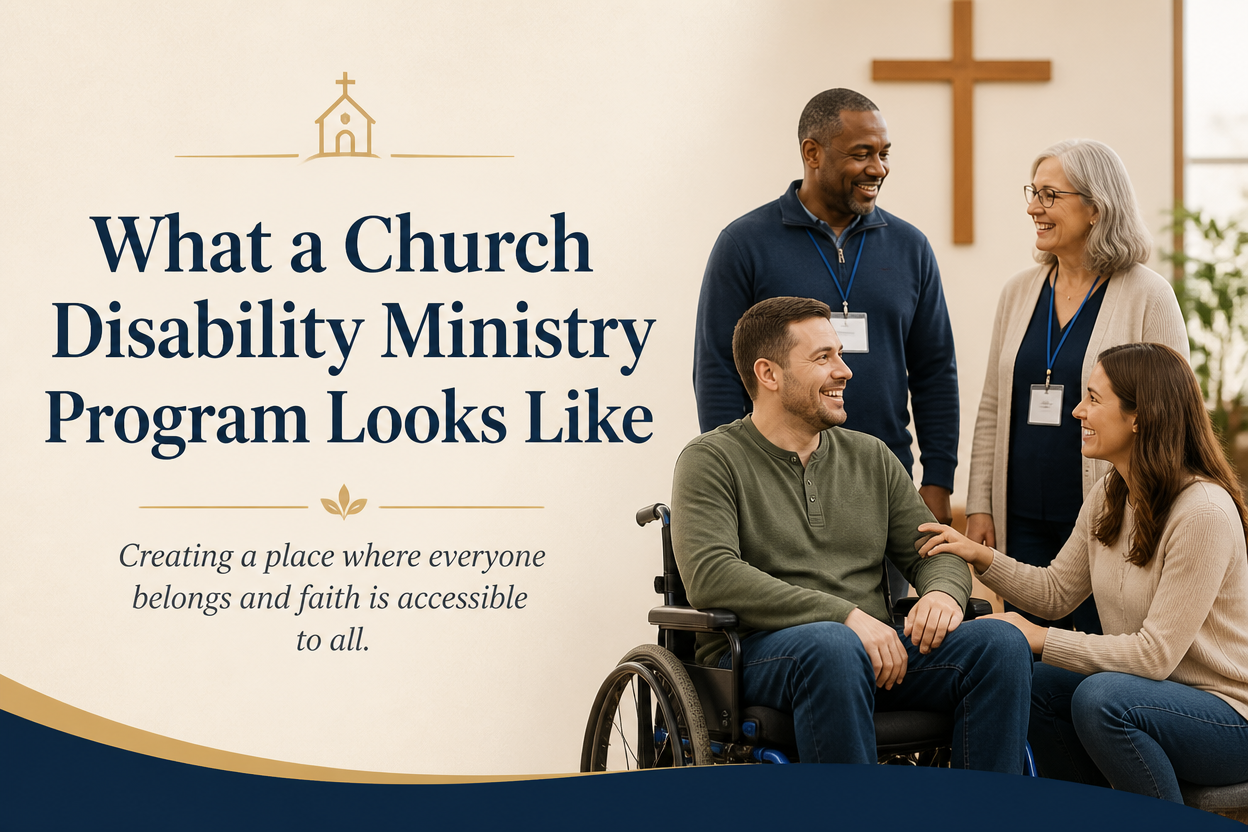
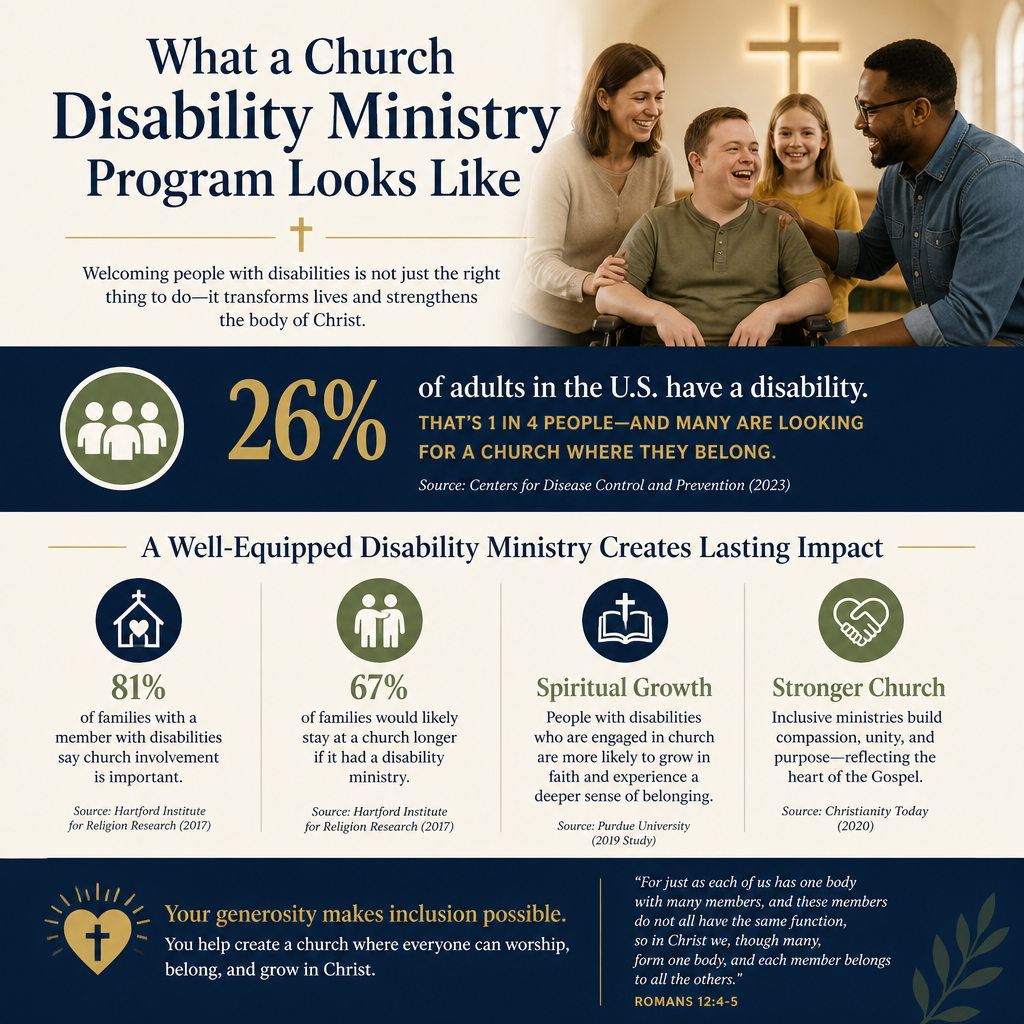
What a church disability ministry program looks like is not first a question of ramps, headphones, or classroom ratios. It is a question of ecclesiology: whether the local church will receive disabled brothers and sisters as indispensable members of Christ’s body, not as occasional guests. Paul’s language in 1 Corinthians 12 is unsentimental and direct: those members that seem weaker are necessary, and God has arranged the body so that there may be no division.
For Christian donors, this is also a question of faithful generosity. Many disability ministries operate in the space between church life and social services, where good intentions can drift into paternalism, and where under-resourcing can quietly become exclusion. Mature giving asks not only, “Does this ministry do compassionate work?” but, “Does it strengthen the church’s ability to belong to one another?”
1. A disability ministry begins with a doctrine of the church
Belonging is the goal, not attendance
Programs worth supporting articulate a clear theological center: disabled people are not a separate constituency to be accommodated; they are the church. That conviction reshapes the metrics. Success is not merely “How many families came to the special needs event?” but “Are children and adults with disabilities participating in worship, sacraments, discipleship, and mission with appropriate supports?”
Practically, this means the ministry is integrated into ordinary church life. Greeters, small group leaders, children’s ministry teams, and pastoral staff share responsibility. When disability ministry is isolated as a specialized department, it can become a well-run side room where families are served but not truly known.
Language reveals whether a church sees persons or projects
Churches differ on terminology, and Christians genuinely disagree about person-first versus identity-first language in some disability communities. The more reliable indicator is not fashionable phrasing, but whether communication honors agency and dignity. Mature programs describe people as disciples, friends, and members before they describe them as needs.
Donors can listen for whether the ministry’s public voice invites mutuality. The New Testament’s “one another” commands do not run in a single direction. A credible disability ministry expects the whole church to receive gifts from disabled members, not only to deliver services to them.
2. A credible program is built around family discipleship and pastoral care
Respite is real mercy, but it is not the whole ministry
Caregivers often carry chronic fatigue, financial pressure, and a steady stream of institutional friction. A thoughtful church program offers respite at times, because rest is not an indulgence; it is part of creaturely faithfulness. Yet if respite becomes the headline, the church can unintentionally treat disability as a problem to be managed away from the congregation.
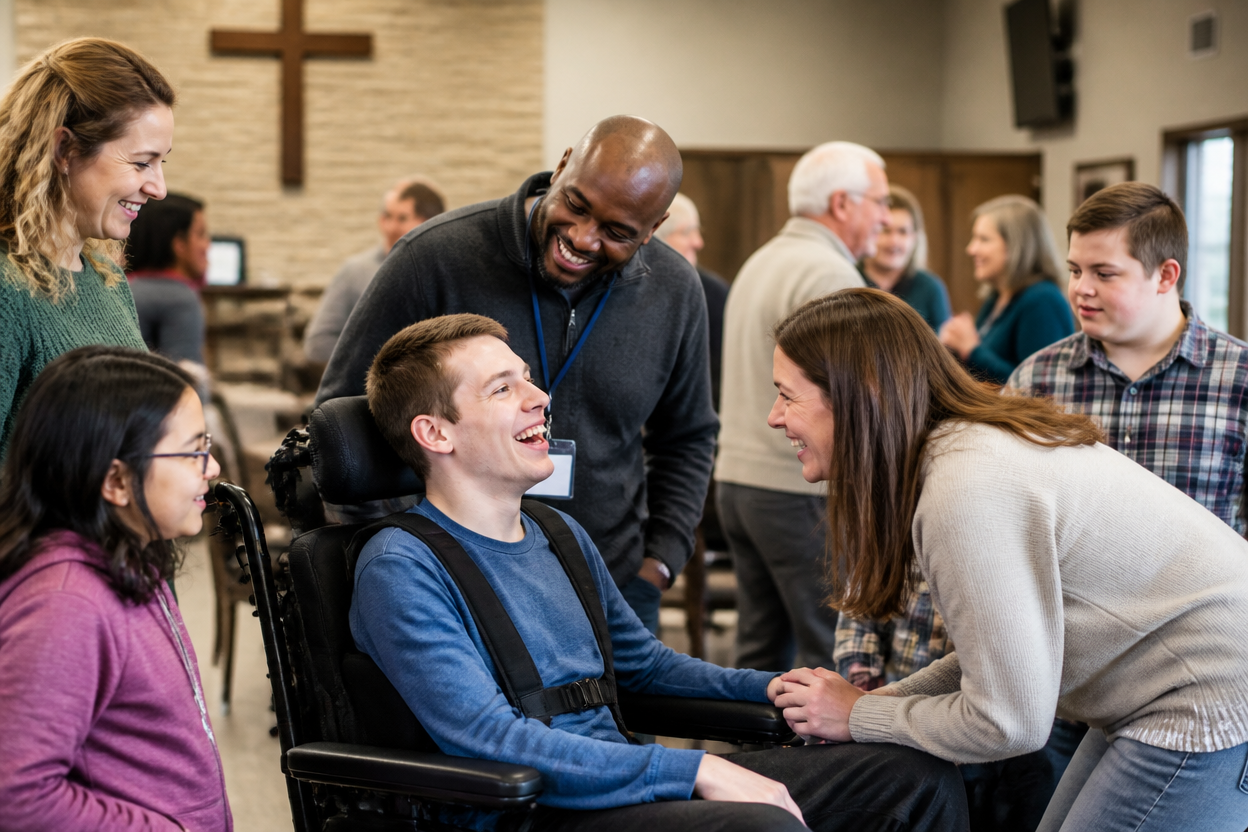
The stronger pattern is “supported belonging.” Children’s ministry teams train to include a child with autism in a typical class with a buddy; a student with Down syndrome is invited into youth group with appropriate supports; an adult with intellectual disability is welcomed into a small group and given a real role.
Pastoral care must extend beyond the diagnosed individual
Disability often affects entire family systems: siblings who feel overlooked, marriages strained by constant vigilance, grandparents navigating grief and hope. A program donors can trust builds a pastoral pathway for the whole household, not only for the person with a diagnosis. This can include prayer, counseling referrals, support groups, and practical help that is coordinated rather than chaotic.
When programs collaborate with community resources, they should do so with discernment. Some partnerships are straightforward; others carry conflicting anthropology. A church does not outsource discipleship. It integrates what is beneficial while keeping spiritual formation under pastoral oversight.
3. The work is practical, but it is not merely logistical
Accessibility includes the building and the liturgy
Physical access matters. A church that cannot be entered by wheelchair users, or that has inaccessible restrooms, is not simply inconvenient; it signals who is expected to belong. Many churches address this with capital projects, and donors can play a meaningful role.
But accessibility also includes the shape of worship and communication. Clear signage, sensory-aware seating options, hearing assistance, visual supports, and trained ushers can make the difference between a family enduring a service and actually participating. Programs that take this seriously do not treat worship as a fixed product. They treat it as the gathered people of God, ordered in love.
Safety, consent, and dignity require real policies
Disability ministry involves vulnerable people, which requires high standards. Credible programs have background checks, volunteer screening, two-adult rules, incident reporting, and clear boundaries around toileting and physical assistance. They train volunteers to ask permission, to preserve privacy, and to honor “no.”
Donors should also expect ministries to understand mandatory reporting laws and safeguarding practices. In the United States, abuse and neglect are tragically common for people with disabilities. The Centers for Disease Control and Prevention notes that children with disabilities are at increased risk of violence compared to children without disabilities, and responsible ministries treat that risk as a call to vigilance, not fearmongering. Centers for Disease Control and Prevention
4. What donors should look for in program design and outcomes
A program that can describe its model can improve it
Many churches begin disability ministry reactively: a family arrives in crisis, a volunteer steps up, a room is repurposed. Compassion can start that way. But donor-worthy work eventually becomes coherent. Leaders can describe who they serve, what supports they provide, what participation looks like, and what safeguards protect people.
Healthy programs typically address several domains at once: worship inclusion, children and student ministry supports, adult discipleship, caregiver care, and congregational training. The details differ by context, but a donor should be able to see an intentional pathway rather than a series of exceptions.
Evaluation is not a threat to compassion
Some Christians worry that measuring outcomes feels clinical. The wiser concern is different: poorly chosen metrics can reduce persons to numbers. Yet refusing to evaluate can conceal harm and waste. Programs that honor dignity can still track whether families remain connected to the church, whether volunteers are retained and trained, and whether participants have meaningful roles.
One practical lens donors can use is whether the program resists the “project mentality” described in the When Helping Hurts framework articulated by Steve Corbett and Brian Fikkert. The heart posture matters, but the operating assumptions matter too: are we doing for people what they can do with appropriate supports, or are we building dependence? Moody Publishers
- Clarity: a written ministry model with defined supports and boundaries
- Safeguards: volunteer screening, safety procedures, and incident reporting
- Integration: shared ownership across church ministries, not isolation
- Training: ongoing formation for volunteers and staff, not one-time orientation
- Participation: meaningful roles for disabled members in worship and community
5. How to fund disability ministry without undermining it
Designated gifts help, but they can also distort priorities
Disability ministry is often underfunded because its “outputs” are less marketable than a mission trip or a new building. Donors can correct that imbalance. Still, heavy restrictions can unintentionally force a church to fund visible program elements while starving the unglamorous necessities: staff time, volunteer training, and safeguarding.
The more mature approach is to fund capacity that protects dignity and enables belonging. That may include accessibility renovations, curriculum adaptations, paid coordination, background checks, sensory equipment, transportation support, or scholarships for caregiver counseling. The question is not, “Is overhead low?” but, “Is the ministry responsibly resourced for the work it claims to do?” The broader philanthropic sector has recognized the harm of obsessing over overhead, including the widely cited Overhead Myth letter signed by GuideStar, BBB Wise Giving Alliance, and Charity Navigator. GuideStar
Verification matters because good stories are not governance
Disability ministry attracts heartfelt storytelling, and some stories are true and holy. But donors also know that emotionally compelling work can coexist with weak controls, unclear leadership accountability, or inconsistent reporting. This is where independent verification is a service to both the donor and the ministry.
At Most Trusted, we evaluate ministries against The Most Trusted Standard, a 15-criteria framework that examines faith commitments, financial integrity, governance and leadership practices, and transparency and effectiveness. For donors supporting disability-related work broadly, our Disability Ministries coverage helps frame the landscape, and our Church Disability Ministry Programs Donors Can Support category reflects the kinds of programs that tend to benefit from careful, church-aware due diligence.
FAQs for What a church disability ministry program looks like
Should a church disability ministry run a separate service or integrate everyone into the main service?
Wise churches treat this as a pastoral question, not a purity test. Integration in the main service often best reflects the church’s unity, especially when appropriate supports are provided. Yet some individuals benefit from a quieter environment or a simplified teaching setting for part of the service. Donors should look for a program that keeps the aim fixed on belonging and avoids creating a permanent parallel church that families did not choose.
What are the most credible uses of donor funding in a church disability ministry?
The most credible funding targets usually strengthen long-term inclusion: staff coordination, volunteer training, safeguarding systems, accessibility upgrades, adaptive curriculum, and supports that enable participation in ordinary church life. Restricted gifts can be helpful when aligned with a clear model. The warning sign is when giving subsidizes a moving target of crises without building sustainable capacity or accountability.
A program that reflects the body of Christ
What a church disability ministry program looks like at its best is not a polished set of accommodations. It is a congregation learning, sometimes slowly, to tell the truth about the body of Christ: that we belong to one another, that honor is given where the world withholds it, and that weakness is not an interruption to mission but one of the places God makes his strength visible. Donors serve that vision well when they fund capacity, require integrity, and insist that compassion and accountability remain together.



