
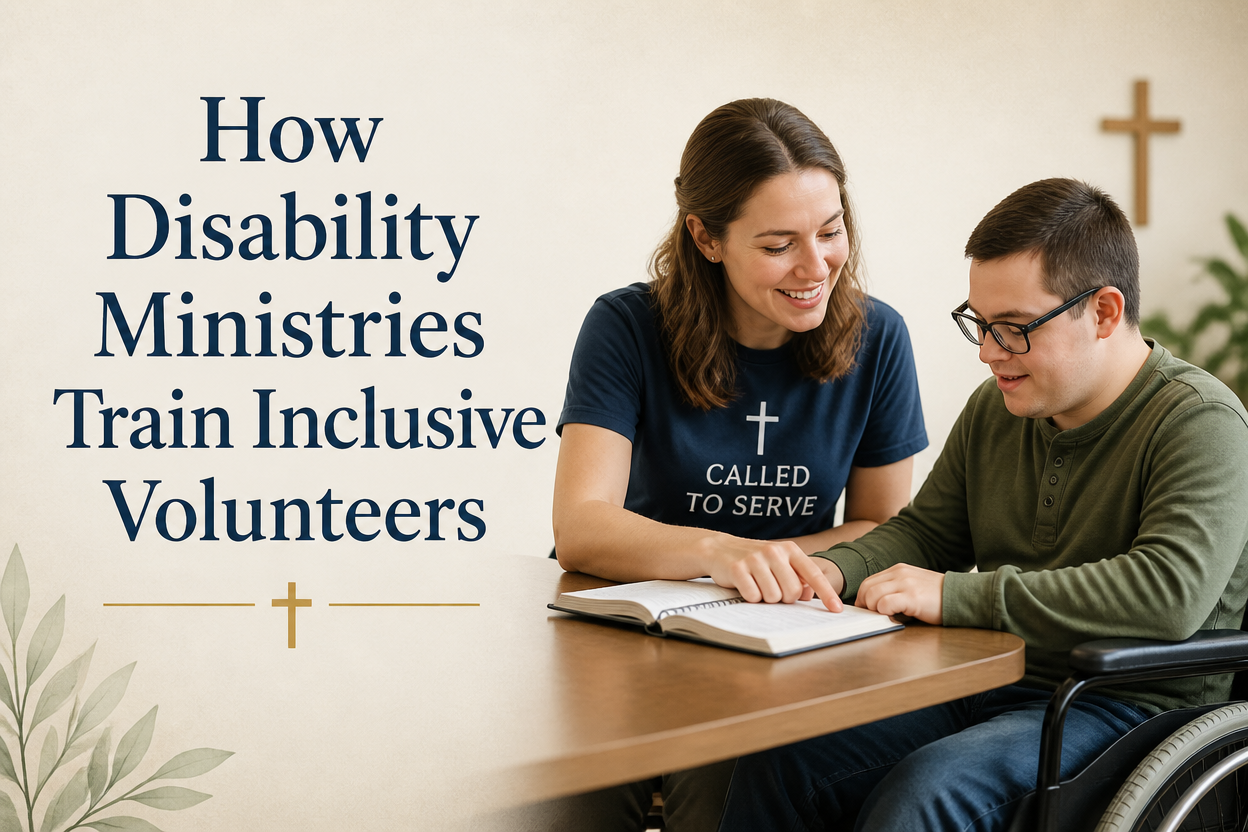
How disability ministries train inclusive volunteers is not a secondary operational question; it is a theological and pastoral test of whether the church will honor the body of Christ as God has actually assembled it. Many congregations affirm inclusion in principle, yet the lived experience of families affected by disability often turns on the competence, steadiness, and spiritual maturity of ordinary volunteers. The quality of training determines whether a ministry becomes a refuge or another place where burdens quietly multiply.
Donors sense this tension. Funding a disability ministry can feel deceptively simple: sponsor a sensory room, underwrite equipment, pay for a part-time coordinator. Yet the decisive work is frequently human formation—recruiting, preparing, supervising, and retaining volunteers who can serve with dignity, safety, and consistency. Across our verification work at Most Trusted, we find that the healthiest ministries treat volunteer training as discipleship with clear standards, not as a one-time orientation.
Inclusive volunteer training begins with a Christian doctrine of personhood
Disability ministry training is most durable when it starts where Scripture starts: every human being bears the image of God, and the church receives each member as a gift rather than a problem to manage. Paul’s teaching in 1 Corinthians 12 does not treat difference as a regrettable obstacle to overcome. It names the weaker members as indispensable, and it rebukes the instinct to value only what appears strong.
That doctrine changes what volunteers are being trained to do. The aim is not merely to “help special needs families.” The aim is to practice faithful presence, to honor agency, and to make room for participation in worship and community on terms that are genuinely accessible. Effective ministries train volunteers to see beyond sentimentality and beyond discomfort, holding both tenderness and competence together.
Training that avoids pity and avoids denial
Two distortions regularly surface. Pity frames disability primarily as tragedy and turns service into emotional charity; denial insists that disability is irrelevant and treats accommodations as spiritual weakness. Inclusive ministries refuse both. They acknowledge hardship without reducing a person to hardship, and they teach volunteers to make practical accommodations without treating those accommodations as exceptions to “normal church.”
Formation for speech, posture, and prayer
Language and posture matter because they reveal what volunteers believe. Strong training includes basic people-first communication, respect for alternative communication methods, and appropriate ways to pray with families without implying blame or simplistic causality. For donors, this is a signal worth watching: the ministry’s training content should reflect orthodox Christian anthropology rather than a mix of cultural tropes and therapeutic slogans.
Competence is pastoral care, not bureaucracy
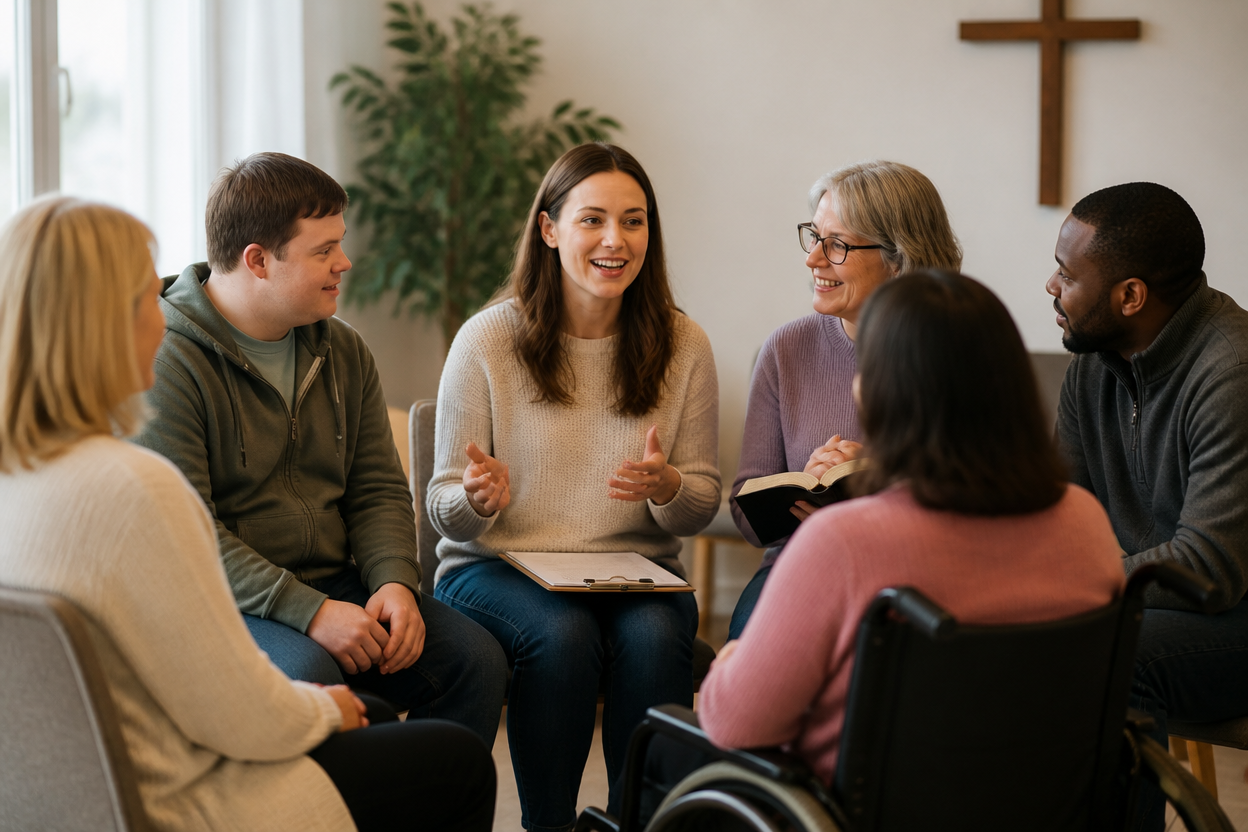
Inclusive volunteer training must eventually become specific. Volunteers need to know what to do in the nursery, in a buddy program, in a classroom, in corporate worship, and in a hallway conversation when a family is exhausted. Competence reduces risk, prevents shame, and honors the family’s trust.
Ministries that train well also teach volunteers what they are not being asked to do. Volunteers are not amateur clinicians. They are not “fixers.” They are members of the church providing consistent support within clear boundaries, escalating concerns to designated leaders, and documenting incidents appropriately when safety is involved.
Safety and screening are part of inclusion
Some churches hesitate to require screening or formal processes for volunteers serving children and vulnerable adults, fearing it will feel unwelcoming. The evidence argues the opposite. Abuse prevention is a pastoral obligation, and disability can increase vulnerability. For example, the U.S. Department of Justice’s Bureau of Justice Statistics has reported that people with disabilities experience higher rates of violent victimization than those without disabilities, which has direct implications for church safeguards and training Bureau of Justice Statistics.
Training for predictable moments
Many incidents that feel “unexpected” are, in fact, predictable: sensory overload, transitions between spaces, fire alarms, crowded hallways, unfamiliar substitutes, or a change in routine. Ministries train inclusive volunteers by rehearsing these moments in advance—what to say, where to go, whom to call, and how to preserve dignity when quick action is required.
- Clear role definitions for buddies, classroom aides, and respite volunteers
- Simple de-escalation scripts that avoid shame and reduce stimulation
- Two-adult rules and incident reporting expectations
- Medical and allergy protocols with strict boundaries on who administers what
- Emergency plans tailored for mobility, sensory, and communication needs
Inclusive ministries train for partnership with families, not replacement
The most common failure point in disability ministry volunteer systems is not a lack of goodwill. It is an implicit assumption that the church knows what a family needs without asking. Families affected by disability often carry an accumulated history of being misunderstood by institutions—schools, healthcare systems, even extended family. The church must not add to that burden.
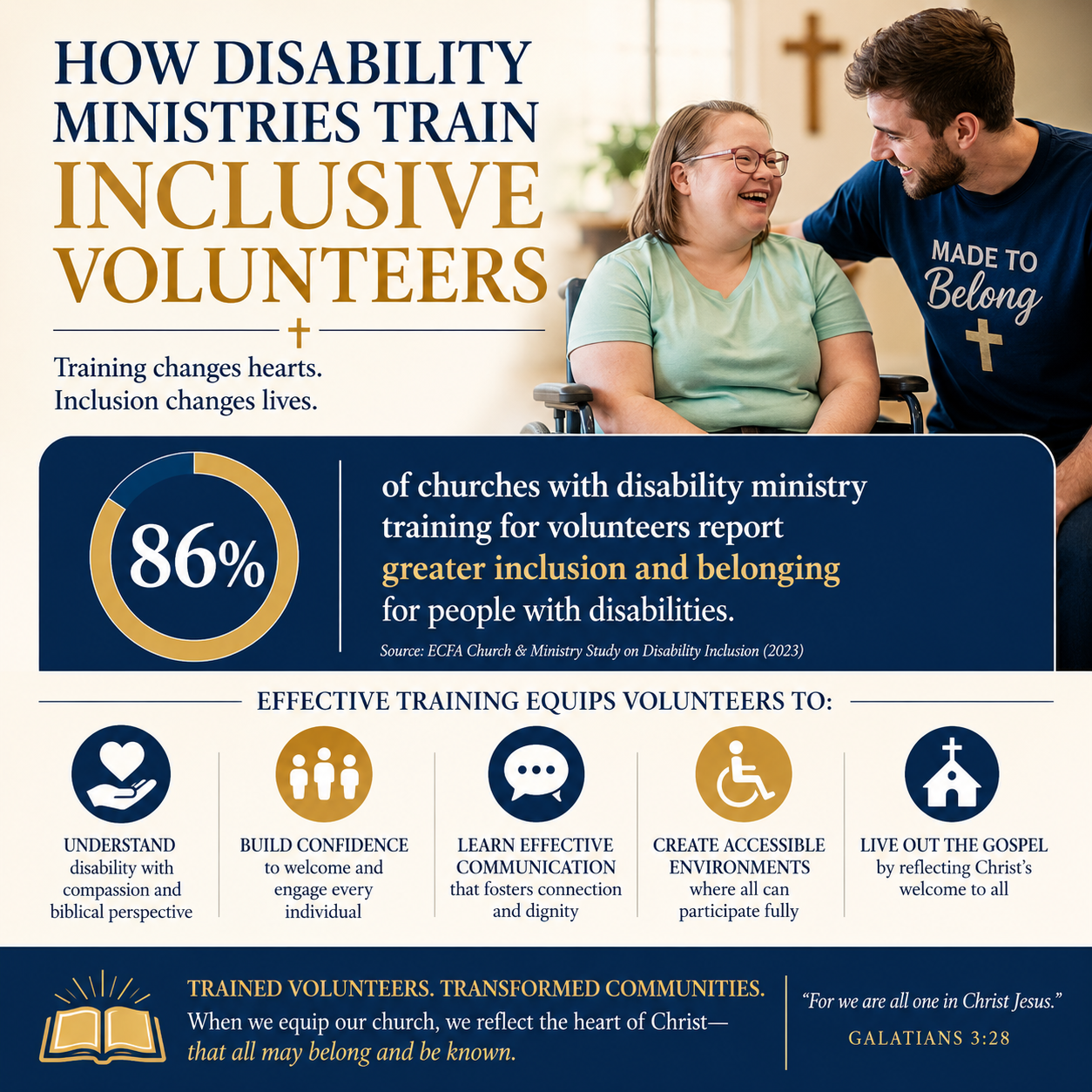
Training should therefore include structured listening: intake conversations that ask what helps, what harms, what triggers anxiety, what calming strategies work, and what “success” looks like for that child or adult in a church setting. Good ministries treat those details as pastoral knowledge, not as inconveniences.
Consent, agency, and dignity
Donors should look for training that explicitly addresses consent and personal agency. Volunteers must learn to ask before touching, to respect boundaries, and to avoid narrating someone’s story as a ministry “example.” When photo policies exist, volunteers should know that families may have legitimate safety and privacy reasons for declining. This is not optics management; it is neighbor-love.
Supporting siblings and caregivers without making them invisible
Inclusive volunteer training also prepares teams to notice the often unseen members of a disability-affected household. Siblings may experience inconsistent attention, and caregivers may live under chronic fatigue. The CDC describes caregiving as a widespread public health issue with measurable impacts on wellbeing, which helps explain why predictable support from a church can be profoundly stabilizing Centers for Disease Control and Prevention.
What this means in practice is that volunteer training should include hospitality for the whole family: helping a caregiver arrive without chaos, offering consistent check-in routines, and ensuring that accommodations do not isolate the family from the worshiping community.
Consistency requires systems, supervision, and spiritual formation
Many churches can recruit volunteers for a launch. Fewer can sustain a trained team across months and years. Families do not experience inclusion through a single successful Sunday; they experience it through consistency. Training is therefore incomplete without ongoing supervision and a clear pathway for feedback, re-training, and, when necessary, removal from service.
This is where donor support can be unusually strategic. The most critical “expense” is often leadership time: a coordinator who schedules, coaches, communicates with families, and maintains standards. Ministries that meet The Most Trusted Standard tend to show evidence of ongoing training rhythms rather than relying on informal tribal knowledge.
Training that accounts for volunteer turnover
Volunteer turnover is normal, particularly in seasons of church growth or congregational change. Healthy disability ministries plan for it: written procedures, short training modules that can be repeated quarterly, and mentorship structures where newer volunteers shadow experienced ones. This is not an attempt to mechanize ministry. It is a recognition that families should not pay the price for institutional forgetfulness.
Burnout is a real spiritual and operational risk
Disability ministry volunteers frequently serve in emotionally demanding situations. If churches treat volunteers as endlessly flexible, they will eventually lose them. Training should normalize limits: scheduled rotations, mandatory breaks, and a culture in which stepping back is treated as honesty rather than failure. For donors, this is a mark of maturity. A ministry willing to name burnout is more likely to protect families from the instability that burnout produces.
Donors should fund training with the same rigor as programs
Christian donors often prefer tangible gifts: equipment, curriculum, facilities. Those can matter. Yet inclusive volunteer training is frequently the higher-leverage investment because it shapes every interaction that follows. It is also harder to evaluate from a distance, which is why donors benefit from independent verification.
Most Trusted exists to help donors give with confidence by evaluating ministries against The Most Trusted Standard, a 15-criteria framework spanning Faith Foundation, Financial Integrity, Governance and Leadership, and Transparency and Effectiveness. For disability ministries, those categories translate into specific, observable questions: Is the ministry’s theology of disability coherent and orthodox? Are there documented safeguarding practices? Does leadership oversee incident reporting and family communication? Are results described with clarity rather than inspirational vagueness?
What prudent donors ask before funding volunteer training
Church disability ministry is not uniform. Christians genuinely disagree about some models—segregated classrooms versus fully integrated approaches, the role of professional therapists in church spaces, and how to balance sensory accommodations with liturgical tradition. Mature ministries can articulate their approach without caricaturing others, and their training reflects that clarity.
Donors can ask for training materials, schedules, and accountability processes. They can also ask whether the ministry has external partners (for example, local disability organizations) and how those partnerships are governed. When donor funding accelerates growth, the question becomes whether the ministry’s systems can bear the weight of new families without lowering standards.
For donors seeking context on the wider landscape, our reporting on Disability Ministries clarifies the common models and the accountability questions that recur across the field.
And for donors specifically assessing fundable initiatives within churches, Church Disability Ministry Programs Donors Can Support provides a structured view of where training, staffing, and safeguarding investments tend to produce the most reliable outcomes.
FAQs for How disability ministries train inclusive volunteers
What should a disability ministry volunteer training include at minimum?
At minimum, training should cover a theological foundation for inclusion, role clarity and boundaries, safeguarding and screening expectations, basic disability awareness and communication, de-escalation and sensory support, emergency procedures, and a documented pathway for escalation and incident reporting. It should also include ongoing refreshers rather than a one-time session, because consistency is what families experience as trust.
How can donors tell whether a ministry’s volunteer training is substantive or merely symbolic?
Substantive training is written down, repeated on a schedule, and tied to supervision. It names difficult realities—behavioral escalation, caregiver exhaustion, volunteer burnout—and defines protocols that protect dignity and safety. Symbolic training is vague, inspirational, and rarely connected to screening, incident reporting, or ongoing coaching. Donors can request sample materials and ask how training outcomes are monitored over time.
Training is where inclusion becomes credible
When disability ministries train inclusive volunteers with theological seriousness and operational rigor, families do not have to choose between worship and safety, between belonging and dignity. The church becomes more truthful about the body Christ has given it, and more trustworthy in the ordinary practices of care. For donors, funding that kind of formation is not ancillary to the mission; it is one of the clearest ways to strengthen the integrity of what a church says it believes.



