
What disability ministry resources help small churches is not primarily a question of budgets or building codes. It is a question of ecclesiology and discipleship: whether the local church will make space for members with disabilities to belong, to be known, and to be needed as full participants in the body of Christ.
For Christian donors, the challenge is equally serious. Some “resources” expand access and dignity; others unintentionally reinforce dependency, segregate families, or confuse hospitality with programming. We can give generously without giving naïvely, and we can ask better questions than “Does this church have a ramp?” The New Testament presents the church as a body in which “the parts of the body that seem to be weaker are indispensable” (1 Corinthians 12:22). That doctrine should shape how we fund disability ministry.
Start with resources that form a church not just a program
Small churches often assume disability ministry begins with equipment and ends with volunteers. In practice, lasting disability ministry begins with a theological and pastoral framework that can be taught, repeated, and embodied. The most durable resources are those that change the church’s shared imagination about belonging.
Training that treats disability as a discipleship issue
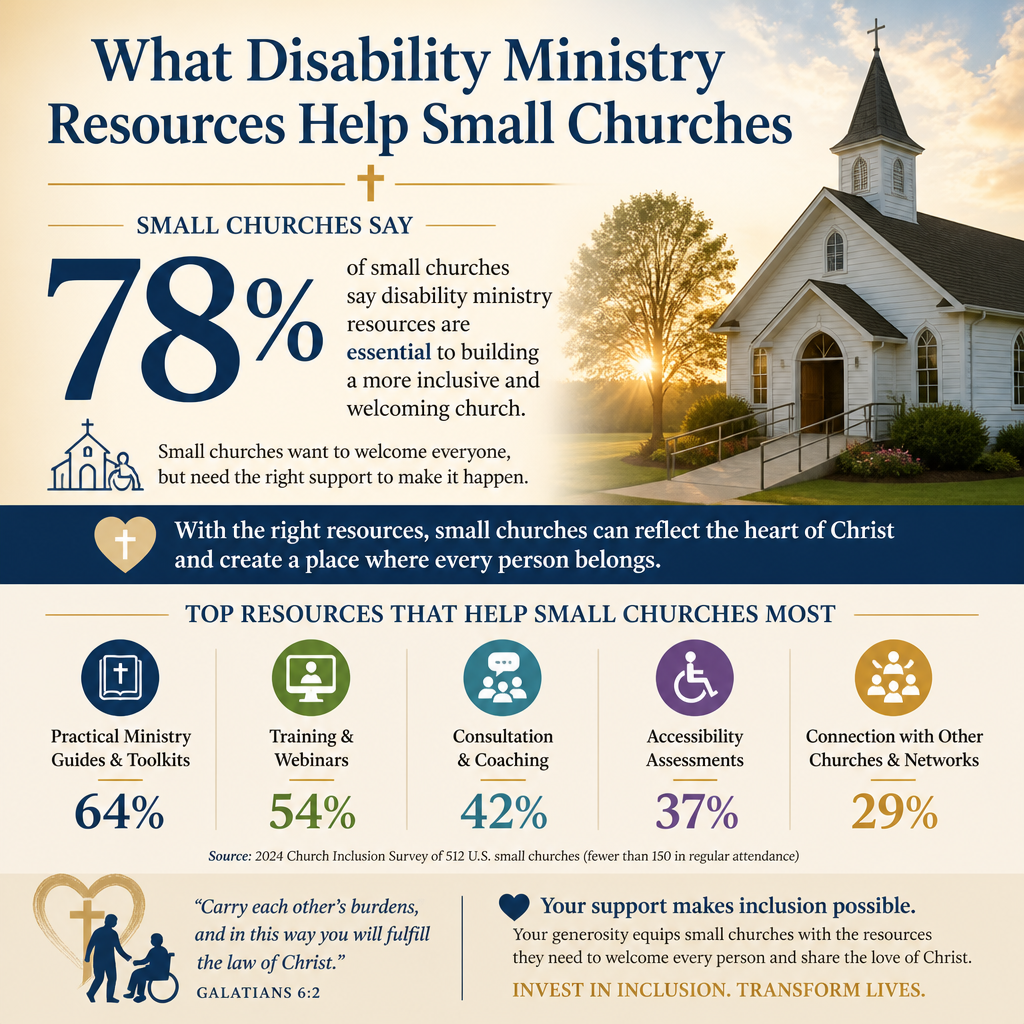
Churches need training that is concrete but not reductionist: how to communicate with a non-speaking adult, how to support a family navigating an IEP, how to include a member with cognitive disability in membership and serving, and how to respond to suffering without platitudes. Joni and Friends has served churches for decades with a mix of theological depth and practical tools, including church training and a long track record of convening disability ministry leaders (Joni and Friends).
Donors can underwrite training nights, send lay leaders to regional conferences, or fund a part-time disability ministry coordinator for a season. The point is not to professionalize care, but to reduce the recurring fragility where one faithful volunteer carries an entire ministry until exhaustion.
Pastoral guidance for inclusion without pretending the work is simple
Christians genuinely disagree about some questions: how to structure a “buddy” system without infantilizing adults; how to design sensory spaces without creating de facto segregation; how to speak about healing in a way that honors God’s power without implying that faithfulness requires “getting better.” Resources that are honest about these tensions are typically more trustworthy than those that promise a frictionless model.
When evaluating training providers, we look for clarity on doctrine, a non-performative commitment to dignity, and a willingness to name safeguarding and power dynamics. Across our verification work at Most Trusted, ministries that meet The Most Trusted Standard tend to show their work: what they teach, what they require of leaders, and how they handle failure without hiding it.
Prioritize resources that make worship and membership genuinely accessible
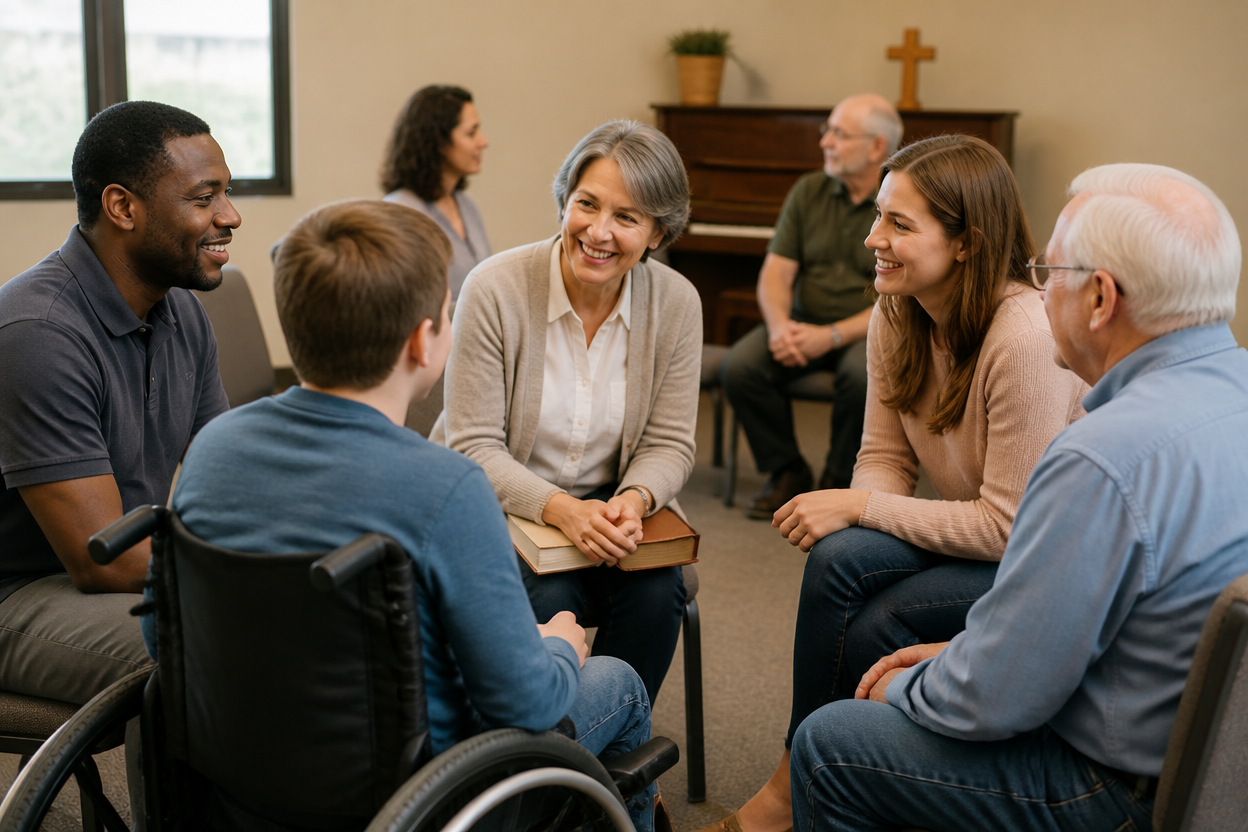
Accessibility is not a special-interest add-on; it is a test of whether a church believes its own doctrine of the church. The aim is not merely that families can enter a building, but that they can participate in the means of grace—Word, prayer, fellowship, and the sacraments—in a way that is understandable and hospitable.
Communication tools that reduce avoidable barriers
Small churches can make meaningful changes without rebuilding a sanctuary. Clear signage, predictable service flow, and printed visuals of the order of worship are low-cost and often high-impact. Hearing assistance and captioning are more complex, but technology has become more attainable. Churches considering assistive listening should consult established accessibility guidance from hearing-health organizations rather than improvising (American Speech-Language-Hearing Association).
We encourage donors to fund solutions that remain when the volunteer who championed them moves away. A portable hearing loop or a dependable captioning workflow is more durable than a one-time “special needs Sunday” that raises awareness but changes little.
Membership pathways that honor agency and accountability
Some churches unintentionally communicate that members with disabilities are perpetual recipients rather than fellow disciples. The resource gap is often not architectural but procedural: can a member with an intellectual disability pursue baptism and membership with appropriate support? Can the church provide catechesis that is faithful to doctrine while adapted for comprehension?
Resources that equip elders, pastors, and membership classes to make room for supported participation often matter more than another sensory toy bin. Donors can fund curriculum adaptation, one-on-one mentoring, and the time required for pastoral care that is slower but not lesser.
Equip volunteers with safeguards not just enthusiasm
Small churches often rely on goodwill. Disability ministry, however, sits at the intersection of vulnerability, intimacy, and trust. Resources that strengthen safeguarding are not bureaucratic; they are a form of neighbor love.
Clear policies for screening and supervision
Churches need written policies for volunteer screening, two-adult rules, restroom assistance protocols, and incident reporting. These policies must account for adults with disabilities, not only children. Donors can underwrite background checks, training subscriptions, and the administrative capacity required to keep policies alive rather than archived.
For donors who want to understand baseline child-safety standards across ministries, the Evangelical Council for Financial Accountability provides guidance and resources related to governance and accountability expectations (ECFA). Not every church will align with every standard, but the direction is instructive: serious ministry includes serious safeguards.
Respite models that support families without outsourcing discipleship
Respite care is one of the most requested supports among families impacted by disability. It can also be one of the most easily mishandled if it becomes transactional babysitting rather than relational care. Churches should aim for respite that is integrated into community: familiar volunteers, consistent routines, and clear expectations.
- Volunteer training that includes disability-specific communication and de-escalation
- Written care plans created with parents or caregivers
- Consistent teams rather than rotating strangers
- Clear boundaries for medical tasks and personal care
- A pathway for the individual to participate in church life beyond respite hours
What this means for donors is straightforward: fund the unglamorous elements—training time, screening, coordination, and follow-up—that keep respite from becoming risky or unsustainable.
Invest in community partnerships that expand capacity without duplicating systems
Small churches do not need to become disability service agencies. They do need to know how to partner wisely so that families are not left alone to navigate complex educational, medical, and social-service ecosystems. The best resources often function as bridges.
Referral networks with competent boundaries
Pastors and lay leaders should know how to refer families to reputable local providers and support groups while staying within pastoral competence. Churches can maintain a vetted directory, invite local professionals to speak, and connect families to respite and advocacy organizations.
For donors, a strategic approach is to fund convening: a quarterly gathering of local disability leaders across churches, a shared training event, or a pooled fund for accessibility improvements across multiple small congregations. Many communities already have nonprofit disability organizations; the church’s role is often to become a faithful partner, not a parallel institution.
Coordination across the broader disability ministries landscape
Some donors prefer to give where outcomes are easily measured. Disability ministry frequently yields fruit that is real but not easily quantified: a family that returns to corporate worship after years away; a teenager who serves on the welcome team; an adult with disabilities who is known by name rather than managed as a problem. Metrics matter, but they must be matched to the nature of pastoral work.
For donors comparing approaches, our Disability Ministries coverage highlights the range of church-based and nonprofit models. The goal is not to prescribe one model, but to encourage giving that strengthens belonging, safety, and long-term faithfulness.
Give with verification in view not just need
Disability ministry can attract strong emotions and urgent appeals. That is understandable: families often carry heavy burdens, and churches often feel behind. Yet donor urgency can become vulnerability, particularly when a ministry’s claims outpace its governance, finances, or safeguarding practices.
What donors should look for in disability ministry funding requests
Whether we are supporting a local church initiative or a nonprofit serving many churches, the same accountability questions apply. Is the budget realistic? Are leaders competent and appropriately supervised? Is there evidence of safeguards? Is there transparency about what the ministry can and cannot do?
Most Trusted exists because donors deserve more than inspirational storytelling. We evaluate nonprofits against The Most Trusted Standard, a 15-criteria framework spanning faith commitments, financial integrity, governance, and transparency and effectiveness. Verification is not a substitute for prayerful discernment, but it is a disciplined way to reduce preventable risk.
A practical donor pathway for small-church disability ministry
Many donors want to help the small church down the street and also strengthen the wider ecosystem. A balanced approach often includes both: direct support to a local congregation’s accessibility and volunteer training, and support to vetted nonprofits that provide training, respite models, and family care at scale. The wisest giving tends to be patient and sustained rather than episodic.
For donors exploring where to direct support, our Church Disability Ministry Programs Donors Can Support coverage is designed to help donors compare programs with clarity about what they do, how they are governed, and what a credible model looks like in practice.
FAQs for What disability ministry resources help small churches
Should small churches start with building upgrades or volunteer training?
Both matter, but volunteer training and clear policies often come first because they shape how people are received once they arrive. Many accessibility improvements are low-cost and immediate, while major construction can take years. A church that trains volunteers well can begin practicing inclusion before the capital campaign is finished, and it will use the building more wisely when upgrades are completed.
How can donors help without pressuring churches into unrealistic programs?
We recommend funding capacity rather than spectacle: training, safeguarding, coordination time, and modest accessibility improvements that will be maintained. Donors can also fund partnerships with reputable disability ministries that equip churches. When donors tie gifts to sustainable practices and transparent reporting, they strengthen churches rather than burden them.
A faithful resourcing posture for small churches
The disability ministry resources that best serve small churches are those that make the church more itself: a community where the vulnerable are protected, the overlooked are honored, and every member is treated as indispensable in Christ. Donors have a distinctive calling here. We can fund the slow work—training, safeguards, accessibility, and partnership—so that families are not merely accommodated, but truly shepherded within the life of the church.



