
Church disability ministry programs donors can support are not peripheral to the church’s calling; they sit near the center of what it means to honor Christ in the body. Scripture’s logic is not that the church makes room for people with disabilities as an act of charity, but that we recognize and receive one another as indispensable members. Paul’s teaching is explicit: “the parts of the body that seem to be weaker are indispensable” (1 Corinthians 12:22). For donors, the question is rarely whether disability ministry matters. The harder question is what kinds of programs actually strengthen participation, protect dignity, and support families over the long arc.
Disability ministry has matured in recent decades, and it has had to reckon with tensions donors should name plainly. Some churches have built warm, well-staffed programs that inadvertently isolate participants from the wider congregation. Others have pursued “inclusion” language without the training or safeguarding structures needed for real safety, especially for children and vulnerable adults. Still others depend on a single heroic volunteer, which often collapses under predictable strain. Generous donors can help churches and partner ministries move from fragile goodwill to durable, accountable care.
At Most Trusted, we verify Christian nonprofits so donors can give with confidence. We evaluate ministries against The Most Trusted Standard, a 15-criteria framework across Faith Foundation, Financial Integrity, Governance and Leadership, and Transparency and Effectiveness. What follows is a donor-oriented map of the kinds of church disability ministry programs worth supporting, the indicators of health we look for, and the questions that protect both recipients and the church.
What donors are actually funding in disability ministry
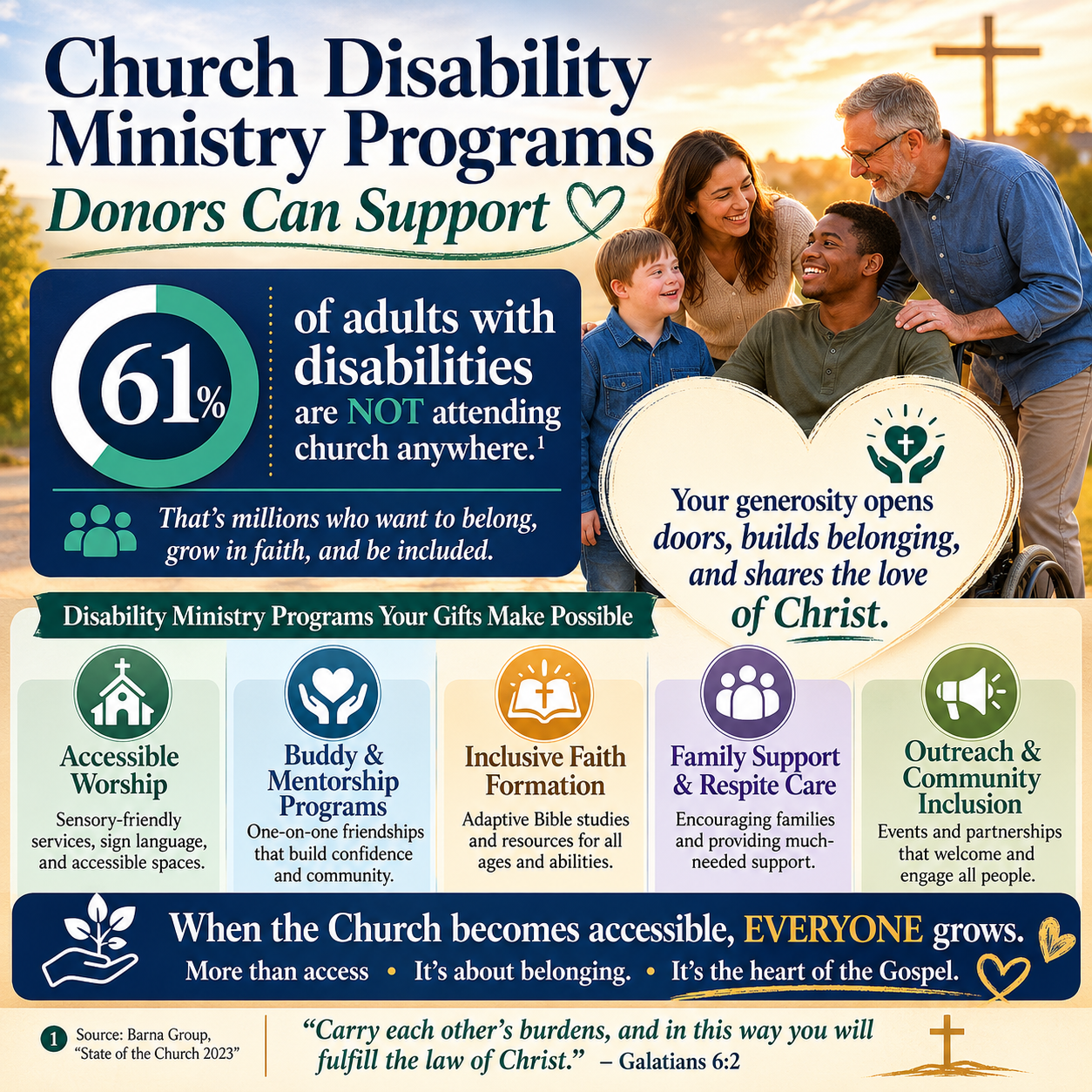
The phrase “disability ministry” can describe a wide range of realities, from a sensory-friendly worship gathering to a trained buddy system integrated into every Sunday service. Donors make better decisions when they fund an outcome rather than a label. The outcome worth funding is not simply attendance; it is meaningful participation in the worshiping life of the church and strengthened households that are not carrying burdens alone.
Many donors also want clarity about scope. Some programs are church-run; others are nonprofit partners that equip churches with training, curriculum, respite events, or consultation. Both can be faithful. The donor’s task is to determine whether the model respects the image of God in participants, includes a credible theology of suffering and hope, and has the operational competence to keep people safe.
Participation, not parallel programming
Parallel programming is sometimes necessary, particularly when a child needs specialized support or when a participant would be overwhelmed in the main service. But when separation becomes the default, churches can unintentionally communicate that people with disabilities are present but not integral. Donors can support programs that increase participation over time: trained volunteers who help someone remain in worship, thoughtful accommodations, and leadership that expects spiritual growth rather than mere management.
Family systems, not isolated individuals
Disability often affects a whole household: siblings, marriages, finances, and a family’s ability to engage in church life without exhaustion. A ministry that serves only the individual participant may still be doing good, but the stronger model treats the family as the unit of care. This can include parent support cohorts, coordinated care calendars, pastoral attention to caregiver burnout, and respite structures that give families real rest rather than one-off “special events.”
Safety and dignity as first-order priorities
Churches sometimes assume goodwill is sufficient for disability ministry. It is not. Programs that serve children and vulnerable adults require rigorous safeguarding: background checks, two-adult rules, incident reporting, training on boundaries, and clear policies on toileting and physical assistance. Donors should regard these as discipleship commitments, not bureaucratic overhead. Funding that strengthens safeguarding is often among the most protective gifts a donor can make.
Programs that strengthen inclusion in worship and congregational life
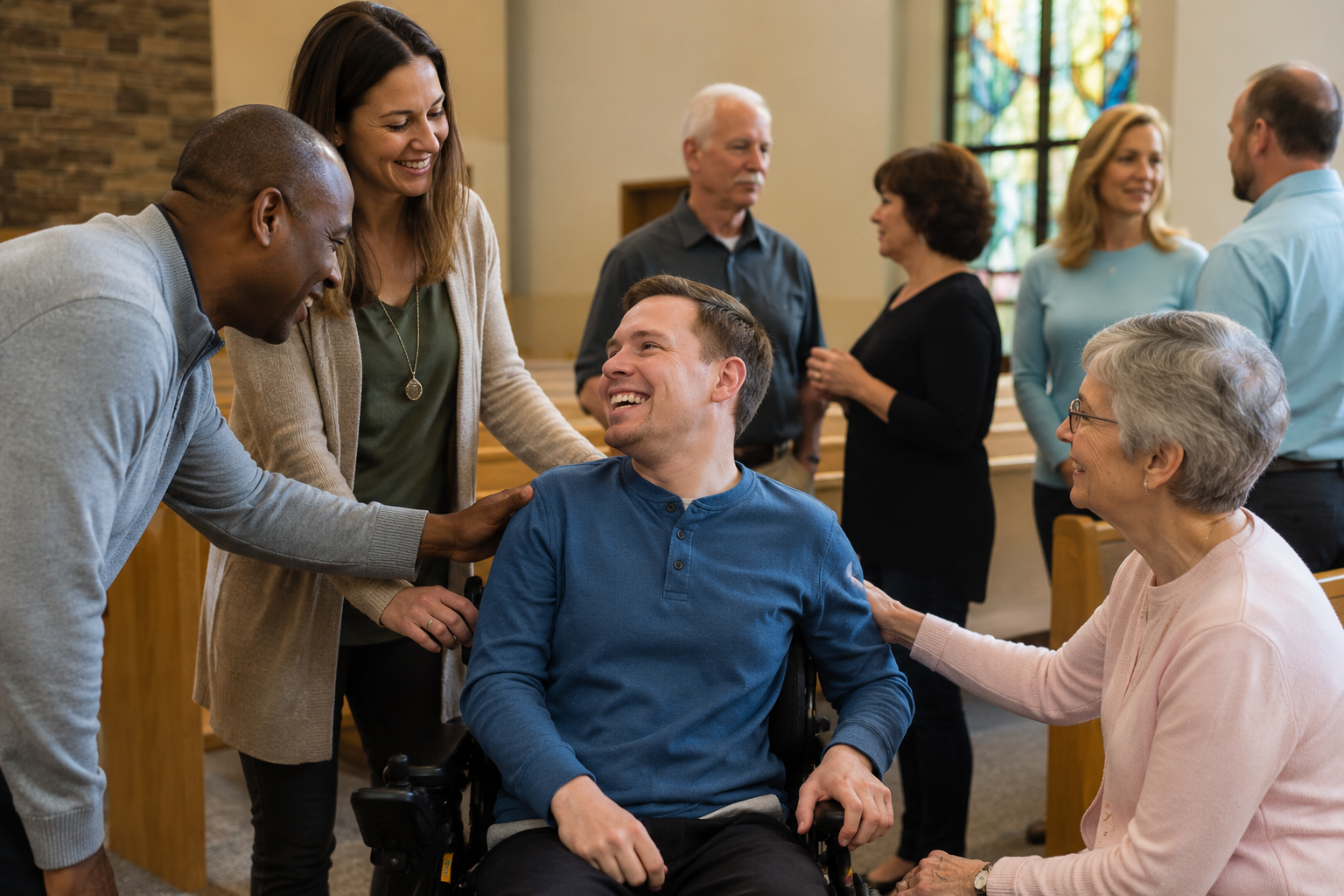
The most credible church disability ministry programs do not treat worship as an optional extra. They aim, with patience, to help people participate in Word and sacrament, prayer, fellowship, and service according to their gifts and limits. This work is often quiet: trained volunteers, predictable routines, communication supports, and thoughtful pastoral leadership. Yet it is also one of the clearest ways a congregation proclaims that Christ’s kingdom is for the whole body.
Sensory supports and predictable environments
Many individuals with autism, PTSD, or sensory processing differences experience worship spaces as physically overwhelming. Donor funding can support practical accommodations: sensory kits, noise-reducing headphones, visual schedules, clearly marked quiet rooms, and training for greeters and ushers. These details communicate welcome without demanding that someone “push through” what the environment makes unbearable.
When donors evaluate these programs, we recommend asking whether the church has done the slower work of anticipating needs rather than reacting to crises. Predictability is not a luxury for many families; it is the difference between participating and staying home.
Buddy ministries that are actually ministries
A buddy system is not simply childcare. At its best, it is a structured discipleship role in which volunteers are trained to support participation in worship, build steady relationships, and respect the agency of the person they serve. Donors can fund training, curriculum, volunteer supervision, and program coordination so that buddies are not improvising alone. Under-resourced buddy ministries often burn out volunteers and leave families hesitant to try again.
The donor’s due diligence question is whether the church treats volunteers as a managed team with clear expectations and accountability, not as a pool of well-meaning substitutes.
Accessible communication and teaching
Some of the most important accommodations are not physical but communicative: simplified sermon outlines, visual supports, assistive listening devices, captioning for video, or trained interpreters. Donors can also fund inclusive discipleship materials for children and adults with intellectual disabilities. The goal is not to dilute doctrine; it is to communicate the same gospel with clarity and hospitality.
For donors, the key indicator is whether the ministry can articulate how accommodations serve spiritual formation rather than merely reducing disruption.
Programs that support families through respite, training, and long-term care
Family support is where disability ministry often becomes most costly and most missional. Many parents and caregivers carry sustained stress that is hard to see from a Sunday pew. Research consistently links caregiving with elevated strain, and churches that ignore this reality unintentionally push faithful families to the margins. The donor’s role is to help the church become a stable community of care over years, not only during a child’s early grades or a crisis season.
Respite is one of the most contested concepts in disability ministry. Christians genuinely disagree about the best models: some prioritize respite nights that give caregivers a break; others emphasize family-integrated support that keeps the household together. Both approaches can be faithful when they are safe, well-designed, and shaped by what families say they actually need.
Respite care that is safe, trained, and predictable
Families do not need “date night” marketing; they need trustworthy care. Donors can fund respite programs that include qualified leadership, adequate volunteer-to-participant ratios, medical information protocols, and policies for elopement risk, allergies, and behavioral escalation. When respite is run casually, it can become unsafe. When it is run well, it can restore marriages, reduce caregiver burnout, and help families remain connected to their church.
For donors who want evidence that caregiver strain is real and common, the National Alliance for Caregiving provides reputable synthesis on caregiving burden and health impacts (National Alliance for Caregiving).
Parent and sibling support structures
Some of the most transformative programs are not public-facing. Parent cohorts that meet regularly, trained facilitators who can lead prayerful, theologically grounded conversations about suffering and hope, and sibling groups that help brothers and sisters name their experiences can reshape a family’s endurance. Donors can underwrite childcare for these groups, licensed professional consultation when appropriate, and the materials that keep support consistent.
In our verification work, we observe that ministries with durable family support typically track participation over time and adjust their programming to reduce “drop-off” when families hit adolescence or major transitions.
Transitions to adulthood and meaningful vocation
Many churches do better with children’s accommodations than with adult inclusion. Yet families often feel the heaviest uncertainty as a child approaches adulthood: guardianship decisions, employment, community integration, and long-term housing. Donors can support programs that address transition planning, cultivate friendships across age groups, and create meaningful service roles within the church.
Where appropriate, churches may partner with community disability organizations for job coaching or supported employment. Donors can encourage these partnerships while still holding the church accountable for its distinctive calling: spiritual care, belonging, and discipleship.
How to evaluate disability ministries with donor-grade rigor
Generosity is not opposed to scrutiny. Scripture commends both compassion and discernment. Donors can ask hard questions without cynicism, because vulnerable people deserve ministries that are not merely sincere but trustworthy. What this means in practice is that donors should evaluate disability ministry programs with the same seriousness they apply to any ministry serving children or the vulnerable.
Some donors hesitate to ask detailed questions because they fear appearing ungracious. Yet ministries that are healthy usually welcome accountability, especially when the questions are focused on safety, stewardship, and mission clarity rather than stylistic preferences. This is also where independent verification can serve the church. Most Trusted exists to reduce information asymmetry between donors and ministries, and to make credible excellence easier to recognize.
Questions that reveal whether a program is stable
- Is this ministry dependent on one person? If the coordinator steps away, does the program continue with documented processes and trained backups?
- Is there a clear budget and a realistic staffing plan? Underfunded programs often rely on invisible labor, which eventually fails families.
- How are volunteers trained and supervised? Training should cover disability awareness, behavior support, boundaries, and emergency procedures.
- How does the church handle incidents? A credible program has reporting pathways, documentation practices, and pastoral follow-up.
Safeguarding and governance that protect the vulnerable
Disability ministry frequently involves vulnerable adults, a category many churches have not defined carefully. Donors can ask whether the church has a safeguarding policy that addresses adults with diminished capacity, not only children. Donors should also ask who has oversight: Is there elder or board accountability, or is this ministry treated as an informal subset of children’s programming?
When donors support nonprofit partners that equip churches, the same questions apply. How are trainers vetted? How is information handled? Are there appropriate boundaries in volunteer training? Governance practices are not distractions from the gospel; they are part of loving our neighbor in truth.
Measuring what matters without reducing people to metrics
Metrics in disability ministry can become dehumanizing if they treat people as outputs. But the absence of any evaluation often hides dysfunction. Strong ministries measure what matters carefully: volunteer retention, family participation over time, incident rates and resolution patterns, training completion, and the degree to which participants are integrated into worship and relationships.
Donors sometimes fixate on overhead ratios, but sector leaders have warned for years that overhead alone is a poor proxy for effectiveness. The “Overhead Myth” letter—signed by Charity Navigator, GuideStar, and the BBB Wise Giving Alliance—has been influential in helping donors ask better questions about outcomes and transparency (Charity Navigator).
For donors who want disability-related context that is broadly credible, the Centers for Disease Control and Prevention offers baseline information on disability prevalence and accessibility considerations (CDC). While such sources do not dictate theology, they help churches and donors avoid operating on assumptions.
Donors who want a wider view of Christian giving within Disability Ministries should hold two commitments together: the church’s biblical obligation to honor and include those who are often overlooked, and the sober reality that programs serving vulnerable people can harm when they are underbuilt or unaccountable. Holding both commitments is not a lack of faith; it is a mature form of stewardship.
Giving that makes the church more faithfully itself
The most meaningful gifts to church disability ministry programs donors can support are often the least visible: training that prevents harm, staffing that stabilizes care, respite that restores weary families, and accommodations that make worship accessible. These are not merely “supports” around the edges of church life. They are expressions of the gospel’s claim that the body of Christ is one body, composed by God’s wise design.
Donors serve the church best when they fund ministries that combine theological clarity with operational seriousness. Where that combination is present, disability ministry becomes not a special-interest program, but a sustained witness to the Lord who welcomed the overlooked, restored the afflicted, and built a kingdom where honor is given to those who lacked it.



