
How hospice support works in Christian senior care is not first a question of logistics. It is a question of what we believe about the body, suffering, and the presence of God when medicine can no longer promise cure. For Christian donors, hospice can feel like a threshold: a family’s last season with a parent or spouse, and a ministry’s last opportunity to practice mercy without pretense.
Across Christian senior care, hospice support sits at the intersection of clinical standards, family fear, and spiritual hope. It can be administered well, with candor and tenderness; it can also be muddled by confusion about what hospice is, anxiety about medication, or suspicion that hospice is “giving up.” Serious Christian care refuses both despair and denial. It names death as an enemy and yet insists it is a defeated enemy in Christ.
Hospice in Christian senior care begins with clarity about purpose
Hospice is not abandoning care
Hospice is a model of care for people expected to be in the last months of life, focused on comfort, symptom management, and support for family and caregivers. In the United States, hospice is typically authorized when a physician certifies a terminal prognosis, and the patient elects comfort-focused care rather than curative treatment under the Medicare hospice benefit. Clear, public information on this structure is available through the Centers for Medicare and Medicaid Services CMS.
The Christian moral concern is not whether hospice hastens death; ethically practiced hospice does not aim at death. Its aim is proportionate relief of suffering, honest companionship, and the refusal to reduce a person to their medical chart. Christians have long affirmed that it is permissible to forgo extraordinary or burdensome treatment when it no longer offers reasonable hope of benefit. The duty is not to prolong biological life at any cost, but to love the neighbor in truth.
The goal is faithful presence under conditions medicine cannot fix
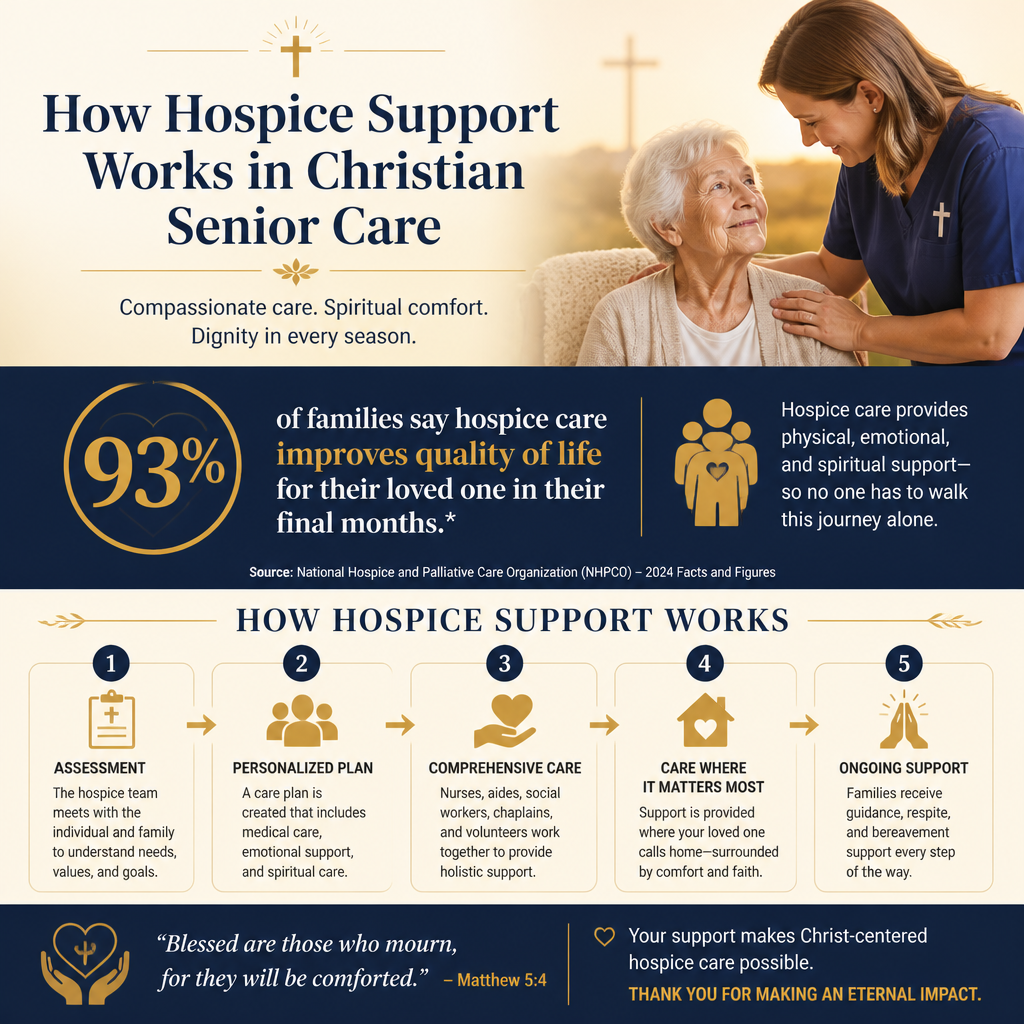
Christian senior care ministries often describe hospice as a form of pastoral and clinical partnership: nurses attending pain and respiratory distress; aides supporting bathing and turning; chaplains addressing fear, guilt, unfinished relationships, and the desire for prayer. The care is both ordinary and holy. Visiting the sick in Matthew 25 is not limited to the season when recovery is possible; it is precisely about meeting Christ where weakness and dependence are exposed.
What this means for donors is that hospice is not a “special program” appended to a campus. It is a test of whether a ministry can maintain dignity, transparency, and family trust when outcomes cannot be measured in cures.

How hospice support is delivered inside Christian senior care settings
Care is coordinated across multiple teams
In many Christian senior care communities, hospice is provided by an external hospice agency working alongside the facility’s own nursing and caregiving team. The hospice agency typically supplies specialized staff, equipment, and an interdisciplinary plan of care; the senior care community continues providing room, board, and daily support as appropriate to the resident’s setting.
Operationally, the work is coordination. Families can experience the handoffs as disorienting: multiple phone numbers, new clinicians, new medication schedules, and a sudden vocabulary of “comfort kits,” “continuous care,” and “respite.” Strong ministries treat this transition as a ministry moment, not an administrative burden. They assign a primary point of contact, communicate in writing, and keep care conferences disciplined and humane.
Common hospice supports families should expect
While specific services depend on the hospice provider and the resident’s needs, hospice support in a Christian senior care context typically includes the following:
- Skilled nursing focused on pain, breathing, nausea, agitation, and skin integrity
- Medication management ordered for symptom relief rather than cure
- Personal care support for bathing, mobility, and comfort measures
- Medical equipment and supplies appropriate to the setting
- Spiritual care and counseling for the resident and family
- Bereavement support for family members after death
When these elements function well, families describe a different kind of “quality”: not the absence of grief, but the absence of chaos. It becomes possible to pray without panic, to speak plainly about what is coming, and to spend time on what love requires rather than on constant triage.
The spiritual and ethical tensions hospice brings to the surface
Pain relief, sedation, and Christian conscience
Christian families sometimes worry that strong pain medications or palliative sedation will shorten life or blunt consciousness in ways that feel spiritually threatening. The concern deserves respect. A ministry that treats such questions as ignorance forfeits trust. A ministry that answers with precision helps families pursue both relief and integrity.
Ethically, a key distinction is intention. Palliative care seeks to relieve suffering; euthanasia seeks death as the means or the end. Christian senior care ministries that are worthy of donor confidence will have written policies, physician oversight, and clear boundaries that prohibit any practice intended to cause death. They will also communicate that untreated pain can be its own form of cruelty and can prevent meaningful prayer, reconciliation, and rest.
Hospice is where families confront unfinished spiritual work
Hospice often accelerates conversations that families have postponed for years: forgiveness between siblings, confession of old wounds, fear of judgment, anger at God, or the quiet loneliness of a saint who has outlived friends and strength. Skilled chaplains do not rush the moment. They bring Scripture as a steadying reality—Christ present with the dying, the promise of resurrection, the legitimacy of lament—without using theology to silence sorrow.
Christians genuinely disagree about how much spiritual counsel should be directive versus non-directive in end-of-life care, especially in multi-denominational communities. The best ministries do not pretend the tension is absent. They articulate their faith commitments, honor the resident’s church history, and collaborate with pastors and congregations when families desire it.
What donors should ask about hospice support in Christian senior care ministries
Trust requires verifiable practices, not inspiring language
Donors are often moved by stories of tender bedside care. Those stories matter, but they are not a governance system. The question is whether a ministry can demonstrate accountable, consistent hospice partnerships and end-of-life practices across many residents, not only during exceptional moments.
This is where independent verification can serve the Church. At Most Trusted, we evaluate ministries against The Most Trusted Standard, a 15-criteria framework spanning Faith Foundation, Financial Integrity, Governance and Leadership, and Transparency and Effectiveness. End-of-life care touches several of those criteria at once: doctrinal clarity, ethical policy, staff training, complaint handling, financial practices, and honest reporting of outcomes and limitations.
Specific questions that tend to surface the truth
Across our verification work, we observe that ministries with mature hospice support can answer detailed questions without defensiveness. Donors and boards can ask:
- Which hospice agencies do you partner with, and how are those partners evaluated?
- How do you communicate prognosis, care goals, and medication changes to families?
- What are your written boundaries regarding euthanasia and physician-assisted suicide?
- How are chaplains trained, supervised, and integrated with clinical teams?
- How do you handle grievances when a family believes care has fallen short?
These questions are not adversarial. They are a form of stewardship. Scripture commends both compassion and prudence; Christian donors should not be shamed for requiring clarity when vulnerable people and sacred trust are at stake.
For donors who want a wider view of how ministries structure care and accountability across late life, the broader landscape of Christian Senior Care Ministries provides important context for comparing models, theological commitments, and operational realities.
How hospice is funded and why transparency matters for donors
Medicare, room and board, and the risk of confusion
In many cases, hospice clinical services are covered under the Medicare hospice benefit when eligibility criteria are met, while room and board are handled separately depending on whether the resident is at home, in assisted living, or in a skilled nursing setting. The result can be a confusing financial picture for families and a reputational risk for ministries that communicate poorly.
Public guidance on the Medicare hospice benefit is available through Medicare’s official resources Medicare.gov. Donors should expect Christian senior care ministries to help families understand what is covered, what is not, and what the likely out-of-pocket costs may be, without burying surprises in paperwork.
The care that cannot be billed still must be provided
Some of the most important hospice-adjacent supports are not easily reimbursed: staff time spent sitting with a resident who is anxious at night; a chaplain’s extended presence with a family after a hard turn; the patient advocacy required when a family is fragmented or overwhelmed. Ministries sometimes make quiet trade-offs here, especially under staffing pressure. The harder question is whether the ministry’s financial model can sustain humane staffing ratios and pastoral care without shifting the burden onto families when they are least able to carry it.
Donors can support end-of-life faithfulness by funding what reimbursement does not: chaplaincy capacity, caregiver training, family education, and benevolence funds for residents whose resources are thin. When donors understand these cost dynamics, they can give in a way that strengthens integrity rather than distorting incentives.
Those who are evaluating specific types of services, including hospice partnerships and pastoral care models, will often find clearer comparisons in Programs and Services in Christian Senior Care Ministries.
FAQs for How hospice support works in Christian senior care
Does hospice mean a Christian senior care ministry is giving up on the resident?
No. Hospice changes the goal of medical care from cure to comfort when cure is no longer reasonably attainable, but it does not remove the obligation to love, to tell the truth, and to provide skilled support. In Christian senior care, hospice can be a disciplined form of hope: not optimism about outcomes, but confidence that a person’s worth is not measured by recovery.
How can donors evaluate whether a ministry handles end-of-life care with integrity?
Donors can look for written ethical boundaries, clear hospice partnerships, transparent communication practices, and accountable governance. Ministries that can explain how they select hospice providers, how they address family grievances, and how chaplaincy is supervised typically have fewer hidden risks. Independent verification, including evaluation against The Most Trusted Standard, can further clarify whether a ministry’s public claims are matched by verifiable practices.
A faithful hospice ministry is measurable in its honesty
Christian senior care at the end of life is not primarily an exercise in sentiment. It is a commitment to presence, truth-telling, and mercy under conditions that expose every weakness in an organization. Hospice support works well when clinical excellence, spiritual care, and transparent leadership reinforce one another, and when families experience that they are not alone in the valley of the shadow of death.



