
When donors ask what services do Christian senior care ministries provide, they are often trying to discern more than a menu of programs. They are trying to understand whether a ministry is practicing the kind of patient, embodied mercy Scripture commends, and whether their giving will translate into dignified care for older adults who may be vulnerable to neglect, isolation, or financial exploitation.
Senior care is rarely simple. Aging brings medical complexity, family strain, grief, and spiritual questions that do not yield to quick solutions. The most credible Christian ministries in this space tend to combine direct care with durable supports for caregivers, while remaining clear about what they can and cannot provide safely and ethically.
1 The core service is dignified daily care and presence
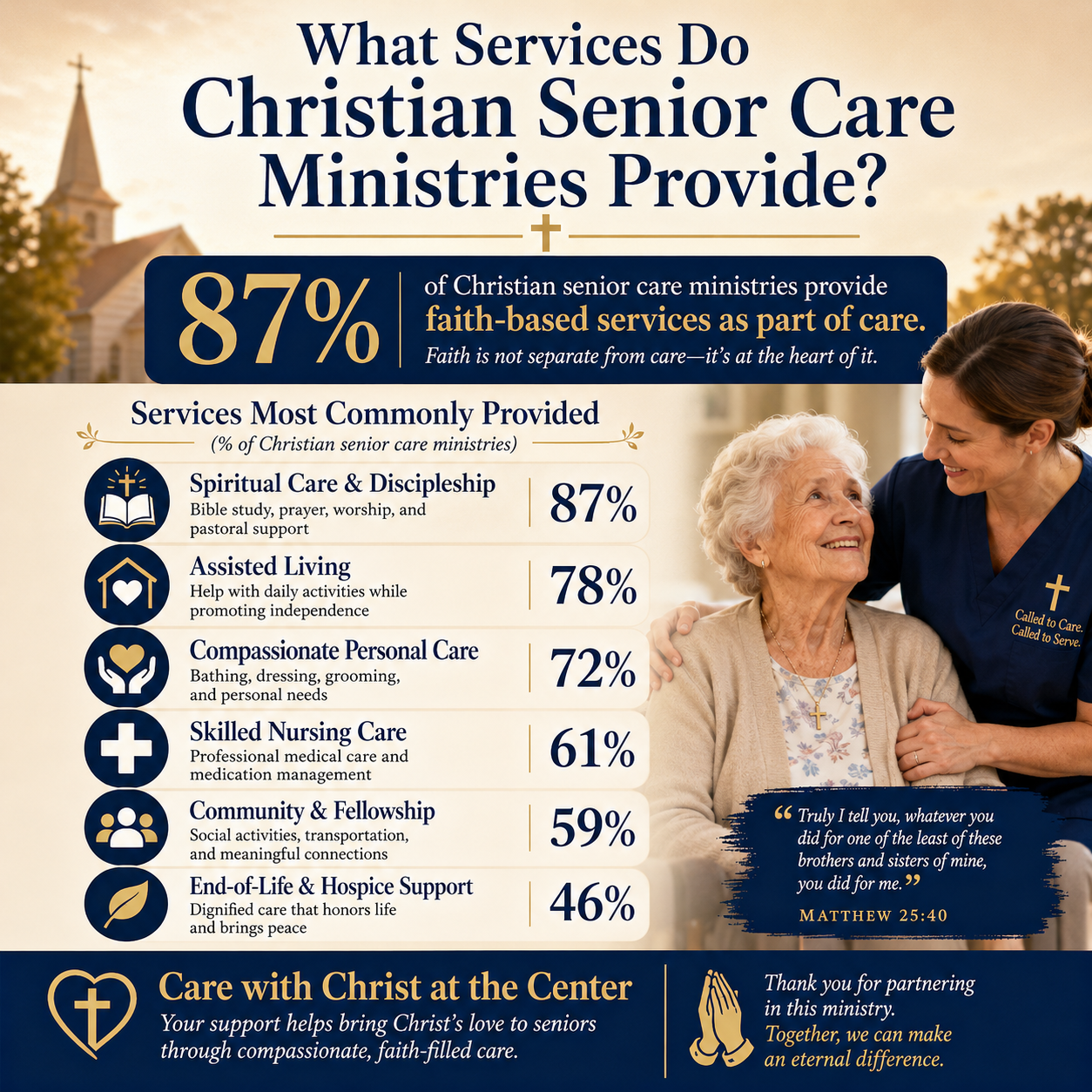
Many Christian senior care ministries begin with the most basic need: stable, dignified daily care that treats an older adult as a person made in God’s image, not as a task list. In practice, that can mean a continuum of supports, from companionship to skilled nursing, depending on the ministry’s licensing and model.
Across our verification work at Most Trusted, we observe that strong ministries describe their services in concrete terms and define boundaries plainly. They do not imply that prayer can substitute for clinical competence, nor do they treat spiritual care as an optional add-on. They hold both together, with appropriate expertise and oversight.
Residential care, assisted living, and nursing services
Some ministries operate campus-based communities that include independent living, assisted living, memory care, and skilled nursing. Others operate a single level of care and partner for referrals. The services typically include help with activities of daily living such as bathing, dressing, meals, mobility, and medication administration, alongside safety monitoring and social engagement.
Donors should be aware that the regulatory environment matters. Residential and clinical services are shaped by state licensing, staffing requirements, and inspection regimes, and ministries that downplay those realities are signaling risk. The highest-quality organizations will be candid about compliance, incident reporting, and how they handle escalation when a resident’s needs exceed what the facility can safely provide.
Home-based services that keep seniors in place
A significant portion of older adults prefer to remain at home, and many Christian ministries focus on enabling “aging in place” through home health, home care, meal delivery, transportation, and home modification assistance. This model can protect dignity and family continuity, but it also introduces practical challenges: worker safety, travel time, consistency of care, and the difficulty of serving rural areas at sustainable cost.
When a ministry provides in-home supports, donors should look for clear screening and supervision of caregivers, documented safeguarding policies, and mechanisms for clients and families to raise concerns without fear.

2 Medical support and care navigation are often the decisive need
Families rarely struggle only with kindness and companionship; they struggle with complexity. Chronic illness, hospital discharges, insurance decisions, and medication regimens can overwhelm even capable adult children. Ministries that address medical coordination well often reduce preventable crises and help families make decisions with clarity rather than panic.
Care coordination and transitions from hospital to home
Many ministries provide case management that helps seniors and families coordinate appointments, communicate with clinicians, arrange durable medical equipment, and plan for safe transitions after hospitalization. Research consistently associates poor care transitions with avoidable readmissions, which is one reason navigation support can be so consequential. The U.S. Department of Health and Human Services has described preventable hospital readmissions as a significant driver of cost and patient harm, especially among medically complex populations; see U.S. Department of Health and Human Services.
Not every ministry is positioned to do this work well. Case management requires training, appropriate documentation, and disciplined privacy practices. Donors should treat vague promises of “helping families figure it all out” as insufficient unless the ministry can articulate its process and qualifications.
Memory care and dementia-informed support
Dementia changes everything: communication, safety, family dynamics, and long-term financial planning. Specialized Christian senior care ministries may offer dementia-specific residential units, day programs, caregiver coaching, and respite designed around predictable routines and environmental safety.
Prevalence is not a marginal issue. The Alzheimer’s Association reports that millions of Americans live with Alzheimer’s disease, with risk rising steeply with age; see Alzheimer’s Association. Donors who want their giving to meet a real, growing need often prioritize ministries that can demonstrate dementia competence, staff training, and thoughtful family support.
3 Spiritual care and pastoral accompaniment are distinct services
Christian senior care is not merely senior care with religious symbols. The most faithful ministries understand spiritual care as a discipline of presence, truth-telling, and hope in Christ, offered without coercion and with respect for conscience. Older adults may be facing accumulated grief, unresolved conflict, fear of suffering, and the spiritual weight of life review. A ministry can neither manufacture faith nor ignore the soul.
Chaplaincy, worship, and sacramental life
In residential settings, ministries often provide chaplaincy, Bible studies, corporate worship, prayer, and pastoral counseling. Some provide sacramental ministry consistent with their tradition. The quality question for donors is whether chaplaincy is integrated into care plans and offered with appropriate training and accountability, rather than functioning as a thin layer of religious programming.
Scripture’s mandate is not sentimental. James connects faithful religion to care for widows in their distress, binding piety to costly action. That theological claim should lead ministries toward consistent, embodied care, especially when cognitive decline or frailty makes an older adult less “visible” to ordinary community life.
End-of-life support and grief care
Many Christian senior care ministries offer hospice partnerships, palliative support, or dedicated end-of-life accompaniment, alongside grief care for families. This work requires candor about suffering and death, and a refusal to trade Christian hope for denial. Donors should look for ministries that speak honestly about comfort, symptom management, and family support, and that avoid simplistic narratives that can shame families facing painful decisions.
Older adulthood is also a season where spiritual abuse can occur through manipulation, fear-based pressure, or disregard for consent. Ministries worthy of trust name these risks and train staff accordingly.
4 Family and caregiver support often determines whether care is sustainable
Even when older adults receive competent care, the burden borne by family caregivers can be immense. Christian ministries frequently serve the family system, not only the individual senior. This is a practical extension of neighbor love, because caregiver collapse can precipitate crisis, unsafe living situations, or unnecessary institutionalization.
Respite, adult day programs, and caregiver training
Respite care may take the form of short-term residential stays, in-home relief, or adult day programs that provide structured supervision and social engagement. Caregiver education can include dementia communication strategies, fall prevention, medication organization, and guidance on recognizing signs of depression or elder abuse.
The need is widespread. The National Alliance for Caregiving has documented the scale of unpaid caregiving in the United States and the associated strain on caregivers; see National Alliance for Caregiving. Donors should treat caregiver support as a core ministry service, not a secondary benevolence project.
Support groups and counseling grounded in Christian community
Many ministries host support groups for spouses, adult children, and widows and widowers. In healthier ministries, these groups are not merely emotional outlets; they are structured, well-facilitated spaces that help families make decisions with integrity, resist resentment, and remain present to an aging parent with patience.
As donors evaluate this work, it is worth asking whether the ministry’s model respects family diversity and complexity. Not every older adult has attentive children nearby, and not every family history is safe or reconcilable. Credible ministries resist easy moralizing and instead provide practical help with a pastoral posture.
5 Practical benevolence and advocacy protect seniors from common forms of harm
Christian senior care ministries frequently encounter seniors living at the edge of financial stability, especially those on fixed incomes facing housing costs, medical bills, or predatory practices. Some ministries therefore provide benevolence, legal and financial guidance partnerships, and advocacy for safer systems.
What this means in practice is that senior care services often extend beyond “care” narrowly defined. They include guarding the vulnerable from exploitation, helping families plan with wisdom, and addressing the social conditions that isolate older adults.
Benevolence supports that meet concrete needs
Common supports include emergency rent or utility assistance, food support, help obtaining mobility equipment, transportation, and home safety improvements such as ramps or grab bars. In donor terms, these programs can appear modest, but they frequently prevent cascading crises that force seniors into unsafe situations.
One hallmark of integrity is how a ministry makes benevolence decisions. Clear eligibility criteria, documentation, privacy protections, and conflict-of-interest safeguards are not bureaucratic obstacles; they are part of loving stewardship.
Advocacy, safeguarding, and referral networks
Some ministries focus on identifying abuse, neglect, or exploitation and connecting seniors to appropriate services. Others train churches to build visitation teams, transportation ministries, or “care circles” that reduce isolation. In many communities, the most effective senior care is a coordinated ecosystem rather than a single organization acting alone.
For donors who want to situate their giving within a broader view of Christian Senior Care Ministries, it is helpful to distinguish between ministries providing licensed clinical care and those strengthening congregational or community-based support. Both can be faithful; they simply require different forms of oversight, competence, and financial structure.
A short list of services donors commonly fund
- In-home companionship and personal care under appropriate supervision
- Memory care programs and dementia-informed caregiver coaching
- Respite services that prevent caregiver burnout and crisis placements
- Chaplaincy and end-of-life accompaniment integrated with care plans
- Benevolence funds for urgent needs such as housing, utilities, or accessibility repairs
How donors can evaluate senior care ministries with confidence
The harder question is not whether a ministry offers a moving story, but whether it can demonstrate faithful governance, financial integrity, and measurable effectiveness without reducing human care to metrics. Senior care is labor-intensive and compliance-heavy; it will rarely score well on simplistic overhead expectations. Wise donors resist the “overhead myth” logic and ask better questions about outcomes, staffing, and transparency. Charity Navigator, Candid, and BBB Wise Giving Alliance have publicly argued against evaluating charities primarily by overhead ratios; see Charity Navigator.
At Most Trusted, we evaluate ministries against The Most Trusted Standard, a 15-criteria framework spanning faith foundation, financial integrity, governance and leadership, and transparency and effectiveness. In senior care, that often means examining safeguarding, clinical oversight where relevant, restricted-gift practices, related-party transactions, board independence, and the ministry’s clarity about what it does for whom and at what cost.
Donors comparing options within Programs and Services in Christian Senior Care Ministries should expect clear documentation: audited or review-level financials when appropriate to size, transparent program descriptions, meaningful policies for incident reporting, and a governance posture that invites scrutiny rather than resisting it.
FAQs for What services do Christian senior care ministries provide
Do Christian senior care ministries only serve Christians?
Some do, but many serve seniors regardless of faith and offer spiritual care as an available ministry rather than a condition of receiving help. Donors should look for clarity about admission criteria, religious expectations, and how the ministry protects freedom of conscience while remaining explicitly Christian in mission.
How can donors tell whether a senior care ministry is safe and well-run?
Responsible ministries are transparent about licensing and inspections where applicable, publish clear safeguarding policies, and describe staffing qualifications and supervision. Financially, they explain how care is funded, how restricted gifts are handled, and how the board provides real oversight. Verification against a framework such as The Most Trusted Standard helps donors assess these elements with more discipline than reputation alone can provide.
Care that honors elders and warrants trust
Christian senior care ministries provide services ranging from daily assistance and medical navigation to pastoral care, caregiver support, and practical benevolence. The ministries most worthy of donor confidence name the complexities of aging, commit to accountable practice, and make their claims verifiable. That is not cynicism; it is stewardship shaped by love of neighbor and reverence for the dignity of those who have borne life’s long burdens.



