
Programs and services in Christian senior care ministries are not merely a list of benefits; they are the concrete form of a theological conviction that age does not diminish dignity, calling, or the church’s obligations of love. Donors often ask a practical question—what do these ministries actually provide?—because the needs are varied and the cost of care is high, but the deeper question is whether a ministry’s services are ordered toward faithful presence rather than institutional efficiency.
Scripture does not treat old age as disposable. The command to “honor your father and your mother” extends beyond childhood obedience into a community ethic of provision and respect. The church’s earliest witness included organized care for vulnerable members, and that pattern still presses on us when frailty, dementia, disability, and poverty converge in a senior’s final years. Christian senior care ministries serve in a landscape where medical systems are complex, families are stretched, and well-intentioned giving can drift into sentimentality without measurable help.
What donors are actually funding when they support senior care
Christian donors tend to give most readily to visible needs: a wheelchair ramp, an emergency bill, a van for appointments. Those are legitimate expressions of mercy. Yet the most faithful senior care is often quiet, ongoing, and administratively demanding: care coordination, consistent visitation, spiritual companionship, and the slow work of supporting families who are making hard decisions with imperfect information.
Across our verification work at Most Trusted, we observe that strong ministries describe their programs in a way that reflects both compassion and discipline. They can tell you who is served, how eligibility is determined, what outcomes are sought, and what safeguards exist against dependency, misallocation, or mission drift. The goal is not to force human care into sterile metrics, but to ensure that donor funds translate into sustained service rather than episodic crisis response.
Direct care versus support services
Some Christian senior care ministries directly operate facilities or home-based services: assisted living, nursing care, memory care, hospice, home health aides, or adult day programs. Others function as a ministry of support around seniors who remain in their homes or in non-Christian settings, providing transportation, meals, volunteer companionship, pastoral care, case management, and financial assistance.
Donors should not assume one model is always “more spiritual” or “more effective.” Facility-based care can provide safety and clinical oversight, especially for dementia and complex medical needs. Home-centered support can protect dignity and continuity for seniors who are stable but isolated. What matters is whether the program model fits the need, and whether governance and financial stewardship are strong enough to sustain care when costs rise and staffing is thin.
The pressure points families face
Senior care ministries increasingly serve families under strain: adult children coordinating care from a distance, spouses exhausted by years of caregiving, and seniors living on fixed incomes in communities where housing and health costs have outpaced retirement savings. The U.S. Department of Health and Human Services notes that “someone turning age 65 today has a nearly 70% chance of needing some type of long-term care services and supports” Administration for Community Living. That probability changes how donors should think about sustainability: episodic generosity is rarely enough when long-term care needs extend for years.

Core service categories in Christian senior care ministries
Programs and services in Christian senior care ministries typically fall into several categories, often combined within a single organization. The most credible ministries name these categories clearly, avoid overstating what they can deliver, and build partnerships when a need exceeds their competence.
Basic needs and stability services
Many ministries begin with practical help: food support, utility assistance, minor home repairs, mobility aids, and help securing benefits. These services are sometimes dismissed as “small,” but they often prevent rapid decline. A replaced water heater or a repaired stair rail can be the difference between remaining at home and an avoidable hospitalization or placement.
When ministries offer financial assistance, donors should ask how they verify need, how they prevent fraud, and how they avoid substituting for family responsibilities where support is available. The wiser ministries do not simply pay bills; they build a plan with the senior and family, clarify expectations, and connect recipients to longer-term supports.
Care coordination and navigation
Even financially stable seniors can be overwhelmed by the complexity of care: primary care, specialists, medications, therapy, insurance denials, and discharge planning. Ministries that provide case management or care navigation often deliver disproportionate value, because coordination reduces duplication and helps seniors actually access services for which they are eligible.
In practice, this may include accompanying seniors to appointments, helping them understand treatment options, communicating with adult children, and aligning volunteer support with clinical realities. For donors, these programs can feel less tangible than “direct aid,” but they frequently prevent crisis escalation and protect seniors from being lost in the system.
Transportation, meals, and companionship
Isolation accelerates decline. Transportation ministries, meal delivery, friendly visitor programs, and phone reassurance lines may look modest, but they are often the scaffolding that allows seniors to remain safely in the community. A missed appointment, an empty refrigerator, or days without human contact can set off cascading harm.
When evaluating these services, donors should look for screening and supervision of volunteers, clear boundaries, and a documented plan for responding to red flags such as cognitive impairment, neglect, or suspected abuse. Compassion without safeguards is not a virtue; it is a liability for seniors and for the church’s witness.
Specialized care and the tensions donors should name
Senior care becomes ethically and spiritually demanding when suffering is prolonged and outcomes are not “fixable.” Dementia, terminal illness, and caregiver burnout force families into decisions where every option has loss. Christian ministries cannot remove that grief, but they can provide trustworthy guidance, presence, and clinically competent support.
Caregiver respite and family strengthening
Much senior care is actually family care. Ministries that provide respite—adult day services, short-term stays, trained volunteers, or subsidized in-home aides—are often protecting the senior by protecting the caregiver. The National Alliance for Caregiving and AARP report that family caregivers provide extensive unpaid care and frequently experience significant strain National Alliance for Caregiving. Donors should treat respite as a serious ministry output, not a peripheral convenience.
The tension is real: respite can become a stopgap that postpones necessary transitions, or it can be the support that makes faithful long-term home care possible. Credible ministries do not romanticize either outcome. They help families face reality with clarity and charity.
Memory care and dementia support
Dementia care requires specialized training, environmental safety, and consistent routines. Ministries serving seniors with Alzheimer’s disease and related dementias should be explicit about staff qualifications, safety protocols, and how they communicate with families. Spiritual care in dementia is not primarily cognitive instruction; it is accompaniment, familiar Scripture and hymns, gentle prayer, and honoring the person who remains when memory fractures.
Donors should also ask how a ministry protects residents from overmedication, neglect, or the subtle indignity of being treated as tasks. Operational excellence here is not secular; it is a moral obligation.
Hospice support and end-of-life care
Christians genuinely disagree about some end-of-life decisions, and ministries should not pretend otherwise. Yet the church’s historic emphasis is clear: we neither hasten death nor abandon the dying. Hospice, when practiced with integrity, is not “giving up”; it is a shift from curative treatment to comfort, presence, and family support.
Donors evaluating hospice-adjacent ministries should look for alignment with clinical standards, partnerships with licensed providers when required, and careful language about pain management and consent. The most faithful programs combine skilled symptom relief with spiritual presence that does not manipulate fear. For many seniors, the final season is a time when pastoral care becomes as urgent as clinical care.
How to evaluate program credibility before you fund it
Donors are not wrong to be cautious. Senior care is expensive, regulated, and vulnerable to both naïve sentiment and hard-nosed cost-cutting. Mature Christian philanthropy holds together mercy and prudence: we give, and we ask appropriate questions about stewardship, safety, and truthfulness.
Most Trusted exists to help donors give with confidence by evaluating ministries against The Most Trusted Standard, a 15-criteria framework spanning Faith Foundation, Financial Integrity, Governance and Leadership, and Transparency and Effectiveness. When a senior care ministry meets those criteria, donors are not guaranteed a perfect program, but they are far more likely to fund work that is accountable, financially sustainable, and consistent with its stated Christian mission.
Evidence of real outcomes without reducing care to numbers
Senior care ministries should be able to show outputs and outcomes appropriate to their services: number of seniors served, visits completed, respite hours delivered, transportation rides provided, emergency interventions, and, when relevant, health-related indicators tracked ethically and legally. Donors should resist two errors: demanding simplistic “ROI” measures for sacred human care, or accepting vague stories without verifiable reporting.
The best reporting names limitations openly. If a ministry cannot measure loneliness reduction directly, it can still report consistent contact, referrals made, crisis escalations prevented, and family feedback collected with safeguards. Humble clarity is more trustworthy than sweeping claims.
Financial integrity and the true cost of care
Senior care creates constant temptation to understate cost, because donors prefer to fund “services” rather than administration. Yet staffing, training, background checks, insurance, facility maintenance, and compliance are not optional; they are part of loving seniors responsibly. The broader nonprofit sector has argued persuasively that overhead ratios alone are a poor proxy for effectiveness, a point made in the “Overhead Myth” letter endorsed by leading evaluators Candid GuideStar. Donors should still expect disciplined budgeting, but not the fiction that serious care can be delivered without serious infrastructure.
What this means in practice is that trustworthy ministries explain their cost structure plainly, build reserves appropriately, and avoid funding models that depend on constant emergency appeals. Stability is a form of protection for seniors.
Spiritual care that is pastoral rather than performative
Christian senior care ministries often emphasize chapel services, bedside prayer, Scripture reading, and pastoral visitation. Donors should look for spiritual care that is integrated into daily life rather than staged for marketing. This includes staff formation, ethical guidelines around consent, and sensitivity to residents with cognitive impairment or spiritual trauma.
Scripture’s vision of the church as one body presses against a transactional model of care. When ministries treat spiritual care as optional and purely private, they risk abandoning seniors at the point of deepest vulnerability. When ministries treat spiritual care as a sales pitch, they dishonor the gospel. The more credible path is patient presence grounded in truth, offered without coercion.
For donors seeking broader context, our coverage of Christian Senior Care Ministries addresses how these organizations fit within the wider ecosystem of church-based mercy, healthcare systems, and long-term care realities.
Giving that strengthens faithful care
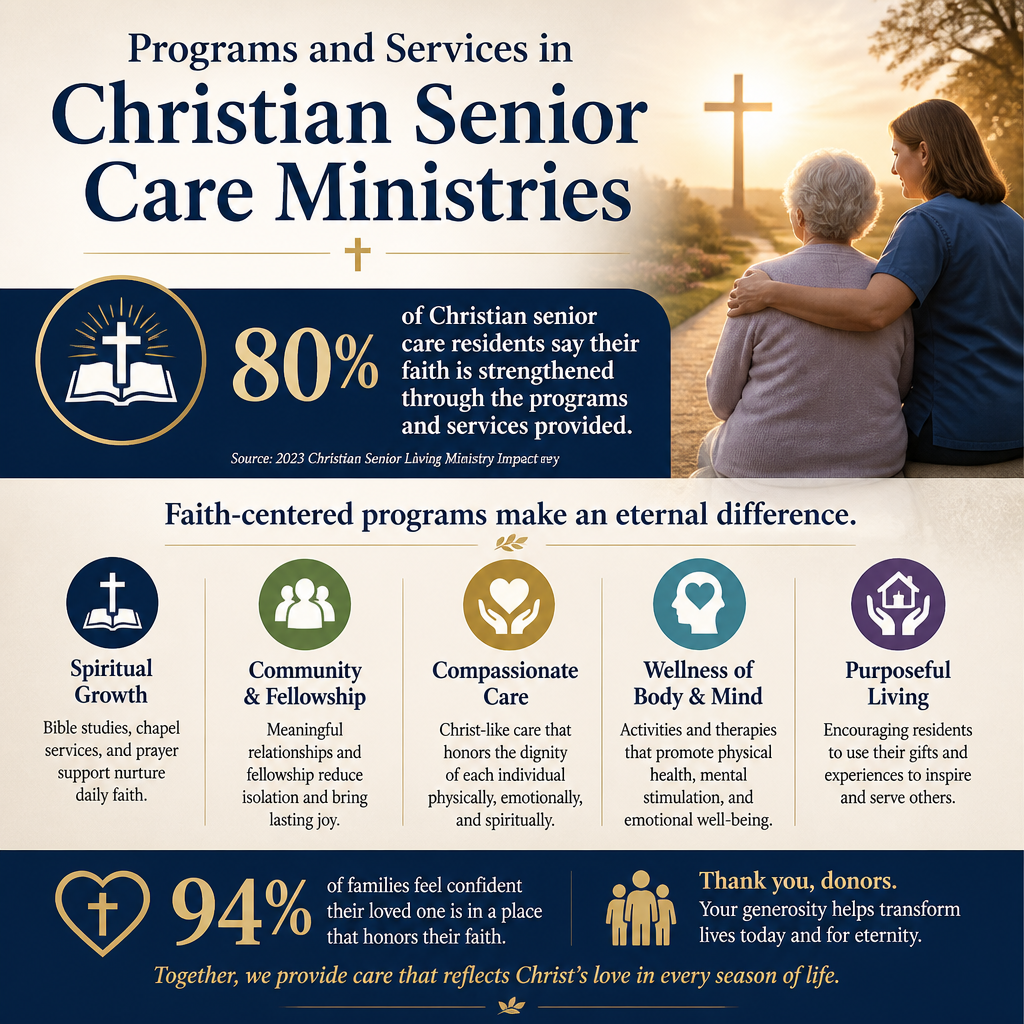
Programs and services in Christian senior care ministries are most compelling when they honor the whole person: body, mind, relationships, and soul. Donors serve seniors well when we fund not only the visible moments of crisis, but the steady work that prevents crisis—trained staff, accountable leadership, clear reporting, and spiritual care that treats elders as image-bearers to the end.
The question is not whether the needs are real; they are. The question is whether a ministry’s services are strong enough to bear the weight of those needs without drifting from Christian truth or abandoning basic standards of safety and integrity. That is where careful verification and disciplined generosity belong together.



