

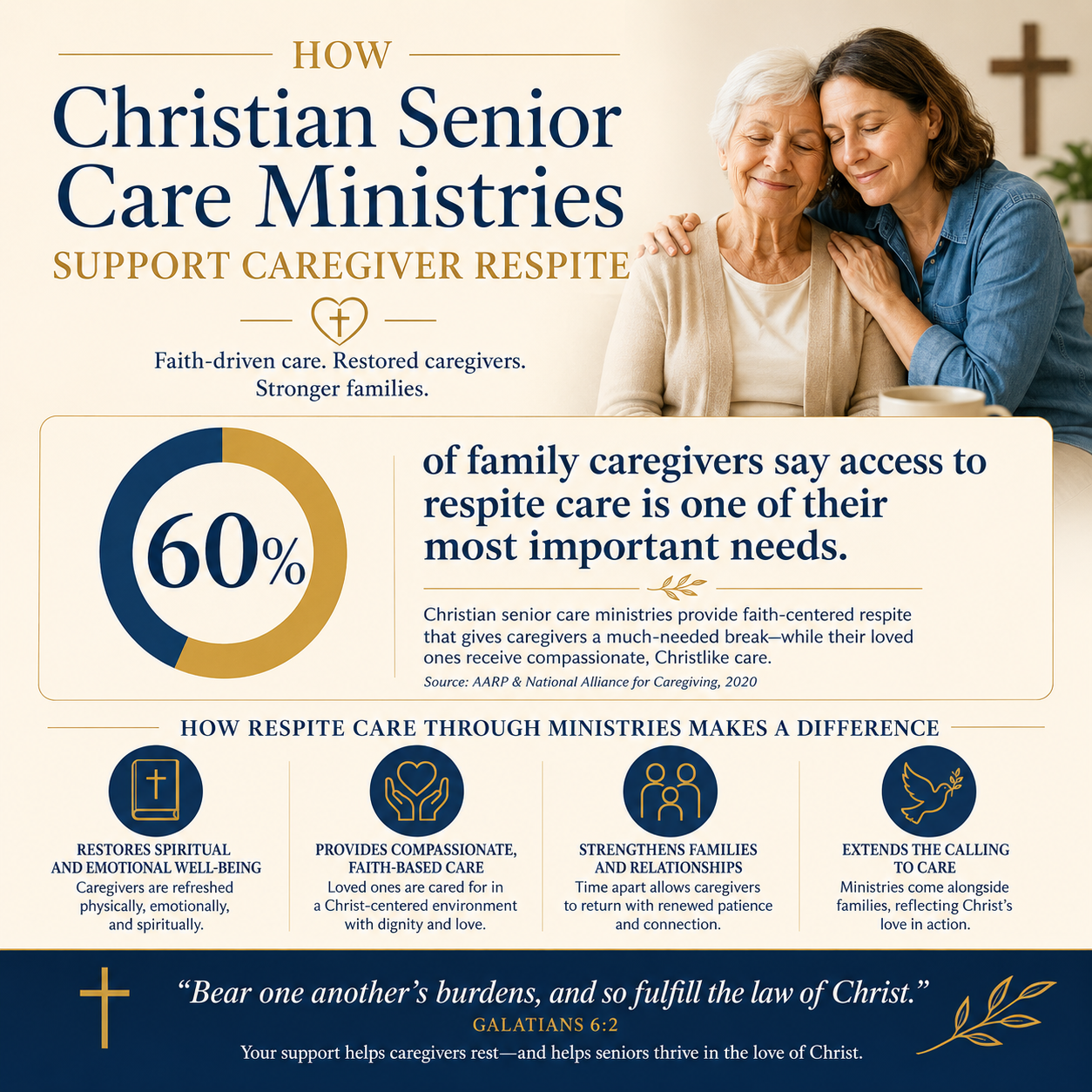
Caregiver respite is one of the quiet crises Christian senior care ministries confront every day. Families who have promised, with sincere love, to keep an aging parent at home can find themselves depleted—spiritually, physically, financially—long before a medical chart shows “burnout.” Respite is not a luxury. It is one of the practical ways the church helps caregivers endure without breaking.
Christian donors often ask what effective respite actually looks like and how to distinguish mature ministries from well-intentioned efforts that unintentionally create instability for frail seniors. The best programs treat respite as a form of neighbor-love that protects the dignity of the older adult while strengthening the household that is carrying the weight.
Why respite is a theological and pastoral responsibility
Honoring limits is not a lack of faith
Scripture’s call to “honor your father and your mother” is not sentimental. It is concrete and costly. Yet Christian tradition has never treated human finitude as a spiritual failure. Caregivers are embodied creatures with sleep needs, employment obligations, medical appointments, and sometimes children still in the home. Respite is one way the church acknowledges those limits without surrendering the call to fidelity.
Jesus’ own pattern includes intentional withdrawal for rest and prayer. That rhythm does not excuse negligence; it guards against collapse. In elder care, collapse has moral consequences: an exhausted caregiver is more likely to make unsafe medication decisions, miss early signs of infection, or respond harshly in moments of stress. Respite is a pastoral intervention before a crisis becomes irreversible.
The stakes are large and the burden is widely borne
Family caregiving is not a marginal phenomenon. The National Alliance for Caregiving and AARP report that 53 million Americans provided unpaid care to an adult or child in the prior year, reflecting the scale of households attempting to sustain care without formal support (AARP Public Policy Institute). Christian ministries that serve seniors are often serving entire family systems, whether they name it that way or not.
The field has had to reckon with a difficult reality: some families can provide extensive care for years; others cannot, even with deep devotion. A mature ministry does not shame caregivers for needing help. It builds a pathway for help that is safe for the senior and sustainable for the household.

What effective respite looks like in Christian senior care ministries
Respite is a continuum, not a single service
Respite is frequently misunderstood as “a weekend off.” In practice, it is a continuum of supports that can be scaled to the senior’s needs and the caregiver’s capacity. In higher-acuity situations, respite may involve licensed nursing oversight and careful handoffs. In lower-acuity situations, the most meaningful relief may be a trained companion who sits for three hours so a spouse can attend church, see a counselor, or simply sleep.
Programs tend to be most effective when they offer more than one modality, because caregiving needs shift. Dementia progresses. A caregiver’s employment changes. A hospitalization introduces new risks. Ministries that treat respite as episodic often leave families scrambling during transitions.
Common models ministries use
Across Christian senior care ministries, several models appear repeatedly. Each has strengths and limitations, and the right fit depends on medical complexity, geography, and staffing.
- Adult day programs that provide structured daytime supervision, meals, activities, and social engagement, often including memory care programming.
- Short-stay respite beds in a Christian nursing home or assisted living setting, giving caregivers multi-day relief with 24/7 oversight.
- In-home respite through trained aides or volunteers, appropriate when the home is safe and needs are stable.
- Church-based respite nights that offer a consistent, scheduled evening option with trained teams and clear safety protocols.
- Caregiver support services including counseling referrals, support groups, and education that reduce isolation and improve decision-making.
What this means in practice is that donors should not ask only, “Do they offer respite?” A better question is, “Do they offer respite that matches the senior’s acuity, protects dignity, and reduces long-term strain on the family?”
Program integrity in respite care: what donors should verify
Safety and dignity are operational, not aspirational
Respite care has a particular vulnerability: it is temporary. Temporary service can tempt ministries to underinvest in assessment, documentation, and caregiver communication. Yet the temporary nature of respite is exactly why standards matter. The senior may be disoriented by a new setting. Medication lists may be incomplete. Family instructions may be verbal and forgotten. Mature ministries build systems that treat handoffs as sacred trust.
As donors, we should look for clear intake processes, policies for medication management, incident reporting, staff training expectations, and appropriate clinical oversight when medical needs require it. When respite involves memory care, best practice includes dementia-specific training and environmental safeguards that reduce wandering and agitation. These elements are rarely visible in a glossy brochure, but they are visible in governance documents, program protocols, and transparent reporting.
Guarding against the hidden harms of “help”
Christians have learned in multiple sectors that help can sometimes harm when it is mismatched to the real need. The When Helping Hurts framework, articulated by Corbett and Fikkert, has shaped how many ministries think about dignity, dependency, and wise compassion. In respite, a parallel risk exists: care that displaces the caregiver’s agency or treats the senior as an object of service rather than a person to be honored can leave families feeling sidelined and older adults feeling managed.
Effective ministries invite caregivers into planning, listen carefully to routines that matter, and communicate after each respite period. They also acknowledge what they cannot provide. A ministry that overpromises to secure funding may be setting a family up for a dangerous mismatch.
Donors who want a broader view of how ministries structure these services across the sector can consult Programs and Services in Christian Senior Care Ministries, where we track common offerings and the accountability questions they raise.
Financial and governance realities that shape respite outcomes
Respite is costly, and “low overhead” can be a warning sign
High-quality respite requires staffing, training, insurance, background checks, facilities or transportation, and careful documentation. A ministry that claims to deliver clinically meaningful respite with minimal administrative cost may be relying on fragile systems. The nonprofit sector has increasingly recognized that simplistic overhead ratios mislead donors. In 2013, Charity Navigator, GuideStar, and the BBB Wise Giving Alliance jointly warned donors against using overhead as the sole measure of performance (Charity Navigator).
The harder question is not “How little do they spend on operations?” but “Are their operations proportionate to the risk and complexity of their services?” Respite care touches medication, mobility, cognition, and family stress. Under-resourced operations can translate into preventable harm.
What governance should be doing behind the scenes
Respite programs thrive when boards and executive leaders treat them as mission-critical, not peripheral. That means setting clear service definitions, approving policies that protect clients, funding staff development, and reviewing incident trends with sobriety. It also means refusing the temptation to scale faster than competence allows.
Across our verification work at Most Trusted, we observe that ministries meeting The Most Trusted Standard tend to show alignment between stated theology and operational decisions. They do not separate “ministry heart” from “ministry competence.” They document how funds are used, they maintain appropriate controls, and they can explain how program results are monitored without turning seniors into data points.
How donors can support respite wisely without distorting the mission
Fund the whole system, not only the visible service
Donors often want to fund the hour of care, the respite bed, or the meal. Those are worthy gifts, but respite programs are sustained by less visible necessities: staff supervision, caregiver communication, volunteer training, facility safety upgrades, and case coordination. When donors restrict gifts too narrowly, they can unintentionally weaken the infrastructure that makes respite safe.
Wise giving asks what the ministry must be able to do consistently: screen workers, document care, communicate with families, and respond to incidents with transparency. Those capabilities require administrative strength and financial integrity.
Ask questions that respect both compassion and accountability
Christian donors are not choosing between mercy and prudence. Scripture assumes both. For respite ministries, several questions clarify whether compassion is matched by competence.
Questions we recommend asking:
- How do you assess whether a senior is appropriate for your respite setting, especially when dementia is involved?
- What training is required for staff and volunteers, and how is competency evaluated over time?
- How do you handle medication reconciliation and changes after hospitalization?
- What is your incident reporting process, and how does leadership review patterns and corrective actions?
- How do you communicate with family caregivers before, during, and after respite?
Donors who want to understand the broader landscape of faith-driven elder care, including how ministries integrate spiritual care with clinical realities, can begin with Christian Senior Care Ministries.
FAQs for How Christian senior care ministries support caregiver respite
What makes respite distinctly Christian rather than simply compassionate care?
Respite becomes distinctly Christian when it is grounded in the conviction that older adults bear God’s image and deserve honor, not merely services. Many secular providers deliver excellent care, and Christian donors need not deny that. Christian senior care ministries add a pastoral dimension: prayer when welcomed, attention to spiritual comfort, and an explicit moral commitment to uphold dignity even when cognition declines and reciprocity is no longer possible.
Should donors prioritize volunteer-based respite or professional clinical respite?
The choice depends on acuity and risk. Volunteer-based respite can be appropriate for companionship, short coverage, and relational support when needs are stable and the environment is safe. Professional clinical respite is often necessary when medication management, mobility assistance, dementia behaviors, or complex medical conditions are present. Wise donors fund models that match the realities of the people served rather than forcing a preferred model onto every situation.
A form of care that keeps faith with families
Caregiver respite is one of the most practical ways Christian senior care ministries keep faith with families who want to honor their elders without being consumed by the task. When respite is done well, seniors experience stability and respect, caregivers regain strength, and households remain intact longer. For donors, the opportunity is to fund not only compassionate intent, but the accountable systems that make compassion safe and enduring.



