

How Christian senior care ministries provide emergency aid reveals what a ministry believes about dignity, community, and the limits of institutional care. When an older adult faces a sudden hospitalization, an eviction notice, a caregiver collapse, or a burst pipe that floods a home, the crisis is rarely “only financial.” It is medical, relational, spiritual, and logistical at once, and it exposes how easily the poor, the isolated, and the frail can fall through ordinary systems.
For Christian donors, the question is not whether emergencies exist but what faithful, accountable response looks like. Scripture is unsentimental about the vulnerability of aging bodies, and it is equally clear about the obligations of God’s people. “Do not cast me off in the time of old age; forsake me not when my strength is spent” is both prayer and moral summons (Psalm 71:9). Emergency aid, at its best, answers that summons without reducing a person to a case file or a fundraising story.
Emergency aid in senior care is usually a chain of needs, not a single bill
Donors often imagine emergency aid as a one-time payment for rent, utilities, or a medical bill. Those expenses are real, but in senior care the more common pattern is a chain reaction: a fall leads to an ER visit, which leads to a rehab stay, which exposes unsafe housing, which creates a transportation gap, which strains a caregiver until the caregiver collapses. Effective ministries treat the emergency as a system problem with a person at the center.
Common crisis triggers ministries encounter
Across the field, emergencies often originate in a few predictable places: sudden medical events, housing instability, caregiver burnout, financial exploitation, and transportation failure. The National Council on Aging reports that falls are the leading cause of injury-related death among older adults, and that one in four Americans age 65+ falls each year National Council on Aging. A ministry that serves seniors for any length of time will confront the downstream consequences of that reality.
Why cash alone can be necessary and insufficient
Christians genuinely disagree about the right balance between direct financial assistance and longer-term support. The caution is not that cash is inherently unwise; it is that cash without casework can unintentionally fund avoidable harm. The When Helping Hurts framework, articulated by Corbett and Fikkert, has pressed the church to consider how help can undermine agency if it is not paired with participation, truth-telling, and a plan for stability Chalmers Center. In senior care, that might mean paying for an urgent repair while also arranging home safety modifications, reconciling with family where possible, or connecting a client to benefits enrollment.
How ministries structure emergency aid without compromising dignity
Well-run Christian senior care ministries rarely “hand out money” as their primary intervention. They structure emergency aid as a tightly scoped tool within a broader ministry of presence: assessment, advocacy, pastoral care, and practical service. This is not bureaucracy for its own sake; it is a way to protect seniors from exploitation and to protect donor funds for the sake of future neighbors.
Assessment that is fast but not careless
Emergency response requires speed, but speed must not become credulity. Ministries that do this well use brief intake processes designed for urgency: identity verification, basic financial snapshot, immediate safety check, and a review of existing supports (family, church, benefits, insurance). They often coordinate with hospitals, social workers, and local churches to confirm the situation without shaming the person in crisis.
Concrete forms of aid that match the actual problem
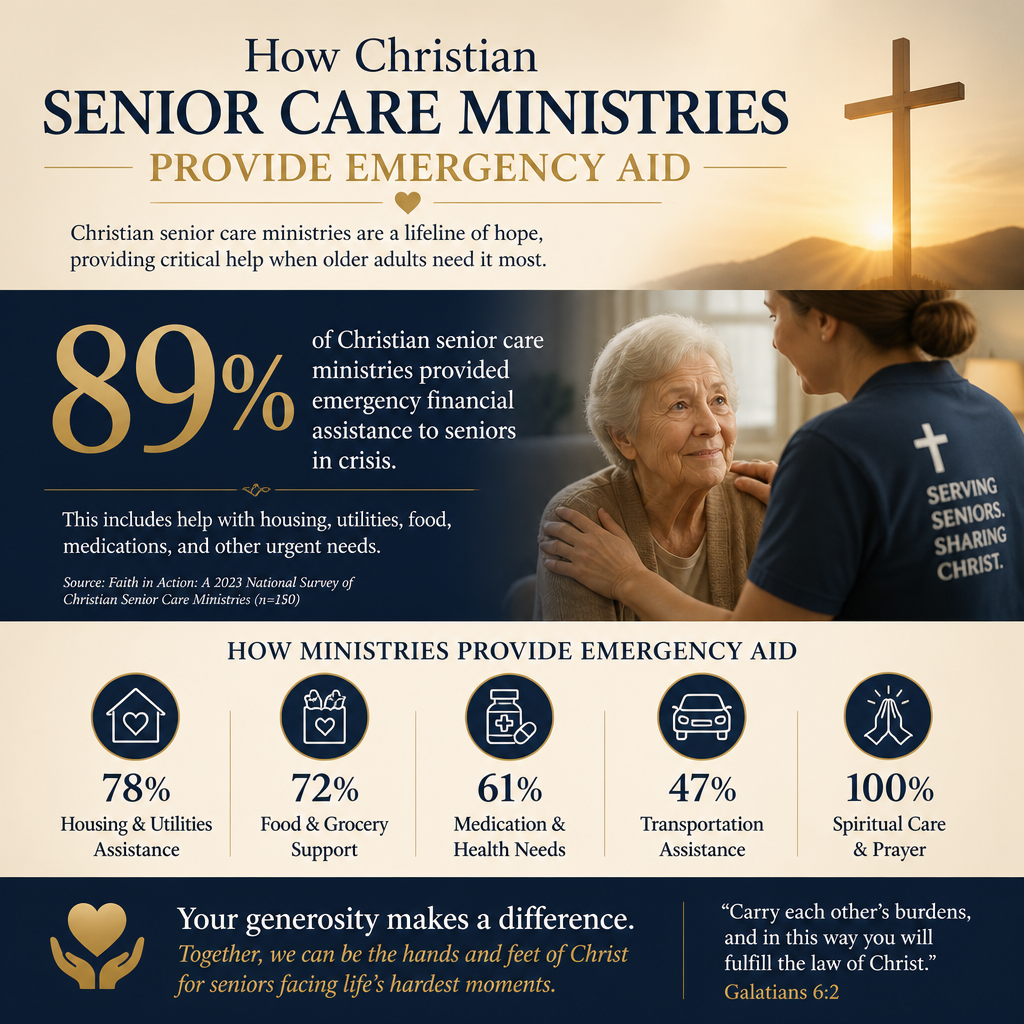
In practice, emergency aid often looks like targeted payments or services that resolve a bottleneck. A strong ministry can respond with more than a check. Typical interventions include:
- Short-term rent or utility assistance to prevent displacement
- Transportation for urgent medical appointments or discharge planning
- Home repairs and accessibility changes to reduce immediate safety risk
- Food provision when mobility or finances collapse
- Temporary respite support when a caregiver reaches a breaking point
What this means in practice is that “emergency aid” is frequently the bridge that makes other help possible: attending the follow-up appointment, returning safely home, or keeping a caregiver stable long enough to avoid institutionalization.
The hardest question is how ministries prevent crisis cycling
Emergency aid can become a revolving door when the underlying drivers remain untouched: unsafe housing, unmanaged chronic disease, isolation, and administrative barriers to benefits. The field has had to reckon with the fact that seniors can be “helped” repeatedly without becoming safer. That is not always the ministry’s fault; it is often the predictable outcome of poverty and fragmentation. But donors are right to ask whether a ministry has a theory of change beyond recurring relief.
Stabilization plans that respect agency
Responsible ministries use stabilization plans that are modest, time-bound, and co-authored with the senior when possible. The plan might include enrolling in SNAP, applying for Medicaid or Medicare Savings Programs, securing a safer living arrangement, or building a small circle of support through a local church. These steps can be slow, and older adults may decline some forms of help for reasons that deserve respect: fear, pride, trauma, or cognitive impairment.
Partnering with churches without offloading responsibility
Local churches can offer relational continuity that a regional ministry cannot always sustain. Yet partnership should not mean dumping complex cases on volunteers. The more credible models train church volunteers, provide supervision, and keep clear boundaries around what volunteers can and cannot do. When coordination is done well, a church becomes part of a senior’s ongoing support without becoming a substitute for professional judgment.
Donors who want to understand the broader context of services ministries provide can review Programs and Services in Christian Senior Care Ministries as a way to see where emergency response fits within a more comprehensive approach to aging.
Accountability for emergency aid is moral, not merely administrative
Every donor who has funded emergency assistance has felt the tension: urgency invites generosity, and urgency also attracts fraud. Scripture does not ask us to become suspicious cynics, but it does call us to prudence. “Whoever is generous to the poor lends to the LORD” (Proverbs 19:17) is not permission to abandon accountability; it is a reason to steward resources as sacred.
What disciplined financial practices tend to include
Across our verification work at Most Trusted, we observe that ministries with consistent emergency-aid outcomes tend to separate compassion from impulse. They set written criteria, approve exceptions through documented processes, and maintain clean financial trails. These practices are not about distrusting seniors; they are about making sure a ministry can keep showing up next week.
The Better Business Bureau’s Wise Giving Alliance has long emphasized that transparency, governance, and truthful communications are core to charitable trust BBB Wise Giving Alliance. In emergency aid, those standards become concrete: receipts for vendor payments, clear caps, conflict-of-interest controls, and careful handling of restricted gifts.
The communication temptations donors should name directly
Emergency stories raise money, and the temptation to dramatize need is real. The harder question is whether a ministry can tell the truth about suffering without turning the vulnerable into marketing content. Donors should look for communications that protect privacy, avoid manipulative imagery, and describe impact in verifiable terms rather than emotional exaggeration. A ministry that cannot fundraise without sensationalism may be revealing something important about its internal culture.
How The Most Trusted Standard helps donors evaluate emergency aid ministries
Many ministries do genuinely compassionate work, and donors still need a way to discern which ones are equipped to handle emergencies responsibly. Most Trusted exists to help donors give with confidence by evaluating Christian nonprofits against The Most Trusted Standard, a 15-criteria framework that examines a ministry’s faith commitments, financial integrity, governance practices, and transparency and effectiveness. Emergency aid is one of the clearest places where these commitments become visible.
Signals that a ministry is prepared for high-stakes assistance
A credible emergency aid program usually shows evidence of mature operational judgment. Donors can reasonably ask for:
- Clear eligibility guidelines and documented exception processes
- Safeguarding practices for vulnerable adults, including reporting protocols
- Vendor payment preference when appropriate, reducing misuse risk
- Meaningful board oversight of benevolence and crisis funds
- Outcome reporting that distinguishes activity from actual stabilization
Questions that require patience, not simplistic scoring
Not every ministry can publish detailed client outcomes, especially when privacy and safety are at stake. Smaller ministries may also lack sophisticated data systems. The question is not whether a ministry looks polished; it is whether it can demonstrate faithful stewardship: consistent documentation, honest constraints, and a pattern of learning. Donors can support capacity-building without excusing basic lapses in governance or financial clarity.
For donors assessing the broader field, Christian Senior Care Ministries provides a wider view of models, risks, and the kinds of verification questions that matter when frailty and urgency converge.
FAQs for How Christian senior care ministries provide emergency aid
Should donors prioritize emergency aid or long term senior support programs?
Both are biblically coherent, and the wisest giving often holds them together. Emergency aid prevents immediate harm and can keep a senior housed, safe, and connected to care. Long-term support reduces the likelihood that the next predictable crisis becomes catastrophic. Donors can ask whether a ministry’s emergency assistance connects to stabilization pathways rather than functioning as repeated one-off relief.
What documentation is reasonable to expect for emergency assistance?
Donors should expect enough documentation to show that assistance was approved under stated criteria and delivered as intended: internal approval records, general categories of aid provided, financial controls, and aggregated reporting on how crisis funds are used. It is usually not appropriate for ministries to share personally identifying details. The appropriate standard is verifiable stewardship without compromising the privacy and dignity of vulnerable seniors.
Emergency aid is a test of a ministry’s theology of neighbor
Emergency response in senior care is not simply a charitable transaction; it is a moral practice shaped by what we believe about the image of God, the body, and the church’s obligations to the vulnerable. The best Christian senior care ministries meet urgent needs quickly, but they also refuse to confuse speed with faithfulness. They protect dignity, coordinate care, and report with candor. For donors, that combination of compassion and accountability is not optional; it is the integrity of Christian stewardship under pressure.



