

How Christian senior care ministries help low-income seniors is a test of whether the Church will treat aging as a spiritual and moral reality, not merely a demographic trend. For donors, the question is not only whether needs are real, but whether a ministry’s care is competent, dignifying, and sustainably funded in a way that honors both the recipient and the giver.
Scripture does not permit sentimental distance from the elderly poor. Israel was commanded to honor father and mother, and the New Testament church is instructed to take serious responsibility for widows, with careful discernment and orderly practice (1 Timothy 5). That combination—mercy with discernment—remains the challenge for senior care ministries serving older adults whose incomes do not meet the cost of safe housing, medical support, and daily help.
The need is not abstract and the cost curve is unforgiving
Low income meets high fragility
Older adults living near or below poverty experience a compounding set of risks: housing instability, untreated chronic conditions, social isolation, and limited capacity to advocate for themselves across complex systems. The financial math is not subtle. Many seniors rely primarily on Social Security, and a meaningful share live with little to no margin for rent increases, medication copays, or unexpected caregiving costs.
The U.S. Census Bureau reports that older adults remain a sizable portion of those living in poverty in the United States, with variation by race, gender, disability status, and household structure; donors should treat those differences as a guide to targeted compassion, not as a reason for cynicism about “the poor.” U.S. Census Bureau
Housing and care are the pressure points
For low-income seniors, the crisis often consolidates around housing and the practicalities of daily life. A modest decline in mobility can turn an apartment into a trap. A missed medication refill can become an emergency department visit. These are not simply “quality of life” issues; they are matters of safety, stewardship, and human dignity.
We also encourage donors to hold two truths together. First, public programs matter: Medicaid is a major payer for long-term services and supports, and it shapes what care is available and where. Second, public programs do not eliminate the pastoral and relational needs of aging, nor do they address loneliness, spiritual care, and the personal advocacy required when systems fail or families are absent.

What Christian senior care ministries actually do for low-income seniors
Direct services that reduce risk and restore stability
Christian senior care ministries serve low-income seniors through a range of programs, from simple interventions to highly regulated care. In practice, many ministries build a continuum: relief for immediate pressures, support for daily functioning, and long-term housing or care when fragility increases.
Common forms of ministry include:
- Affordable senior housing with on-site coordination and community life
- Home repair and accessibility modifications, such as ramps and grab bars
- Caregiver respite, adult day programs, and friendly visiting to reduce isolation
- Transportation to medical appointments and grocery stores
- Medication assistance, nutrition support, and benefits navigation
Not every ministry should attempt every service. The field has learned that “doing more” without adequate staffing, clinical oversight, or financial capacity can create harm—especially when vulnerable seniors are involved.
Spiritual care that respects agency rather than exploits need
Christian distinctiveness is not a marketing layer. At its best, it is a commitment to see older adults as image-bearers with enduring vocation, not as problems to be managed. That includes prayer, chaplaincy, worship access, and pastoral companionship—offered without coercion and with respect for conscience. Donors should expect ministries to articulate how they avoid manipulating material need for spiritual compliance.

Many donors are drawn to organizations where spiritual care is integrated with clinical excellence and ethical boundaries. This is also where careful governance matters, because the vulnerable deserve more than good intentions.
Models that tend to serve low-income seniors well
Mission-driven housing and subsidized care
One effective model is mission-driven senior housing that combines affordable rent with service coordination. Ministries may finance such work through philanthropic support, government housing programs, and cross-subsidization from market-rate units. Each funding mix carries constraints: compliance requirements, fluctuating reimbursement, and the perennial temptation to prioritize easier-to-serve residents over those with higher needs.
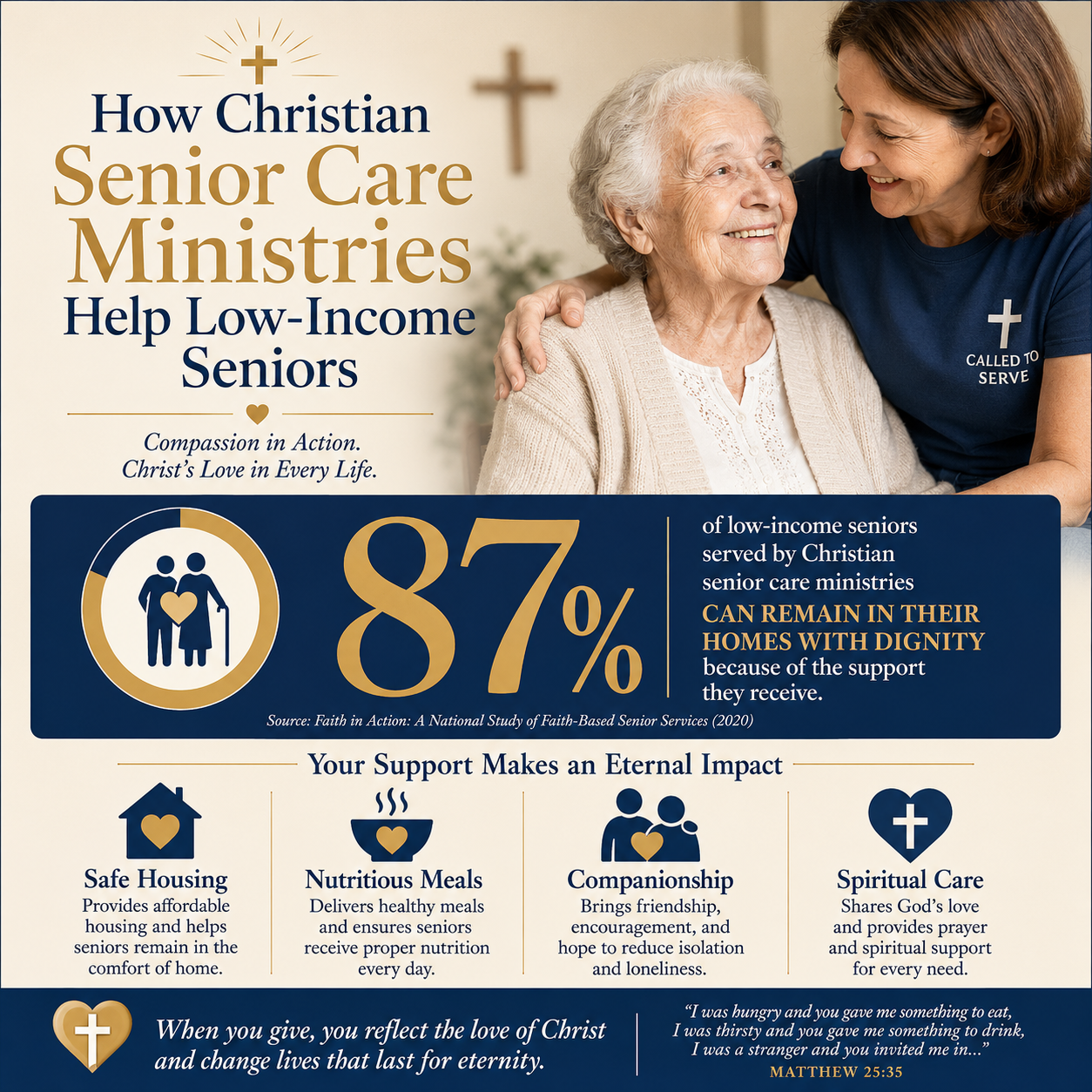
Donors should ask what a ministry does when a resident’s care needs increase. Some organizations can only offer independent living. Others coordinate home health or transition support. A smaller number operate assisted living or skilled nursing, which involves strict regulation and substantial staffing requirements.
Congregation-anchored networks
Another model worth attention is the church-anchored network: volunteers providing transportation, home visits, minor repairs, and meals, coordinated through trained staff. When supervised well, these ministries can extend the reach of professional services and reduce isolation, a factor strongly associated with poor health outcomes in older adults. The U.S. Surgeon General has treated social connection as a public health concern; donors should not dismiss it as secondary to “real needs.” U.S. Department of Health and Human Services
The harder question is how these networks ensure safety: background checks, safeguarding policies, boundaries in financial help, and clear escalation paths when elder abuse or cognitive decline is suspected.
Where well-intentioned giving can go wrong in senior care
The dignity risk of paternalism
Christians genuinely disagree about how to balance compassion and accountability, but senior care raises a distinct version of the debate. Many low-income seniors are not “unmotivated”; they are constrained by fixed income, disability, and grief. Ministry approaches shaped by suspicion can become punitive. Approaches shaped by naïve generosity can become controlling, creating dependency or eroding a senior’s agency.
The When Helping Hurts framework, articulated by Corbett and Fikkert, has sharpened the Church’s understanding that harm can be done through aid that undermines responsibility, local relationships, and long-term capacity. In senior care, the parallel concern is aid that bypasses family systems unnecessarily, or that displaces the senior’s own voice in decisions that affect their daily life.
Financial fragility and the temptation to underinvest
Senior care is labor-intensive, and competent care is not cheap. Ministries that rely on underpaid staff, chronic understaffing, or deferred maintenance may keep costs low while putting seniors at risk. Donors should also resist simplistic pressure to minimize overhead. The Overhead Myth letter—signed by organizations including GuideStar and Charity Navigator—warned that fixating on overhead can incentivize underinvestment in the very systems that protect beneficiaries. Candid GuideStar
What this means in practice is that donors should be wary of narratives that promise high-touch care without the staffing and infrastructure that care requires. A mature donor posture values both compassion and operational truthfulness.
How donors can evaluate ministries with confidence
Questions that reveal seriousness
Within Christian Senior Care Ministries, donors encounter wide variation: some organizations focus on community-based supports, others operate residential care, and many do both. The evaluation questions should match the ministry’s risk profile. A transportation ministry is not judged the same way as a skilled nursing operator, but both should demonstrate moral clarity, competent leadership, and transparent reporting.
Across our verification work at Most Trusted, we find that the ministries most worthy of sustained donor confidence tend to do several things consistently: they define their faith commitments clearly, they tell the truth about finances, they govern with independence and competence, and they can show evidence that services are delivered as promised to the people they claim to serve.
Applying The Most Trusted Standard to senior care
The Most Trusted Standard evaluates ministries across four domains: Faith Foundation, Financial Integrity, Governance and Leadership, and Transparency and Effectiveness. In senior care, these domains become practical.
Donors can press for verifiable answers:
- Faith Foundation: Is spiritual care integrated ethically, without coercion, and with pastoral competence?
- Financial Integrity: Are audited financials available where appropriate, and is the funding model realistic for the services promised?
- Governance and Leadership: Does the board provide independent oversight, especially where vulnerable adults are served?
- Transparency and Effectiveness: Does the ministry report meaningful outcomes, not only stories, and does it name limitations candidly?
For donors exploring specific service lines—housing, home-based support, respite care, or clinical programs—our team encourages attention to Programs and Services in Christian Senior Care Ministries so giving aligns with both conviction and practical impact.
FAQs for How Christian senior care ministries help low-income seniors
What outcomes should donors look for in ministries serving low-income seniors?
Appropriate outcomes depend on the service, but donors should expect clarity. For housing programs, that may include housing stability, reduced emergency transitions, and resident well-being measures. For home-based supports, it may include fewer missed appointments, improved safety through home modifications, and documented reductions in isolation through consistent contact. Outcomes should be paired with safeguarding practices and a truthful account of what the ministry cannot control, such as broader housing markets or workforce shortages.
Is it better to fund direct aid to seniors or fund the ministry infrastructure?
Both can be faithful stewardship when matched to actual needs. Direct aid can prevent immediate harm, such as eviction, utility shutoff, or an unsafe home condition. Infrastructure funding can sustain the staffing, compliance, training, and case management that keep a program safe and effective over time. Donors should be cautious of false binaries; the moral question is whether the ministry can demonstrate that funds translate into dignifying care with appropriate oversight.
Giving that honors elders requires both mercy and verification
Christian senior care ministries help low-income seniors when they address material vulnerability without erasing personal agency, and when they pair spiritual care with practical competence. Donors should not have to choose between compassion and due diligence. When ministries can demonstrate integrity under The Most Trusted Standard, giving becomes not only generous, but also disciplined in the way Scripture commends: a mercy that tells the truth and protects the vulnerable.



