

Why Christian senior care ministries focus on the aging is not primarily a question of demographics or institutional strategy. It is a question of discipleship: what it means to honor those whose strength is failing, whose voices are quieter in public life, and whose needs are complex, chronic, and often hidden behind closed doors.
For Christian donors, this focus can feel less intuitively “missional” than work with children, global crises, or evangelistic campaigns. Yet Scripture repeatedly treats the care of older adults as a measure of covenant faithfulness, and the realities of modern longevity have only intensified the moral stakes. The ministries worthy of support are those that translate that biblical obligation into competent, verifiable care without using sentiment as a substitute for stewardship.
Scripture makes aging a spiritual priority, not a sentimental cause
Honor is a command with material implications
The fifth commandment does not treat aging as optional concern: “Honor your father and your mother” (Exodus 20:12). In the biblical imagination, honor is not mere deference. It includes protection, provision, and truth-telling about obligations when burdens increase. Proverbs ties righteousness to the treatment of the vulnerable, and the aged often become vulnerable not because of moral failure but because bodies and minds change.
The New Testament sharpens the point by making family responsibility explicit. Paul writes, “If anyone does not provide for his relatives… he has denied the faith” (1 Timothy 5:8). That is a severe sentence, and it lands in a context about the church’s structured care for widows. Christian senior care ministries exist, in part, because modern households often cannot meet these obligations alone, even when families are faithful and present.
The church has always had to build institutions of mercy
Christians sometimes speak as though “institutional care” is inherently secular, but the history of Christian mercy is full of durable structures: hospitals, hospices, alms systems, and religious communities ordered toward care. The question is not whether a ministry has programs, staffing models, or facilities. The harder question is whether those structures are governed by a coherent theology of human dignity, honest financial practice, and a disciplined commitment to the truth.
Across our verification work at Most Trusted, we observe that senior care ministries that remain explicitly grounded in Christian doctrine tend to resist two temptations at once: reducing older adults to “service recipients,” and reducing donors to “funding sources.” They speak and act as though older adults are neighbors to be honored, and donors are stewards who deserve clarity.

Aging is where the dignity of the image of God is tested by complexity
Chronic needs reveal whether care is truly person-centered
Many of the most visible charitable needs are episodic: a disaster, a medical bill, a short-term gap. Aging is different. It often involves gradual loss, repeated transitions, and overlapping needs: mobility, memory, medication management, housing, spiritual care, and family support. Christian senior care ministries focus on the aging because this is where the culture’s commitment to human dignity is most likely to thin into slogans.
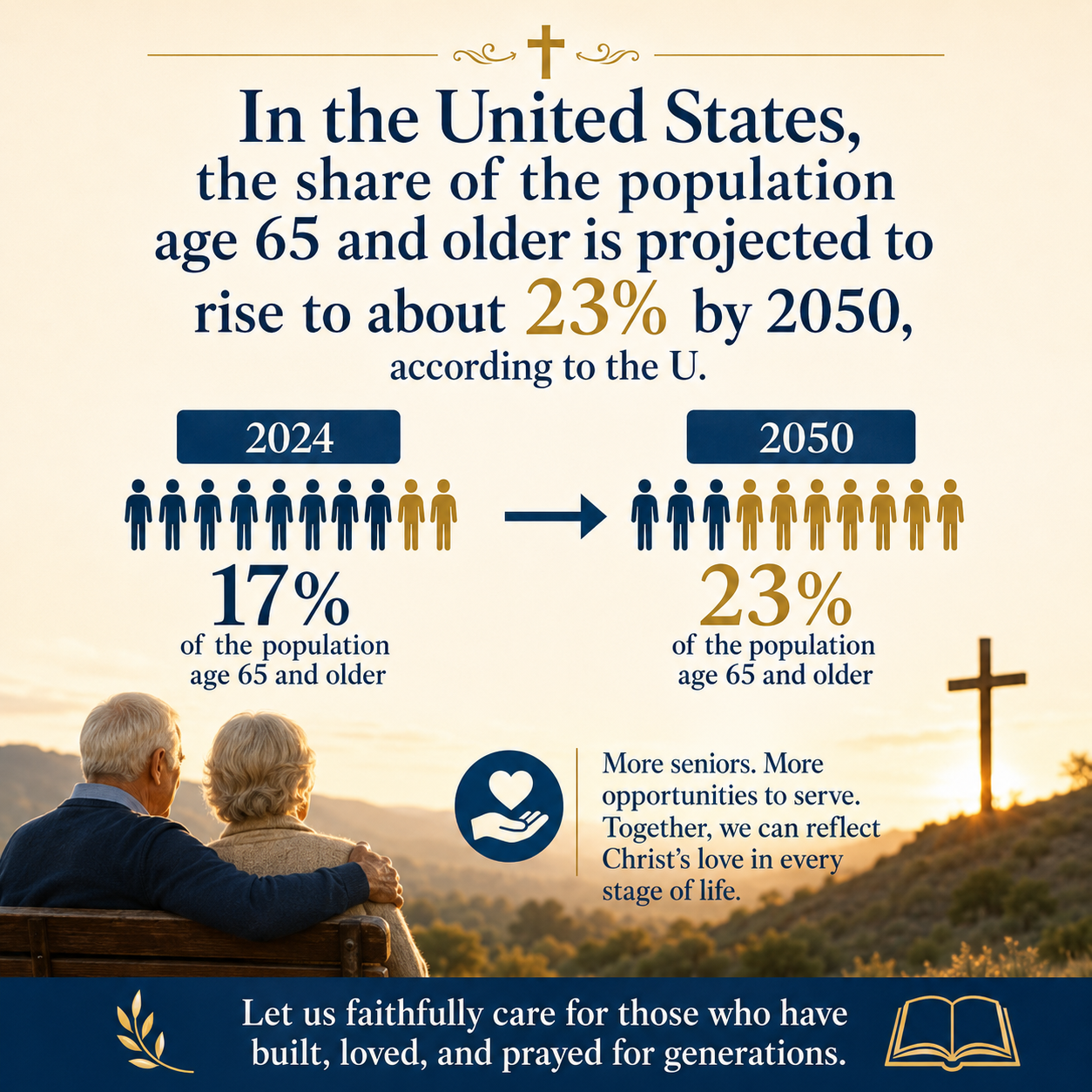
Modern longevity is not a theoretical issue; it is a defining social fact. In the United States, the share of the population age 65 and older is projected to rise to about 23% by 2050, according to the U.S. Census Bureau. That projection does not tell donors whom to support, but it does clarify why the need will not recede. Christian institutions that have built ethical, competent models now will be positioned to serve faithfully in the decades ahead.
Memory care and end-of-life decisions require moral clarity
Dementia and related conditions raise questions that cannot be answered by efficiency alone: consent, freedom, risk, spiritual agency, and how to treat a person whose personality is changing. The same is true of end-of-life care: how to address pain, how to respect patient wishes, how to avoid both overtreatment and neglect, how to support families who are grieving in advance. Senior care ministries that are explicitly Christian can bring clarity about personhood that does not depend on productivity or cognitive performance.
That clarity must be paired with competence. Good intentions do not prevent medication errors, preventable falls, or harmful staffing decisions. Donors should expect ministries to document outcomes, train staff, and pursue appropriate accreditation or clinical partnerships where relevant. Theology sets the moral horizon; wise governance and transparent reporting determine whether care is safe and faithful.
Families are carrying more than they can bear, and the church is part of the answer
The hidden burden is real, even in faithful homes
Many Christian donors have watched the strain of caregiving reshape a household: a spouse who cannot sleep, an adult child managing bills and appointments from across the country, a family navigating confusion about when independent living is no longer safe. This burden is often carried quietly because it feels like private responsibility. Scripture affirms that family responsibility is real, but it does not imply that families must carry it without the help of the Body of Christ.
Caregiving is widespread. In the United States, about 53 million adults provided unpaid care to another adult or child in 2020, according to AARP and the National Alliance for Caregiving. That headline number includes many caregiving situations, not only senior care, but it helps donors see why “family will handle it” is often unrealistic, even when families are committed and loving.
Senior care ministries often serve the caregiver as much as the resident
Effective ministries understand that care is relational. They provide respite, caregiver education, support groups, pastoral counseling, and practical navigation help. When a ministry is well-run, families gain clarity about options, boundaries, and finances. When a ministry is poorly governed, families can experience confusion, pressure, or vague promises that collapse during crisis.
Donors can learn a great deal by observing how a ministry communicates with families: Are policies written plainly? Are costs disclosed early? Are complaint processes real? Are there pastoral care practices for residents and families, not only marketing language? The ministries that meet The Most Trusted Standard tend to treat the family system as part of the ministry’s responsibility, not as a peripheral concern.
Senior care ministries can drift without strong governance and transparent finances
High-cost care invites both sacrificial giving and serious risk
Senior care is expensive because it is labor-intensive, regulated, and often clinical. That reality creates an ethical tension for donors. On one hand, high costs can be legitimate: staffing, facilities, training, insurance, and compliance are not optional. On the other hand, high-cost environments can conceal waste, weak controls, or misaligned incentives. Sentiment toward elders cannot replace careful evaluation.
What this means in practice is that donors should ask harder questions than they might in other ministry categories. Not because senior care is suspect, but because the operational complexity is real. Good ministries welcome this scrutiny, since it protects residents and strengthens long-term credibility.
What careful donors should verify
Most Trusted exists to help donors give with confidence by evaluating ministries against The Most Trusted Standard, a 15-criteria framework spanning faith foundation, financial integrity, governance and leadership, and transparency and effectiveness. In senior care, several verification themes recur:
- Clear statements of Christian identity that shape practice, not merely branding
- Independent board governance with documented oversight of quality and finances
- Audited financials and prudent reserves appropriate to the ministry’s obligations
- Transparent fee structures and policies that protect residents from confusion or surprise
- Documented safeguarding practices, incident reporting, and staff training
Christians genuinely disagree about how much of senior care should be institutional versus home-based, and about how to weigh costs against scale. Those debates are not signs of unfaithfulness; they reflect trade-offs in a world of scarcity. Verification does not settle every prudential judgment, but it can clarify whether a ministry is competent, governed well, and honest about its outcomes and constraints.
Focusing on the aging is also an evangelistic witness, but not a transactional one
Mercy at the margins reveals what we believe about Christ
Jesus’ teaching in Matthew 25 ties eternal stakes to ordinary acts of mercy: feeding, welcoming, clothing, visiting, and caring for the sick. Older adults are often “the sick” in slow motion, living with limitations that do not fit dramatic narratives. A church that honors older adults offers a public contradiction to a culture that prizes independence, novelty, and the appearance of strength.
This is not a call to instrumentalize care as a tactic. Christian senior care ministries should not treat residents as projects. But faithful care does bear witness. When a ministry provides consistent, dignified care to those who can give little in return, it demonstrates that Christian love is not a market exchange.
Donors can support witness through patient, durable funding
Senior care ministries often need patient capital: scholarship funds, benevolence funds, facility upkeep, staff development, chaplaincy programs, and long-term planning. These are not always “exciting” line items, but they often determine whether residents are safe and staff turnover is restrained.
Donors who want a broader view of the ministry landscape can engage Christian Senior Care Ministries as a category and evaluate the distinct models within it. For those comparing approaches to operations and accountability, How Christian Senior Care Ministries Work provides the working context that helps donors ask better questions without defaulting to cynicism.
FAQs for Why Christian senior care ministries focus on the aging
Is senior care best handled by families rather than ministries?
Scripture assigns real responsibility to families, and Christian teaching should not erase that duty. At the same time, many families face medical complexity, geographic distance, financial constraints, and caregiver burnout. Senior care ministries can serve as an extension of the church’s mercy, providing specialized care, respite, pastoral support, and structured accountability that a household often cannot sustain alone.
How can donors distinguish faithful senior care from exploitative fundraising?
Faithful senior care is concrete and verifiable: clear governance, audited financials, transparent policies, competent staffing, documented safeguarding, and honest reporting about outcomes and limits. Exploitative fundraising tends to substitute emotional appeal for clarity and resists scrutiny. Donors should expect ministries to welcome questions, disclose costs without evasion, and demonstrate that theological commitments are embodied in daily practice.
A mature Christian case for caring for the aged
Christian senior care ministries focus on the aging because honoring elders is a biblical obligation, not a charitable preference. The realities of longevity, dementia, caregiver strain, and high-cost care make this work difficult, and difficulty is precisely why it requires the church’s best attention. Donors serve the mission well when they fund ministries that pair theological seriousness with measurable integrity, so that older adults are not merely remembered in principle but cared for in truth.



