
How donor-advised funds support Christian senior care ministries is ultimately a question of stewardship under constraint: how to give with patience, clarity, and accountability when the needs of frail elders are long-term and the costs are structurally high. For many Christian donors, the DAF is not merely a tax instrument; it is a way to set resources apart for mercy and justice, then release them to ministries with deliberation that honors both compassion and prudence.
Senior care is also a field where sentiment can outpace due diligence. The command to honor father and mother (Exodus 20:12) and the call to care for widows and the vulnerable (James 1:27) are plain. The harder work is discerning which organizations are prepared to serve older adults faithfully and safely, and which are operating with governance or financial practices that put residents, families, and donors at risk. That is where giving vehicles and verification standards belong in the same conversation.
Why donor-advised funds fit the time horizon of senior care
Senior care is a long obedience in one direction
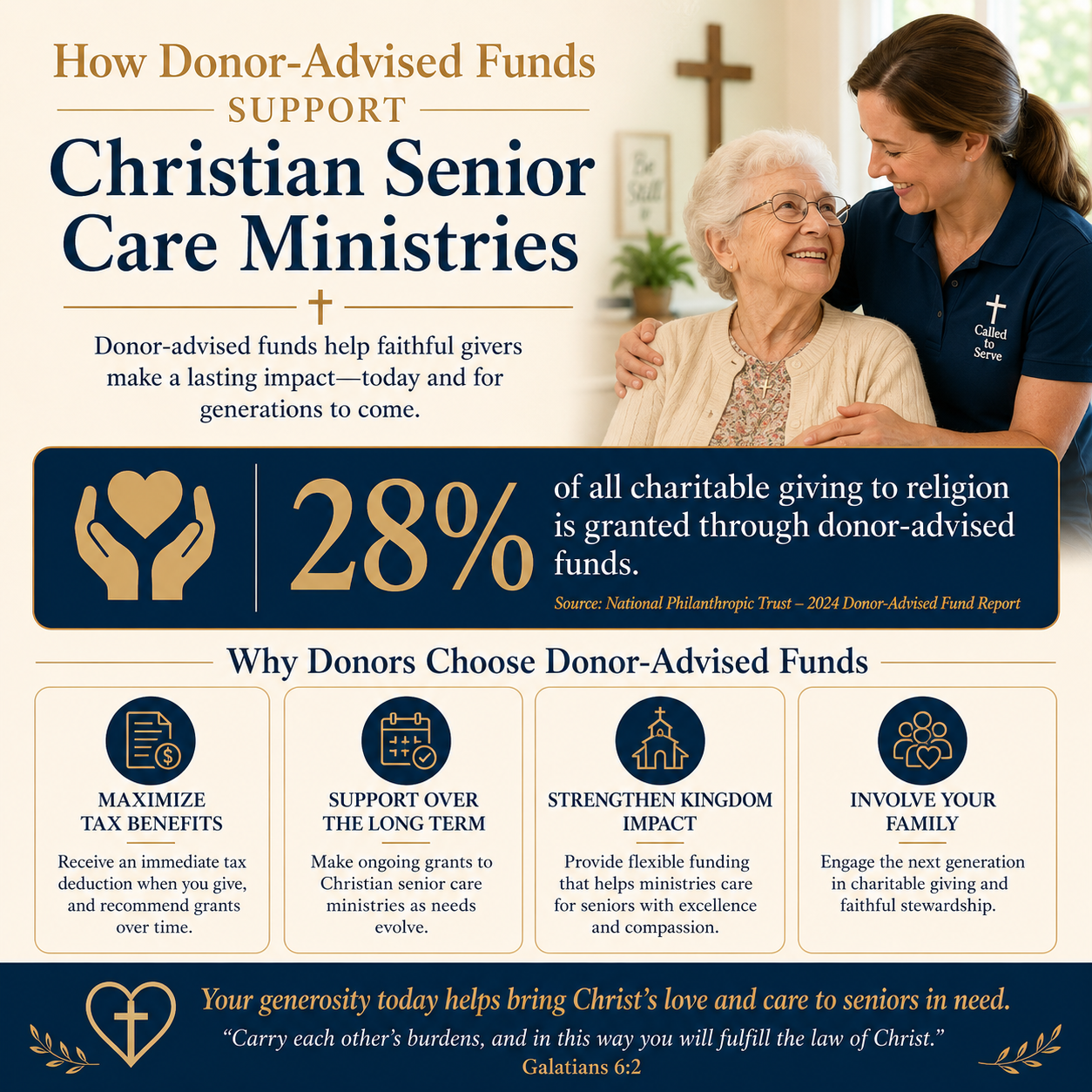
Christian senior care ministries rarely operate on short cycles. Residents age in place, staff turnover affects continuity of care, and capital decisions shape quality for decades. A donor-advised fund can match that timeline by allowing donors to contribute in a high-income year, then distribute grants over multiple years as ministries demonstrate sustained performance and integrity.
What this means in practice is that donors can fund both immediate needs and longer-range capacity: a benevolence fund that prevents a resident from being discharged for nonpayment, and also staff formation, facility modernization, or care coordination that reduces avoidable crises. The DAF’s basic structure makes staged giving more natural than a single annual check, which can unintentionally reward short-term narratives over durable outcomes.
DAFs can reduce reactive giving and increase discernment
Senior care appeals to Christian conscience precisely because vulnerability is visible: dementia, disability, loneliness, poverty, and spiritual isolation often converge in the final years. Yet the same visibility can pressure donors into urgency without verification. A DAF allows donors to slow down enough to ask governance and safeguards questions before funding, without delaying the act of setting money apart for ministry.
DAFs have also become a major part of American philanthropy. In 2023, donor-advised funds reported an estimated $54.77 billion in grants, according to the National Philanthropic Trust’s annual report (National Philanthropic Trust). That scale matters for Christian senior care because it shapes how ministries plan; many now assume donors will give through DAFs and need clear processes to receive grants cleanly and promptly.

What DAF giving can and cannot do for Christian senior care ministries
What DAFs do well
A DAF can support the parts of senior care that are hard to fund through operating margins alone: benevolence, chaplaincy, staff development, and capital improvements. Many Christian senior living organizations also run community programs—caregiver respite, transportation, home repairs, meal delivery—that do not fit neatly into a “resident fee covers costs” model. DAF grants can help sustain those works of mercy without forcing ministries to distort their pricing or admission practices.
DAFs can also help donors support ministries across geographies. Adult children often live far from aging parents. A DAF makes it easier to fund faithful work near a parent’s residence while maintaining one coherent giving plan for the household.
What DAFs do not solve
DAFs are not accountability systems. They do not, by themselves, ensure that a ministry is governed well, reports transparently, protects vulnerable residents, or measures impact honestly. They also do not eliminate the moral weight of funding choices. The Christian duty to “test everything; hold fast what is good” (1 Thessalonians 5:21) applies as much to a DAF grant recommendation as it does to any other gift.
DAFs also introduce timing tensions. Some sponsoring organizations require additional processing time, and some ministries rely on seasonal cash flow. If a ministry depends on year-end giving to make payroll or meet debt covenants, donors using DAFs should communicate early and give the ministry time to plan.
How to evaluate a Christian senior care ministry before recommending a DAF grant
Start with mission clarity and theological consistency
Christian senior care is not merely a set of services delivered in a Christian setting. At its best, it is a witness to the dignity of the person made in the image of God, including the person whose cognition is failing and whose productivity is gone. Donors should look for a ministry that can articulate how faith shapes care: pastoral presence, ethical boundaries, and a theology of aging that does not treat dependency as shame.
Across our verification work at Most Trusted, ministries that meet The Most Trusted Standard tend to describe spiritual care with specificity rather than slogans: chaplaincy staffing, pastoral oversight, resident choice, and safeguards against coercion. They also acknowledge that spiritual care is not an excuse for clinical negligence; Christian love must be expressed through competent, accountable practice.
Ask governance and safeguarding questions with seriousness
Senior care serves a population that is unusually vulnerable to neglect, exploitation, and disorientation. Governance is not optional. Donors should look for an active, independent board; clear lines of authority between board and executive leadership; and documented policies on conflicts of interest, mandatory reporting, and resident rights.
Where the ministry operates licensed facilities, donors should treat regulatory compliance as a baseline, not a badge of honor. If public inspection reports are available, they should be reviewed with care. The Centers for Medicare and Medicaid Services maintains a public database of nursing home quality and inspection information (Centers for Medicare and Medicaid Services). Even when a Christian ministry is not a nursing home, the discipline of reviewing objective records can correct the donor’s natural bias toward trusting a ministry’s stated intentions.
- Does the ministry publish audited financial statements or, at minimum, reviewed statements?
- Is there a clear policy and practice for handling allegations of abuse or neglect?
- Are related-party transactions disclosed and governed transparently?
- Can the ministry explain how it assesses care quality, not only program activity?
- Does leadership speak candidly about risks, including staffing shortages and regulatory pressures?
Donors seeking a curated view of this field can explore Christian Senior Care Ministries as a starting point for identifying organizations that take these questions seriously. Discernment is strengthened when it is informed by comparable information across ministries, not by impression and proximity alone.
Practical DAF strategies that strengthen senior care ministries
Align restricted giving with real operational constraints
Donors often prefer restricted gifts because they feel concrete. Senior care, however, can be damaged by restriction that does not match operational reality. A beautifully restricted gift for a resident activity room does little if staffing is too thin to run the program. A DAF can support better alignment: donors can fund a specific need in one year and then fund operating capacity the next, as the ministry demonstrates wise execution.
In many cases, the more faithful approach is a disciplined but flexible pattern: a portion for benevolence or pastoral care, and a portion unrestricted for the daily costs of competent service. The popular fixation on overhead has been corrected in the broader philanthropy world by the “Overhead Myth” letter signed by GuideStar, Charity Navigator, and the BBB Wise Giving Alliance, which argues that simplistic overhead ratios can mislead donors and harm nonprofits (Candid GuideStar). Senior care is a prime example: quality requires investment in people, systems, and compliance.
Use multi-year commitments and clear communication
Ministries can plan responsibly when donors are predictable. A DAF makes it easier to recommend the same grant annually and to communicate intent to renew. For Christian senior care ministries, that predictability can stabilize benevolence funds and chaplaincy programs that otherwise rise and fall with donor emotion.
The harder question is how to combine multi-year commitment with real accountability. We recommend setting renewal conditions tied to transparency and governance rather than to vanity metrics. For example: the timely publication of financial statements, a board-approved safeguarding policy, and an annual narrative report that names both accomplishments and setbacks. These are not bureaucratic hurdles; they are expressions of truthfulness in a ministry entrusted with vulnerable people.
How Most Trusted approaches verification for senior care focused giving
The Most Trusted Standard as a donor’s due diligence companion
Most Trusted exists to help Christian donors give with confidence. Our evaluations are structured around The Most Trusted Standard, a 15-criteria framework that examines Faith Foundation, Financial Integrity, Governance and Leadership, and Transparency and Effectiveness. For senior care, those categories translate into very practical questions: whether the ministry’s Christian commitments are clear, whether financial practices are stable and auditable, whether leadership is accountable, and whether reporting allows donors to see what is truly happening.
In a sector where services can be complex and regulated, donors often need more than encouragement; they need verifiable evidence. Verification does not replace prayer or pastoral counsel, but it does help align giving with truth. The Christian tradition has long treated truthfulness as a moral obligation, not merely a communications preference.
Where verification is especially important in senior care
Senior care ministries can drift in predictable ways: mission language becomes generic, resident complexity outpaces staff capacity, fundraising stories emphasize exceptional cases while everyday care weakens, and boards defer too easily to executive leadership. Verification is most valuable when it surfaces these risks before they become crises.
Donors who want to deepen their approach to this domain can also review How to Give to Christian Senior Care Ministries, where we address giving considerations that go beyond any single funding vehicle. DAFs are helpful tools, but the deeper question remains: are we directing resources toward ministries that are faithful, competent, and accountable in the care of elders?
FAQs for How donor-advised funds support Christian senior care ministries
Can we use a donor-advised fund to support a specific resident or family member in Christian senior care?
In general, DAF grants cannot provide more than incidental benefit to the donor or related parties, and they are typically not permitted to satisfy personal financial obligations. If the intent is to pay for a particular individual’s fees or care costs, that is usually treated as a personal benefit and is not appropriate for a DAF. The right next step is to ask the DAF sponsoring organization for its policy and to ask the ministry whether it has a benevolence fund that supports residents based on need without directing the gift to a designated individual.
Should we restrict a DAF grant to chaplaincy or spiritual care in a senior living ministry?
Chaplaincy and spiritual formation are often central to Christian distinctiveness, and restricting a gift there can be appropriate when the ministry has clear staffing, reporting, and resident-choice practices. The caution is that spiritual care cannot be isolated from overall care quality. If staffing, compliance, or clinical partnerships are weak, chaplaincy funding may not address the most urgent risks to resident wellbeing. Many donors choose a blended approach: a portion designated for chaplaincy and a portion unrestricted to strengthen the ministry’s capacity to deliver safe, dignified care.
Giving that honors elders and tells the truth
Donor-advised funds can strengthen Christian senior care ministries when they serve a larger commitment to faithful stewardship: patient planning, careful verification, and grants aligned with real operational needs. The honor Scripture commands toward elders is not sentimental. It is practical, sacrificial, and truthful. When DAF giving is paired with rigorous accountability, donors are better positioned to support ministries that provide dignified care and credible Christian witness in the final chapters of life.



