

How Christian senior care ministries work is ultimately a question of stewardship: how the Church organizes mercy for older adults whose bodies are weakening, whose families are stretched, and whose income often does not match the true cost of care. Donors who love Scripture’s commands to honor father and mother and to care for the vulnerable also want to know what actually happens after a gift is made—who receives help, how decisions are made, and what safeguards keep compassion from becoming waste or harm.
At their best, these ministries are not simply “senior programs.” They are institutions of Christian presence in a season of life that can be marked by loneliness, declining health, and spiritual discouragement. Yet the field must also reckon with practical tensions: long-term care is expensive; regulatory environments are complex; and well-intentioned donors can unknowingly underwrite models that are financially unstable or insufficiently accountable. Mature giving asks for both tenderness and due diligence.
Christian senior care is a ministry of presence, not only a service
Senior care ministry begins with a theological conviction: aging does not diminish human dignity. Scripture consistently treats the elderly as worthy of honor and protection, and it warns against communities that discard the weak. The fifth commandment does not expire when parents become costly or complicated to care for (Exodus 20:12). The Church’s calling is not merely to extend life, but to uphold the image of God in lives that are frail and often hidden from public view.
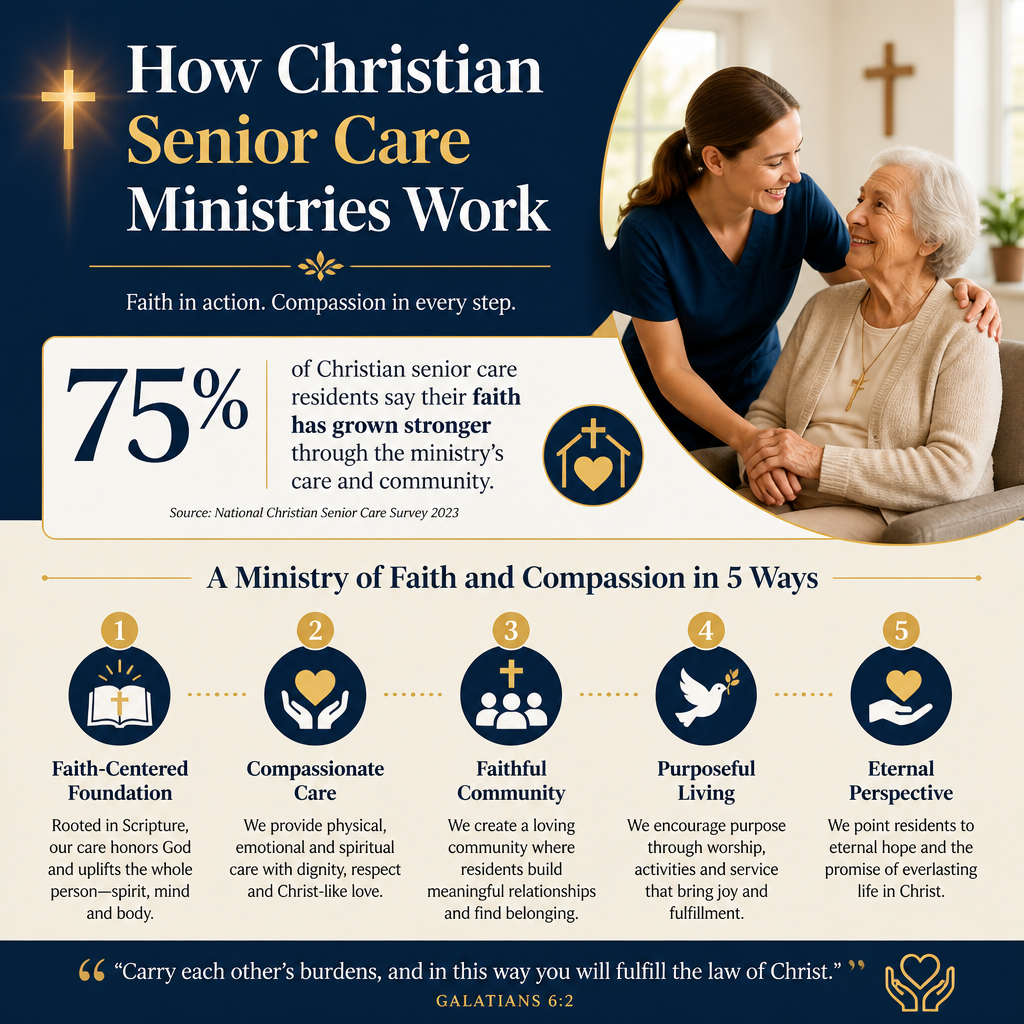
What this means in practice is that Christian senior care ministries often hold together three aims that are difficult to balance: physical care, social and emotional support, and spiritual formation. Donors should expect clear articulation of how a ministry integrates these, because “Christian” can mean anything from light chaplain access to a comprehensive discipleship environment shaped by worship, pastoral care, and ethical commitments in clinical decisions.
Common ministry models and what donors are actually funding
Christian senior care ministries typically operate through a handful of structures, each with distinct cost profiles and accountability challenges. Some are residential: independent living communities, assisted living, memory care, and skilled nursing. Others are non-residential: home repair and accessibility modifications, meal delivery, transportation to medical appointments, respite care for family caregivers, adult day programs, pastoral visitation, and hospice support.
In residential settings, donors may be funding benevolence care for residents who outlive savings, capital improvements that keep a facility safe and compliant, staff training and retention efforts, or pastoral programs that do not pay for themselves through fees. In non-residential settings, donors often fund the “last-mile” gaps that government programs and insurance do not cover: transportation, companionship, caregiver coaching, or small emergency grants that keep an older adult stable at home.
Why “spiritual care” requires operational clarity
Spiritual care is not an ornamental add-on. Done well, it is a disciplined practice: trained chaplains, local church integration, appropriate boundaries in evangelism, and safeguards for residents with cognitive decline. Donors should look for ministries that define spiritual goals with care—avoiding manipulation and respecting conscience—while still naming a clear Christian identity in worship, pastoral counseling, and end-of-life support.
The harder question is how a ministry measures spiritual faithfulness without turning souls into metrics. The strongest organizations combine qualitative pastoral reporting, resident and family feedback, and governance oversight that ensures theological commitments shape policy decisions, not merely branding.

Funding flows are complex because care is complex
Senior care is one of the most financially demanding forms of Christian mercy. Even when residents pay fees, the true cost of staffing, facilities, insurance, and compliance can exceed what many older adults can sustain. For donors, understanding “how it works” requires tracing the major revenue streams and recognizing where philanthropy typically carries the weight.
Earned income, insurance, and philanthropy often sit together
Many residential ministries rely on earned revenue (resident fees) as the primary operating base. Skilled nursing and some clinical services may also involve reimbursements through Medicare or Medicaid, depending on the ministry’s structure and licensure. Philanthropy then fills gaps that markets and public funding do not cover: uncompensated care, benevolence funds, capital renewal, chaplaincy, and quality improvements that are mission-critical but not revenue-positive.
Donors should resist simplistic assumptions that any single stream is “pure” and the others are compromises. The moral question is not whether a ministry has earned revenue; it is whether the ministry’s financial model is honest, sustainable, and governed in a way that keeps mission and neighbor-love central when budgets tighten.
Why staffing is often the decisive constraint
In senior care, staffing levels and staff stability are frequently the difference between a safe environment and a fragile one. The U.S. Bureau of Labor Statistics projects strong growth in several direct-care roles, reflecting the demographic reality and the rising demand for caregivers (U.S. Bureau of Labor Statistics). Ministries that plan responsibly will speak candidly about wages, training, turnover, and the spiritual and emotional burdens borne by frontline staff.
For donors, this means that gifts designated for “programs” may be less effective than gifts that strengthen staffing systems: retention initiatives, clinical training, trauma-informed care education, and supervision structures that prevent burnout and neglect. A ministry’s ability to retain qualified caregivers is not peripheral; it is a moral issue.
Capital needs are not a distraction from mission
Facilities age. Safety standards change. Memory care environments require specialized design. Donors sometimes mistrust capital campaigns, fearing that bricks and mortar displace compassion. In senior care, the opposite is often true: capital investment can be the difference between a dignified environment and an unsafe one, especially for residents with mobility limitations or dementia.
Discernment still matters. Responsible ministries differentiate between essential capital renewal and expansion that outpaces demand or managerial capacity. They also report clearly on restricted gifts, depreciation, and long-term maintenance planning, rather than treating capital as a one-time event.
Accountability in senior care must be stronger than general nonprofit norms
Because senior care involves vulnerable adults, accountability must extend beyond typical nonprofit reporting. It includes clinical quality, safeguarding, grievance processes, and governance that can withstand pressure from donors, families, regulators, and internal financial stress. Donors should expect a higher bar than they might apply to a ministry that distributes goods or runs short-term programs.
Governance, conflicts of interest, and the stewardship of power
Senior care ministries often manage significant assets, complex reimbursement systems, and high-stakes decisions. That makes governance quality central. Healthy boards maintain independence, document conflicts of interest, and ensure that executive compensation and related-party transactions are handled with seriousness. Donors should be cautious when governance looks like a family enterprise, a closed network, or a ministry insulated from outside scrutiny.
At Most Trusted, our verification work focuses on whether ministries meet The Most Trusted Standard, including criteria tied to governance independence, financial controls, and transparent reporting. In this category, strong governance is not abstract virtue; it is protection for residents and integrity for donors.
Transparency that respects privacy without hiding performance
Senior care ministries must protect resident privacy, and donors should not expect voyeuristic reporting. Yet privacy cannot become a blanket rationale for non-disclosure. Mature transparency includes audited financial statements when appropriate, clear explanations of care models and pricing, documented safeguarding policies, and forthright reporting on how benevolence funds are granted and tracked.
Verifiable evidence suggests that older adults face elevated risk of abuse and exploitation, particularly when isolated or cognitively impaired (World Health Organization). Ministries that serve seniors should therefore be able to show donors concrete prevention measures: staff screening, mandatory reporting training, complaint channels, and oversight procedures that do not depend on a single heroic leader.
Effectiveness in senior care is not only “outcomes,” but stability over time
Some donors want a straightforward “cost per outcome” calculation. Senior care does not always cooperate with that desire. In chronic conditions and end-of-life contexts, success may look like stability, reduced avoidable hospitalizations, faithful companionship, and a family that can sustain caregiving without collapsing.
Responsible ministries report what they can measure (resident satisfaction, staff retention, incident rates, chaplaincy engagement) while acknowledging what remains partly qualitative: peace, spiritual resilience, reconciliation with family, and the simple mercy of being known. Donors should not confuse what is easy to measure with what is most important.
What prudent Christian donors should examine before giving
Donors often enter senior care giving through a personal doorway: a parent’s decline, a church member’s loneliness, or the dawning awareness that many faithful saints will spend their final years under-resourced. Wise generosity does not stop at empathy. It asks whether a ministry’s model can bear the weight of vulnerable lives entrusted to it.
Clarity of mission and theological commitments
Donors should look for ministries that state their Christian commitments with specificity—how worship is practiced, how chaplaincy is staffed, how ethical questions are handled, and how the ministry partners with local churches. A generic “faith-based” label is not enough. The question is whether the ministry’s identity shapes its daily decisions about staffing, resident dignity, and truth-telling when problems arise.
Christians genuinely disagree about some contested questions in institutional care: how explicitly evangelistic chaplaincy should be in a care environment, how to handle residents of other faiths, and how to balance clinical autonomy with spiritual counsel. Mature ministries name these tensions and provide policies that show careful thought rather than slogans.
Financial integrity and the real cost of benevolence
Many ministries offer benevolence programs for residents who exhaust resources. Donors should ask how those funds are awarded, who approves them, and what portion of residents receive assistance. The risk is not only fraud; it is also optimistic budgeting that creates a “benevolence promise” a ministry cannot keep when occupancy dips or reimbursements change.
We also recommend watching for signs of the starvation cycle described in nonprofit finance literature, where organizations underinvest in core capacity and quietly accumulate operational fragility (Stanford Social Innovation Review). In senior care, chronic underinvestment does not merely reduce efficiency; it can translate into unsafe ratios, deferred maintenance, and preventable harm.
How and when to fund senior care ministries most responsibly
Senior care ministries often need funding most acutely in predictable seasons: capital renewal cycles, staffing transitions, census changes, and moments when benevolence demand rises (for example, when residents outlive savings or families experience economic shock). Restricted gifts can be helpful when donors understand the ministry’s constraints. Unrestricted giving is often the most stabilizing, provided the ministry has demonstrated trustworthy governance and transparent financial practices.
For donors who want added confidence, it is reasonable to seek independent verification. Most Trusted exists to help donors evaluate Christian nonprofits against The Most Trusted Standard so giving can be both warm-hearted and well-grounded. For the broader landscape of organizations and models, see Christian Senior Care Ministries as you assess where your stewardship can do the most good.
Faithful senior care requires both compassion and proof
Christian senior care ministries work when they unite a clear theological vision of human dignity with operational competence that can sustain care for years, not weeks. Donors should not be pressured into naïveté by urgent stories, nor pushed into cynicism by the complexity of the sector. The right posture is disciplined mercy: giving that honors the elderly, supports caregivers, and insists on governance and transparency worthy of vulnerable lives.



