

When Christian senior care ministries need funding most, it is rarely when the brochure arrives or the gala is scheduled. It is when faithfulness to honor older neighbors collides with fragile cash flow, rising clinical complexity, and the slow administrative work that protects residents who can no longer protect themselves.
Christian donors often assume the most urgent needs are visible: a new wing, a van, a Christmas outreach. Those needs can be real. Yet the funding moments that most determine whether a senior care ministry remains safe, stable, and spiritually grounded are often less visible: staffing gaps, reimbursement delays, capital repairs that cannot wait, and the cost of serving residents who are running out of money without compromising care.
The most acute funding pressure is operational, not ceremonial
Most Christian senior care ministries carry a daily moral weight: residents are not “clients” who can easily be rescheduled. They are people made in the image of God, often with dementia, limited mobility, and complex medication regimens. The ministry’s credibility is proven in ordinary shifts, not occasional campaigns.
Staffing and compliance are the dominant drivers. Labor is typically the largest line item in senior living and long-term care, and wage pressure has increased across the country as health systems, agencies, and retailers compete for the same workforce. The U.S. Bureau of Labor Statistics projects that home health and personal care aide roles will be among the fastest-growing occupations from 2022 to 2032, which signals sustained demand and continued competition for staff.U.S. Bureau of Labor Statistics
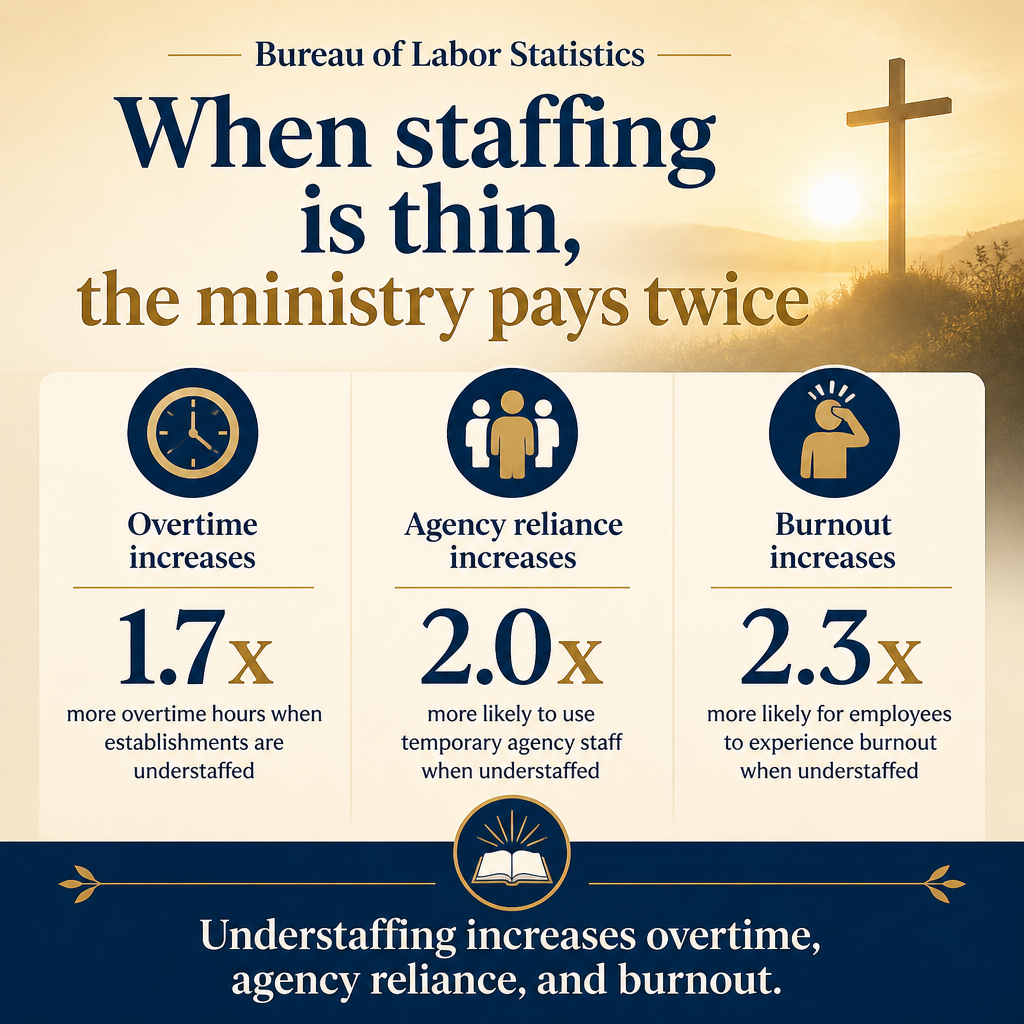
When staffing is thin, the ministry pays twice
Understaffing increases overtime, agency reliance, and burnout. It also increases risk: medication errors, falls, delayed toileting, and avoidable hospitalizations. Even when a ministry’s intentions are exemplary, insufficient staffing can erode the very care donors believe they are supporting.
Donors who want their giving to protect dignity should understand that the “unseen” budget lines—retention bonuses, training hours, background checks, clinical supervision—are often the lines that preserve consistent, humane care.
Why operations can become spiritually decisive
Scripture’s call to honor older people is not sentimental. “Stand up in the presence of the aged, show respect for the elderly and revere your God” (Leviticus 19:32). Respect is expressed in reliability: clean linens, safe transfers, timely wound care, and staff who are formed to treat residents as persons rather than tasks. Funding that stabilizes daily operations often has the most direct impact on that biblical mandate.

Cash-flow crunches often peak when reimbursement lags and costs surge
Many Christian senior care ministries operate within a mix of private pay, Medicare, and Medicaid. That blend can be mission-aligned—especially when a ministry chooses to serve residents who cannot pay market rates—but it exposes ministries to delays and unpredictability.
The timing problem donors rarely see
Payroll is weekly or biweekly. Vendor invoices come due quickly. Reimbursement can arrive later, be reduced after audits, or be temporarily held during claim disputes. A ministry can be financially honest and still be financially strained if working capital is thin.
Medicaid also commonly reimburses below the cost of care, shifting pressure onto private-pay margins, philanthropy, or cost containment. The Medicaid and CHIP Payment and Access Commission has documented that Medicaid payment rates are often below costs in long-term services and supports, which helps explain why facilities serving higher Medicaid shares can face chronic financial strain.Medicaid and CHIP Payment and Access Commission
Short-term gifts can prevent long-term spiritual harm
A cash-flow crisis can force decisions that injure trust: reducing activities that provide meaning, delaying maintenance that affects safety, or relying on revolving-door agency staffing that undermines consistent relationships. In Christian senior care, relationship is not a luxury; it is part of the ministry’s pastoral responsibility.
For donors evaluating where to give, the question is not whether a ministry “should be able to cover payroll.” The question is whether the ministry has built reserves, forecasting discipline, and governance practices that keep residents from bearing the cost of financial volatility.
End-of-life transitions and benevolence care create predictable funding cliffs
The most painful funding moments often cluster around the resident’s final chapters: a spouse dies, adult children discover hidden debt, savings run out, or a resident’s needs rise beyond what a lower-acuity setting can provide. Christian ministries that keep faith with families in those moments often do so at a real financial cost.
When residents outlive their assets
Senior care leaders sometimes describe a “spend-down” dynamic: residents enter with resources, but over time those resources are exhausted. A ministry that promises stability faces a hard tension—either discharge a resident into disruption, or carry the gap through charity care, cross-subsidy, or fundraising.
Christians genuinely disagree about how to allocate limited charitable dollars between direct benevolence and long-term institutional sustainability. Yet it is difficult to defend a funding philosophy that treats residents as spiritually central while treating their late-stage financial vulnerability as someone else’s problem.
What wise donors ask before funding benevolence
Well-directed benevolence giving is rarely a blank check. It is often tied to clear eligibility, documentation, and accountability so that compassion does not become an ungoverned subsidy. Across our verification work at Most Trusted, the ministries that meet The Most Trusted Standard tend to pair mercy with clear policies: how benevolence is granted, who approves it, how it is reported, and what safeguards prevent favoritism or quiet coercion.
Donors seeking deeper context on the ministry models behind these decisions can review Christian Senior Care Ministries, where we examine the landscape donors are actually funding.
Deferred maintenance and safety upgrades become emergencies at the worst moment
Senior care is physical. Buildings age; roofs leak; HVAC systems fail; elevators wear; generators must be tested; kitchens and laundries operate at industrial intensity. Deferred maintenance is not a cosmetic issue. In a setting where residents are frail, the margin for failure is narrow.
Capital needs do not wait for a campaign calendar
A roof replacement postponed for two fiscal years can become a mold problem in one storm season. An aging nurse call system can become a response-time problem overnight. When capital breaks, ministries often have to choose between expensive financing and rapid fundraising.
Donors sometimes prefer projects because they feel concrete. Yet operational stability and capital readiness belong together. A ministry that never budgets for replacement cycles is often forced into reactive appeals, and reactive appeals can pressure leaders toward simplistic storytelling rather than transparent reporting.
Due diligence that respects residents
Funding moments around facilities are also moments to ask governance questions. Who oversees property and risk? How are vendor bids handled? Are reserves restricted and honored? How are related-party transactions avoided? These are not peripheral. They are part of loving older neighbors with seriousness rather than sentiment.
Regulatory shocks and reputational crises are when verification matters most
Senior care ministries operate under significant regulatory oversight. Surveys, citations, changing infection-control requirements, insurance renewals, and litigation risk can alter a ministry’s financial position quickly. Even for faithful organizations, the regulatory environment is exacting, and the consequences of missteps are disproportionate because vulnerable people are at stake.
When a ministry is tempted to trade transparency for survival
A crisis can create a moral hazard: minimizing bad news to protect donations. Mature Christian donors should expect candor instead. The goal is not public shaming; it is truthful stewardship. Scripture does not treat financial and institutional integrity as optional. “We aim at what is honorable not only in the Lord’s sight but also in the sight of man” (2 Corinthians 8:21).
This is where independent verification can serve the church. Most Trusted evaluates ministries against The Most Trusted Standard, a 15-criteria framework spanning faith foundation, financial integrity, governance and leadership, and transparency and effectiveness. When pressure rises, those criteria are not bureaucratic hurdles; they are guardrails that protect residents and donors alike.
Signals donors can watch for during high-pressure seasons
- Leadership communicates setbacks with specific facts, not vague reassurances.
- Financial statements and audits are accessible, current, and consistent with appeals.
- Board oversight is visible in policies, minutes-level decisions, and conflict-of-interest controls.
- Care quality and staffing plans are addressed directly, not displaced by marketing language.
- Restricted gifts are honored as restricted, with clear reporting back to donors.
Donors who want to understand how these organizations function day to day can also review How Christian Senior Care Ministries Work for the operational realities that make certain seasons financially acute.
FAQs for When Christian senior care ministries need funding most
Should donors prefer funding specific projects or general operating support?
Both can be faithful, but they fund different kinds of risk. Projects can address real needs—memory care renovations, safety upgrades, vehicle replacements—yet many of the highest-stakes pressures in senior care are operational: staffing stability, compliance, clinical supervision, and the working capital required to withstand reimbursement delays. We generally regard unrestricted or responsibly designated operating support as especially valuable when a ministry can demonstrate disciplined budgeting, strong board oversight, and transparent reporting consistent with The Most Trusted Standard.
How can donors tell whether a senior care ministry is prepared for a funding shortfall?
Preparedness is usually visible in governance and financial practices rather than in inspirational messaging. Donors can ask for recent audited financials, evidence of board-level financial oversight, reserve policy clarity, and a candid explanation of payer mix and cash-flow timing. The healthiest ministries do not promise that emergencies will never happen; they demonstrate how they will keep residents safe and honored when they do.
Funding urgency is often the price of keeping faith with the vulnerable
Christian senior care ministries most need funding when they are bearing the quiet costs of stability: retaining staff, sustaining benevolence care without chaos, absorbing reimbursement timing gaps, and repairing what must be repaired to keep frail residents safe. Donors serve the church best when generosity is joined to sober diligence, so that the honor we owe the aged is expressed not only in our intentions, but in institutions worthy of trust.



