

How Christian relief ministries spend donations is not a technical question for accountants; it is a spiritual question for stewards. When Christians give to relieve suffering after war, famine, disaster, or chronic poverty, we are trying to love our neighbor with material faithfulness, not merely good intentions. The New Testament keeps these realities together: compassion that moves toward need, and integrity that refuses darkness in the handling of money (2 Corinthians 8:20–21).
Donors often ask for a simple ratio—“How much goes to the field?”—because it feels measurable. But relief and development work is rarely simple. The same dollar can fund food for a family, a local church partner’s training, a safeguarding system that prevents abuse, and the reporting that proves the program is doing what it claims. Mature Christian giving learns to ask better questions: What problem is being addressed, by what approach, with what accountability, and with what evidence of fruit?
Relief spending begins with clarity about the kind of work being done
Christian ministries often combine at least three types of work under one banner: emergency relief, rehabilitation, and long-term development. Each has legitimate costs, different timelines, and different measures of success. Confusion here is one of the main reasons donors feel uncertain about what their gift “really did.”
Emergency relief is fast and expensive in the short term
Emergency response requires procurement, transport, warehousing, customs clearance, and last-mile distribution. Those costs are not decorative; they are the difference between supplies arriving and supplies sitting on a tarmac. After major disasters, many ministries also pay for surge staff, security, temporary facilities, and rapid assessments. When donors see higher logistics and staffing costs in a relief year, the right question is whether those costs were necessary, well-governed, and ethically executed.
Development spending is slower and often heavier on training and systems
Long-term work—clean water access, agriculture, maternal health, discipleship-based community development—typically spends more on local staff, training, monitoring, and partnership. Those categories can look like “overhead” to an untrained eye, but they often represent the ministry’s commitment to sustainability and local ownership rather than dependency. The field has had to reckon with the damage caused by short-term, externally driven interventions, a concern popularized for many Christians through When Helping Hurts by Steve Corbett and Brian Fikkert.

Budget lines do not tell the whole truth, but they do reveal priorities
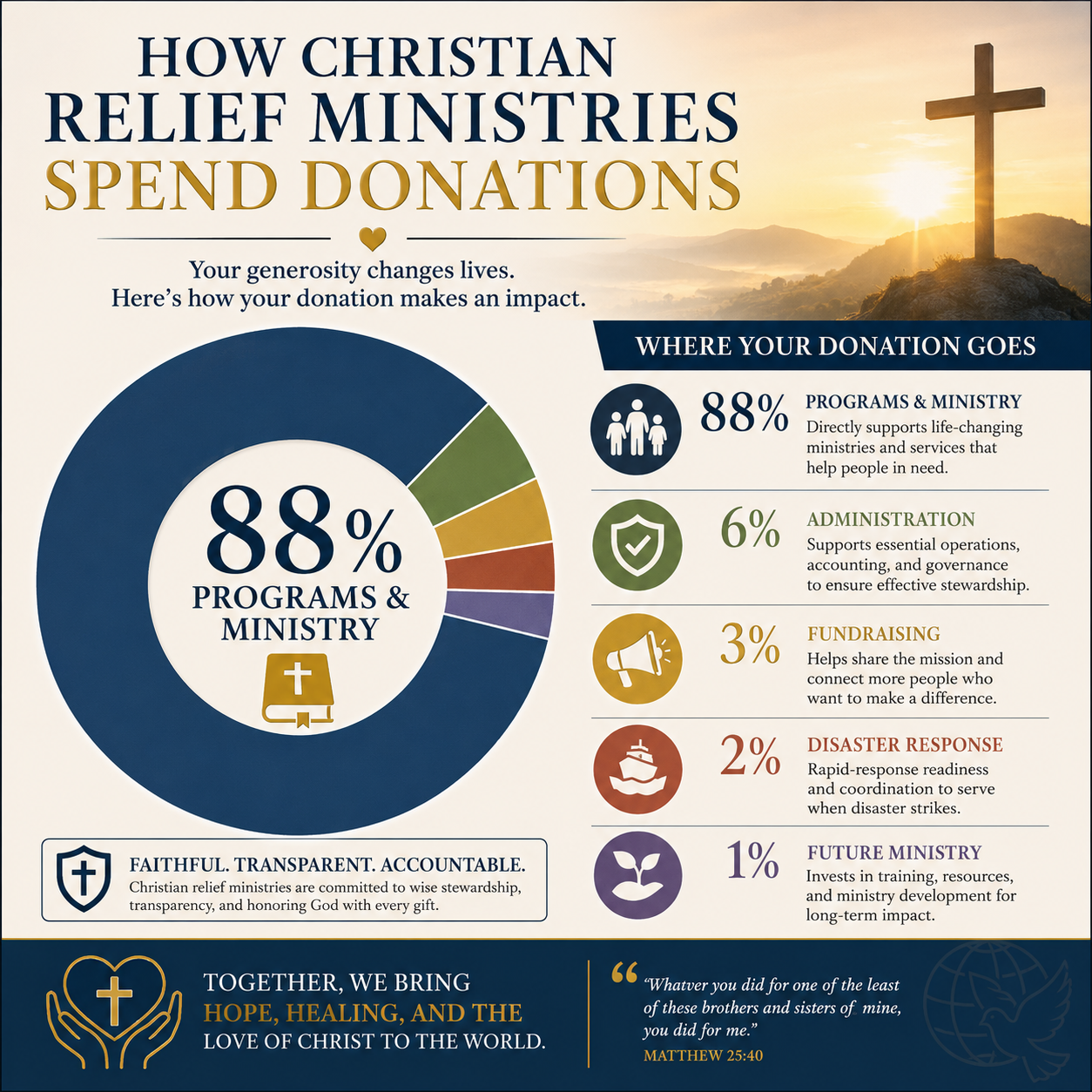
Christian donors deserve honest financial reporting, including audited statements and intelligible program narratives. Yet a budget is also an interpretation: ministries decide what to classify as “program” versus “administration,” and those decisions can vary while still being compliant with accounting standards. Donors should not assume that one pie chart can settle trustworthiness.
Program, administration, and fundraising are real categories with real trade-offs
Strong ministries resist the pressure to starve administration just to please donor instincts. A widely cited warning against simplistic overhead fixation came from a joint statement sometimes called the “Overhead Myth,” signed by GuideStar, BBB Wise Giving Alliance, and Charity Navigator, arguing that overhead ratios alone are a poor measure of impact and can create perverse incentives (Charity Navigator).
What this means in practice is that donors should look for a coherent relationship between spending and mission. A ministry that claims to operate in high-risk contexts but spends almost nothing on compliance, safeguarding, or monitoring is not necessarily efficient; it may be underbuilt for the work.

Restricted gifts add complexity that ministries must explain clearly
Many Christian donors restrict gifts to a specific country, disaster response, or child sponsorship model. Restricted funding can be appropriate, but it can also create distortions. If a ministry receives an influx for a crisis that has passed, or for a program that cannot responsibly expand, leaders face hard decisions: return funds, renegotiate restrictions, or hold resources until a legitimate use emerges. Transparent ministries name these tensions in plain language and show how they handle restricted revenue with integrity rather than opportunism.
What a gift funds in the field is often partnership, not simply delivery
Relief ministries that serve well in the name of Christ rarely do so alone. They work with local churches, indigenous Christian organizations, community committees, government agencies, and other NGOs. The donor’s dollar frequently underwrites not only “stuff,” but the relationships and accountability structures that keep aid from becoming harm.
Local partners are not a marketing detail; they are an ethical requirement
Effective Christian relief increasingly prioritizes local leadership and local church presence. This is partly pragmatic—local leaders understand language, power dynamics, and risk—and partly theological. The body of Christ is not a Western export. Donors should expect ministries to explain how they select partners, how they prevent favoritism and corruption, and how they avoid using local churches merely as distribution channels.
Safeguarding, compliance, and security are ministry costs with moral weight
In fragile settings, the risks are real: diversion of goods by armed actors, exploitation of beneficiaries, coercive “conversion” allegations, or unsafe volunteer practices. Spending on safeguarding training, background checks, complaint mechanisms, and incident response is not optional for serious Christian organizations; it is part of loving our neighbor without partiality or naivety. Donors should not reward ministries for underinvesting in these protections.
Across our verification work at Most Trusted, we observe that ministries meeting The Most Trusted Standard tend to articulate these protective systems clearly, including who owns them internally and how they are tested, reported, and improved.
Transparency is more than disclosure, and effectiveness is more than stories
Relief ministries rightly tell stories because Scripture is not embarrassed by testimony. Yet Christian donors also need verifiable evidence that a ministry’s approach is credible and that its claims correspond to reality. The field has learned that compelling narratives can coexist with weak design, inflated attribution, or incomplete reporting.
Monitoring and evaluation should match the claim
A ministry that claims “we drilled wells” should be able to report functionality over time, not only installations. A ministry that claims “we reduced hunger” should explain its measurement method, its baseline, and what was actually observed. Not every ministry must run randomized controlled trials, but ministries should match their evaluation rigor to the seriousness of their claims and the scale of their budget.
Financial transparency should be legible to donors
At minimum, donors should expect recent audited financial statements, an accessible Form 990 for U.S. nonprofits, a clear description of major programs, and governance disclosures. The IRS requires many nonprofits to file Form 990 and makes filings broadly available; donors can understand a great deal simply by reading the statement of functional expenses and major program descriptions (IRS).
For donors who want a structured way to assess a ministry’s disclosures and claims, Most Trusted evaluates organizations against The Most Trusted Standard, examining faith foundation, financial integrity, governance and leadership, and transparency and effectiveness as a unified stewardship picture rather than as isolated metrics.
How mature donors assess spending without reducing it to a single ratio
Christians genuinely disagree about how much weight to put on overhead, how to prioritize evangelism and mercy together, and which development theories best fit Christian anthropology. Those debates should not paralyze giving, but they should make us more careful in what we reward. The goal is not to find a flawless ministry. The goal is to give with informed confidence, honoring both compassion and truth.
Questions that tend to clarify rather than confuse
- Does the ministry distinguish clearly between emergency relief and long-term development, and budget accordingly?
- Can leadership explain major cost drivers such as logistics, staffing, and partner grants without defensiveness?
- Are safeguarding, compliance, and accountability systems described with specificity and documented?
- Is there evidence the ministry learns from failures and adjusts programs rather than only reporting successes?
- Do financial statements and program claims align, including the handling of restricted gifts?
Where to place this question within a larger stewardship practice
How funds are spent is one piece of wise giving, but it belongs inside a larger discernment process: doctrinal seriousness, governance maturity, and honest reporting about outcomes. Donors who support relief work over many years are often best served by staying close to the broader landscape of Christian Relief and Development Ministries, because patterns of trustworthiness become clearer when ministries are compared within the same field context.
It also helps to review spending questions alongside the practical donor issues within How Christian Relief and Development Ministries Use Donations, where the focus remains on verifiable stewardship rather than impressions.
FAQs for How Christian relief ministries spend donations
Should Christian donors prioritize ministries with the lowest overhead?
Low overhead is not a reliable proxy for faithfulness or effectiveness. Relief and development work requires trained staff, safeguarding systems, partner accountability, and credible monitoring, all of which cost money. The wiser approach is to evaluate whether administrative and fundraising costs are appropriate to the ministry’s scale and risk profile, and whether leadership can justify them transparently in a way that aligns with the mission.
How can donors tell whether a relief ministry is actually effective?
Donors can look for a clear theory of change, measurable outputs that match the program claim, and reporting that includes challenges as well as successes. Audited financials and accessible governance disclosures matter, but effectiveness requires more than financial cleanliness. Mature ministries demonstrate learning over time, provide evidence proportionate to their claims, and show that local partners and beneficiaries are treated with dignity and agency rather than as props for fundraising.
Stewardship that honors both mercy and truth
Christian relief giving is meant to be an expression of love grounded in reality. Donors are right to ask how funds are spent, and ministries are obligated to answer with clarity rather than slogans. When spending patterns, governance practices, and program claims cohere, giving becomes an act of confidence rather than anxiety—and a more faithful participation in the mercy Scripture commands.



