
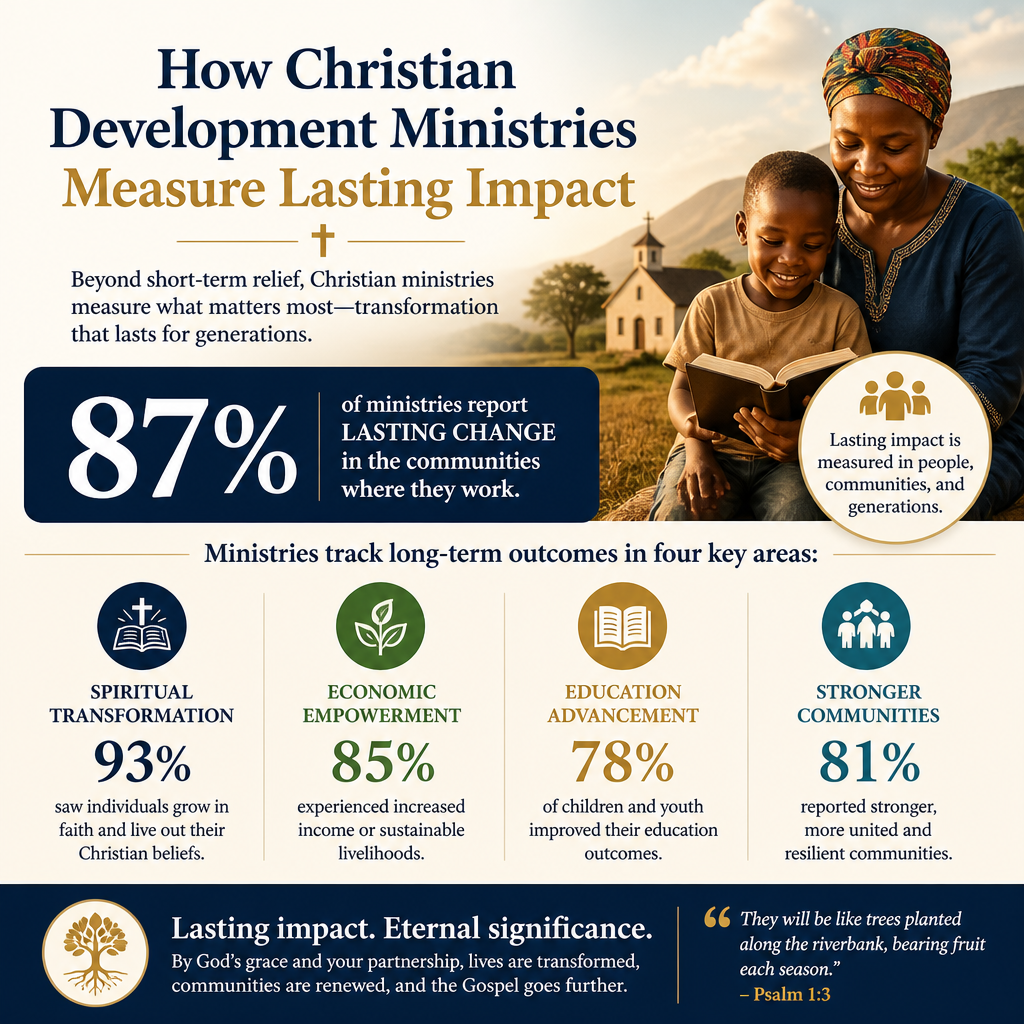
How Christian development ministries measure lasting impact is not a technical question appended to “real ministry.” It is a moral question about whether our giving strengthens what God is already doing in families and communities, or whether it unintentionally replaces local responsibility with donor dependency. Scripture does not reduce mercy to sentiment; it binds compassion to truthfulness. “Little children, let us not love in word or talk but in deed and in truth” (1 John 3:18).
Christian donors often sense the tension. We want to fund work that is unmistakably Christian, but we also want evidence that the work endures after the next grant cycle, the next crop failure, or the next leadership transition. Development outcomes are rarely immediate, and they are never fully controllable. Still, ministries can measure what is plausible to measure, name what cannot be measured cleanly, and show whether they are learning over time rather than repeating attractive stories.
Lasting impact begins with theological clarity about what we can and cannot measure
Spiritual fruit is real, but it is not always quantifiable
Christian development ministries rightly resist reducing human life to metrics. The gospel forms people and communities in ways that will not fit neatly into dashboards. The fruit of the Spirit is not a quarterly indicator. The New Testament also cautions against confusing visibility with faithfulness; some growth is hidden before it is revealed (Mark 4:26–29).
What this means in practice is that ministries should distinguish between spiritual faithfulness and program effectiveness without pitting them against each other. A ministry can be doctrinally sound and operationally weak. It can also be operationally competent while treating Christian identity as branding. Mature ministries name both dimensions plainly: fidelity to Christ and measurable service to neighbor.
Impact claims should match the kind of work being done
Relief, rehabilitation, and development are not interchangeable. Immediate relief after disaster can be measured with speed, coverage, and safety. Long-term development—strengthening livelihoods, local institutions, and household resilience—requires different evidence and a longer horizon. The When Helping Hurts framework, articulated by Steve Corbett and Brian Fikkert, helped the Christian sector articulate this distinction and the moral risk of confusing short-term outputs with long-term restoration When Helping Hurts.
Donors are right to ask for rigor, but rigor is not the same as certainty. Good ministries do not promise clean causality where it is not possible; they explain assumptions, show their data, and demonstrate humility in how they interpret results.

Sound measurement moves from outputs to outcomes to resilience
Outputs are necessary, but they are not impact
Many ministries can report what they delivered: wells drilled, farmers trained, clinics supplied, loans disbursed. These outputs matter because they reflect stewardship and activity. But output counts do not tell us whether household health improved, whether incomes stabilized, or whether local systems became more capable.
The field has learned this lesson repeatedly. One influential articulation is the “starvation cycle” described by Goggins Gregory and Howard: pressure to fundraise drives organizations toward easy-to-tell stories and short-term results, which can weaken long-term effectiveness and learning Stanford Social Innovation Review. Christian donors should not reward ministries for reporting only what is most marketable.
Outcome measurement asks whether lives changed and whether change lasted
Outcome measurement demands a clearer theory of change: if a ministry trains community health workers, what changes should follow, for whom, and over what time frame? Strong ministries then test those assumptions with baseline and follow-up data, comparison where feasible, and transparent acknowledgment of limitations.
When ministries report outcomes, donors should listen for specificity. “Improved food security” can be meaningful if it is tied to defined indicators—months of adequate household food provision, dietary diversity, child growth measures, or reduced negative coping strategies. Without definitions, outcomes revert to impression.
Resilience is the real test of lasting impact
Lasting impact shows itself under stress: market shocks, conflict, illness, leadership turnover, and donor withdrawal. Ministries that measure resilience look for whether communities continue practices without ongoing subsidies, whether local leaders can solve problems with local resources, and whether households can absorb shocks without falling back into crisis.
For donors, this often requires a shift in expectations. Resilience is slower to build and harder to photograph. Yet it aligns closely with a Christian understanding of neighbor-love that seeks not merely to relieve pain today but to help communities move toward stability, dignity, and responsible agency.
Credible evidence depends on strong governance, not merely good intentions
Measurement is only as trustworthy as the systems behind it
Impact reporting can be manipulated, even without malice. Definitions drift. Staff feel pressure to “hit numbers.” Bad news is softened. The ministries that tend to report credibly are those with governance that protects truthfulness—boards that ask hard questions, leaders who welcome corrective feedback, and controls that prevent data from becoming a fundraising instrument.
Financial integrity also matters. A ministry can overstate impact by underinvesting in program design, monitoring, or local partnership because donors have been trained to distrust anything labeled “administration.” The “Overhead Myth” letter—signed by Charity Navigator, GuideStar, and the BBB Wise Giving Alliance—made the case that overhead ratios are a poor proxy for effectiveness and can create perverse incentives Charity Navigator.
Independent verification reduces conflicts of interest
Self-reported impact has an unavoidable conflict: the organization is both narrator and beneficiary. That does not invalidate internal monitoring, but it does elevate the importance of independent verification and transparent disclosure. This is one reason Most Trusted exists. We evaluate Christian nonprofits against The Most Trusted Standard, a 15-criteria framework spanning Faith Foundation, Financial Integrity, Governance and Leadership, and Transparency and Effectiveness. The goal is not to replace donor discernment, but to ground it in evidence that can be checked.
Across our verification work, we observe that ministries with strong governance treat measurement as part of discipleship. They resist exaggeration. They document what failed. And they make it possible for donors to see the difference between aspiration and verified result.
What mature Christian development ministries actually measure
They combine quantitative indicators with qualitative accountability
Quantitative measures provide comparability and trend lines. Qualitative methods—focus groups, structured interviews, case reviews—provide context and expose unintended harm. Done well, qualitative work is not a collection of inspirational quotes. It is a disciplined effort to hear beneficiaries as moral agents who can testify to what helped and what hurt.
Christians genuinely disagree about how much emphasis should be placed on quantification in ministry. But there is broad agreement that truthfulness is not optional. Numbers can clarify; stories can humanize. Both can distort. The question is whether a ministry has built habits of truth that outlast any one campaign.
They track local ownership and exit readiness
Lasting impact is closely tied to local ownership. Ministries that aim for durability measure whether local churches, community groups, and civil structures are leading, funding, and maintaining what was started. Donors should ask whether the ministry has an exit plan that is more than a sentence on a strategy slide.
The following indicators are often more revealing than raw activity counts:
- Evidence of community contribution in cash, labor, or governance, appropriate to local capacity
- Retention and competence of locally trained leaders two to five years after training
- Maintenance and functionality rates for infrastructure after handover
- Household resilience markers during shocks, not only during stable periods
- Documented program adaptations based on feedback and measured results
These measures are not simple, and they are not always flattering. That is precisely why they are worth paying attention to. They pressure ministries toward work that can stand when donor attention moves elsewhere.
How donors can read impact reports with discernment
Ask questions that protect both compassion and truth
Donors do not need to become professional evaluators, but we should become more disciplined readers. Impact reports often contain enough information to assess credibility if we know what to look for: baseline data, time horizons, denominators, and clear definitions. Ministries that are learning will show change over time, including course corrections.
When reviewing a ministry, it can help to compare what is reported publicly with what is governed privately: Does the board see deeper information than donors do? Are there independent audits? Are program evaluations disclosed, even when results are mixed? Are theological claims clear and accountable to a historic Christian confession?
Use reliable reference points, not donor folklore
Well-meaning donor culture can drift into simplistic rules: “low overhead means high impact,” “big ministries are unfaithful,” or “stories are proof.” These slogans do not survive contact with reality. A more reliable approach is to evaluate ministries within a coherent framework that honors both Christian faithfulness and operational integrity.
Most Trusted publishes analysis for donors who want to think carefully about Christian giving. Many readers begin with Christian Relief and Development Ministries, then examine how different approaches to funding shape outcomes over time. We also encourage donors to study How Christian Relief and Development Ministries Use Donations, since impact claims are inseparable from how money is governed, allocated, and reported.
FAQs for How Christian development ministries measure lasting impact
Should Christian development ministries use randomized controlled trials?
Randomized controlled trials can be valuable for specific interventions where randomization is ethical and feasible, and where outcomes are measurable within a reasonable time frame. They are not a universal standard for ministry faithfulness or even for development effectiveness. Many Christian development programs are complex, adaptive, and context-dependent, making clean experimental designs difficult. Mature ministries explain why they chose particular methods and show how they guard against self-serving interpretation.
What is a reasonable time horizon for lasting impact?
It depends on the kind of work. Disaster relief can show meaningful results in weeks and months. Livelihood, health, and education outcomes often require years, and resilience may only be demonstrated when a shock occurs. Donors should be cautious of ministries that promise permanent transformation on short timelines, and equally cautious of ministries that never define what “lasting” means. Clear time horizons, paired with follow-up evidence, are a mark of credibility.
Lasting impact is a matter of truthfulness under God
Christian development ministries measure lasting impact well when they treat evidence as a form of honesty, not a fundraising accessory. They name what they can verify, what they can only reasonably infer, and what remains in God’s providence. Donors who want to give with confidence should reward that kind of clarity, because it strengthens ministries that seek both faithful presence and durable good in the places they serve.



