
How Christian Relief and Development Ministries use donations is not merely a budgeting question. For Christian donors, it is a stewardship question: whether the resources God entrusts to his people are being translated into mercy, justice, and credible witness in the world.
The New Testament assumes that money will follow mission, and that mission will be accountable to truth. Paul organized a complex, multi-church relief effort for Jerusalem and insisted on careful handling of funds “to avoid any criticism” in how the gift was administered (2 Corinthians 8:20–21). That same instinct should shape modern giving: compassion without naiveté, generosity without vagueness.
Donations fund a ministry system, not a single moment of help
Most donors picture relief as a direct transfer: money becomes food, medicine, or shelter. In a narrow set of emergency responses, the line can be short. Yet most Christian relief and development work functions as a system over time: identifying needs, assessing security and access, procuring goods, moving them across borders, coordinating with local authorities, and documenting delivery. When the crisis subsides, the more difficult work begins—restoring livelihoods, strengthening local institutions, and reducing the likelihood that the same community will be back in crisis next year.
That system-level reality is why “program vs. overhead” is an inadequate way to judge faith-based aid. A warehouse lease, a safeguarding officer, or a field finance controller may appear indirect, but the absence of those costs can turn sincere giving into preventable harm. The sector has learned this in multiple painful ways: weak controls enable fraud; weak safeguarding enables abuse; weak monitoring incentivizes impressive stories rather than lasting outcomes.
Relief is urgent, but development is what keeps emergencies from repeating
Relief tends to be time-bound and measurable in inputs: meals delivered, shelters built, water points repaired. Development is longer-term, often less photogenic, and harder to quantify. It includes agriculture support, microenterprise training, water and sanitation infrastructure, maternal health systems, and education access. It also includes strengthening local churches and community organizations so that response capacity is not imported every time a crisis hits.
The tension is real: donors often want immediate results, while field teams know that patient investments in resilience reduce future suffering. Mature ministries communicate this honestly. They do not disguise long-term work as emergency intervention, and they do not treat emergency work as a permanent program simply because it raises funds.
Local partnerships are not a public relations add-on
Many Christian relief ministries work through local partner networks—sometimes churches, sometimes local NGOs, sometimes community-based associations. This can reduce costs and increase legitimacy, but it also raises the bar for due diligence. Donors should expect to see evidence that a ministry vets partners, trains them, and monitors compliance with financial controls and safeguarding standards.
Across our verification work at Most Trusted, we observe that the ministries that meet The Most Trusted Standard treat partner accountability as part of discipleship and governance, not as an administrative inconvenience. They can explain who makes decisions on the ground, how conflicts of interest are managed, and how funds are reconciled when programs span multiple organizations.

Financial categories matter, but they do not tell the whole story
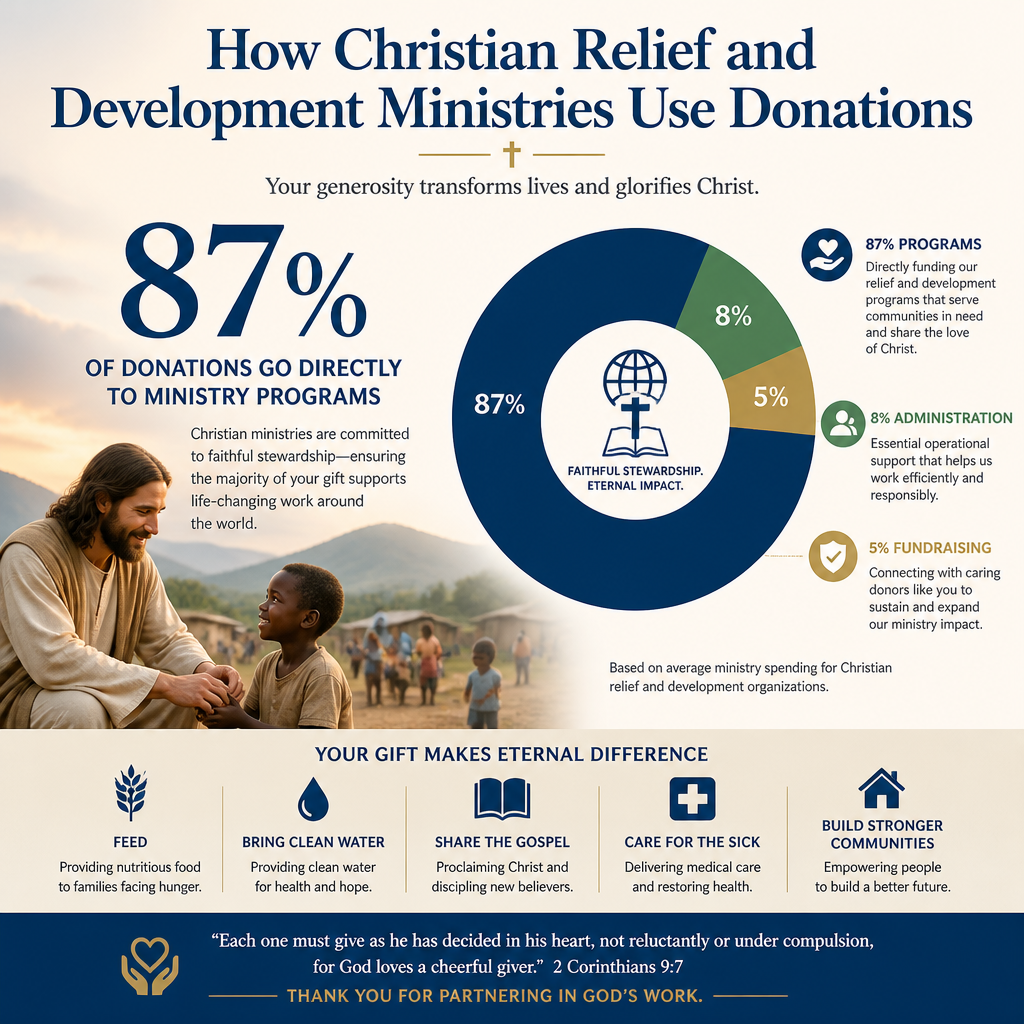
Christian donors routinely ask, “What percentage reaches the field?” The question is understandable, but the answer is frequently misleading. A ministry can classify expenses in ways that inflate “program” percentages without improving impact. Conversely, a ministry can carry necessary administrative costs that protect beneficiaries and donor intent, while reporting a lower program ratio.
This is why the nonprofit sector has pushed back against simplistic overhead scoring. The leaders of GuideStar (now Candid), Charity Navigator, and the BBB Wise Giving Alliance jointly warned that focusing on overhead can create “the false impression that overhead is inherently bad,” and can pressure nonprofits to underinvest in the systems that make programs effective and accountable (GuideStar/Candid).
What a donor should ask instead of chasing a single percentage
Better questions probe whether funds are governed with integrity and aligned with mission. For example:
- Are audited financial statements available and current? Audits are not infallible, but they signal baseline seriousness and external scrutiny.
- Is the ministry clear about restricted versus unrestricted gifts? Donors should be able to understand how designated gifts are tracked and honored.
- Does the organization disclose executive compensation and related-party transactions? These are common areas where trust can erode.
- Does the ministry explain what “field” includes? Field spending may include local staff, partner subgrants, procurement, monitoring and evaluation, and security—each legitimate, each requiring controls.
Transparency is not only disclosure. It is intelligibility. Mature ministries help donors understand the financial logic of their work without resorting to slogans.
Administration and fundraising can be faithfulness, or they can be drift
Some fundraising and administrative investment is necessary to sustain capacity, comply with law, and protect vulnerable people. But the line between necessary and excessive is not always obvious. Donors should look for governance signals: an independent board that can say no, meaningful conflict-of-interest policies, and evidence that leadership decisions are constrained by mission rather than brand-building.
The harder question is whether growth has become a substitute for fruitfulness. A ministry can expand revenue and visibility while becoming less accountable, less local, and less focused on the people it claims to serve. That drift is not primarily a financial problem. It is a spiritual and institutional problem, and it tends to reveal itself in opaque reporting and unchallengeable leadership.
Faithful relief work balances compassion, competence, and witness
Christian donors also ask why some relief ministries fund both aid and discipleship, or why evangelism is sometimes present and sometimes not. Christians genuinely disagree about strategy and emphasis. Yet there are widely recognized ethical boundaries, and serious ministries operate within them.
In humanitarian standards, coercion and conditionality are not acceptable: people should not have to listen to a sermon to receive food, nor should aid be distributed as a reward for conversion. The Christian rationale is not embarrassment about the gospel. It is fidelity to the character of God and the nature of love. Mercy that exploits desperation is not Christian mercy.
Integrity in witness includes rejecting manipulation
In Matthew 5, Jesus describes good works that lead others to glorify the Father, not because the work is attached to a demand, but because the work reflects God’s character. In relief settings, that implies a posture of service that is not transactional. Many ministries express their faith openly—through staff formation, church partnerships, prayer, and long-term community presence—while keeping the delivery of assistance impartial with respect to need.
We recommend donors read a ministry’s statements on humanitarian principles, proselytism, and safeguarding with the same attentiveness they bring to a statement of faith. In practice, these policies reveal how a ministry understands power, vulnerability, and Christian witness under pressure.
Partnership with local churches can be a strength when roles are defined
Local churches often remain when international attention moves on. They know the community, its leaders, and its fault lines. When relief ministries work well with local churches, they can strengthen social trust, improve beneficiary targeting, and sustain care over time. When roles are unclear, however, churches can be burdened with responsibilities they are not equipped to carry, or become perceived as gatekeepers to aid.
Donors should look for evidence that church partnerships include training, clear accountability, and community-wide service—not preferential distribution to insiders. The aim is not to dilute Christian identity. It is to keep Christian identity from being weaponized by poverty.
Transparent ministries show evidence of outcomes, not only activity
Relief and development ministries face a genuine measurement challenge. Counting outputs is relatively easy; proving durable change is harder. Yet donors have a right to expect more than activity reports and moving stories. A ministry that cannot describe what success looks like, and how it knows whether it is achieving it, is not ready for scale.
One reason sophisticated donors are cautious is that good intentions can still produce dependency or distort local markets. The When Helping Hurts framework, articulated by Steve Corbett and Brian Fikkert, has shaped much of the Christian conversation by clarifying how poverty is often relational and systemic, and how outside help can unintentionally reinforce brokenness (Moody Publishers).
What credible impact reporting tends to include
Strong ministries usually provide a mix of quantitative indicators and qualitative evidence, tied to a coherent theory of change. Donors should expect to see:
- Clear outcomes (for example, sustained household income changes, reduced malnutrition rates, school retention, or access to clean water over time), not only inputs distributed.
- Time horizons that fit the work. Agricultural resilience and church-based community development cannot be judged on a quarterly cadence.
- Independent evaluation when appropriate, especially for large programs or contested claims.
- Learning posture: candid discussion of what did not work and what was changed.
Ministries do not need to mimic academic institutions, but they should demonstrate epistemic humility: a willingness to test their assumptions against reality.
Safeguarding and accountability are part of effectiveness
A ministry can deliver impressive outputs while failing to protect people. Safeguarding, anti-trafficking controls, fraud prevention, and complaint mechanisms are not peripheral; they are part of faithful care. Donors should look for ministries that publicly describe how beneficiaries can report harm, how allegations are investigated, and how the organization prevents retaliation.
This is one of the areas where transparency is costly. It requires admitting that risk exists wherever power and vulnerability meet. Ministries that refuse to speak concretely about these systems are asking donors to trust character without structures, which is not how Scripture teaches stewardship in the handling of shared resources.
Giving with confidence requires more than goodwill
Christian relief and development ministries use donations across a spectrum of legitimate work: emergency response, long-term resilience, partner strengthening, governance, safeguarding, and honest reporting. The faithful question is not whether every dollar becomes a visible good within days. It is whether the ministry’s whole system reflects the truthfulness, accountability, and neighbor-love that Christian giving is meant to embody.
Most Trusted exists to serve that discernment. Our verification process assesses ministries against The Most Trusted Standard so donors can distinguish between compelling narratives and verifiable integrity. For donors who want to place their giving within a broader understanding of Christian Relief and Development Ministries, the central task remains the same: to give in a way that honors Christ, protects the vulnerable, and can withstand the light.



