

How Christian relief ministries work with local partners is not a secondary operational detail. It is one of the clearest windows into whether a ministry understands both the dignity of the people it serves and the limits of what outsiders can responsibly do in moments of crisis.
Christians who give sacrificially want more than activity; they want faithfulness. The New Testament’s pattern is not disconnected beneficence but mutual responsibility in the body of Christ across geography and culture. When Paul organized famine relief for Jerusalem, he treated stewardship, accountability, and local credibility as spiritual matters, not administrative burdens (2 Corinthians 8–9). That posture still applies when a ministry funds water access, therapeutic feeding, shelter, or trauma care in another country.
Local partnership is not a tactic, it is a theology of neighbor
Why proximity matters in Christian relief
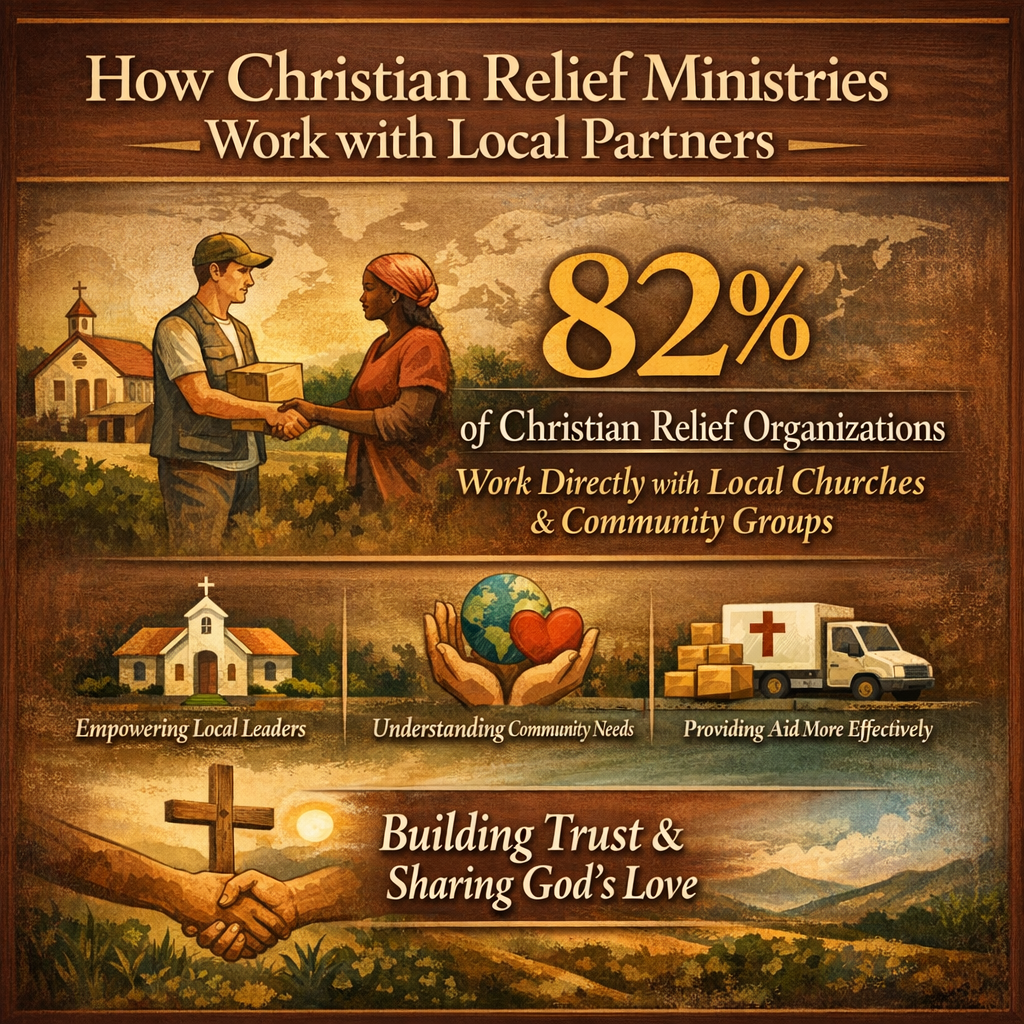
Relief work is often described in logistical terms: supply chains, distributions, and project plans. Yet the first question is theological. Human beings are image-bearers, not recipients; communities are not blank slates for foreign vision. Local churches, clinics, and community-based organizations carry history, trust, and cultural knowledge that outside responders cannot replicate quickly, no matter how competent.
What this means in practice is that strong relief ministries start by asking, “Who is already there, and what are they already doing with integrity?” In emergencies, time matters. But so does discernment. Local partners can identify which households are truly vulnerable, which leaders are trusted, and which interventions will fracture social life even if they satisfy donor expectations.
The Good Samaritan and the limits of distance
Christians often appeal to the Good Samaritan as a rationale for cross-border generosity, and rightly so. The parable commends costly compassion offered without tribal favoritism. Yet the Samaritan also worked through local capacity: an inn, an innkeeper, and a plan for ongoing care (Luke 10:34–35). The act was personal, but it was not solitary. Christian relief at its best follows the same pattern: urgent mercy paired with durable local care.
Christians genuinely disagree about how much control donors or sending organizations should retain. Some fear that local partnerships dilute doctrinal clarity or introduce corruption risk. Others fear that external control recreates paternalism under Christian language. Mature ministries acknowledge both concerns and design accountability that protects people rather than protecting reputations.

What local partners actually do in a crisis
Assessment, targeting, and community legitimacy
When disasters strike, accurate assessment is morally weighty. A partner with deep community ties can distinguish between visible need and hidden vulnerability. Local leaders often know which families are newly displaced, which elderly people are isolated, and which areas are unsafe for women and children. They also know the informal systems that can either support or sabotage a distribution.
This is not theoretical. The humanitarian sector has long warned against “elite capture,” where those with power steer benefits to their own networks. Local partnership can reduce that risk when it is broad-based rather than centered on a single gatekeeper, and when a ministry builds verification and complaint mechanisms into the program design.
Implementation that respects culture and protects the vulnerable
Local partners translate standards into realities: how to organize safe queues, how to avoid stigmatizing households receiving aid, how to communicate in the right language and channels, and how to identify protection risks. They also help ministries avoid a common failure mode in disaster response: delivering goods without ensuring they can be used safely and equitably.
In many contexts, the local church is both a spiritual home and a practical infrastructure, offering trusted meeting space, volunteer networks, and relational accountability. Yet wise ministries do not assume that “church-based” automatically means “safe” or “effective.” Safeguarding, financial controls, and clear eligibility criteria are still required precisely because Christian institutions can be tempted to rely on goodwill rather than verification.
- Needs assessment that reflects local realities, not outsider assumptions
- Beneficiary identification that reduces favoritism and protects dignity
- Distribution logistics including storage, security, and accessible delivery
- Safeguarding for children and vulnerable adults, with reporting pathways
- Feedback and complaints so communities can report harm or exclusion
Funding flows, accountability, and the integrity tests donors rarely see
Why restricted funds and clear agreements matter
Donors often ask whether a ministry “works through locals,” but the more revealing question is how money and authority move. Strong partnerships are governed by written agreements, clear budgets, and shared metrics. They also set realistic overhead assumptions: a partner cannot safeguard children, keep records, and run distributions without administrative capacity. Treating administration as morally suspect is one reason programs collapse under pressure.
The sector has tried to correct simplistic overhead thinking for years. The “Overhead Myth” letter, signed by GuideStar, Charity Navigator, and the BBB Wise Giving Alliance, argued that focusing on overhead ratios can mislead donors and punish healthy investment in systems that prevent harm and waste https://www.guidestar.org/. Christian donors benefit from the same reformation in expectations: lower overhead is not automatically higher faithfulness.
What verification looks for in partner management
Across our verification work at Most Trusted, we find that ministries that meet The Most Trusted Standard tend to treat partner due diligence as a discipline, not a checkbox. They evaluate theology and mission alignment where relevant, but they also examine governance, financial controls, safeguarding practices, and the ability to report results truthfully. This is especially important in high-trust Christian networks, where relationships can unintentionally replace controls.
Good partner management typically includes periodic audits or spot checks, segregation of duties, documented procurement practices, and a credible way for community members to report misuse or abuse. Donors rarely see these systems because they are not compelling fundraising stories. Yet they are among the strongest indicators that a ministry’s compassion is ordered by wisdom.
For donors who want a broader view of how mature ministries structure their work, the wider context sits within Christian Relief and Development Ministries, where we examine the patterns that consistently correlate with integrity and effectiveness.
Capacity building, local ownership, and the long arc beyond relief
The relief to development transition is morally complex
Emergency relief is often necessary, and it can be genuinely life-saving. But it is not morally neutral. If prolonged or poorly designed, it can displace local markets, undermine local initiative, and create dependency dynamics that neither donors nor recipients want. The field has had to reckon with these risks, including in explicitly Christian spaces.
The When Helping Hurts framework, articulated by Steve Corbett and Brian Fikkert, has shaped a generation of Christian thinking about poverty alleviation by emphasizing dignity, agency, and the dangers of one-way giving https://whenhelpinghurts.org/. Christians may debate applications, but the central insight is difficult to avoid: helpers can harm when they confuse their resources with God’s wisdom, or their urgency with God’s timing.
What healthier partnership can look like over time
Local partnership is not only about delivering aid; it is about strengthening what remains after outsiders leave. Capacity building can include training in finance and compliance, safeguarding systems, program design, trauma-informed care, and monitoring and evaluation. It can also include theological formation for local leaders where the partner requests it and where it does not become a tool of control.
There is a tension donors should name explicitly. Capacity building is slower and less photogenic than a shipment of supplies. It also tends to be more sustainable. Ministries that consistently choose local ownership over visible control often look less impressive in a single newsletter and more faithful over a decade.
Many of these trade-offs appear in the practical question of how donations are used, which we address more directly in How Christian Relief and Development Ministries Use Donations.
Questions donors should ask before funding partnership-based relief
Due diligence that serves love, not suspicion
Christian donors sometimes hesitate to ask hard questions because they fear sounding cynical. Yet Scripture treats accountability as a form of love, particularly where money and power are involved. Paul insisted on transparent handling of funds “to avoid any criticism of the way we administer this liberal gift” (2 Corinthians 8:20). The concern was not public relations; it was witness and integrity.
The harder question is not whether a ministry has partners, but whether its partnership model is coherent under pressure. Disasters expose weak governance. They also expose ministries that have confused brand visibility with local flourishing.
A practical set of donor questions
Before giving, we recommend asking questions that illuminate both character and competence:
- How are local partners selected, and what disqualifies a partner?
- Who controls funds and procurement, and what financial controls are in place?
- What safeguarding standards govern work with children and vulnerable adults?
- How does the ministry handle complaints from community members or staff?
- What evidence is reported back, and what is verified independently?
These questions do not guarantee perfection. They do reveal whether a ministry is prepared to tell the truth about its work, including its limitations, and whether it has designed systems that protect the people donors mean to serve.
FAQs for How Christian relief ministries work with local partners
Are local partners mainly a way to reduce costs?
They should not be. Local partnership can reduce certain expenses, but mature ministries pursue it primarily because proximity brings knowledge, legitimacy, and continuity that outsiders cannot replicate quickly. Healthy partnerships also require investment in financial controls, safeguarding, and reporting, which can increase administrative costs in the short term.
How can donors know whether a partnership is actually accountable?
Donors can look for specific evidence: written partner agreements, clear budgeting and reporting, independent audits where feasible, safeguarding policies that are enforced, and credible feedback channels for communities. At Most Trusted, we evaluate these features against The Most Trusted Standard so donors can distinguish between partnership as a slogan and partnership as a disciplined practice.
Why partnership is a test of Christian stewardship
Local partnership is where Christian relief ministries disclose what they believe about power: who gets to define need, who gets to make decisions, and who bears the risk when programs fail. Donors who care about faithfulness should expect ministries to treat these as spiritual questions with practical consequences. The aim is not merely to send help, but to honor Christ by serving neighbors in ways that strengthen, rather than replace, the local body and the local community.



