

When Christians ask how Christian medical ministries spend donor gifts, they are rarely asking a purely financial question. They are asking whether mercy is being practiced with truth, whether suffering is being met with competent care, and whether their stewardship is bearing faithful fruit. In a sector where need is not theoretical and harm can be irreversible, the moral weight of a budget is unusually concrete.
Medical ministry sits at a demanding intersection: clinical standards, cross-cultural ethics, disaster logistics, and the Christian mandate to love our neighbor. Donors often want simplicity—“How much goes to the field?”—but mature stewardship requires more textured questions. The healthiest ministries are not those with the thinnest overhead; they are those that can show, with verifiable evidence, that gifts are governed wisely and deployed toward durable healing.
What donor gifts fund in a credible medical ministry
Most Christian medical ministries spend donor gifts across a set of recurring categories: direct clinical care, supply chains, personnel, partnerships, and the less visible work that makes safety and continuity possible. The challenge is that “medical care” is not a single line item. A cataract surgery depends on sterile instruments, trained staff, postoperative follow-up, electricity, and a referral pathway when complications occur.
Across our verification work at Most Trusted, the ministries that meet The Most Trusted Standard tend to make their spending intelligible to donors without oversimplifying it. They distinguish between what is truly programmatic care and what is administrative support that protects patients and improves outcomes.
Direct patient care and clinical operations
This is the most recognizable category: consultations, procedures, medications, lab work, imaging, and inpatient care where facilities exist. In some ministries, “direct care” also includes community health outreach, maternal health services, and public health interventions that prevent disease rather than only treating it.
What this means in practice is that a “program expense” number can hide very different realities. A pharmacy budget might represent lifesaving chronic disease management, or it might represent short-term distribution without continuity. Donors do not need to become clinicians, but they should expect a ministry to describe its model of care clearly enough that continuity and patient safety are not assumed.
Supplies, equipment, and the cost of doing medicine responsibly
In medical work, certain costs are not optional. Sterilization, safe storage, refrigeration for vaccines, biomedical waste disposal, and quality-controlled procurement often look like overhead on a spreadsheet, but they function as patient protection. A ministry that cuts these corners may appear efficient while quietly transferring risk to vulnerable people.
When donors encounter “equipment” expenses, the relevant question is rarely whether equipment is expensive. It is whether equipment is appropriate to the context, maintainable, and paired with trained staff and ongoing supply chains. A broken ultrasound machine in a rural clinic is not a neutral asset; it is a stranded promise.

Personnel and partnerships that protect patients
Christian compassion does not suspend the moral requirement of competence. Medical ministry depends on people: physicians, nurses, pharmacists, community health workers, logisticians, translators, and administrators who keep operations safe. In many settings, staffing and training are among the most substantial program costs, and they often should be.
Local staffing and capacity strengthening
Healthy medical ministries invest in local clinicians and staff, not as an afterthought but as a central strategy. This includes salaries, continuing education, and supervision structures that sustain quality. When donors see spending on “training,” the question is whether it strengthens local capacity in ways that endure after a visiting team departs.
Christians genuinely disagree about the best balance between expatriate staffing and local hiring in fragile contexts. There are regions where specialized expatriate roles are temporarily necessary. But the field has had to reckon with the long-term distortions created when outside personnel consistently displace local professionals or create parallel systems that collapse when external funding shifts.
Partnership models and the ethics of referral
Many ministries deliver care through partnerships with hospitals, government clinics, church networks, or community-based organizations. Donor gifts may fund referral fees, transportation for patients, or subsidized surgeries at partner facilities. This can be a mark of humility and wisdom—recognizing that a ministry is one part of a health ecosystem, not the whole system.
Partnership spending deserves scrutiny because it is also a common place for opacity. Donors should expect clarity on how partners are selected, how payments are governed, and what safeguards exist against conflicts of interest. A credible ministry can explain how it avoids paying for care that is unnecessary, unsafe, or exploitative.
Transparency questions that matter more than the overhead ratio
Many donors have been trained to treat “low overhead” as the primary indicator of excellence. That assumption has been widely challenged by nonprofit evaluators who warn against equating minimal administrative costs with effectiveness. Charity Navigator, Candid (GuideStar), and the BBB Wise Giving Alliance have jointly cautioned that overhead ratios can mislead donors and pressure nonprofits to underinvest in systems that make programs work.Charity Navigator
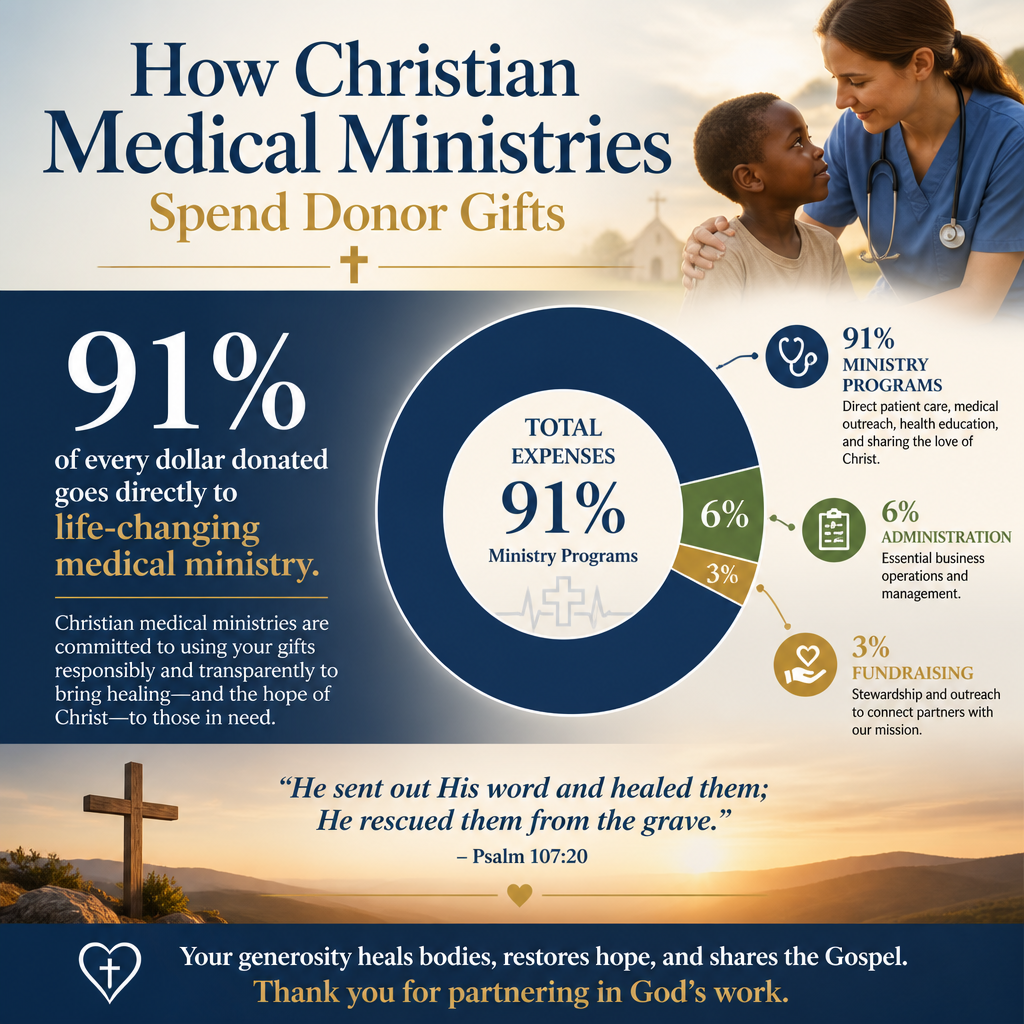
Medical ministry is a clear example of why the overhead fixation can backfire. Compliance systems, clinical protocols, data security, and incident reporting are not luxuries. They are forms of stewardship because they reduce preventable harm. The more vulnerable the patient population, the greater the moral burden to document safeguards.
What to look for in financial reporting
Donors should expect financial statements and annual reports that allow a reasonable reader to follow the flow of funds. When categories are overly broad, the result is not simplicity but obscurity. When narratives are only celebratory and never analytical, donors are being invited to feel rather than to evaluate.
A strong transparency posture commonly includes:
- Audited financials or, for smaller ministries, reviewed statements with clear disclosure
- Specific program descriptions that connect spending to a defined model of care
- Policies addressing conflicts of interest, whistleblowing, and safeguarding
- Evidence of board oversight that is active rather than ceremonial
- Clear explanation of restricted versus unrestricted gifts and how each is used
How Most Trusted approaches donor confidence
At Most Trusted, we evaluate ministries against The Most Trusted Standard, a 15-criteria framework that tests faith commitments, financial integrity, governance, and transparency and effectiveness. That framework is designed to honor the donor’s stewardship obligation without reducing discernment to a single metric. When a ministry can document controls, publish coherent reporting, and show board-level accountability, donors can give with more confidence that compassion is being exercised with integrity.
For donors comparing organizations within the same field, it is often helpful to begin with the broader landscape of Christian Medical Ministries and then narrow attention to the specific models that align with your convictions and risk tolerance.
Effectiveness in medical ministry is not a story, it is evidence
Christian donors rightly care about spiritual faithfulness, but faithfulness in healthcare also includes truthfulness about results. A ministry may tell compelling stories and still fail to deliver consistent, safe outcomes. Mature ministries respect donors enough to measure what can be measured, to name limits, and to improve over time.
Outcome measures and the discipline of follow-up
Outcomes in healthcare are often slow, complex, and influenced by factors outside a ministry’s control. Yet there are common markers of seriousness: post-operative follow-up rates, continuity for chronic disease patients, maternal and neonatal outcomes where relevant, and referral completion rates for cases beyond a clinic’s capacity.
Donors should not assume that an impressive number of “patients seen” is automatically good news. Volume can represent access, but it can also mask thin care. The harder question is whether the ministry can describe what happens after the encounter, especially for patients with complications or long-term conditions.
Medical missions and the caution learned over time
Short-term medical trips remain meaningful for many churches, and they can be done well. They can also create dependency, undermine local health systems, or provide episodic care without continuity. The broader Christian development conversation—shaped in part by the When Helping Hurts framework articulated by Corbett and Fikkert—has pressed ministries to consider unintended consequences and to prioritize approaches that strengthen rather than replace local capacity.When Helping Hurts
Donors do not need to reject short-term work categorically. They should, however, ask whether trips are embedded in a long-term strategy, governed by clinical standards, and accountable to local leaders. Good intentions are not a clinical protocol.
Where donor gifts can drift and how disciplined ministries prevent it
Every ministry faces pressures that can pull spending away from its stated purpose: donor expectations, crisis response cycles, the temptation to scale too quickly, and the internal fatigue that comes with constant exposure to suffering. The question is not whether temptation exists, but whether governance and leadership are structured to resist it.
Common risk areas in spending
In medical ministry, a few categories recur in cases where donors later feel misled. These patterns do not indict an entire field, but they do clarify what accountability should prevent.
Risk areas include unclear related-party transactions, medical inventory that is donated but recorded as program “spending” without clear valuation policies, inflated patient counts, and fundraising narratives that imply direct care when funds primarily support overhead or expansion planning. Another recurring risk is “equipment-first” giving—major purchases without maintenance plans or trained operators—leading to stranded assets and quiet program failure.
Controls that signal mature stewardship
Disciplined ministries build controls that are not merely bureaucratic but pastoral in the deepest sense: they protect patients and honor donors. These controls include segregation of financial duties, documented procurement policies, board review of executive compensation, incident reporting mechanisms, and clinical governance that takes adverse events seriously.
Donors evaluating how gifts are used within How Christian Medical Ministries Use Donations should expect this kind of sober specificity. The ministries worthy of trust do not ask for unexamined confidence; they provide accountable reasons for confidence.
FAQs for How Christian medical ministries spend donor gifts
What percentage should go to programs in a Christian medical ministry?
There is no single faithful percentage. Medical work requires real infrastructure—quality control, staffing, compliance, and systems that protect patients—and those costs can be both necessary and mission-advancing. Donors should look for clear reporting, audited or reviewed financials where appropriate, and evidence that administrative spending is proportionate, governed, and connected to safer, more effective care.
How can donors tell whether medical mission stories reflect real impact?
Donors can ask for outcome-oriented reporting that goes beyond counts of “patients served.” Credible ministries can describe their model of care, continuity plans, follow-up practices, and partnership accountability. They can also name limitations candidly. Stories have a rightful place in Christian witness, but in healthcare, truthfulness includes measurable evidence that care was safe, appropriate, and sustained where sustainability is required.
Stewardship that honors the sick and the giver
Christian medical ministries spend donor gifts faithfully when budgets serve patients rather than appearances, and when compassion is disciplined by governance, clinical competence, and truth-telling. Scripture’s call to visit the sick is not sentimental; it is a summons to costly love shaped by integrity. Donors who give with clear-eyed discernment participate in that integrity, joining mercy to accountability for the good of neighbors made in God’s image.



