

Christian donors asking what share of donations funds direct medical care are asking a stewardship question before God, not merely a nonprofit accounting question. In Christian medical ministries, the answer is rarely a single percentage that can be compared cleanly across organizations, because “direct care” can be delivered through different models and recorded under different expense lines.
What responsible donors should expect is not a marketing-friendly ratio, but verifiable clarity: clear definitions, consistent reporting, and leadership willing to explain trade-offs without manipulating the categories. Across our verification work at Most Trusted, the ministries that meet The Most Trusted Standard tend to lead with definitions and documentation rather than with a headline number.
Direct medical care is real, but it is not one accounting category
Different ministry models produce different expense patterns
Two faithful Christian medical ministries may both provide life-saving care and yet show very different “direct care” shares on paper. A hospital-based mission may report salaries for clinicians as program expense, while a medical shipment ministry may record freight and warehousing as program expense, and a patient-assistance ministry may record grants to partner clinics as program expense. Each may be “direct” in a meaningful sense, even when the line items look dissimilar.
This is why experienced donors read audited financials and program notes, not only a pie chart. The Internal Revenue Service’s Form 990 instructions acknowledge the complexity by requiring nonprofits to allocate many shared costs across program, management, and fundraising functions, which introduces judgment into the numbers even when reported in good faith IRS.
Program expense is not a synonym for bedside care
Many donors use “direct medical care” to mean “care that touches a patient,” but financial statements generally use “program services,” which can include training, logistics, community health education, follow-up, medical records, spiritual care, and quality assurance. In cross-cultural settings, these “supporting” activities often determine whether care is safe, dignifying, and sustainable rather than episodic.
Christians genuinely disagree about how much infrastructure is appropriate in charity. The sharper question is whether an organization’s infrastructure serves patients and local partners, or serves institutional comfort and growth for its own sake. That is a moral question as much as a financial one.

High program ratios can mislead and low ratios can be responsible
The field has rejected simplistic overhead scoring
Many donors were trained to treat “overhead” as the enemy. Yet the modern nonprofit field has had to reckon with the damage done by that assumption. Leaders across charity evaluation and accountability have argued that an exclusive focus on overhead can punish investment in capacity, systems, and evaluation that protect beneficiaries and improve outcomes; this critique is commonly referenced as “the overhead myth” The Chronicle of Philanthropy.
For Christian medical ministries, this matters because the ethical stakes are high. Poor systems can mean counterfeit medicines, broken cold chains, compromised patient confidentiality, unqualified clinicians, or partner clinics left with unusable equipment. A ministry can boast an impressive “direct care share” and still be reckless.
Donors should look for the kind of effectiveness that can be shown
What this means in practice is that we should be suspicious of ratios offered without definitions and documentation. A ministry that claims “95% goes to medical care” should be able to answer, plainly and precisely: What counts as medical care? Does that include procurement staff? Clinical supervision? Training? Translation? Medical waste disposal? Follow-up? If a ministry cannot explain its own number, the number is not trustworthy.

Conversely, a ministry with a moderate program ratio may be investing in the very things that keep patients safe and partnerships durable. “Administration” can include compliance, internal controls, and safeguarding measures that mature Christian donors should want, particularly when ministry work occurs where governance and supply chains are fragile.
What a responsible direct care share often looks like in practice
Reasonable ranges depend on the care delivery pathway
It is possible to state a careful generalization: ministries that provide care directly through clinics and hospitals often show substantial personnel costs in program services, while ministries that fund partners or ship supplies often show large program expenses in grants, inventory, freight, and warehousing. Comparing these models by a single “direct care share” can misread what the ministry actually does.
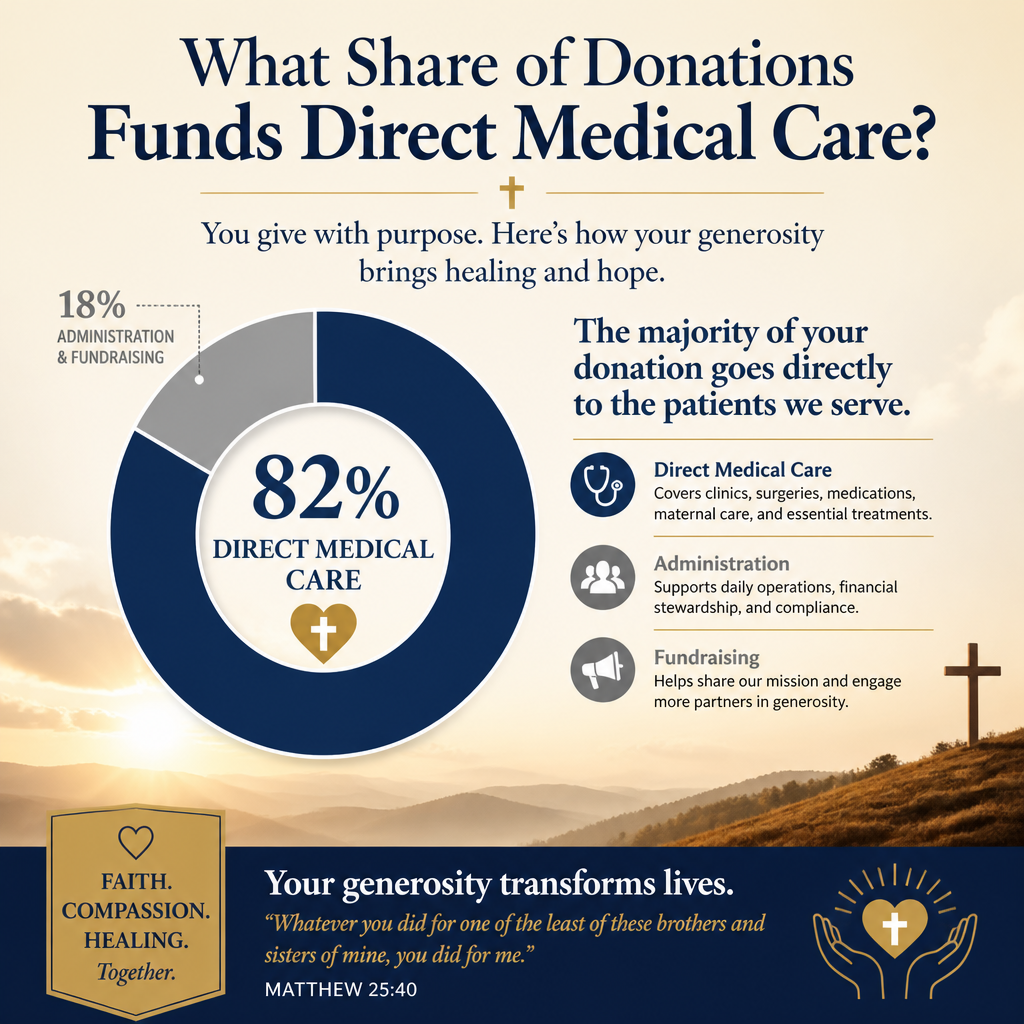
Many donors ask for a range anyway. We encourage donors to begin with the organization’s audited statements and Form 990, then evaluate whether the reported mix of program, management, and fundraising is coherent with the ministry’s strategy and scale. When an organization’s financial story does not match its operational story, further questions are warranted.
Verifiable markers that correlate with integrity
Across Christian medical ministries, several patterns tend to accompany credible “direct care” claims:
- Clear definitions of what the ministry counts as medical program work, with consistent use year to year
- Audited financial statements that align with the narrative presented to donors
- Evidence of quality controls for medicines, devices, and clinical practice appropriate to the setting
- Transparent reporting on restricted gifts and how restrictions are honored
- A posture of accountability toward local partners rather than a posture of control
These are not cosmetic signals. They are practical safeguards against the temptation to present ministry as simpler than it is, and against the temptation to use beneficiaries to fund a brand.
How to evaluate direct medical care without being manipulated by ratios
Ask definition questions before asking for a percentage
Wise donors begin by asking what the organization means by “direct medical care.” For a medical mission hospital, does it include chaplaincy and pastoral counseling integrated with care? For a maternal health program, does it include training for birth attendants and follow-up visits? For a mobile clinic, does it include vehicle maintenance and fuel? The goal is not to “catch” the ministry, but to understand the ministry truthfully.
Then ask for the percentage, but require the ministry to tie it to its audited financials. If the percentage is calculated from internal reports rather than audited statements, ask why. There are legitimate reasons, but donors should understand them.
Read the ministry through the lens of Scripture and stewardship
Jesus commends costly mercy, but never commends careless mercy. In Matthew 25, care for the sick is named as a mark of faithful discipleship, not as a sentimental option. At the same time, Scripture consistently condemns weights and measures that mislead. A ministry that manipulates categories to appear more “direct” is practicing a form of dishonest measure, even if the work itself is good.
For donors seeking a grounded overview of the distinctive opportunities and risks in this space, our coverage of Christian Medical Ministries reflects recurring patterns we see in verification: the strongest organizations take truth-telling as part of discipleship, including truth-telling about money.
What Most Trusted looks for when claims about direct care are made
The Most Trusted Standard emphasizes integrity over optics
Most Trusted exists because sophisticated Christian donors want more than assurances. Under The Most Trusted Standard, we examine ministries across faith commitments, financial integrity, governance and leadership, and transparency and effectiveness. For questions about direct medical care, the decisive issue is whether a ministry can show—through audits, policies, governance, and results reporting—that its funds are handled with candor and competence.
In this category of ministry, we pay particular attention to restricted fund practices, related-party transactions, and the internal controls that govern purchasing and distribution. Medical work creates unique risks: procurement fraud, diversion of supplies, informal payments, and well-meant “workarounds” that become patterns. A ministry that acknowledges these risks and demonstrates controls is more trustworthy than a ministry that denies the risks and advertises a pristine ratio.
Donors can honor both compassion and accountability
Some donors fear that careful questions will “quench the Spirit” or signal distrust. Yet Christian stewardship is not cynicism; it is love disciplined by truth. Asking how a ministry defines “direct medical care,” how it verifies delivery, and how it safeguards patients is not antagonism. It is a way of honoring the people the ministry serves, who bear God’s image and deserve more than our intentions.
For a wider view of how Christian organizations should speak about money, costs, and outcomes without reducing mission to metrics, see our reporting on How Christian Medical Ministries Use Donations.
FAQs for What share of donations funds direct medical care
Is there a “good” percentage that should go to direct medical care?
There is no single biblical or financial threshold that applies across all Christian medical ministries. A “good” share depends on the model: operating a clinic, funding local partners, shipping supplies, training clinicians, or combining these. What donors should require is verifiable reporting tied to audited statements and a clear explanation of what the ministry counts as medical program work.
Should we avoid ministries with higher administrative or fundraising costs?
Not automatically. Higher support costs can signal inefficiency, but they can also reflect necessary investments in compliance, medical quality controls, safeguarding, and accountable growth. The concern is not the existence of overhead; the concern is whether the spending aligns with the ministry’s mission, is governed well, and is explained honestly without manipulating categories.
Giving with confidence requires more than a ratio
The share of donations that funds direct medical care matters because money is moral matter, and Christian donors should want their gifts to relieve suffering with integrity. The most responsible approach is to demand clarity: clear definitions, audited documentation, and evidence that care is delivered safely and respectfully. When a ministry can show those things, the percentage becomes a meaningful signal rather than a marketing claim.



