
How often Christian medical ministries publish impact reports is not a clerical detail; it is one of the clearest signals of whether a ministry expects to be known by the truth rather than by impressions. Christian donors are not merely purchasing outcomes. We are offering stewardship before God, and Scripture repeatedly ties stewardship to honesty, accountability, and works that can withstand light.
Medical work carries a particular moral weight because the suffering is immediate and the giving is often urgent. Yet urgency can quietly lower expectations. The question is not whether a ministry tells stories; the question is whether it publishes verifiable evidence with a cadence that allows the church to discern fruit over time, learn from failure, and correct course.
Impact reporting is a spiritual and fiduciary obligation
Truth telling belongs to Christian witness
Christian ministries rightly resist a reduction of mercy to metrics. Healing is never only a number, and the Kingdom is not a spreadsheet. But Christian credibility depends on truthfulness in the ordinary sense: claims should be proportionate to evidence, and public communication should not imply more certainty than the data can support.
Scripture’s concern is not only that giving happens, but that it happens with integrity. Paul took pains to arrange transparent handling of funds so that “no one should blame us about this generous gift” (2 Corinthians 8:20–21). Medical ministries operate with high trust from donors and high vulnerability among patients. That combination makes disciplined reporting a moral duty, not an optional administrative exercise.
Donors are responsible for more than intentions
Most donors do not have access to site visits, clinical staff, or local health systems data. What this means in practice is that the impact report becomes the primary window into reality. When it is absent, infrequent, or vague, donors are asked to supply trust without the evidence that mature stewardship requires.
In our work at Most Trusted, we evaluate ministries against The Most Trusted Standard, a 15-criteria framework across Faith Foundation, Financial Integrity, Governance and Leadership, and Transparency and Effectiveness. Reporting cadence is not the whole story, but it tends to correlate with whether a ministry has built the internal disciplines that keep compassion accountable.

So how often should a Christian medical ministry publish an impact report
Annual is the baseline for serious accountability
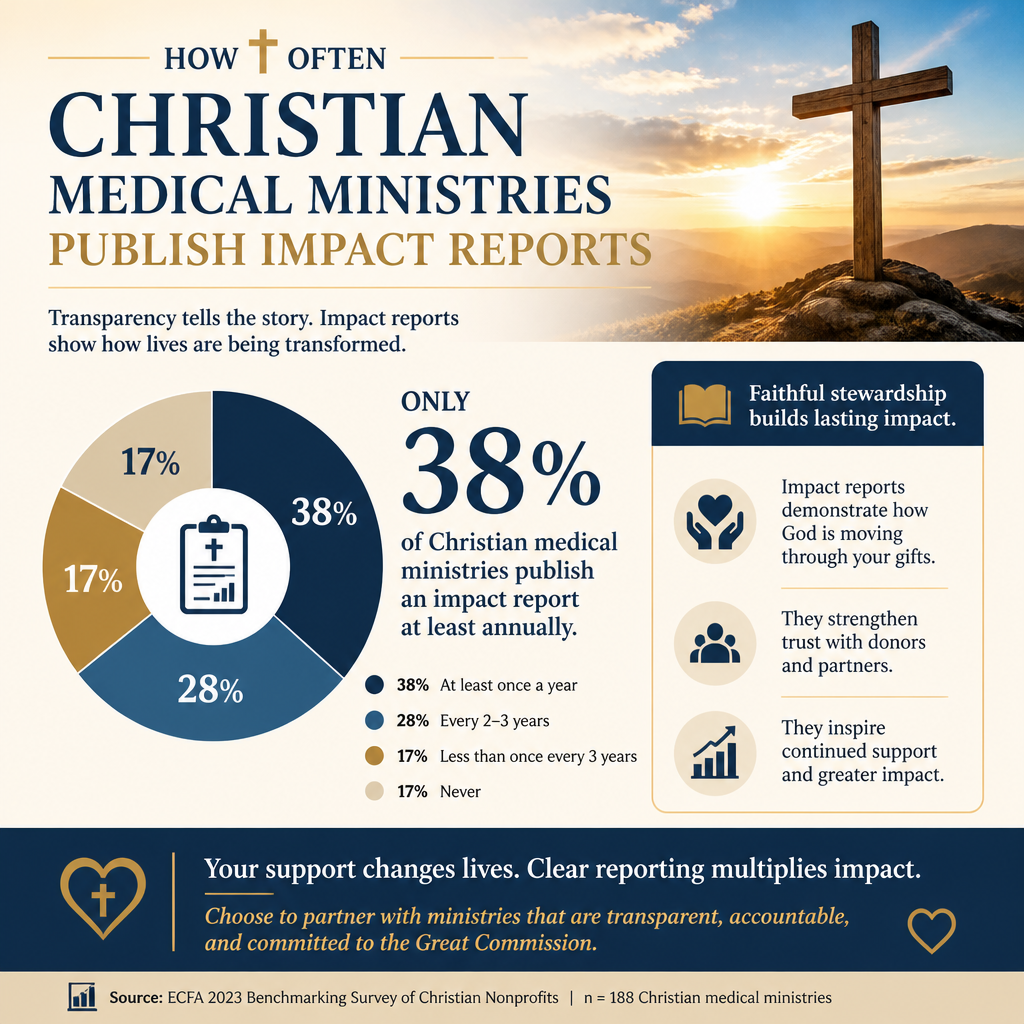
For most Christian medical ministries, an annual impact report is the minimum credible rhythm. Annual reporting aligns with audited financial statements, board review cycles, and the natural arc of program planning. It also respects the time required to gather, clean, and interpret data without turning reporting into a constant publicity loop.
Annual does not mean glossy. A serious annual report can be plain, even modest, as long as it is specific: what was attempted, what was achieved, what changed, and what did not. The ministries that are most mature in transparency often include clear definitions, limitations, and year-over-year comparison rather than isolated highlights.
Quarterly and semiannual updates can serve donors when they are honest
Many ministries also publish quarterly or semiannual updates. This can be appropriate when operations are continuous and donors are funding time-sensitive work such as mobile clinics, maternity care, malnutrition treatment, or disaster response. The purpose should be operational clarity, not fundraising acceleration.
There is a trade-off. More frequent communication can pressure teams to produce constant wins, which can lead to selective storytelling. A disciplined approach is to reserve the comprehensive measurement, outcomes analysis, and program learning for the annual report, and use interim updates for straightforward activity reporting and notable changes in context.
What mature impact reporting includes for medical ministry
Outputs, outcomes, and the limits of each
Medical missions reporting can become either simplistic or evasive. Simplicity shows up when a ministry publishes only outputs: patients seen, surgeries performed, medications distributed. Evasion shows up when a ministry speaks in spiritual or emotional terms while leaving the medical claims unmeasured. Mature reporting distinguishes outputs from outcomes and treats both with appropriate humility.
Outputs matter because they describe real service delivered. Outcomes matter because they describe whether those services led to measurable improvement: recovery rates, follow-up adherence, maternal outcomes, referral completion, or improved access for high-risk populations. Not every ministry can measure clinical outcomes at the same depth, especially in low-resource settings. But every ministry can be explicit about what it measures, why it measures it, and what it cannot currently verify.
Context, quality, and patient dignity
Impact in medicine is not only volume; it is quality, safety, and respect for persons. Reporting should show how the ministry safeguards patient dignity, protects privacy, obtains consent, and avoids coercion in evangelism. Christians genuinely disagree about how to speak of gospel witness in clinical settings, but no serious Christian ethic permits exploiting vulnerability. A credible report names the guardrails.
In our review work, we also watch for whether ministries acknowledge adverse events, constraints, and hard trade-offs. A report that contains no tension is rarely a sign of perfection; it is usually a sign that the ministry has not built a culture where truth is safe.
Red flags when impact reports are absent or infrequent
Silence is not neutrality
A ministry can do good work and still struggle with reporting. Sometimes the barrier is capacity: overextended staff, limited data systems, or unstable field conditions. Donors can and should make room for complexity. But the absence of reporting over multiple years should be treated as a meaningful signal, because it makes external accountability difficult.
Healthcare is especially susceptible to inflated claims because numbers sound authoritative. A ministry that does not publish definitions, methods, and timeframes can unintentionally mislead even when it is acting in good faith.
Questions donors should ask when reports are thin
When a Christian medical ministry publishes minimal reporting, donors do not need to become adversarial. But we should ask questions that encourage clarity and protect integrity:
- What outcomes does the ministry define as success, and how are they measured?
- What portion of patients receive follow-up, and what limits follow-up?
- How does the ministry ensure clinical quality and appropriate referral pathways?
- How are patient privacy and informed consent handled in storytelling and evangelism?
- What did not go as planned this year, and what was learned?
These questions are not bureaucratic. They are a modern form of the due diligence Paul modeled when handling gifts publicly and carefully.
How Most Trusted evaluates reporting cadence and credibility
Cadence is only meaningful when paired with verifiability
An impact report is valuable only if it can be checked against reality. Across our verification work, we have found that the most trustworthy ministries publish on a consistent schedule and also make it possible to trace claims to underlying records, partners, or established methods. Consistency without substance becomes marketing. Substance without consistency becomes an occasional burst of transparency that leaves long stretches unaccountable.
This is why we treat reporting as part of a wider integrity picture: governance oversight, financial disclosures, conflict-of-interest management, and clarity about theology and practice. The same ministry that avoids clear impact reporting often avoids other forms of scrutiny as well.
Where to situate this question within broader donor discernment
Impact reporting cadence should be assessed alongside what the ministry does and where it operates. Surgical programs, for example, may reasonably report outcomes per campaign or per specialty, whereas community health programs may report by quarter because activities and seasonal disease patterns shift quickly. Disaster medical response may require immediate situation reports, followed by a slower, audited assessment once the crisis stabilizes.
Donors who want a broader framework for evaluating ministries in this sector can start with Christian Medical Ministries, where we discuss the distinctive accountability challenges and credibility markers common to this work.
For donors focusing on measurement practices specifically, we also address common reporting standards, indicators, and red flags within How Christian Medical Ministries Measure Impact.
FAQs for How often Christian medical ministries publish impact reports
Is an annual impact report enough for a medical ministry?
Annual reporting is typically the baseline for credible accountability, especially when it includes clear definitions, year-over-year comparisons, and program learning. Some ministries should add interim updates for time-sensitive work, but frequent communication cannot substitute for an annual report that is specific and verifiable.
What if a ministry serves in unstable settings and cannot measure outcomes well?
Instability can make rigorous outcome measurement difficult, and donors should acknowledge that constraint. The integrity test is whether the ministry states its limits plainly, uses the best feasible indicators, and shows a plan to improve measurement over time. A report that names what cannot be verified is often more trustworthy than one that implies certainty without evidence.
Stewardship that welcomes the light
Christian medical ministry deserves the church’s generosity, and it also deserves the church’s careful discernment. The question of how often impact reports are published is ultimately a question about habits of truth: whether a ministry is willing to be known as it is, not as it wishes to be perceived. Donors can honor both mercy and integrity by favoring ministries that report consistently, define their claims carefully, and demonstrate learning under the scrutiny that faithful stewardship requires.



