
How Christian medical ministries measure impact is not a secondary reporting question for Christian donors. It is a stewardship question: whether gifts entrusted to the Lord are being translated into faithful care for the sick, responsible leadership, and truthful public witness. In a field where needs are real and stories are often heartbreaking, donors can be pulled either toward sentimentality or toward a narrow demand for metrics that does not fit the nature of pastoral, medical, and diaconal work.
Scripture refuses both extremes. Jesus commends quiet mercy done “in secret” (Matthew 6:3–4), and he also demands visible fruit that can be recognized (Matthew 7:16). Christian ministries should not treat measurement as a public-relations accessory, but neither should donors treat impact as unknowable. Verifiable evidence and candid reporting are part of integrity.
Impact in Christian medical ministry must be measured at more than one level
Medical ministry is rarely a single intervention with a single outcome. A clinic visit may lead to a diagnosis, medication adherence, family stability, restored capacity to work, and renewed trust in caregivers. It may also, in hard cases, lead to little measurable improvement, even when care was competent and compassionate. Mature impact measurement begins by acknowledging that health outcomes, spiritual care, and human dignity do not collapse into one metric.
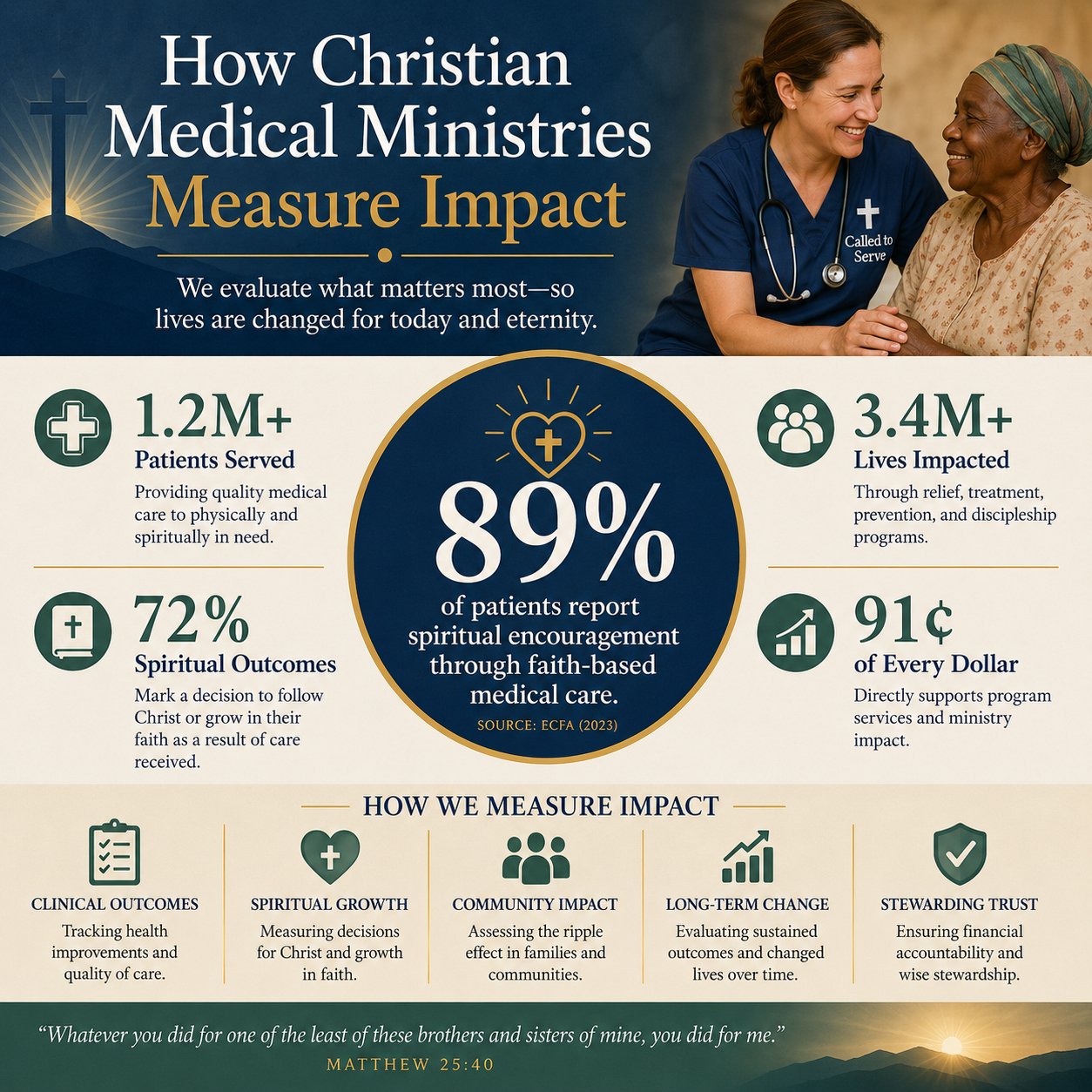
The ministries that report well tend to separate three questions that donors frequently mix together: what was delivered (outputs), what changed for patients and communities (outcomes), and what lasting patterns shifted (longer-term impact). This is standard practice in program evaluation, and it is also a way of honoring truth. Inflating outputs into outcomes is a subtle form of dishonesty, even when unintended.
Outputs are necessary, but they are not the point
Outputs matter because they create accountability: patient encounters, surgeries performed, prescriptions dispensed, mobile clinic days, community health workers trained, or emergency shipments delivered. Outputs should be clearly defined and consistently counted. A ministry that cannot reliably report what it did is not positioned to tell the truth about what changed.
Donors should be cautious, however, when impact reporting never moves past volume. “We treated 10,000 patients” can conceal the harder questions: Was care clinically appropriate? Were patients followed up? Were the most vulnerable reached? Were there meaningful handoffs to local providers? In health work, volume without quality can become a spiritualized version of throughput.
Outcomes require clinical discipline and ethical humility
Outcomes ask whether care actually improved health and reduced suffering. Depending on the program, this may include blood pressure control, diabetes management, infection rates, maternal and newborn outcomes, malnutrition recovery, adherence to antiretroviral therapy, or functional improvements after surgery. When outcome indicators are chosen well, they are not a concession to secular expectations; they are a form of love. If we claim to serve patients, we should care whether they are healthier.
At the same time, Christian donors should not reward ministries for overstating causality. Many programs operate in environments with unstable housing, food insecurity, conflict, or broken health systems. Wise reporting will name these constraints rather than hiding them behind selective success stories.
Long-term impact often depends on systems, not events
Some of the most important impact in Christian medical ministry is indirect: strengthening local capacity, rebuilding trust in care, creating pathways for prenatal support, improving referral networks, or reducing catastrophic medical spending for households. These changes can be real and measurable, but they require patience and careful evaluation design.
The field has also learned that short-term medical efforts can have mixed effects. Done well, they can fill genuine gaps and respond to crises. Done poorly, they can disrupt local systems or normalize dependence. Donors serve ministries best when they ask not only “How many people were treated?” but also “What is being built that will remain when the visiting team leaves?”

Patient stories belong in reporting, but they must be handled with theological and clinical care
Christian donors often give because a story pierces the heart. That is not inherently manipulative. Jesus himself uses narrative to teach moral perception. Still, stories are not self-validating. The same story can be told in ways that dignify a patient or in ways that commodify suffering for fundraising.
Across our verification work at Most Trusted, the most credible ministries treat storytelling as a matter of neighbor love and truthfulness, not marketing technique. They obtain meaningful consent, protect privacy, and refuse to present patients as props for donor reassurance.
Stories should illuminate what numbers cannot
Quantitative measures rarely capture fear, isolation, and the slow rebuilding of hope. A patient story can show what “access to care” means in a family’s actual life: a mother no longer choosing between rent and medication, a child returning to school after a surgery, a father able to work again. These accounts are morally significant, even when they are not statistically representative.
The discipline is to keep stories tethered to what the ministry can substantiate. A story that implies a medical miracle should not be used to suggest typical results. Likewise, a story of spiritual conversion should be reported with reverence, not as a metric to be tallied for donor satisfaction.
Consent and dignity are non-negotiable
Medical ministries handle sensitive information by definition. Donors should expect clear policies: informed consent for photos and testimony, safeguards for minors, and careful use of clinical details. These are not merely legal precautions; they reflect a Christian understanding of persons as image-bearers, not content.
When a ministry cannot explain how it protects patient dignity in communications, it is a sign that impact reporting may be serving institutional needs more than patient good.
Spiritual care reporting requires theological sobriety
Christian medical ministries often include prayer, pastoral support, chaplaincy, or church partnership. Donors rightly want to know whether the ministry is Christian in more than name. But spiritual outcomes are not always measurable in the same way as clinical outcomes, and Christians genuinely disagree about what should be counted.
We are persuaded that the best reporting treats spiritual care as faithful presence and clear witness, not as a quota. Ministries can report practices (chaplain visits, prayer offered when welcomed, referrals to local churches) while resisting the temptation to reduce spiritual work to a scoreboard.
Donors should expect evidence of quality, not just scale
Medical impact depends on more than activity. Clinical quality, safety, and continuity of care are often what separates meaningful ministry from well-intentioned harm. This is especially true in emergency response, short-term surgical programs, and community health outreach where follow-up is difficult.
What this means in practice is that donors should look for signals of medical rigor: credentialing standards, clinical protocols, supply chain integrity, medication safety, and referral systems. Many of these do not produce dramatic storytelling, but they are the moral architecture of trustworthy care.
Health outcomes are shaped by social determinants
Even in high-income contexts, health outcomes are profoundly influenced by factors outside the clinic: income, education, housing stability, access to food, and social support. The U.S. Centers for Disease Control and Prevention describes “social determinants of health” as conditions in the places people live, learn, work, and worship that affect health outcomes CDC.
Medical ministries that measure impact well do not ignore these realities. They may partner with churches for practical care, connect families to community resources, or provide navigation support. Donors can ask whether the ministry’s measurement approach acknowledges these determinants rather than implicitly blaming patients for outcomes that reflect structural hardship.
Emergency response requires a different impact logic
When disasters strike, speed and coordination matter. In the first days after an earthquake or hurricane, the most faithful “outcome” may be the restoration of basic services: triage capacity, wound care, safe water, and essential medications. Later phases shift toward rehabilitation, mental health support, and rebuilding local capacity.
Donors should not demand long-term health outcomes from a ministry whose mandate is rapid relief, but they should expect evidence of responsible coordination, appropriate scope, and post-deployment reporting. The question is not whether every emergency intervention produces lasting transformation, but whether the ministry acted competently, ethically, and in proper partnership with local authorities and providers.
Measuring financial protection for families is part of medical impact
Christian medical ministries often serve families who are one medical event away from collapse. Measuring impact can include tracking how care reduced financial catastrophe: bills negotiated, care subsidized, debt prevented, or families stabilized through case management. This is not merely economic. It is a tangible form of mercy.
In global health contexts, the World Health Organization has documented the burden of “catastrophic health spending” and the way out-of-pocket costs can push households into hardship World Health Organization. Donors can reasonably ask ministries how they understand and measure the financial dimension of medical crisis in the communities they serve.
Trustworthy impact reporting aligns with financial integrity, governance, and transparency
Impact claims do not stand alone. They are strengthened or weakened by the ministry’s financial integrity, governance, and transparency. A ministry may report compelling outcomes, but if it cannot produce clear financial statements, explain oversight structures, or document safeguarding practices, donors are being asked to take too much on trust.
That is why our work at Most Trusted evaluates ministries against The Most Trusted Standard, a 15-criteria framework across Faith Foundation, Financial Integrity, Governance and Leadership, and Transparency and Effectiveness. For Christian medical ministries, measurement is one aspect of a larger integrity ecosystem.
Frequency and consistency matter more than polish
Many donors ask how often a medical ministry should publish impact reports. There is no single schedule that fits every model. A national health network may publish annual outcomes and audited financials; a smaller clinic may do an annual report with quarterly program updates. The deeper question is whether reporting is consistent over time and whether the ministry is willing to disclose both gains and constraints.
We are skeptical of reporting that appears only during fundraising season, or that changes metrics year to year without explanation. Stability of definitions and candid trend discussion are hallmarks of credibility.
Independent verification clarifies what is being claimed
Even sincere ministries can drift into ambiguous language: “lives transformed,” “communities healed,” “countless helped.” Christian donors should not be forced to interpret poetry as accountability. Independent review can help clarify what a ministry is actually claiming, what evidence supports the claim, and where uncertainty remains.
For donors evaluating specific organizations, it is often useful to begin with the broader landscape of Christian Medical Ministries and then move toward the particular measurement practices, governance, and reporting discipline of the ministry under consideration.
Overhead debates are a poor substitute for effectiveness
Donors sometimes default to simplistic ratios as a proxy for impact. The nonprofit sector has repeatedly argued that overhead ratios alone are an incomplete measure of performance; the “Overhead Myth” statement by GuideStar (now Candid), Charity Navigator, and the BBB Wise Giving Alliance urged donors to consider governance, transparency, and results rather than fixating on administrative spending Candid.
Christian medical work is especially vulnerable to this distortion because clinical excellence requires systems: medical records, quality assurance, training, cold-chain management, and compliance. Some of that will be categorized as “overhead.” The moral question is not whether administrative costs exist, but whether the ministry can show that resources are stewarded well and directed toward verifiable good.
What Christian donors should require, and what they should resist
Christian donors should require clarity: defined programs, measurable aims, honest reporting, and evidence that patient dignity and clinical quality shape operations. They should also require humility: acknowledgement of limits, the complexity of health outcomes, and the difference between correlation and causation.
Donors should resist two temptations. One is to treat moving stories as sufficient proof of effectiveness. The other is to demand a level of quantification that drives ministries away from the sickest, most complex cases because those cases make outcome metrics look worse. Faithful measurement does not exist to protect reputations; it exists to serve truth, neighbor love, and responsible stewardship.



