
How to support local churches through a donor-advised fund is ultimately a question of stewardship: how to give with both conviction and care. For Christian donors, the goal is not merely tax efficiency, but faithful participation in the church’s worship, witness, and mercy in ways that are verifiable, wise, and sustainable.
Local churches occupy a unique space in Christian giving. They are not simply another nonprofit with a mission statement and a budget. They are the gathered people of God, entrusted with Word and sacrament, discipline and discipleship, and the everyday care of souls. At the same time, churches handle real money, employ staff, operate programs, and sometimes face governance and transparency gaps that make conscientious donors pause. A donor-advised fund can help, but it also introduces constraints that deserve plain acknowledgment.
Start with a clear theology of church support and a realistic definition of success
Supporting the local church is not identical to funding a project
Scripture treats material support for ministry as a serious moral responsibility, not a discretionary add-on. Paul argues that those who proclaim the gospel should receive their living from the gospel (1 Corinthians 9), and he instructs churches to honor leaders who labor in preaching and teaching (1 Timothy 5). Those texts are not a warrant for uncritical giving, but they do establish a baseline: funding spiritual labor is normal Christian practice.
What this means in practice is that “impact” in a local church often cannot be reduced to a program outcome. A healthy church is forming people over decades: teaching doctrine, discipling families, reconciling conflicts, burying the dead, and sending missionaries. Donors who use a DAF often prefer designated initiatives because they are easier to measure. Yet the ordinary work of pastoral ministry is precisely what many churches struggle to fund consistently.
Church budgets are morally charged documents
A church budget is a set of priorities under constraint. Staff compensation, benevolence, children’s ministry safety, facilities, missions, and mercy work compete for finite resources. Wise DAF giving begins by asking what the budget reveals about the church’s theology and leadership, not only its efficiency.
Christians genuinely disagree about what counts as an appropriate ratio of internal ministry to external mission. Some traditions emphasize local pastoral care and catechesis; others expect a significant percentage to flow outward to missions and mercy. A donor-advised fund does not resolve those differences. It does, however, encourage donors to name their convictions and fund accordingly.

Understand what a donor-advised fund can and cannot do for church giving
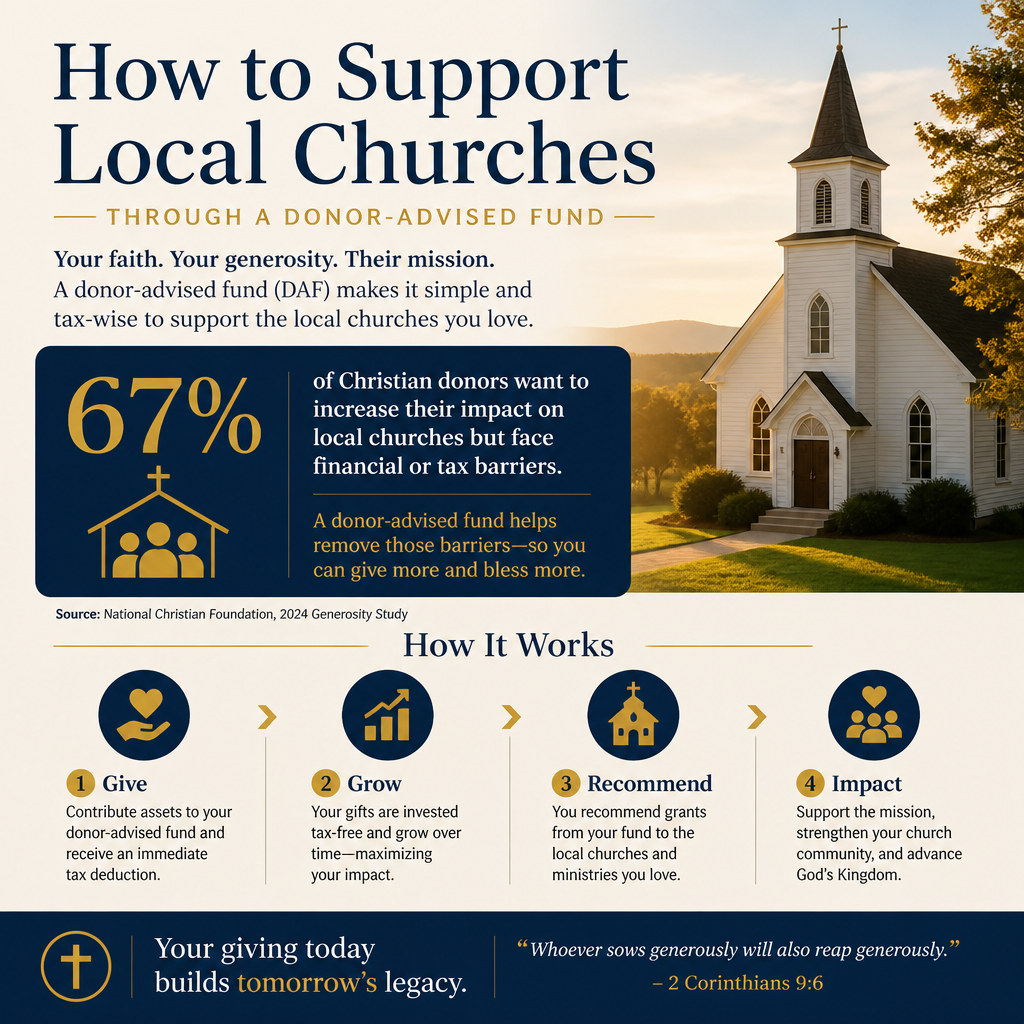
DAFs can increase consistency and reduce year-end distortion
Many households give in uneven bursts: a large year-end gift prompted by tax planning, a special offering, and then months of minimal support. A DAF can steady that pattern. Donors can contribute to the DAF in a high-income year and recommend grants to the church on a monthly or quarterly cadence. Churches, in turn, can plan staffing and ministry with fewer surprises.
DAFs also help donors separate the act of giving from the volatility of personal cash flow. In uncertain economic periods, this can protect both the donor’s long-term generosity and the church’s operational stability.
DAFs are still regulated charitable vehicles with real constraints
Not every gift that feels like “supporting the church” is eligible for DAF treatment. A DAF grant must be a charitable contribution to a qualified organization, not payment for goods or services, not a pledge payment if the sponsor prohibits it, and not a mechanism for personal benefit. Donors who are accustomed to purchasing event tables, paying for camp tuition, or covering conference tickets through their giving must slow down and confirm what their DAF sponsor permits.
It is also important to acknowledge a broader concern raised by church leaders: DAFs can create distance. When members’ giving moves to an external sponsor, pastors may lose visibility into congregational participation. That visibility is not about control; it can be part of pastoral care and shared responsibility. Donors can address this by proactively communicating with church leadership about their giving rhythm and intent.
Do due diligence on the church with the same seriousness you bring to other ministry giving
Churches often have fewer external disclosure requirements
Many donors assume that because a church is “the church,” it is automatically trustworthy in financial practice. Theologically, the church is holy in Christ. Practically, local churches are led by fallen people, and financial missteps can occur through sin, negligence, or simple lack of expertise. Unlike many nonprofits, churches are not required to file a public Form 990, which means donors often need to ask more directly for information.
Across our verification work at Most Trusted, we observe that strong ministries tend to welcome reasonable questions. They do not treat basic governance and financial accountability as a threat; they treat it as part of faithful stewardship before God and neighbor.
Ask for concrete documents and practices, not vague reassurance
Before recommending substantial or ongoing DAF grants, request materials that show how the church handles money and authority. The point is not suspicion. The point is clarity.
- Audited financial statements or a third-party financial review, if available
- Annual budget and year-end financial summary presented to the congregation
- Elder or board governance documents, including conflict-of-interest expectations
- Written financial controls, including dual-approval processes for disbursements
- Policies for benevolence distributions and designated gifts
When churches cannot provide these items, it does not automatically mean wrongdoing. Smaller congregations may rely on volunteer treasurers and basic bookkeeping. The harder question is whether the church is taking reasonable steps to mature its practices as resources grow.
For donors who want a structured lens for evaluating Christian organizations, The Most Trusted Standard is designed for precisely this kind of discernment across faith commitments, financial integrity, governance and leadership, and transparency and effectiveness. Even when a church is not formally reviewed, the same criteria can guide donor questions and expectations.
Structure DAF support in ways that strengthen the church rather than complicate it
Give to the general fund when you trust the leadership and mission
Designated giving can be a gift, but it can also become a constraint. Churches can end up with a well-funded project and an underfunded payroll. If a donor’s primary goal is to support the church’s pastoral ministry and ordinary operations, general support is often the most faithful and least disruptive form of DAF grantmaking.
For donors concerned about mission drift, the solution is rarely tighter designations. It is clearer governance, sound teaching, and leadership accountability. If those are lacking, a DAF designation cannot repair the deeper problem.
When you designate, tie the gift to a ministry goal and a reporting practice
Some designations are both appropriate and helpful: a benevolence fund, a local missions partnership, refugee assistance, theological training scholarships, or a capital campaign with clear oversight. In those cases, donors should ask for a defined purpose, a time horizon, and a reporting expectation that matches the scale of the gift.
One practical approach is to align the grant with the church’s existing categories and reporting rhythms, rather than creating a bespoke donor-driven structure. If the church reports quarterly to elders on benevolence distributions, for example, a donor can request that same level of reporting without increasing administrative burden.
Donors who give through DAFs should also coordinate with the church to ensure grants are recorded as charitable gifts and acknowledged appropriately. Most DAF sponsors send grants with a cover letter and may allow donors to include a note, but churches differ in how they reconcile anonymous gifts and year-end statements.
Connect local church support to the wider ecosystem of Christian ministry with careful boundaries
Churches are often grantmakers, even if they do not call themselves that
Many local churches pass donor funds outward: to missionaries, church planters, pregnancy care centers, disaster response, and global partners. Donors who want to support local churches through a donor-advised fund should pay attention to this second layer. A church may be financially healthy internally while channeling significant funds to partners that are less transparent or poorly governed.
This is an area where donors can serve the church rather than merely fund it. Asking the church how it vets partners, whether it receives reports, and how it responds to concerns can strengthen the church’s own stewardship practices. For donors who also fund parachurch ministries directly, it is often wise to coordinate: avoid duplicating support unintentionally and consider whether direct grants to verified ministries may be cleaner than routing funds through multiple intermediaries.
Use verification and research to reduce avoidable risk
Not every risk can be eliminated. Ministry involves people, and people are complex. But avoidable risk should be reduced, especially when a donor is stewarding significant resources intended for the Kingdom.
Most Trusted exists to help donors give with confidence by evaluating Christian nonprofits against The Most Trusted Standard. When a church partners with external ministries, donors can encourage leaders to prioritize organizations that demonstrate credible governance, clear financial reporting, and transparent program claims. When donors want broader context for disciplined DAF-based giving, engaging the wider conversation on Christian Donor-Advised Funds is often a helpful next step.
For donors who are refining their approach to DAF grantmaking choices, the practices associated with Giving Strategies Using Christian Donor-Advised Funds can clarify how to balance convictions, constraints, and verifiable trust signals without reducing Christian generosity to a spreadsheet exercise.
FAQs for How to support local churches through a donor-advised fund
Can a donor-advised fund grant be used for my tithe to a local church?
Many donors do use DAF grants to support their local church, and many DAF sponsors allow grants to churches that qualify as 501(c)(3) organizations. The more careful question is pastoral rather than technical: some churches teach that a tithe is a personal act of worship tied to the believer’s offering in the gathered community. If giving through a DAF creates distance, reduces congregational participation visibility, or shifts giving into a pattern driven primarily by tax planning, it can undercut the spiritual purpose even if it is permitted. We recommend speaking with church leadership about expectations and communicating clearly about your giving rhythm.
Should we give to the general fund or designate our DAF grant to a specific ministry?
General support is often the healthiest choice when a church’s leadership is trustworthy and the budget reflects sound priorities, because it funds the ordinary work that keeps ministry faithful and stable. Designated grants can be appropriate when the purpose is clear, the oversight is defined, and the church can report without excessive burden. If a donor’s impulse to designate arises mainly from concern about governance or transparency, it is usually wiser to address those concerns directly before giving rather than trying to control outcomes through restrictions.
Faithful support that a church can actually steward
Supporting local churches through a donor-advised fund can be an act of disciplined generosity: consistent, thoughtful, and aligned with the long horizon of discipleship. The opportunity is not merely to route funds efficiently, but to strengthen the ordinary, costly work of the church with gifts that are accountable, pastorally sensitive, and worthy of the gospel the church proclaims.



