

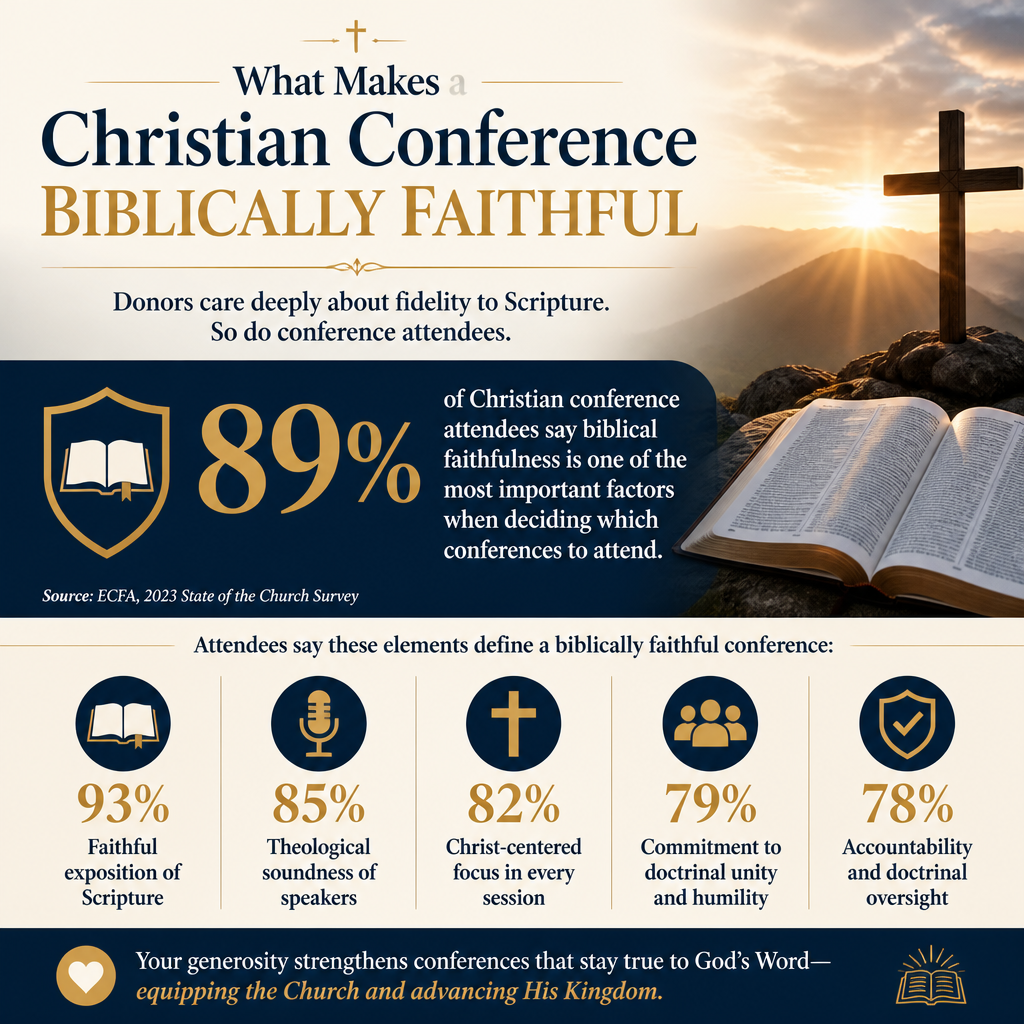
What makes a Christian conference biblically faithful is not first its production quality, its speaker lineup, or its attendance numbers. A conference is biblically faithful when its teaching, practices, and measurable fruit submit to Scripture, strengthen the local church, and form disciples whose lives bear the marks of repentance, love, and endurance.
Donors feel the pressure of this question because conferences are persuasive. A compelling weekend can move a room, open wallets, and create the sense of a spiritual turning point. Yet Scripture repeatedly distinguishes between momentary enthusiasm and lasting obedience. Jesus warns that some receive the word “with joy” and yet have no root (Luke 8:13). Paul insists that even eloquence and spiritual gifts mean little without love (1 Corinthians 13:1–2). Faithfulness is not cynicism; it is discernment practiced under the lordship of Christ.
Faithfulness begins with the message and the authority of Scripture
The gospel must remain central, not assumed
A biblically faithful conference makes the gospel explicit. It does not treat Christ’s atoning work as the entry point and then move quickly to “practical” themes that can be sustained without him. Paul summarized his ministry as delivering “of first importance” that “Christ died for our sins in accordance with the Scriptures… that he was raised on the third day” (1 Corinthians 15:3–4). Conferences can drift into therapeutic encouragement, culture-war identity, or leadership technique. Those themes may touch real needs, but they cannot replace the announcement of Christ crucified and risen.
Donors can listen for whether sin and grace are named with biblical clarity. A faithful conference preaches repentance without manipulation and assurance without presumption. It teaches union with Christ, justification by faith, and the call to holiness as a response to grace rather than a path to earn it. When the gospel is central, the invitation is not merely to attend an event but to belong to Jesus and his church.
Scripture should govern, not decorate
Many conferences quote Scripture. Biblical faithfulness is a stronger claim: Scripture must function as the controlling authority. That means texts are handled in context, the speaker’s main point is tethered to the passage’s main point, and difficult doctrines are not quietly edited out. The Bereans were commended because they examined the Scriptures daily to see whether the apostolic message was true (Acts 17:11). That posture should be encouraged, not treated as disloyalty.
The harder question is what a conference teaches implicitly. Do the songs, stories, and exhortations present a God who is holy, personal, and sovereign, or a God who primarily exists to validate the attendee’s plans? A biblically faithful conference makes room for the full counsel of God, including suffering, self-denial, and the slow work of sanctification.
Faithfulness is tested by the conference’s ecclesiology and accountability
Conferences should strengthen the local church, not compete with it
Christian conferences can serve the church when they equip leaders, provide specialized training, or foster collaboration across regions. They become spiritually hazardous when they function as parallel authority structures that siphon loyalty away from pastors and elders. Scripture’s ordinary means of discipleship are local and embodied: elders who “keep watch over your souls” (Hebrews 13:17), the preaching of the Word (2 Timothy 4:2), the sacraments, and mutual care in a congregation.
A faithful conference speaks and acts as a servant of the church. It encourages participants to submit to their local leadership, to reconcile where relationships are strained, and to integrate any new commitments into the life of their congregation. For donors, one revealing question is whether the conference’s call-to-action directs people toward their churches, or away from them toward the conference brand.
Plural leadership and meaningful oversight matter
Event ministries can be structurally vulnerable: charismatic founders, concentrated decision-making, and rapid scaling. Biblical patterns press against those risks. The New Testament assumes shared leadership and accountable stewardship (Acts 14:23; 1 Peter 5:1–3). A faithful conference should be governed by a board that is active, independent, and competent, with clear lines of authority over finances, safeguarding, and doctrinal commitments.
Across our verification work at Most Trusted, ministries that meet The Most Trusted Standard tend to treat governance as a spiritual discipline, not a legal formality. Donors should not accept “trust us” when the ministry has the power to shape thousands of Christians. They should expect clarity about leadership selection, conflict-of-interest controls, and external accountability.
Faithfulness shows up in ethics, money, and the way influence is handled
The Bible treats financial practices as discipleship issues
Jesus spoke with unusual frequency about money because money reveals worship. A biblically faithful conference handles pricing, fundraising, and speaker compensation in ways that are truthful and free from coercion. It avoids spiritualizing financial urgency (“God told us we must raise this tonight”) and it refuses to equate generosity with spiritual maturity in a way that burdens the poor.
Good stewardship also requires sober attention to incentives. When ticket sales, sponsorships, and online virality fund an operation, the temptation is to prioritize what sells. Biblical faithfulness resists that drift. It places integrity over expansion, even when that costs growth.
Transparency is not a posture, it is a practice
Donors should be able to see how the conference is funded, what proportion of revenue comes from donations versus registrations, and whether the ministry provides basic financial disclosures. In the United States, many ministries file Form 990; churches generally do not, and some conference operations are housed under church structures. Christians genuinely disagree about what level of disclosure is required in every case, but Scripture commends walking in the light (1 John 1:7) and handling gifts “honorably not only in the Lord’s sight but also in the sight of man” (2 Corinthians 8:21).
For donors who want to assess ministries in this space, our broader work on How Christian Conferences Measure Impact addresses what can and cannot be verified with integrity. A faithful conference does not inflate claims to satisfy supporters; it states what it is accountable for and what it is not.
- Clear fundraising language that distinguishes ticket revenue, donations, and restricted gifts
- Accessible financial reporting appropriate to the organization’s structure
- Conflicts-of-interest controls for vendors, platforms, and related-party transactions
- Safeguarding policies for minors and vulnerable adults, including reporting procedures
- Honor in compensation that avoids secrecy and celebrity premiums
Faithfulness requires care for people, not merely content delivery
Spiritual authority must be exercised with pastoral restraint
A conference environment amplifies power. Lighting, music, peer pressure, and public response moments can produce genuine conviction, but they can also produce compliance that collapses at home. Biblical faithfulness means the conference designs its ministry practices to protect consciences rather than capture them. Leaders should avoid public shaming, performative altar calls that function as social sorting, and claims of prophetic certainty that override wise counsel.
Paul’s ministry model included “not domineering over those in your charge, but being examples” (1 Peter 5:3), and he refused to “peddle the word of God for profit” (2 Corinthians 2:17). Conferences should align with that posture: strong exhortation without spiritual pressure tactics.
Safety and dignity are theological commitments
Faithfulness is tested in how the ministry treats those with less power: women, children, volunteers, and those seeking counsel. The church has learned through grievous failures that vague commitments are inadequate. Concrete safeguards, trained staff, clear reporting pathways, and appropriate boundaries in prayer and counseling are not secondary concerns; they are part of loving one’s neighbor.
Donors should ask whether the conference has third-party background checks where appropriate, whether volunteers are trained for their roles, and whether leaders submit to policies that constrain them. Where conferences host minors, safeguarding should be explicit and publicly available. Conferences that resist these questions often frame them as secular suspicion. Scripture frames them as responsible shepherding.
Faithfulness can be evaluated by fruit, but fruit must be defined carefully
Impact is more than attendance and emotion
Conference metrics are often blunt: registrations, social engagement, immediate giving, and attendee satisfaction. Those indicators are not meaningless, but they are not the fruit Scripture emphasizes. Jesus speaks of abiding that bears lasting fruit (John 15:5). Paul describes the fruit of the Spirit as character formed over time (Galatians 5:22–23). A faithful conference, therefore, should be cautious about declaring victory based on a moving testimony line or a surge in commitments.
Research on religious experiences supports this caution. Large, emotionally intense gatherings can produce short-term changes that fade without integration into community and practice. The question is not whether a conference can catalyze change; it often can. The question is whether the ministry is structured to help changes endure in the life of the church.
What donors can ask for without demanding the impossible
Some outcomes are difficult to measure with precision. Conferences are episodic; discipleship is lifelong. Yet credible indicators exist. A biblically faithful conference can track whether pastors report strengthened leaders, whether attendees connect to local congregations, whether training translates into sustained ministry practices, and whether safeguarding and governance systems are functioning under stress.
For donors assessing conference ministries within the broader ecosystem of Christian Camps and Conferences, the most revealing evidence is often mundane: documented policies, clear oversight, consistent theological commitments, and humility about what the event can accomplish. When a ministry claims certainty where only God can give it, it should raise concern.
Across our work at Most Trusted, the ministries that align with The Most Trusted Standard are typically marked by two traits that can be verified: they submit their claims to scrutiny, and they treat people as ends rather than means. Both are practical expressions of the doctrine that every person bears God’s image and that ministry is stewardship, not ownership.
FAQs for What makes a Christian conference biblically faithful
Is a conference biblically faithful if it has well-known Christian speakers?
Not necessarily. Well-known speakers may be faithful servants of Christ, but biblical faithfulness is a property of the conference as a whole: its doctrinal commitments, governance, safeguarding, fundraising ethics, and relationship to the local church. Donors should evaluate the conference’s oversight and practices, not only the platform’s reputation.
Should donors prioritize conferences that report large numbers of conversions or commitments?
Conversion is God’s work, and public numbers can be difficult to verify and easy to inflate. A faithful conference will celebrate genuine gospel fruit while speaking with restraint about what it can count. Donors can reasonably ask how decisions are followed up, how churches are involved, and what evidence exists of enduring discipleship rather than momentary response.
Faithfulness is measured by submission to Christ over time
A Christian conference is biblically faithful when it places the Word of God over brand, when it serves the local church rather than rivaling it, when it handles money and influence with transparent integrity, and when it pursues fruit that endures beyond a weekend. Donors who give with discernment are not withholding faith; they are practicing stewardship shaped by Scripture and informed by sober attention to how ministry actually works.



