

How Christian conferences measure impact is not a secondary question for Christian donors; it is part of faithful stewardship. Conferences routinely promise renewal, training, and a strengthened church. Donors rightly ask whether those claims can be tested without reducing discipleship to a spreadsheet. Scripture does not treat fruit as unknowable: Jesus taught that “you will recognize them by their fruits” (Matthew 7:16). The work is to define fruit carefully, measure it honestly, and resist the twin temptations of hype and cynicism.
The challenge is that conferences are episodic by design. A weekend gathering can catalyze conviction, clarify a calling, or reorient a leader’s ministry. Yet the most decisive evidence often emerges months later in the ordinary faithfulness of local churches. Wise measurement, then, distinguishes between immediate outputs, near-term outcomes, and longer-term formation, while acknowledging what cannot be neatly attributed to a single event.
Start with a biblical and practical theory of change
Impact measurement becomes credible when it begins with theological clarity about what the conference is for. Some conferences exist to equip pastors and elders for the ministry of the Word; others gather students for evangelism and vocation; others focus on counseling, missions, or worship. Those purposes are not interchangeable, and neither are their indicators. When donors hear “lives changed” without a defined end, it is difficult to know whether the ministry is aiming at regeneration, sanctification, skill development, or institutional growth.
Define the fruit the conference is actually pursuing
Scripture gives both direction and restraint. The New Testament speaks about visible fruit—love, repentance, endurance, generosity, and sound doctrine—while warning against boasting in numbers for their own sake. A biblically faithful conference will be able to articulate aims such as: strengthening leaders to “preach the word” (2 Timothy 4:2), training believers for “the work of ministry” (Ephesians 4:12), or mobilizing Christians for good works prepared by God (Ephesians 2:10). Those texts do not provide a metric, but they do provide a standard: the conference should be able to explain how its program choices plausibly serve those ends.
Separate outputs, outcomes, and formation
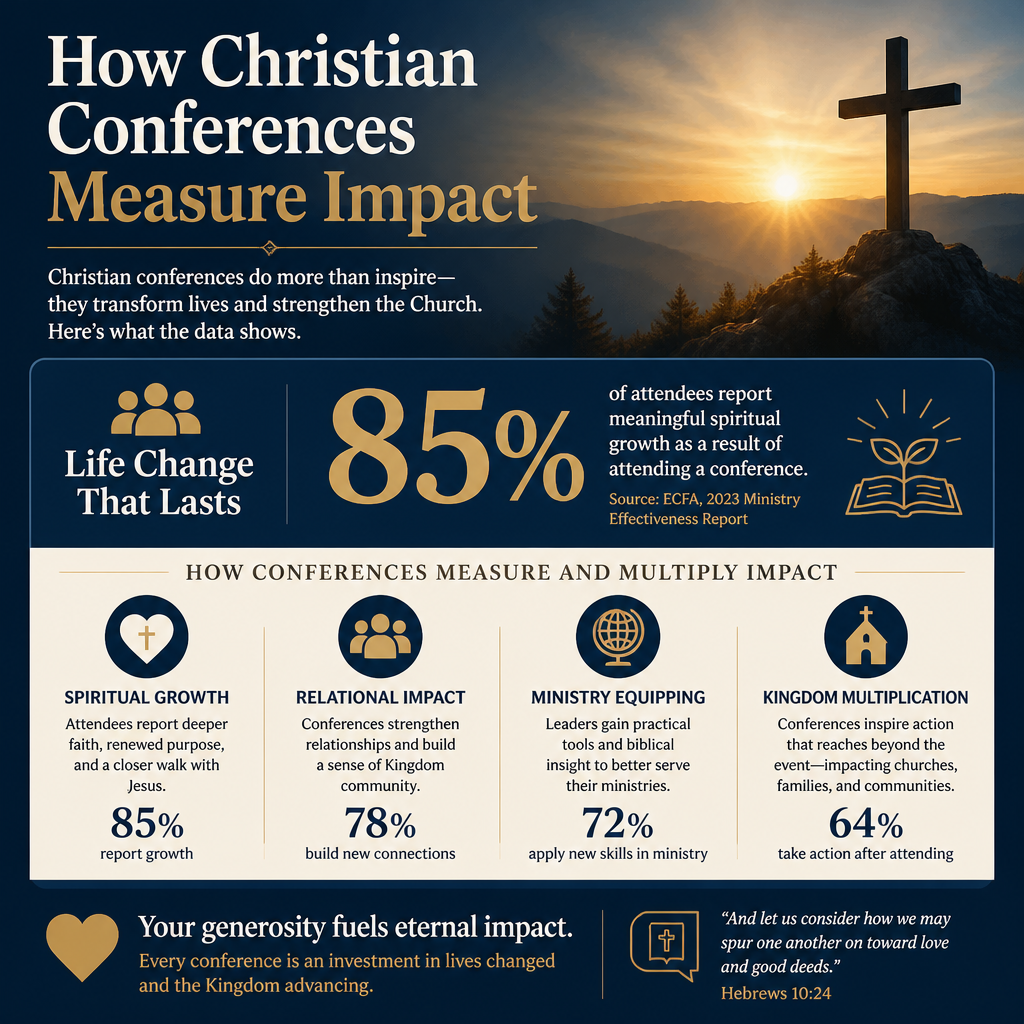
Outputs are countable activities: registrations, sessions delivered, scholarships granted, churches represented, languages served. Outputs matter because they reflect execution and reach, but they do not prove spiritual fruit. Outcomes are nearer-term changes plausibly connected to the event: increased knowledge, clarified next steps, ministry practices adopted, commitments made with support structures. Formation is longer-term: sustained habits of prayer and obedience, healthier leadership patterns, congregational resilience, and durable evangelistic witness.
Name what can and cannot be attributed
Christian donors tend to be allergic to both inflated certainty and vague spirituality. The honest posture is to acknowledge that God gives the growth (1 Corinthians 3:6) while still doing the work of evaluation. A conference can credibly claim contribution, not exclusive causation. It can test whether participants were equipped, whether they acted on what they received, and whether follow-up structures supported lasting change. It cannot claim to control the Spirit’s work or to own every downstream outcome.

Use the right metrics without letting metrics become the mission
Effective conferences measure what they can see, in a way that is proportional to the ministry and coherent with its theology. Donors should expect more than headcounts and testimonials, but they should also be wary when measurement frameworks become performative. The aim is not to mimic corporate dashboards; it is to tell the truth about what happened and what followed.
Participant-level measures that respect discipleship
For many conferences, the most honest near-term indicators are participant-level: pre- and post-event surveys on knowledge and confidence, intent-to-act questions tied to concrete behaviors, and short follow-up surveys that test whether the intent became action. In leadership settings, that may include adoption of specific practices (regular elder prayer, implementing a safeguarding policy, establishing a preaching plan, or beginning a counseling referral network). In evangelism-oriented settings, it may include participation in local outreach with a church partner, enrollment in ongoing training, or initiation of campus small groups under accountable oversight.
There is legitimate debate over self-reported measures. They are vulnerable to “event glow” and social desirability bias. Yet for spiritual and relational outcomes that are not easily observed, self-report is often a necessary starting point. The key is disciplined design: anonymous instruments, consistent questions over time, and follow-ups that test persistence rather than emotion.
Church and ministry-level signals that matter to donors
Conferences that primarily serve church leaders can measure outcomes at the level where fruit should appear: local churches. That does not mean a conference should pry into sensitive congregational data, but it can gather indicators such as: the proportion of attendees who are active in local church leadership, the percentage who report implementing one or two specific changes, and the extent to which those changes remained in place six or twelve months later.
Where possible, conferences can also track participation in cohorts, mentoring structures, or regional networks that continue beyond the event. Donors should value those structures because they reduce the common pattern of a “mountaintop” experience followed by drift. If a conference claims to strengthen the church, donors should expect some evidence that the conference strengthens churches in durable, ordinary ways.
Financial integrity is part of impact
For donors, impact is never purely programmatic. It includes whether funds were handled with integrity and clarity. The contemporary nonprofit sector has had to reckon with distorted giving incentives that treat low overhead as synonymous with effectiveness. The “Overhead Myth” statement—signed by major evaluators—argued that overhead ratios are a poor proxy for performance and can push organizations toward underinvestment in capacity and accountability GuideStar. Donors are right to ask for discipline in spending, but mature evaluation asks whether spending aligns with mission, whether reserves and cash flow are prudent, and whether the ministry can sustain its commitments without constant crisis fundraising.
Pay attention to follow-up and discipleship pathways
A conference can be excellent on stage and still fail in impact because it is thin after the closing session. The harder question is whether participants are connected to ongoing discipleship and accountable practice. For Christian donors, follow-up is where sincerity becomes visible: a ministry that expects fruit will plan for cultivation.
Concrete next steps beat vague inspiration
High-integrity conferences make it easy to translate conviction into obedience. They provide next steps that are specific, time-bound, and appropriately local: suggested rhythms of prayer, a reading plan, a six-week training cohort, templates for governance policies, introductions to vetted partner ministries, or a structured pathway into local church service. Donors can ask whether the conference offers such pathways and whether they are used, not merely advertised.
This is also where donors can test whether a conference is designed for formation or for spectacle. If the only “next step” is to buy next year’s ticket, the ministry’s impact claims should be treated cautiously.
Local church integration is a credibility marker
Conferences are not the church, and they should not compete with the church. The most credible conferences build their impact logic around strengthening local congregations and sending participants back under shepherding and community. This can be as simple as requiring attendees to affirm involvement in a local church, offering discounts through church groups, or equipping pastors with tools that are implemented in congregational life.
For donors, this matters because many of the failures in modern ministry are downstream of disconnection: charismatic leadership without accountability, teaching without pastoral care, zeal without wisdom. A conference that honors the local church is more likely to produce fruit that remains.
Safeguarding and spiritual care are part of effectiveness
Measurement discussions often overlook the ministries of care that prevent harm: safeguarding protocols, clear reporting mechanisms, and responsible counseling referral practices. These are not bureaucratic add-ons. They are acts of love and justice, especially when conferences serve youth, survivors of abuse, or vulnerable populations. Donors should ask whether the conference has trained staff, clear policies, and governance oversight that treats safety as a spiritual responsibility, not a legal checkbox.
What donors should ask and how Most Trusted evaluates conference impact
Donors are often forced to make decisions with limited information: a compelling speaker lineup, a glossy video, and a handful of stories. Stories belong in Christian testimony, but donors also need verifiable signals of integrity and effectiveness. Across our verification work at Most Trusted, we find that conferences that mature over time tend to become more specific in their claims and more transparent in their reporting. They learn to show their work.
Questions that clarify whether impact is real
- What is the conference’s primary aim? Ask for a short statement that names the intended outcome and the biblical rationale.
- Who is the conference for? Donors should expect clarity on audience selection and whether scholarships prioritize those with limited access.
- What evidence is collected? Look for a measurement plan: baseline data, post-event assessment, and follow-up at meaningful intervals.
- What is the follow-up pathway? Ask what percentage of participants enter cohorts, mentoring, or local church-integrated next steps.
- How is theological faithfulness safeguarded? Ask how speakers are vetted, how doctrinal boundaries are defined, and what governance oversight exists.
- What happens when results are mixed? Mature ministries can name what did not work and what changes were made.
How The Most Trusted Standard applies to conferences
Most Trusted evaluates ministries against The Most Trusted Standard, a 15-criteria framework across four domains: Faith Foundation, Financial Integrity, Governance and Leadership, and Transparency and Effectiveness. In conference settings, “effectiveness” often depends on the other domains more than leaders expect. A conference can report strong attendance and still fail the test of trust if its governance is weak, its financial reporting is opaque, or its doctrinal commitments are unclear.
Conversely, some of the most credible conference ministries are modest in scale but strong in accountability: clear statements of faith, independent boards with real oversight, audited financials when appropriate to size, conflict-of-interest discipline, and forthright reporting on outcomes and limitations. Donors should understand that transparency is not a public-relations posture; it is a moral posture shaped by the fear of the Lord.
Funding timing and sustainability are part of impact stewardship
Conference funding often concentrates around predictable cash-flow pressure points: venue deposits, insurance, speaker travel, technology contracts, and scholarship pools. Donors can ask when funds are most needed and whether the ministry budgets conservatively. Underfunded conferences are tempted toward last-minute marketing, inflated claims, and reduced safeguarding capacity. Overfunded conferences can drift into unnecessary production escalation. The stewardship aim is sufficiency for mission, with disciplined restraint.
For donors seeking broader context on this sector, our coverage of Christian Camps and Conferences addresses the distinctive accountability questions that arise when spiritual formation is pursued through time-bound events.
What faithful impact measurement makes possible
When Christian conferences measure impact well, donors are not asked to choose between spiritual seriousness and empirical honesty. They can support ministries that name a clear purpose, gather evidence proportionate to that purpose, and build follow-up pathways that honor the local church. That kind of measurement does not replace prayer, discernment, or pastoral wisdom. It strengthens them by refusing both manipulation and naiveté, and by treating donor stewardship as a matter that belongs under the lordship of Christ.



