
How Christian conferences measure discipleship outcomes is not a technical question alone. It is a stewardship question, because donors are not funding an event; they are participating in the church’s moral responsibility to “present everyone mature in Christ” (Colossians 1:28).
The difficulty is that discipleship is both unmistakably real and not fully reducible to metrics. Scripture gives concrete fruit—repentance, obedience, love, endurance—yet it also warns against measuring holiness by appearances and slogans. Mature conferences have had to reckon with this tension: the outcomes donors rightly want to see are often slow, relational, and embedded in local churches, while conference programming is time-bound and episodic.
Discipleship outcomes are more than attendance and satisfaction
Why donors keep asking for more than stories
Many conferences report what is easiest to count: registrations, engagement on an app, sessions attended, or post-event satisfaction surveys. Those data are not meaningless. They tell us whether logistics served participants well and whether content connected in the moment. But they are not discipleship outcomes in any biblical sense. A full room can still be spiritually thin.
Donors have learned this, sometimes painfully, across multiple sectors of ministry. Emotional intensity can be mistaken for transformation. A compelling speaker can become the proxy for spiritual maturity. When giving is tethered to these proxies, the result is often disappointment and cynicism.
A more biblically coherent definition of outcome
Conferences are not the church, but they are often a catalytic tool for the church. The most credible outcomes, then, are not “Did attendees like the event?” but “Did attendees take durable steps of obedience that endure beyond the event, in accountable community?” That framing aligns with the New Testament’s emphasis on perseverance and embodied faith (James 1:22–25).
What this means in practice is that outcomes should be defined in advance, tied to a theology of formation, and specific enough to be checked later. The field is right to resist simplistic scorecards. But it is also right to resist the opposite error: treating discipleship as unmeasurable and therefore unaccountable.

Strong measurement begins with a theory of formation
What a conference can and cannot claim to produce
A conference can plausibly claim to do certain things well: teach, exhort, model, convene, and create a focused environment for repentance and recommitment. It cannot responsibly claim to “disciple” in isolation from the local church’s ordinary means of grace. When conferences over-claim, measurement becomes marketing, and donors are asked to fund a narrative rather than a ministry.
Christians genuinely disagree about the relative weight of event-based ministry versus slow, local formation. That disagreement is not merely pragmatic; it reflects different ecclesiologies and different expectations about what conferences are for. Credible measurement starts by naming those assumptions rather than hiding them.
Common outcome categories worth measuring
Across our verification work at Most Trusted, we observe that conferences with higher integrity tend to specify outcomes in categories that can be followed over time. These are not the only legitimate categories, but they are among the most coherent for donors evaluating whether an event is serving long-term discipleship:
- Knowledge and conviction: clarified doctrine, biblical literacy, and a strengthened commitment to orthodox Christian belief.
- Practices: adoption of concrete disciplines such as Scripture reading, prayer, confession, and Sabbath.
- Community: connection to a local church, small group, or mentoring relationship with accountability.
- Character and repentance: identifiable areas of sin confronted and addressed over time.
- Vocation and mission: faithful service in ordinary callings, and, where appropriate, measured engagement in evangelism and mercy.
These categories are measurable without pretending to measure the Holy Spirit. They allow conferences to distinguish between immediate response and sustained change.
Methods that respect both theology and evidence
Pre and post instruments that measure change not enthusiasm
Many conference surveys are designed to elicit affirmation, not to detect change. A better approach uses pre- and post-event instruments that ask the same questions at different times and focus on specific behaviors and commitments. Even then, self-report has limits. People overestimate their follow-through and are often influenced by social desirability.
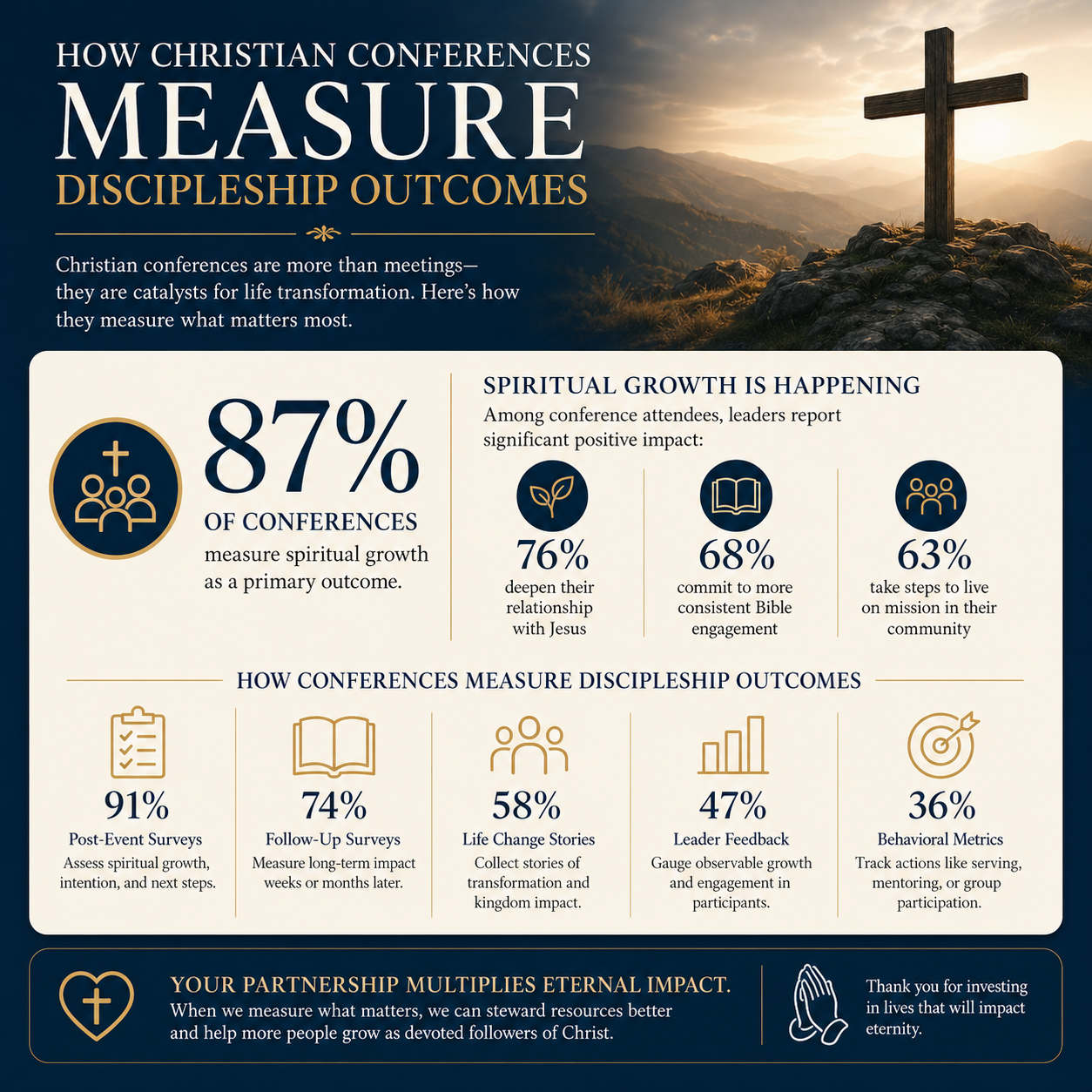
One corrective is to delay part of the measurement. Outcomes assessed at 30, 90, or 180 days are less vulnerable to post-event emotional peak. The harder question is whether the conference has the operational discipline to collect and analyze those data, and whether leaders are willing to publish what they learn, including what does not flatter the brand.
Church-anchored verification is the gold standard
Because discipleship is ordinarily church-embedded, the most credible outcome measurement involves the local church. Some conferences work with pastors and ministry leaders to validate follow-up: Are participants joining a church? Entering a discipleship relationship? Persisting in a recovery group? Serving in ministry? These data require consent, privacy safeguards, and humility about what can be confirmed.
When conferences do this well, they tend to see their role more clearly: a conference is a catalyst and connector, not a substitute shepherd. Donors should interpret that posture as maturity, not as a lack of ambition.
What donors should ask for and what to treat cautiously
Signals of maturity in a conference impact report
Donors are often shown moving testimonies. Those belong in Christian reporting, because Scripture honors personal witness. But mature reporting distinguishes testimony from outcome, and story from evidence. The most credible conferences will show donors how stories were selected, whether they are representative, and how the ministry is correcting for survivorship bias.
They will also treat negative feedback as a form of stewardship, not as a threat. If an event creates short-term zeal but long-term disillusionment, that is a real outcome and should be faced.
Questions we recommend donors bring to the table
When evaluating conferences within Christian Camps and Conferences, donors can ask questions that align with biblical seriousness and practical accountability:
Definition: What outcomes does the conference claim to influence, and what outcomes does it explicitly not claim?
Time horizon: What evidence exists at 90 or 180 days, not only on the final day?
Church connection: How does the conference integrate with local churches, and how are pastors involved in follow-up?
Data integrity: What percentage of attendees respond to follow-up surveys, and how does the conference address nonresponse bias?
Transparency: Will leadership share what did not work, and what was changed as a result?
These questions do not require a donor to become a statistician. They require the donor to insist that spiritual claims be matched with appropriate forms of accountability.
How Most Trusted evaluates discipleship measurement without reducing it
The Most Trusted Standard and effectiveness claims
Most Trusted exists to help donors give with confidence by evaluating ministries against The Most Trusted Standard, a 15-criteria framework across Faith Foundation, Financial Integrity, Governance and Leadership, and Transparency and Effectiveness. For conferences, the measurement question often sits in that last domain: are outcomes defined clearly, reported honestly, and supported by methods that fit the ministry’s claims?
We do not treat measurement as a replacement for theology. We treat it as a discipline of truth-telling. A ministry that makes large spiritual claims but declines any meaningful follow-up is asking donors to fund confidence without evidence. A ministry that measures everything but cannot articulate a coherent theology of formation is asking donors to fund technique without spiritual substance.
What effectiveness looks like in the real world
The best practice is rarely a single metric. It is a measurement system that is proportionate to the ministry, transparent about limitations, and integrated into decision-making. Conferences that meet higher standards tend to show how measurement changes programming decisions: session selection, small group design, pastoral care pathways, safeguarding practices, and how they equip churches for post-event discipleship.
This emphasis on honest reporting aligns with broader philanthropic wisdom. The “Overhead Myth” statement by major charity evaluators argued that donors should not fixate on administrative ratios but should ask whether a nonprofit is well-run and effective in its mission Charity Navigator. For Christian conferences, the analog is straightforward: do not fixate on the impressiveness of the event; assess whether the ministry can credibly describe what it is producing and how it knows.
For donors following the wider discussion under How Christian Conferences Measure Impact, the underlying question is not whether a conference can produce perfect evidence. The question is whether it will tell the truth about what it is seeing, learn from what it finds, and remain accountable to the church and to the Lord of the church.
FAQs for How Christian conferences measure discipleship outcomes
Can discipleship outcomes really be measured without becoming performative?
They can be measured in ways that are modest and appropriate to the claim. The goal is not to quantify holiness exhaustively but to verify whether a ministry’s stated aims are being pursued and whether participants are taking sustained steps of obedience in community. Measurement becomes performative when it is used to produce donor reassurance rather than to seek truth and guide improvement.
What is a reasonable follow-up window for conference outcomes?
Immediate post-event surveys are useful for logistics and initial response, but they are a weak proxy for discipleship. Many conferences find that 90 days is a meaningful first checkpoint for behavioral follow-through, with 180 days offering a clearer picture of persistence and church connection. The appropriate window depends on the outcomes being claimed and whether local churches are involved in verification.
Stewardship requires truthful claims and patient evidence
Christian conferences will always be tempted to report what is most flattering: large numbers, moving stories, visible enthusiasm. But discipleship outcomes are measured best when leaders accept the difference between catalyst and completion, and when donors insist that spiritual claims be tethered to accountable follow-up.
Donors are not asking conferences to master social science. They are asking for integrity: a theology of formation that fits the church, evidence gathered with humility, and reporting that treats truth as a Christian duty rather than a fundraising strategy.



