

What outcomes donors can expect from Christian conferences is a stewardship question before it is a programming question. Conferences can be genuine means of grace—teaching the Word, strengthening the Church’s moral imagination, and sending Christians back to their congregations with clearer callings. They can also become expensive events that generate strong emotions and weak fruit, especially when ministries cannot explain what changed, for whom, and for how long.
Scripture presses donors toward discernment rather than cynicism. Jesus warned that some hear the word “with joy” and yet have no root (Luke 8:13). Paul, by contrast, describes ministry that produces “obedience of faith” among the nations (Romans 1:5), a phrase that refuses to separate belief from lived allegiance. Donors have a right to ask whether a conference is designed and evaluated to move people toward that kind of durable formation.
Outcomes worth funding are more than attendance and enthusiasm
Counting the crowd is not the same as counting the cost
Many conferences report outcomes that are easiest to tally: registrations, seats filled, session satisfaction scores, social media reach, and a highlight reel of altar calls. Those metrics are not meaningless, but they are not sufficient for donor confidence. A sold-out room can coexist with superficial discipleship, and a modest room can house deep pastoral work.
We recommend distinguishing outputs from outcomes. Outputs describe what the ministry delivered; outcomes describe what changed in participants because the ministry delivered it. Christian donors generally do not object to funding outputs. The concern is whether a ministry is mistaking outputs for proof of spiritual fruit, or using them as a substitute for evaluation.
Fruit must be defined carefully in the Christian register
“Fruit” is not a vague religious synonym for positive feelings. The New Testament gives it moral and communal specificity: love, joy, peace, patience, kindness, goodness, faithfulness, gentleness, and self-control (Galatians 5:22–23). For conferences, that translates into measurable proxies that remain recognizably theological—such as repentance that leads to restitution, renewed commitment to a local church, reconciliation within families, or increased perseverance in vocational faithfulness.
At the same time, Christians genuinely disagree about what can be measured and what should remain largely qualitative. A conference that treats all spiritual formation as quantifiable tends to flatten the soul. A conference that treats all formation as ineffable tends to evade accountability. The donor’s work is to support ministries that hold both truths with integrity.

Donors should expect evidence of durable formation, not only a peak experience
Short-term spiritual intensity can be real and still be incomplete
A conference is an intervention with a built-in limitation: it is time-bound. Even a theologically serious event can unintentionally train participants to seek periodic emotional renewal instead of ordinary faithfulness in the local church. That does not discredit conferences; it clarifies what they can and cannot accomplish. Healthy conference outcomes look less like a spike and more like a trajectory.
Research in the broader field of behavior change reinforces the common-sense point that intention is not the same as follow-through. For example, the American Psychological Association notes that roughly 9% of Americans who make New Year’s resolutions report keeping them, a cautionary baseline for any “commitment moment” model of change (American Psychological Association). Christian leaders need not import secular frameworks uncritically, but donors should be sober about how easily strong intentions fade without structures of support.
Follow-up is not a marketing feature, it is part of discipleship design
Conferences that pursue durable outcomes typically build a pathway beyond the event: small-group materials, pastoral toolkits, coaching cohorts, or partnerships with local churches. These are not add-ons. They are the bridge between an event and a life.
Concrete outcomes donors can reasonably expect to see tracked over time include (1) increased Scripture engagement, (2) consistent participation in a local church, (3) relational repair and peacemaking, (4) vocational clarity and ethical endurance, and (5) sustained service to neighbors in tangible mercy. When ministries define outcomes at this level, evaluation becomes possible without reducing spiritual life to a spreadsheet.
Responsible conference outcomes connect to the local church and community impact
The conference is a gathering, not the Church
Christian conferences often serve the Church best when they strengthen what pastors and elders are already trying to do: teach sound doctrine, shepherd people through suffering, form Christian moral reasoning, and cultivate communal worship. Problems arise when conferences compete with the local church for loyalty or treat ecclesial accountability as optional.
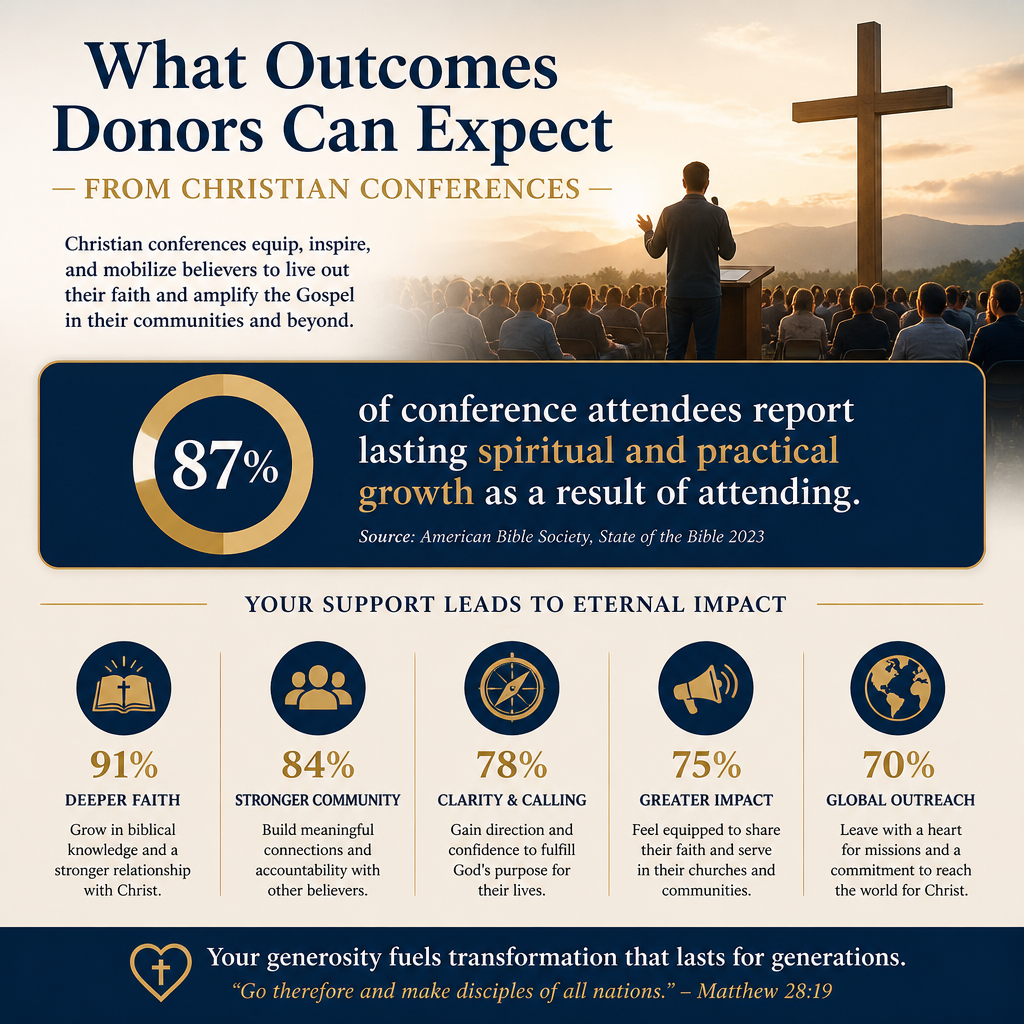
Donors can ask whether the ministry’s theory of change is church-anchored. Do participants return to congregations with tools that pastors can affirm and use, or with expectations the local church cannot realistically meet? The most credible ministries are candid about this tension and design their programming to honor the ordinary means of grace rather than displace them.
Community outcomes should be described with specificity, not sentiment
Many conferences rightly emphasize mission and mercy. Yet donor confidence rises when ministries can articulate the link between conference content and community-level results. If an event claims it will catalyze foster care engagement, prison ministry, pro-life pregnancy support, or refugee care, then donors can expect evidence that participation leads to sustained, accountable service.
In this area, language matters. “We inspired people to care” is not the same as “participants joined vetted local efforts, completed required training, and served for six months.” Across Christian Camps and Conferences, the ministries most likely to produce community outcomes are those that treat partnerships, safeguarding, and local coordination as essential—not as administrative burdens.
What to ask for: outcomes, methods, and safeguards that match the claim
A credible outcomes posture includes clear definitions and honest limits
Donors are often placed in a false choice: accept inspiring stories as sufficient, or demand scientific certainty that is unrealistic for spiritual formation. There is a better path. A credible conference ministry can explain:
- What the conference exists to change, and for whom
- How the teaching and programming are designed to produce that change
- What indicators are tracked immediately, and what is tracked over time
- How follow-up is handled, especially for people in crisis
- What outcomes the ministry does not claim, because the event is not designed for them
These questions are not hostile. They are a form of Christian stewardship, akin to Paul’s concern that giving be administered “honorably” (2 Corinthians 8:20–21).
Safeguards are outcomes work, not a separate compliance category
Conferences carry predictable risks: spiritual manipulation, inadequate counseling capacity, poor child protection practices, and celebrity dynamics that undermine pastoral accountability. Donors should expect ministries to describe safeguarding policies with clarity: background checks, incident reporting protocols, boundaries for prayer ministry, and referral pathways for mental health emergencies.
These safeguards are not distractions from mission; they are part of effective ministry. When preventable harm occurs, the damage is not only personal. It also corrodes public trust in Christian witness.
How Most Trusted evaluates conference outcomes under The Most Trusted Standard
Verification is not a replacement for discernment, but it disciplines it
Donors often face an information asymmetry: the ministry knows its operations; the donor sees a website and a moving testimony. Most Trusted exists to narrow that gap. We evaluate Christian nonprofits against The Most Trusted Standard, a 15-criteria framework that examines faith commitments, financial integrity, governance, and demonstrated transparency and effectiveness.
For conferences specifically, our work attends to whether outcomes claims are coherent, whether reporting is consistent over time, and whether the organization has governance and financial practices that protect donors and participants. A ministry that cannot articulate outcomes clearly often cannot manage growth responsibly. A ministry that refuses scrutiny rarely becomes more trustworthy with scale.
Effective reporting balances numbers, narratives, and accountability
We look for ministries that pair stories with substantiation. Narratives remain essential in Christian philanthropy because people are not data points. But narratives should be framed in ways that are accountable: what was done, what changed, what support was provided afterward, and what the ministry learned when results were weaker than hoped.
The stronger ministries also avoid the “overhead” fixation that can push organizations to underinvest in evaluation, safeguarding, and staff formation. The 2013 “Overhead Myth” letter—signed by Charity Navigator, BBB Wise Giving Alliance, and GuideStar—argued that simplistic overhead ratios are a poor proxy for nonprofit performance (Charity Navigator). Donors do not serve the Church by rewarding ministries that underfund the very systems that make outcomes credible.
For donors comparing conference ministries within How Christian Conferences Measure Impact, the most practical question is whether the organization can show consistent, humble, and verifiable evidence that participants are being formed into faithful disciples who remain accountable to Christ and his Church after the event ends.
FAQs for What outcomes donors can expect from Christian conferences
What is a reasonable time horizon for evaluating conference outcomes?
Immediate feedback can assess delivery quality, but formation outcomes generally require months, not days. We recommend expecting ministries to report both short-term indicators within a few weeks of the event and follow-up indicators at three to twelve months, especially when the conference makes claims about calling, moral change, or sustained service.
Should donors prioritize conferences that report a high number of decisions or commitments?
Public commitments can be meaningful, but a high count alone does not establish durable fruit. Donors should ask how the ministry defines a “decision,” what pastoral care and follow-up accompany it, and whether participants are connected to local-church accountability. In the New Testament, perseverance and maturity matter as much as beginnings (Colossians 1:28).
Giving with clear expectations honors both the Gospel and the donor
Christian conferences can be faithful instruments for teaching, worship, repentance, and missional clarity. Donors serve the Church best when they fund conferences with outcomes that are defined theologically, pursued with pastoral wisdom, and reported with verifiable humility. The goal is not to subject the work of the Spirit to the metrics of a corporation. It is to practice Christian stewardship with enough clarity that joy, integrity, and accountability can coexist.



