

What Christian apologetics ministries teach is not merely a catalogue of arguments for God’s existence. At their best, these ministries form Christians to love God with the mind, to endure honest questions without fear, and to commend the gospel with clarity and humility in a skeptical age.
Donors often support apologetics for one of two reasons: a desire to strengthen the church’s confidence, or a desire to reach those who dismiss Christianity as irrational or harmful. Both aims are legitimate, and both can drift. Apologetics can become combative, overly abstract, or detached from the church’s ordinary life. A mature approach keeps apologetic work tethered to the gospel, the local church, and accountable ministry practice.
Apologetics begins with the gospel, not with winning
What is being defended
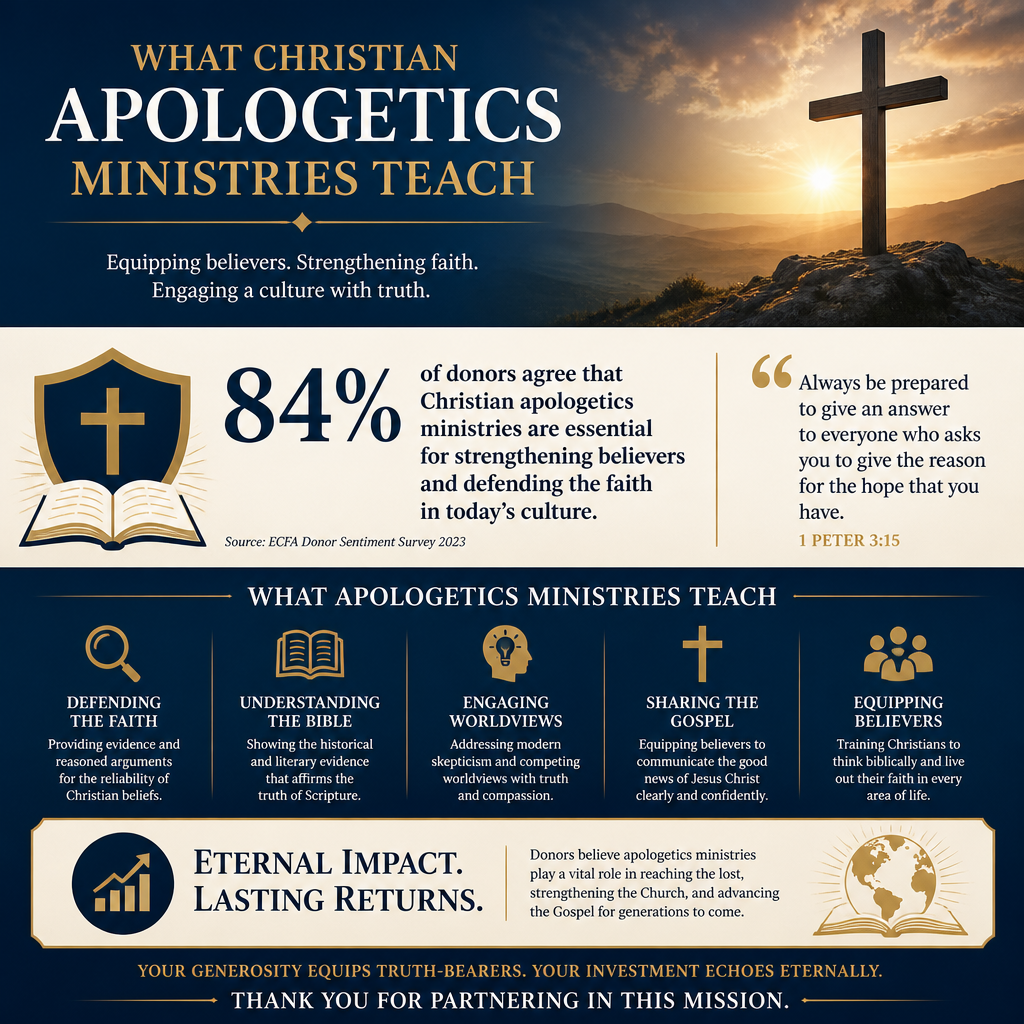
Christian apologetics, historically, is the reasoned commendation of the faith once delivered to the saints. The New Testament’s emphasis is not on cleverness but on faithful witness: “always being prepared to make a defense to anyone who asks you for a reason for the hope that is in you; yet do it with gentleness and respect” (1 Peter 3:15). That verse is as much about posture as it is about content.
Many apologetics ministries explicitly teach that Christianity is not a therapeutic sentiment or a tribal identity but a public truth claim about God’s action in history. The death and resurrection of Jesus, the lordship of Christ, the authority of Scripture, and the call to repentance and faith remain central. When apologetics reduces itself to generic theism, it can win agreement while leaving people untouched by the specific claims of the gospel.
Why tone and telos matter
Christians genuinely disagree about how confrontational apologetics should be in a polarized environment. Some audiences respond to direct critique of rival worldviews; others only hear disdain. The best ministries teach both courage and restraint: courage to name error, restraint to refuse contempt. Donors should look for ministries that form Christians to speak the truth in love, not simply to accumulate rhetorical victories.
Across our verification work at Most Trusted, we observe that apologetics organizations with a clear spiritual aim also tend to be clearer about ethical boundaries—how they represent opponents, how they treat staff, and how they measure “fruit” beyond clicks or attendance. Clarity of mission does not guarantee integrity, but it often supports it.

Apologetics ministries teach intellectual credibility across key questions
Arguments and evidence are treated as stewardship
Most apologetics ministries teach a set of core lines of reasoning that have longstanding roots in Christian thought: cosmological and moral arguments for God’s existence, the intelligibility of the universe, the reliability and historical context of the New Testament, and the coherence of Christian doctrine. They also teach that arguments are not neutral instruments. They are forms of stewardship—tools used to serve people, not to dominate them.
Well-formed apologetics distinguishes between evidence that is publicly accessible and claims that are received by faith. The resurrection, for example, is taught as a historical claim with public implications, not a private metaphor. Many ministries draw on the broad historical consensus that Jesus of Nazareth was crucified under Pontius Pilate; that baseline is widely affirmed by non-Christian historians as well as Christian scholars, though interpretations differ. Donors should prefer ministries that cite sources responsibly and avoid overstated claims that later unravel under scrutiny.
Science and faith are handled with care
One of the most common donor expectations is that apologetics will help young Christians withstand scientific skepticism. Many ministries teach that Christianity is not anti-science and that scientific inquiry can be seen as exploration of God’s ordered world. They often address evolution, origins, miracles, and questions of human uniqueness.
These conversations are contested among faithful Christians, and apologetics ministries land in different places. The donor’s task is not to demand uniformity but to demand honesty: clear definitions, charitable engagement with alternative views, and a refusal to exploit scientific complexity for rhetorical effect. Pew Research has documented the persistence of perceived tension between science and religion in American life, even while many religious Americans affirm that science and faith can be compatible in important respects (Pew Research Center).
They train Christians for cultural engagement and moral clarity
Worldview formation and competing narratives
Apologetics ministries frequently teach “worldview” categories: how underlying beliefs about reality, human nature, and morality shape what people find plausible. This can be a gift to donors who want the church to move beyond reactive outrage. A serious worldview approach asks what a culture worships, what it fears, and what it promises, and then evaluates those commitments under the light of Scripture.
At the same time, worldview teaching can become simplistic if it reduces people to caricatures. Mature apologetics trains Christians to listen carefully, to distinguish between a person’s stated beliefs and their lived longings, and to respond with both moral seriousness and empathy. Donors should be cautious when a ministry consistently presents opponents as irrational, evil, or beyond dialogue.
Human dignity and the image of God
Many apologetics ministries teach moral apologetics: the claim that Christianity uniquely grounds human dignity because all people are made in the image of God (Genesis 1:27). This becomes especially relevant in debates over human life, sexuality, race, technology, and political power. The best ministries keep dignity central even when they defend unpopular moral conclusions.
A frequent tension is that apologetics can become functionally political, even when it claims not to be. Christians genuinely disagree about strategy and prudence in public life, but basic standards still apply: clarity about what is theological conviction versus partisan inference; refusal to spread misinformation; and commitment to the church’s unity in Christ.
They shape evangelism, discipleship, and resilience under doubt
Answering questions is not the same as shepherding souls
Apologetics ministries often serve Christians walking through doubt: a child in college, a spouse deconstructing, a long-time believer troubled by suffering or unanswered prayer. Here apologetics overlaps with pastoral theology. Good ministries teach that doubt can be an occasion for growth in humility and dependence, not an automatic sign of rebellion.
Many emphasize the difference between intellectual questions and moral or relational resistance. Scripture itself recognizes this complexity: people can “suppress the truth” (Romans 1), and people can also be “tossed to and fro” by teaching (Ephesians 4). Apologetics that ignores spiritual formation tends to produce either anxiety or arrogance.
Common outcomes worth funding
Donors should expect apologetics to produce more than content. The most credible ministries articulate how their work strengthens churches and individuals. A few outcomes that tend to be both meaningful and observable include:
- Christians who can explain the gospel clearly and answer common objections without hostility
- Church leaders equipped with resources for preaching, teaching, and student ministry
- Public events that model respectful dialogue with skeptics and other faiths
- Discipleship pathways that integrate doctrine, spiritual disciplines, and intellectual formation
- Resources that help parents and educators address questions of identity, suffering, and Scripture
When donors evaluate an apologetics ministry’s claimed impact, they should ask how the ministry verifies these outcomes. Attendance counts are not worthless, but they can be ambiguous. A smaller, deeper formation model may bear more lasting fruit than a larger, thinner media footprint.
Donors should assess apologetics ministries with verification-level clarity
Content can be excellent while governance is weak
Apologetics ministries often attract charismatic communicators and loyal audiences. That combination can create genuine gospel opportunity, and it can also produce accountability risks. The Christian sector has learned repeatedly that compelling public teaching does not substitute for board oversight, financial discipline, or transparent reporting. Donors do not honor God by ignoring preventable governance failures.
This is where independent evaluation matters. Most Trusted exists to help donors give with confidence by assessing Christian nonprofits against The Most Trusted Standard, a 15-criteria framework across Faith Foundation, Financial Integrity, Governance and Leadership, and Transparency and Effectiveness. Apologetics ministries should welcome this kind of scrutiny because truth-telling is not only their message; it must be their practice.
What to look for when giving
Across our work, the ministries most worth sustained donor partnership tend to show a consistent pattern: clear doctrinal commitments, disciplined finances, and transparent communication about both successes and limitations. The harder question is whether a ministry can speak about truth with the same integrity it demands in debate.
As donors compare approaches and models, it helps to place apologetics within the wider ecosystem of Christian ministry outcomes. Many donors benefit from reviewing the broader landscape of Christian Apologetics Ministries and then considering specific program expectations within Programs and Outcomes in Christian Apologetics Ministries. What is being taught, and what is being formed, should align.
FAQs for What Christian apologetics ministries teach
Do apologetics ministries mainly teach arguments, or do they teach discipleship?
The strongest apologetics ministries teach both, and they integrate them. They offer reasons for Christian belief while also training Christians in humility, careful listening, prayerful dependence, and faithful evangelism. When apologetics becomes only argumentation, it tends to produce either combative posture or fragile confidence.
What should donors ask to evaluate an apologetics ministry responsibly?
Donors should ask about doctrinal clarity, the ministry’s relationship to the local church, and the fruit it expects beyond audience size. Practical questions include whether the organization has an independent board, audited or reviewed financials, a clear conflict-of-interest policy, and transparent reporting on outcomes. Those are the kinds of indicators Most Trusted examines when evaluating ministries against The Most Trusted Standard.
A faithful apologetics ministry teaches truth with integrity
Christian apologetics ministries teach that Christianity is reasonable, coherent, and publicly defensible, and that faith is not a retreat from reality. They also teach, implicitly or explicitly, a doctrine of the person: opponents are neighbors, not projects. For donors, the essential question is not only whether a ministry’s arguments are strong, but whether the ministry’s life together is ordered by the same truth it proclaims.



