

Donors ask what outcomes apologetics evangelism events produce because public gatherings can consume significant budget, volunteer hours, and reputational capital. The question is not whether proclamation matters. Scripture is unambiguous that the gospel is “the power of God for salvation” (Romans 1:16). The question is how to recognize, support, and verify fruit that is real, durable, and appropriately reported.
Apologetics events sit at an intersection: evangelism, discipleship, and public witness. They can remove obstacles to faith, clarify Christian doctrine for searching skeptics, strengthen believers facing intellectual pressure, and shape a community’s confidence to speak of Christ. They can also drift into entertainment, brand-building, or unmeasured activity that is difficult for donors to evaluate. Mature giving requires clearer categories for outcomes than “attendance” or “energy in the room.”
Start with outcomes that match the Christian purpose of apologetics
Apologetics serves proclamation and formation
The New Testament presents apologetics as truthful testimony and reasoned defense in service of the gospel. Peter’s command to “always be prepared to make a defense” is explicitly tethered to hope, gentleness, and reverence (1 Peter 3:15). Paul’s public reasoning in Acts is aimed at persuasion toward Christ, not merely the display of intellect (Acts 17:2–4). Those texts push donors to ask whether an event is ordered toward conversion and discipleship, not only toward intellectual stimulation.
What this means in practice is that outcomes should be defined in spiritual categories that still admit careful measurement. A ministry may not be able to “count conversions” with precision, and Christians genuinely disagree about how to interpret immediate response metrics. But a ministry can report credible indicators of engagement with the gospel, connection to the local church, and sustained follow-through.
The outcomes are often sequential, not instantaneous
Many apologetics events are “pre-evangelistic” in the sense that they clear away objections so that a person is willing to consider Christ. Donors should not expect a one-night event to do what normally requires patient conversation and pastoral care. Even Billy Graham Association materials, representing one of the most recognized evangelistic models, emphasize local church follow-up and discipleship pathways rather than treating a decision as the endpoint (Billy Graham Evangelistic Association).
A useful donor frame is to evaluate a ministry’s theory of change: How does the event connect to ongoing relationships, church life, and pastoral care? The strongest programs describe this sequence plainly and then document it with evidence that can be checked.

Measure what can be measured without claiming more than Scripture warrants
Attendance is a weak outcome on its own
Attendance matters, but it is an input-output confusion to treat a crowd as fruit. A large room may indicate effective promotion, a well-known speaker, or cultural curiosity. It may also represent faithful local partnership. Donors should treat attendance as a threshold metric: it answers whether the ministry can convene people. It does not answer whether people were served, persuaded, or connected to ongoing discipleship.
When ministries report numbers, the responsible question is whether they can define them precisely. “Registrations,” “check-ins,” and “unique attendees” are different realities. A credible report states which is being counted and how duplicates are handled.
Stronger outcome indicators are behavioral and relational
The most meaningful outcomes are often the quiet ones that indicate movement toward Christ or deeper Christian maturity. Ministries that meet rigorous verification expectations tend to track follow-up, not just applause. Examples of outcomes that can be reported without exaggeration include:
- Meaningful post-event conversations: scheduled meetings, pastoral referrals, or trained counselor interactions
- Next-step commitments that are verifiable: joining an inquiry group, signing up for a Christianity Explored course, or requesting a Bible
- Local church connections: referrals accepted by partner churches and confirmed contact attempts
- Volunteer formation: training completion, retention, and demonstrated readiness to engage skeptics with gentleness
- Repeat engagement: attendees returning for a second event or joining a cohort for ongoing learning
These are still imperfect proxies. Yet they are more aligned with what donors are actually trying to fund: faithful witness that produces durable spiritual good.
Assess outcomes at three levels: skeptic, believer, and public square
Outcomes for seekers and skeptics
For nonbelievers, apologetics events often produce two kinds of outcomes: intellectual clarity and relational contact. Intellectual clarity may show up as a person naming what they misunderstood about Christianity, or identifying a specific barrier that can now be discussed. Relational contact shows up when a person is willing to keep talking, to meet with a pastor, or to accept an invitation into Christian community.
Donors can ask ministries to document seeker pathways with modesty and precision: How many requests for follow-up were received? How many were successfully contacted? How many entered a defined next step? A ministry does not need to overpromise to report these indicators with integrity.
Outcomes for believers under pressure
Apologetics events frequently serve Christians who are attempting to remain faithful in settings that penalize Christian conviction. The outcome here is not merely “confidence,” which can be emotional and fleeting, but clarity that strengthens perseverance. Many believers report that their primary challenges are not only intellectual arguments but social cost and fear of isolation.
Research on religious identity and social pressures is complex, but it is broadly recognized that belonging and community support shape religious retention. Pew Research documents the ongoing trend of religious switching in the United States, including movement away from Christianity among some cohorts (Pew Research Center). Apologetics ministries should not treat an event as a substitute for the church, but they can serve the church by equipping believers to endure cultural pressures with truth and charity.
Outcomes for the public witness of the local church
Some outcomes are communal. A well-executed event can strengthen relationships among churches, create a credible public presence, and raise the standard of discourse in a city. These outcomes are harder to quantify, but not impossible to verify. Donors can look for evidence such as written partnership agreements, multi-church steering teams, and post-event debriefs that identify what improved and what failed.
It is also appropriate to ask whether the ministry’s public witness aligns with Christian ethics. Truthfulness, humility, and refusing to caricature opponents are not optional qualities for apologetics. A ministry that generates attention by contempt will often produce donors, clicks, and crowds, but it damages the church’s credibility over time.
Common pitfalls that distort reported outcomes
Counting decisions without pastoral context
Event evangelism has long wrestled with what constitutes a credible profession of faith. Christians genuinely disagree about how to interpret altar calls, prayer cards, or instantaneous decisions, and different traditions will emphasize different evidences of conversion. What should unify donors is the refusal to claim spiritual outcomes that cannot be responsibly substantiated.
We recommend asking ministries to distinguish between immediate responses and confirmed follow-up. If a ministry reports “professions of faith,” donors should ask how those were defined and what process exists to connect individuals to a church where baptism, catechesis, and pastoral care can occur.
Centering the speaker rather than the church
Apologetics events often revolve around a gifted communicator. That can be a legitimate instrument in God’s providence. Yet the danger is that the audience becomes attached to a personality rather than being joined to the local body of Christ. Donors should notice whether the ministry’s reporting emphasizes brand reach or the strengthening of local congregations.
Healthy ministries usually show humility in their ecosystem role. They speak of serving pastors, training volunteers, and equipping churches, not competing with them. They also share credit broadly and can name local partners without reluctance.
What verification-minded donors should ask before funding an event
Evidence aligned with The Most Trusted Standard
Most Trusted exists to help donors give with confidence by evaluating ministries against The Most Trusted Standard, a 15-criteria framework spanning Faith Foundation, Financial Integrity, Governance and Leadership, and Transparency and Effectiveness. In our evaluation work, apologetics events often expose the difference between ministries that can document outcomes and ministries that can only narrate activity.
Before funding an event, donors can request documentation that maps to these concerns: a clear statement of faith and theological accountability; budgets that distinguish restricted event revenue from general funds; conflict-of-interest disclosures; and outcome reporting that includes both positive results and limitations.
Questions that separate narrative from reality
We recommend donors ask a short set of disciplined questions and expect clear, written answers:
- What is the specific audience: high school students, university skeptics, church members, or the general public?
- What next steps exist, and who owns follow-up: the ministry, partner churches, or both?
- How are outcomes defined and counted, and what is the timeline for follow-up reporting?
- What safeguards exist for counseling, prayer ministry, and data privacy for attendees?
- How is the event evaluated afterward, and what changes were made based on prior evaluations?
Donors should also ask what will not be claimed. A ministry that refuses to overstate spiritual impact often demonstrates more maturity than one that markets certainty where Scripture calls for humility.
For donors supporting apologetics more broadly, our coverage of Christian Apologetics Ministries addresses how different models of public engagement, training, media, and campus work tend to report outcomes and governance practices.
For readers comparing event programs specifically, Programs and Outcomes in Christian Apologetics Ministries describes common reporting patterns, follow-up models, and the effectiveness questions that recur across ministries.
FAQs for What outcomes apologetics evangelism events produce
Should donors expect conversion counts from apologetics evangelism events?
Donors should expect honesty more than a single headline number. A ministry may report professions of faith, but responsible reporting defines what was counted, distinguishes immediate responses from later confirmation, and explains the follow-up pathway into a local church. Where follow-up cannot be verified, ministries should avoid treating decisions as settled outcomes.
What is a credible effectiveness report for an apologetics event?
A credible report names the audience, documents attendance with clear definitions, and then reports follow-up outcomes over time: contact attempts, conversations, church referrals, and participation in next-step cohorts or courses. It also names constraints and failures, such as low follow-up response rates or gaps in local church partnership, and explains what will change as a result.
Funding apologetics events with discernment
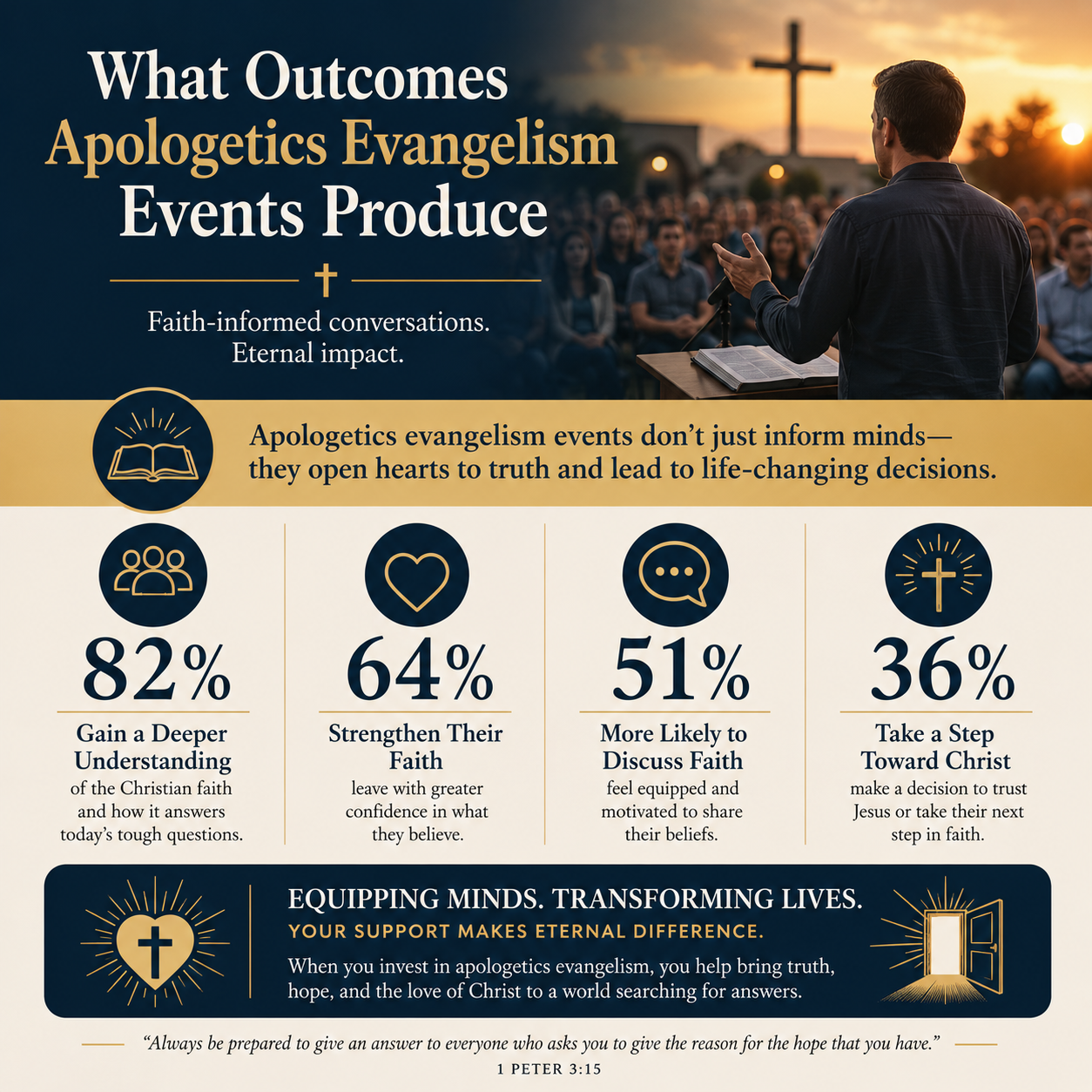
Apologetics evangelism events can produce meaningful outcomes: obstacles removed, seekers connected, believers strengthened, and churches equipped for public witness. Those outcomes are often sequential and relational, which makes them harder to market but not impossible to verify. Donors best serve the church by funding ministries that define fruit carefully, report it precisely, and submit their work to accountability consistent with The Most Trusted Standard.



