

How Christian apologetics ministries support campus outreach is not primarily a question of tactics. It is a question of formation: whether students are being equipped to love God with heart, soul, and mind, and to give a reason for the hope within them with gentleness and respect (Luke 10:27; 1 Peter 3:15). Donors who care about the long-term health of the church should pay attention here, because the university remains one of the most concentrated environments for intellectual pressure, social cost, and spiritual drift.
Campus outreach has also become more complex. Universities are not monolithic, student bodies are more religiously diverse, and the moral imagination of many students is shaped less by inherited tradition and more by digital communities and institutional narratives. Apologetics, at its best, does not replace evangelism or discipleship; it clears impediments, strengthens confidence, and trains Christians to speak truthfully in a contested public square.
Why campus outreach requires intellectual discipleship
Scripture frames reason as part of faithful witness
The New Testament does not oppose reason; it presses reason into the service of worship. Paul’s public reasoning in synagogues and marketplaces (Acts 17) was not an academic exercise detached from mission. It was evangelistic witness anchored in the resurrection. On campus, students are asked—often implicitly—whether Christian claims can survive scrutiny, whether Christian ethics are coherent, and whether Christian hope is more than sentiment.
Verifiable evidence suggests that young adulthood is a decisive period for belief and belonging. In a widely cited analysis of religious switching, Pew Research Center reports that many adults who no longer identify with the religion of their childhood say they made that change before age 24 (Pew Research Center). Apologetics ministries are not the sole answer to this reality, but they address one of its drivers: the perception that Christianity cannot answer serious questions.
Outreach falters when Christians fear questions
Christians genuinely disagree about how much emphasis apologetics should receive in campus ministry. Some worry it can become combative, performative, or detached from prayer and holiness. Those concerns are not theoretical; every generation has seen apologetics used as a substitute for love. Yet the opposite error is also costly: discipling students into a faith that treats hard questions as disloyalty. When students conclude that the church has no credible answers, they often stop asking their questions in Christian community and start answering them alone.
Healthy apologetics ministries on campus help normalize honest inquiry under pastoral care. They create spaces where students can say, without embarrassment, “I do not understand,” and remain in fellowship while they learn. That posture is not weakness; it is a form of humility appropriate to creatures before the Creator.

What apologetics ministries contribute to campus outreach
They train students to engage rather than withdraw
Campus outreach requires Christians who can remain present in the classroom, the residence hall, and the student organization without being governed by fear. Apologetics ministries support that steady presence by helping students articulate what they believe and why, with attention to both intellectual rigor and relational wisdom. In practice, this often includes training in worldview analysis, basic philosophical reasoning, and careful handling of Scripture.
The strongest programs resist a false choice between courage and gentleness. Students learn to distinguish between confidence and arrogance, and between compassion and capitulation. They learn that persuasion is not manipulation, and that winning an argument is not the same thing as loving a neighbor.
They help evangelism address real objections
Campus evangelism commonly encounters a recurring set of objections: the problem of evil, perceived contradictions in Scripture, the exclusivity of Christ, the relationship between faith and science, and the church’s moral failures. Apologetics ministries help campus workers and student leaders address these questions with more than slogans. They also train students to ask better questions back—questions that clarify what a friend actually believes, and what moral or metaphysical assumptions are doing the work in the conversation.
What this means in practice is that outreach becomes more patient and less reactive. When a student says, “I cannot believe in a God who allows suffering,” the conversation is less likely to collapse into defensiveness, and more likely to move toward lament, the cross, and the moral weight of the student’s own protest. A credible apologetic does not remove the mystery of suffering, but it can show why the Christian story has the resources to name evil as evil and still hope.
How apologetics strengthens the long-term fruit of campus ministry
Retention is not the goal, but endurance matters
Campus outreach is rightly measured by faithfulness, not by institutional survival. Yet donors are not wrong to ask whether ministries are helping students endure beyond graduation. The Barna Group has long tracked the spiritual volatility of young adulthood, and their reporting has contributed to sustained attention on the transition from youth ministry into adult discipleship (Barna). Apologetics ministries contribute by reinforcing intellectual resilience: the capacity to face criticism, complexity, and cultural marginalization without abandoning the faith.
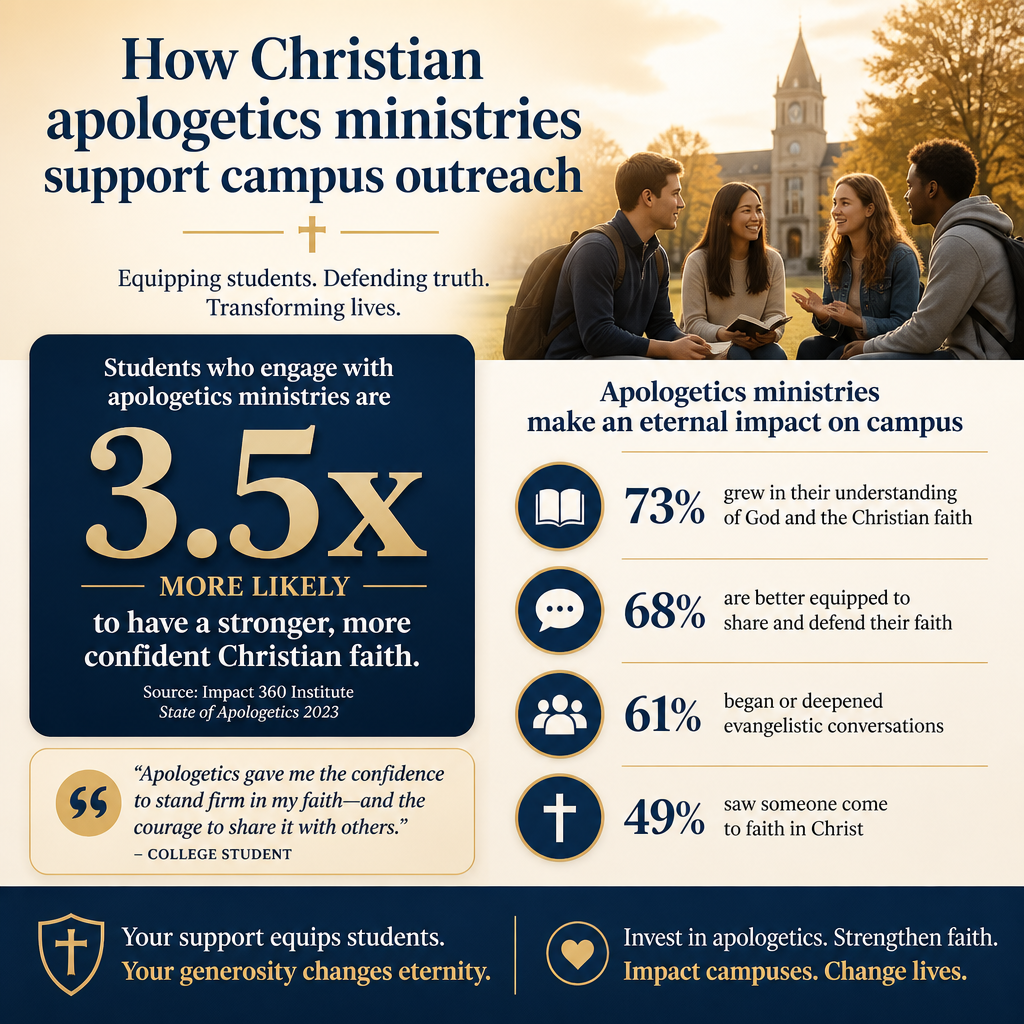
That resilience often shows up in ordinary ways: a student who can read a difficult text without panic, who can admit uncertainty without collapsing into cynicism, who can participate in a seminar without hiding their convictions, and who can speak about Jesus without treating classmates as enemies. These are not spectacular outcomes, but they are foundational ones.
They develop leaders for the church and the marketplace
Universities shape future pastors, educators, researchers, clinicians, engineers, artists, and public servants. A campus outreach movement that produces thoughtful Christian leaders serves the whole church. Apologetics ministries help students integrate vocational calling with Christian conviction, including how to reason about truth, goodness, and human dignity in settings where Christian premises are not shared.
Across our verification work at Most Trusted, we observe that ministries with durable outcomes tend to treat student leadership development as more than event staffing. They invest in mentoring, supervised responsibility, and theological depth. They also maintain clear doctrinal commitments while equipping students to engage across difference without contempt.
What discerning donors should look for in apologetics and campus outreach
Marks of health that are visible and verifiable
Donors often hear compelling stories about debates, speaker events, or viral moments. Those can be useful, but they are not the best indicators of spiritual health. The harder question is whether an apologetics ministry is forming students in Christlike character, submitting to ecclesial accountability, and stewarding resources with integrity. At Most Trusted, we evaluate ministries against The Most Trusted Standard, a 15-criteria framework covering Faith Foundation, Financial Integrity, Governance and Leadership, and Transparency and Effectiveness.
Several indicators tend to matter more than donors initially expect:
- Clear doctrinal commitments paired with humility about nonessential disputes
- Accountable partnerships with local churches rather than functional independence
- Training that includes prayer, Scripture, and spiritual disciplines alongside argumentation
- Safeguards against celebrity culture in speakers and leaders
- Evidence of follow-up discipleship after events, not only event attendance
Common risks the field continues to reckon with
Christian apologetics on campus can drift into patterns that undermine its stated aims. A ministry can become addicted to public confrontation, confusing volume with clarity and confidence with faithfulness. It can reward students for rhetorical dominance rather than spiritual maturity. It can also become narrow, treating a limited set of intellectual questions as the whole of discipleship while neglecting repentance, reconciliation, and the slow work of sanctification.
Donors can ask questions that reveal whether these risks are being taken seriously. Who holds leaders accountable? How are students discipled after they become convinced? How does the ministry handle moral failure? What is the relationship to the local church and to pastoral oversight? These are not peripheral; they are the conditions under which apologetics becomes a servant of mission rather than a rival to it.
How Most Trusted evaluates campus-facing apologetics ministries
Verification serves love of neighbor in Christian giving
Christian donors do not merely fund religious activity; we bear responsibility for whether our giving strengthens faithful witness. Scripture treats stewardship as spiritual formation, not administrative detail. That is why independent verification matters. It protects donors from avoidable confusion, and it protects ministries from incentives that reward spectacle over substance.
Our work at Most Trusted is designed to help donors give with confidence, not by reducing ministry to financial ratios, but by assessing whether governance, doctrine, reporting, and outcomes are coherent and credible. Ministries that meet The Most Trusted Standard tend to communicate clearly about what they do on campus, how they measure spiritual and program outcomes with appropriate humility, and how donor funds are directed toward mission rather than toward avoidable overhead or opaque compensation structures.
Where donors can deepen their due diligence
Campus outreach sits within a wider ecosystem of Christian apologetics, including publishing, conferences, digital media, and local church training. Donors who want to understand the broader landscape of apologetics organizations can review Christian Apologetics Ministries to see how different models fit together and where verification questions commonly arise.
Donors who are specifically focused on program design, reporting, and outcomes can also engage Programs and Outcomes in Christian Apologetics Ministries. The most responsible giving is rarely impulse giving. It is patient support shaped by clarity about mission, evidence, and accountability.
FAQs for How Christian apologetics ministries support campus outreach
Do apologetics ministries replace traditional campus evangelism?
No. Apologetics is a support to evangelism and discipleship, not a substitute for them. On campus, apologetics helps remove intellectual obstacles, correct misconceptions, and train Christian students to speak with clarity. The gospel is still received through the Spirit’s work, and students still need Christian community, sacramental life where applicable, pastoral care, and ongoing formation in holiness.
What should donors ask before funding an apologetics event on a campus?
Donors should ask what happens before and after the event. How are students trained to engage with gentleness and respect? How will the ministry follow up with seekers, skeptics, and Christian students who were stirred up by the discussion? Who provides theological and pastoral oversight? Finally, donors should request clear financial reporting and outcome reporting that avoids inflated claims and explains limitations candidly.
A durable witness requires both truth and trust
Campus outreach will remain a strategic and spiritually demanding field, because universities concentrate questions of truth, identity, and moral authority. Christian apologetics ministries support that outreach when they help students worship God with their minds, endure cultural pressure without rancor, and speak credibly about Christ to skeptical friends. Donors best serve this work by funding ministries that pair intellectual seriousness with ecclesial accountability, transparent stewardship, and measurable faithfulness over time.



