
Programs and outcomes in Christian apologetics ministries matter because donors are not merely funding content; they are funding formation. Apologetics at its best serves the church’s witness by helping ordinary Christians “honor Christ the Lord as holy” and give a reason for their hope “with gentleness and respect” (1 Peter 3:15, ESV). At its worst, apologetics can become an identity project, a content industry, or a combative posture that wins arguments while losing people.
The donor’s question, then, is not whether apologetics ministries can produce outputs—books published, videos released, events held. The question is whether their programs plausibly produce durable outcomes: deeper confidence in the gospel, intellectual humility, evangelistic faithfulness, and resilient discipleship under pressure. Across our verification work at Most Trusted, ministries that meet The Most Trusted Standard tend to define “effectiveness” in ways that are spiritually serious, operationally measurable, and appropriately modest about what can be proven.
What apologetics programs are actually designed to do
Christian apologetics ministries typically operate across three program domains: public proclamation, equipping, and resource development. Each domain carries distinct opportunities and risks, and donors do well to assess ministries according to the outcomes that domain can reasonably deliver.
Public-facing evangelism and witness
Public events—debates, lectures, campus dialogues, and evangelistic forums—aim to remove intellectual obstacles, clarify the gospel, and model Christian reasoning in contested spaces. These programs often emphasize coherence: the credibility of the resurrection, the reliability of Scripture, the problem of evil, and the moral argument. When they are done well, they also emphasize posture: how Christians speak when they are misunderstood, misrepresented, or challenged.
The risk is that public programs can mistake audience reaction for spiritual fruit. A strong Q&A session, a viral clip, or a favorable review is not the same thing as conversion, repentance, or lasting discipleship. Mature ministries treat public events as a front-end witness that must connect to local churches and ongoing pastoral care if it is to bear lasting fruit (1 Corinthians 3:6–7, ESV).
Equipping programs for churches and small groups
Church-based apologetics training ranges from weekend seminars to multi-week courses for adults, youth, and leaders. The best versions help believers name their doubts, understand competing worldviews, and practice communicating the gospel in ordinary life—at work, within families, and in relationships where trust must be earned rather than presumed.
Equipping programs can also serve pastors indirectly by giving lay leaders a structured way to disciple others. Donors should look for ministries that treat the local church not as a distribution channel but as the primary context for Christian formation, under shepherds accountable for souls (Hebrews 13:17, ESV).
Curriculum and resource development
Apologetics ministries often produce books, study guides, video series, podcasts, youth curricula, and training tools for leaders. Resource work scales: a strong curriculum can serve thousands of churches and homes. It also invites donor misunderstanding: the ministry’s visibility may rise faster than its evidence of impact.
For donors, the most relevant questions are editorial and pastoral. Is the ministry’s content tethered to historic Christian orthodoxy? Is it governed by sound theology and spiritual wisdom, not simply by controversy cycles? Is it accessible without being thin, and rigorous without being proud?

Outcomes that matter and how to evaluate them responsibly
Apologetics outcomes are partly measurable and partly spiritual. Donors should resist two equal errors: demanding proof that cannot be produced, and accepting claims that cannot be checked. The field is strongest when ministries articulate outcomes at the right level of confidence and provide credible evidence where evidence is possible.
Growth in confidence and resilience
Many ministries aim to help Christians remain faithful when confronted with skepticism, suffering, or intellectual pressure. This is a legitimate outcome. In recent decades, the “deconstruction” conversation has sharpened the need for resilient discipleship, especially among younger believers navigating secularized institutions.
National research can frame the challenge even if it cannot measure any single ministry’s contribution. For example, Pew Research Center has documented long-term religious change in the United States, including the growth of the religiously unaffiliated (Pew Research Center). Donors should treat such data as context, then ask program-level questions: What does the ministry expect to change in the learner? How is that change assessed over time? What does the ministry do when participants do not experience the hoped-for outcomes?
Improved witness marked by clarity and gentleness
Scripture does not commend mere argumentative success; it commends faithful witness. A ministry may be highly skilled at philosophical or historical argument and still fail at the moral and spiritual aims of apologetics: love of neighbor, patience, truthfulness, and courage without contempt. Outcomes here can be observed indirectly: participant feedback, pastoral reports, and the tone modeled by the ministry’s leaders in public controversy.
We recommend listening for the ministry’s functional definition of “winning.” If it is primarily about defeating opponents, donors should be cautious. If it is about serving seekers, strengthening saints, and glorifying Christ through truthful speech, the ministry is closer to the apostolic pattern.
Conversions and re-engagement are real but difficult to attribute
Some apologetics events produce clear moments of response: professions of faith, renewed commitment, or reconciliations of long-held doubts. These are worth celebrating, but attribution remains complex. Many conversions are the fruit of multiple influences over time: family witness, Scripture exposure, pastoral counsel, suffering, and the quiet work of the Spirit.
Mature ministries speak about conversion outcomes with gratitude and restraint. They may report testimonies and follow-up pathways without presenting inflated causal claims. Donors can ask whether the ministry tracks referrals into local churches, provides follow-up discipleship resources, and partners with pastors rather than substituting for them.
Program models donors commonly support and the trade-offs they entail
Christian donors often gravitate toward apologetics because it feels like a direct response to cultural hostility. That instinct is understandable, but program models differ in their strength of impact and their exposure to mission drift. Clear-eyed philanthropy names the trade-offs rather than assuming every apologetics activity is equally strategic.
Campus outreach and academic engagement
Campus programs can be uniquely important because universities shape leaders and cultural gatekeepers. At the same time, campus engagement is high-friction work: permissions, protests, faculty skepticism, and student transience. Outcomes may be subtle—sustained conversations, small groups formed, Christian students strengthened to speak with integrity in their disciplines.
When donors evaluate campus-facing apologetics, the operational questions matter. Does the ministry have credible safeguarding practices? Are speakers and staff trained for high-conflict environments? Are there local church connections for students who express interest? Programs that treat campus events as isolated spectacles often struggle to show durable fruit.
Worldview training and worldview language
Worldview training can provide a coherent framework for understanding secular ideologies, moral intuitions, and the plausibility structures that shape belief. Done carefully, it helps Christians interpret cultural currents without panic and without naiveté.
Christians genuinely disagree about how worldview teaching should be framed. Some programs drift into a simplistic “Christian worldview versus everything else” posture that does not do justice to common grace, the complexity of social questions, or the difference between political alignment and Christian discipleship. Donors should look for ministries that can distinguish gospel essentials from secondary cultural judgments, and that train believers to reason from Scripture rather than from partisan scripts (Romans 12:2, ESV).
Media and content scale
Digital publishing extends reach, especially for younger audiences who are more likely to search online before they speak to a pastor. The trade-off is that digital platforms reward heat, speed, and constant output. The incentives can push ministries toward controversy, brand positioning, and superficial engagement.
Donors should ask whether a media-driven apologetics ministry has a theology of attention and restraint. Do leaders correct mistakes publicly? Do they decline needless fights? Is content calibrated to serve the church, or to feed the platform?
What to look for under The Most Trusted Standard
Donors often feel they must choose between theological seriousness and organizational credibility. In our work, that is a false choice. Strong apologetics ministries can be confessionally faithful, financially disciplined, well-governed, and transparent about outcomes. The Most Trusted Standard is designed to help donors evaluate precisely those questions.
Faith foundation and doctrinal accountability
Because apologetics engages contested ideas, theological drift can occur quietly through frameworks, emphases, and alliances. Donors should look for clear doctrinal commitments, qualified theological oversight, and an institutional culture that treats Scripture as authoritative rather than merely inspirational. The ministry’s public posture should reflect the character of the gospel it defends.
Governance, leadership, and reputational risk
Apologetics ministries can become personality-driven, especially when built around a prominent speaker. That model can work, but it heightens risk: financial opacity, unchallenged decision-making, and the temptation to equate the leader’s brand with the ministry’s mission.
Good governance looks ordinary: independent boards, clear conflict-of-interest practices, prudent executive accountability, and succession planning that protects the mission beyond any one figure. The donor’s aim is not to punish charisma; it is to ensure that gifts serve the church rather than subsidize fragility.
Transparency and effectiveness without inflated claims
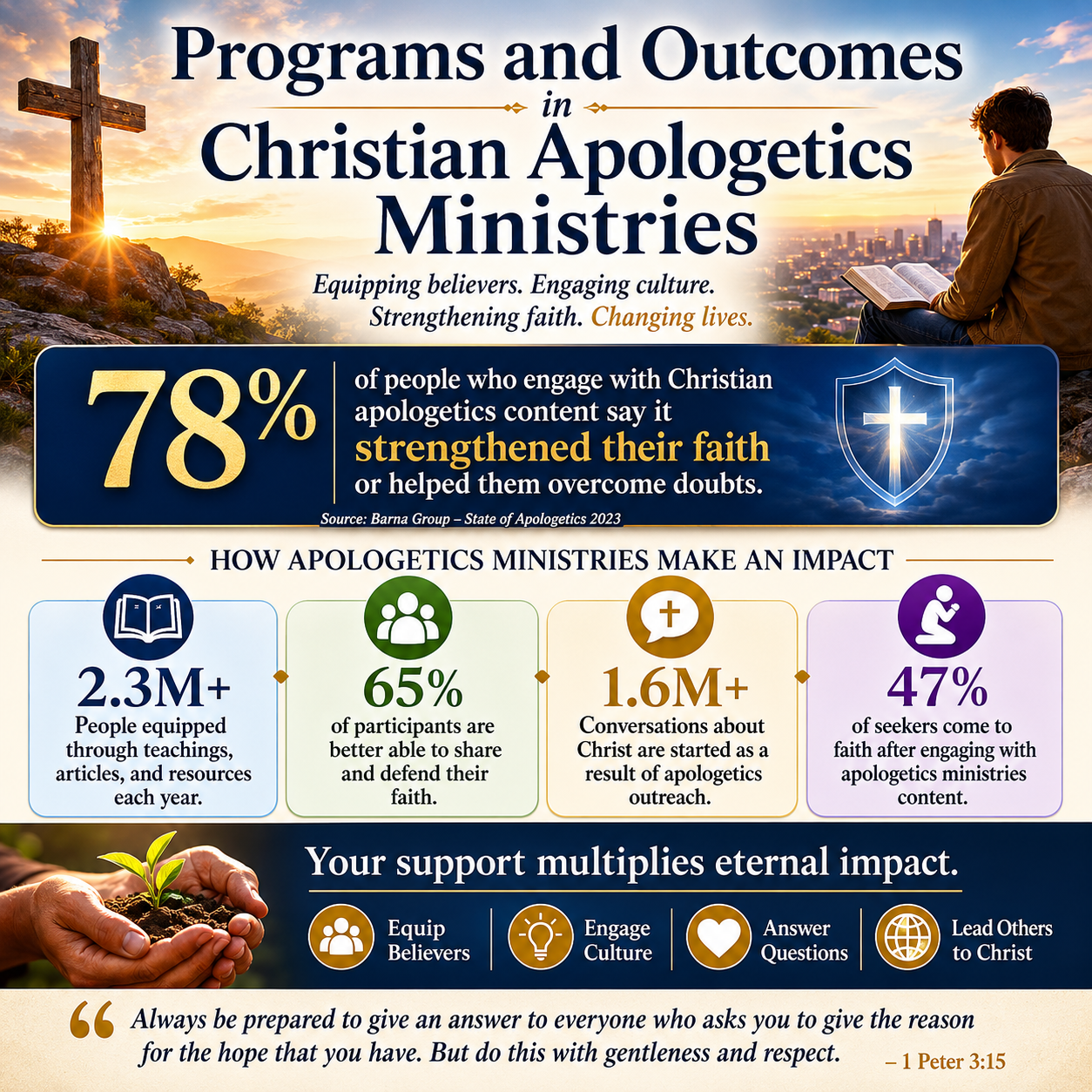
Apologetics effectiveness should be explained with care. The strongest ministries define outputs (events, courses, resources) and link them to intended outcomes (confidence, witness, follow-up engagement), then provide evidence appropriate to the claim: surveys with transparent methodology, longitudinal follow-up where feasible, pastoral feedback, and honest reporting of limitations.
Donors should be wary of ministries that report only reach metrics—views, downloads, attendance—without explaining what changed in the lives of participants. Reach can be meaningful, but it is not a synonym for fruit. The ministry that speaks truthfully about what can and cannot be measured is usually the ministry that is least likely to manipulate donors.
For donors comparing organizations within Christian Apologetics Ministries, the most responsible approach is to fund programs with a credible theory of formation, accountable leadership, and transparent reporting. Most Trusted exists to support that kind of giving, so donors can invest with confidence and without cynicism.
Giving that strengthens witness over the long term
Programs and outcomes in Christian apologetics ministries should be judged by more than intellectual sophistication or cultural relevance. The church needs apologetics that is truthful, courageous, and humble; ministries that can equip saints to endure; and public witness that refuses both fear and contempt. Donors serve that aim by supporting organizations that combine theological fidelity with verifiable integrity, and by expecting candor about results in a field where the most important work is often slow, relational, and spiritually contested.



