
How Christian apologetics ministries equip churches and small groups is not primarily a question of supplying arguments. It is a question of formation: helping ordinary believers love God with the mind, speak with honesty, and remain faithful when doubt, ridicule, or intellectual confusion presses in.
Donors often ask whether apologetics is a luxury in a world of urgent material need. The question deserves respect. Yet the New Testament places a consistent weight on truthful witness. Peter’s instruction is both intellectual and pastoral: “always be prepared to make a defense… yet do it with gentleness and respect” (1 Peter 3:15). When apologetics is healthy, it strengthens discipleship and steadies evangelism; when it is unhealthy, it can become performative, combative, and spiritually thin. Churches and small groups feel the difference.
Apologetics serves the Church when it strengthens faithful witness
From debate culture to pastoral clarity
Apologetics can be reduced to winning arguments, but the church’s calling is different. We are commissioned to bear witness to the crucified and risen Christ, to “speak the truth in love” (Ephesians 4:15), and to contend for the faith without confusing contending with contempt. Ministries that equip churches well tend to emphasize intellectual humility, careful listening, and the limits of what argument alone can accomplish. They teach believers to name what is known, what is probable, and what remains mysterious without surrendering the core claims of the gospel.
This posture matters because small groups are not seminars; they are communities of ordinary Christians carrying ordinary burdens. A mother whose teenager is deconstructing does not need a clever line. She needs language that honors her child’s questions without granting skepticism the authority of final judgment. A thoughtful apologetics ministry helps leaders hold that tension: compassion without capitulation, conviction without caricature.
Equipping for the questions people are actually asking
Across our verification work at Most Trusted, we observe that strong apologetics ministries rarely guess at the church’s needs. They listen: to pastors, youth leaders, campus ministers, and small-group facilitators. They address recurring issues—Scripture’s reliability, the problem of evil, the exclusivity of Christ, sexuality and identity, science and faith, and the credibility of the resurrection—with material that is accessible without being simplistic.
For donors, the practical implication is that “equipping” should be visible in the local church. The healthiest ministries design resources that are teachable, repeatable, and pastorally aware—resources that help the church speak truthfully, not merely sound impressive.

Training that endures is built for small-group reality
Curriculum that can be used, not merely admired
Many apologetics resources are written as though the reader has unlimited time, a graduate-level attention span, and few pastoral responsibilities. Small-group leaders operate under different constraints. They need content that can fit a 60–90 minute gathering, that can be facilitated by volunteers, and that includes the emotional dimensions of doubt—fear, shame, anger, loneliness—without psychologizing away spiritual realities.
When apologetics ministries equip small groups well, they typically provide structured pathways: short videos, guided discussion questions, recommended readings at multiple levels, and leader notes that anticipate common derailments. The goal is not to reduce complexity; it is to stage learning so that ordinary believers can grow steadily, without being overwhelmed or patronized.
Forming leaders who can handle heat
Small-group leaders are often the first to receive hard questions: “Is the Bible racist?” “Did the church invent Jesus’ divinity?” “How can a good God allow abuse?” The leader who panics, dismisses, or bluffs can do lasting harm. Apologetics ministries serve the church by training leaders to respond with three virtues that Scripture commends: truthfulness, patience, and courage.
Practically, we recommend that donors look for ministries that equip leaders to:
- Distinguish sincere doubt from rhetorical attack without shaming either person
- Admit uncertainty where it exists while still teaching what Christians must affirm
- Use primary sources and credible scholarship rather than internet folklore
- Integrate prayer, Scripture, and community rather than outsourcing discipleship to “arguments”
- Refer complex pastoral cases to trained shepherds when appropriate
That blend of intellectual and pastoral competence is difficult to build. It is also where donor support can have disproportionate impact, because volunteer leaders scale discipleship across a congregation.
Church-based equipping requires theological fidelity and institutional credibility
Faithful apologetics begins with faithful theology
Christians genuinely disagree about secondary questions in apologetics: how to weigh historical arguments versus presuppositional approaches, how to engage “New Atheism,” or how to address contested cultural issues without surrendering biblical authority. But churches are right to insist on clarity about the center: the Triune God, the authority of Scripture, the sinfulness of humanity, and salvation in Christ alone.
Apologetics ministries that strengthen local churches typically anchor their public content in their stated doctrinal commitments. They can articulate what they affirm and what they will not teach. That clarity protects small groups from drifting into a vague theism that is rhetorically useful but spiritually hollow.
Why donors should care about verification frameworks
The harder question is that even faithful teaching can be undermined by poor governance, financial opacity, or inflated impact claims. Donors fund more than content; they fund institutions. Most Trusted exists to help donors give with confidence by evaluating ministries against The Most Trusted Standard, a 15-criteria framework spanning Faith Foundation, Financial Integrity, Governance and Leadership, and Transparency and Effectiveness.
Across the apologetics space, this matters because “influence” is easily confused with effectiveness. A ministry can have a large platform and still lack meaningful accountability, clear reporting, or an honest accounting of program costs. Verification does not replace discernment, but it can clarify whether a ministry’s institutional practices support the credibility its teaching demands.
Effective apologetics ministries strengthen churches through partnerships, not replacement
Supporting pastors rather than competing with them
Some apologetics brands function as parallel authorities: the ministry becomes the teacher, the local pastor becomes a distributor. That arrangement is fragile. The church’s health depends on shepherds who know their people and bear responsibility before God for their teaching (Hebrews 13:17). The best apologetics ministries treat pastors as primary and design resources that serve pastoral ministry, rather than siphoning trust away from it.
What this means in practice is that mature ministries build pastor cohorts, provide consultative support for sermon series and difficult questions, and create tools that can be integrated into existing discipleship structures. They also train church leaders to respond to questions without adopting the ministry’s brand voice or argumentative style.
Small groups as frontline disciple-making
Small groups are often where faith becomes resilient. They are also where fragile faith can fracture, because doubts surface in community. Research consistently suggests that religion is weakening among younger cohorts in the United States, which presses churches to take questions seriously rather than treating them as distractions. Pew Research Center has documented the long-term decline in the share of U.S. adults who identify as Christian, a shift with direct implications for how churches disciple believers in a more skeptical environment (Pew Research Center).
Apologetics ministries contribute when they help churches normalize careful inquiry within committed discipleship. The goal is not to produce amateur debaters. It is to help believers persevere, to help seekers hear the gospel without unnecessary offense, and to help the church maintain integrity when cultural winds shift.
Donors who want a wider view of how apologetics ministries operate across the field can consult our coverage of Christian Apologetics Ministries, where we track common program models, risks, and markers of credibility.
What donors should examine before funding apologetics equipping
Indicators of church-serving impact
Donors often ask for metrics, and rightly so. Yet apologetics impact is not always easily counted, and ministries can be tempted to report what is easiest rather than what is truest: views, downloads, follower counts. Those measures have some value, but they do not necessarily indicate local-church fruit.
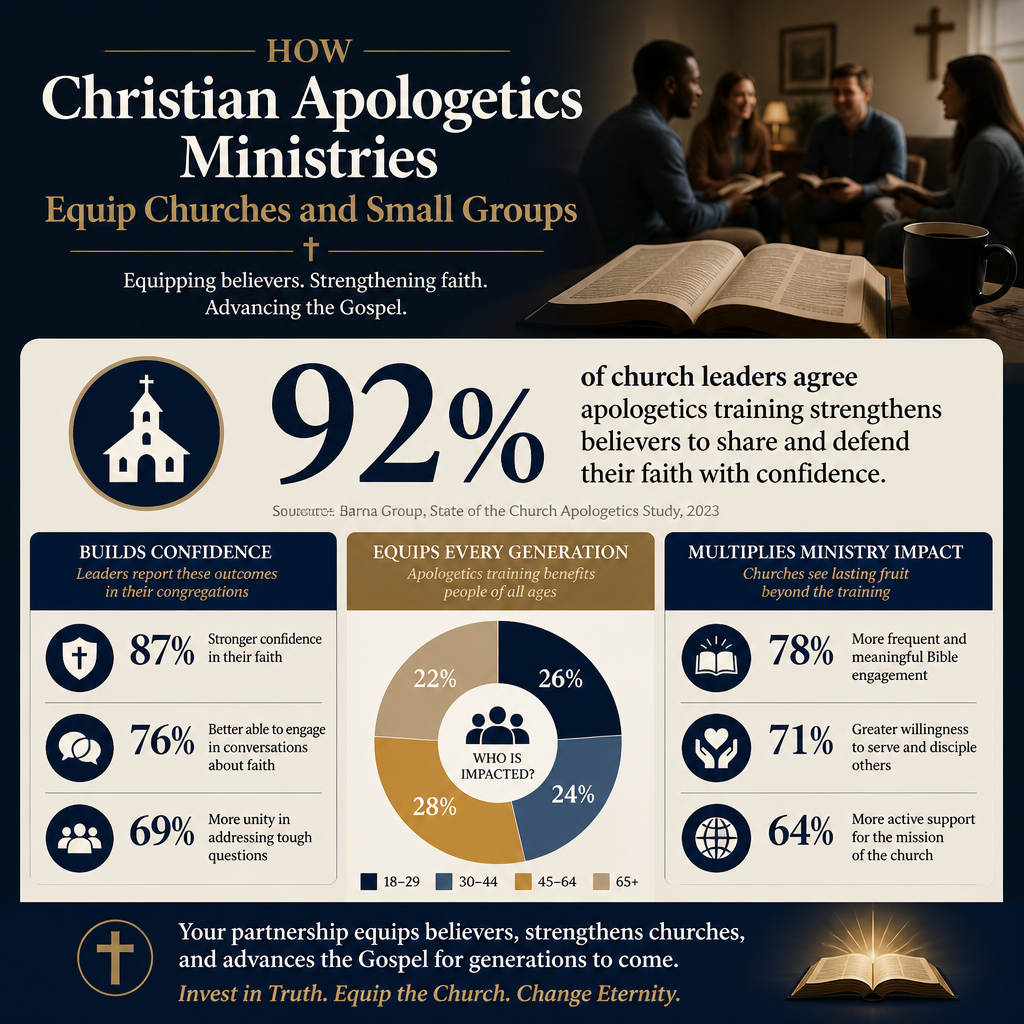
We recommend looking for evidence that a ministry’s work is being used in congregational settings and that it produces durable outcomes such as leader confidence, congregational engagement, and increased capacity to address hard questions without fear. Credible ministries can typically describe how resources move from production to use: training cohorts, church licensing, partnerships with denominations, or structured pathways adopted by groups.
Governance, transparency, and the problem of platform incentives
The apologetics space faces specific temptations: building a public platform can reward heat over light, controversy over clarity, and certainty over carefulness. Those incentives are not neutral. Donors can counteract them by preferring ministries that demonstrate mature governance, clear theological accountability, and transparent reporting. When a ministry claims to “equip thousands of churches,” it should be able to explain what that means and how it knows.
Our approach at Most Trusted is to evaluate these factors in a disciplined way under The Most Trusted Standard, because the church’s intellectual witness is damaged when Christian institutions appear careless with money, evasive with reporting, or thin in accountability. Readers who want to see related analysis on ministry programming and outcomes can also reference Programs and Outcomes in Christian Apologetics Ministries.
FAQs for How Christian apologetics ministries equip churches and small groups
What does it mean for an apologetics ministry to equip a small group rather than merely provide content?
Equipping means the ministry’s resources can be taught and reproduced by ordinary leaders in ordinary settings. That usually includes structured curriculum, facilitator support, and a pastoral posture that addresses both intellectual objections and the spiritual and emotional dynamics of doubt. Content alone can inform; equipping builds capacity in the local church.
How can donors evaluate whether apologetics equipping is producing real fruit?
Donors can look for evidence of adoption and durability: churches that use resources over multiple seasons, leader training cohorts with measurable completion, and feedback loops from pastors and small-group leaders that shape revisions. Donors can also assess institutional credibility—doctrine, governance, financial transparency, and honest reporting—because apologetics depends on trust as well as argument.
Faithful equipping strengthens ordinary discipleship
Christian apologetics ministries serve the church best when they help ordinary believers speak truthfully about Jesus Christ in a skeptical age, with gentleness and respect, and with an intellectual seriousness that matches the gravity of the gospel. For donors, the opportunity is to fund not only compelling ideas but credible institutions whose practices support the witness they commend.



