
How apologetics ministries develop curriculum and resources is not a secondary operational question; it is a discipleship question with donor consequences. Curriculum is where theological fidelity, intellectual honesty, and practical pedagogy either cohere—or drift into reactionary content that raises funds but forms believers poorly.
Donors who support apologetics work are rarely buying “content.” They are underwriting formation: the long, patient work of helping Christians love God with heart, soul, and mind, and helping seekers encounter the gospel without manipulation. That requires more than a charismatic speaker or a timely controversy. It requires a disciplined curriculum process that is accountable to Scripture, aware of the real questions people are asking, and transparent enough to be evaluated.
Curriculum in apologetics begins with theological boundaries, not market demand
Confessional clarity sets the guardrails
The strongest apologetics curricula begin with a defined doctrinal center and a stated theory of how apologetics serves the church. Some ministries are explicitly confessional; others are broadly evangelical. Either can be responsible, but only if the curriculum’s theological boundaries are explicit. Without that clarity, “apologetics” becomes a platform for the teacher’s private hobbyhorses—political, speculative, or merely novel.
For donors, the question is not whether a ministry speaks about contested topics. Christians genuinely disagree about modes of creation, the use of classical or presuppositional approaches, and how to engage contemporary debates over gender, technology, or public life. The question is whether the ministry treats Scripture as governing authority rather than as rhetorical support for positions reached independently.
Apologetics is a servant discipline, not a substitute gospel
Historically, Christian apologetics has been ordered toward proclamation and discipleship, not toward winning arguments for their own sake. When curriculum development is governed by attention metrics, it tends to produce a combative posture—strong on takedowns, weak on spiritual fruit. A ministry can publish highly shareable “answers” while neglecting what pastors and parents need: resources that form humble confidence, address suffering, and point consistently to Christ rather than to the apologist.
In verification work, we find that the ministries most likely to meet The Most Trusted Standard show their theological commitments in writing, train staff and contributors to stay within them, and correct errors publicly when they occur. That kind of restraint is not branding; it is accountability.

Sound curriculum is built from real questions and real audiences
Needs assessment must be more than anecdotes
Apologetics content often begins as a response to questions an apologist received after a talk. That can be a legitimate seed, but mature curriculum development does not stop there. Responsible ministries gather feedback from churches, campus workers, and educators, and they test whether the questions they are addressing are actually representative. Otherwise, a ministry can over-invest in niche debates while neglecting the ordinary crises of belief that families and congregations face.
Several research streams help ministries avoid guesswork. For example, Pew Research Center has documented the religious switching patterns that have contributed to the rise of the religiously unaffiliated in the United States, which affects what kinds of questions churches are fielding and how ministries should frame introductory resources Pew Research Center. A ministry does not need to mimic Pew’s categories, but it should show evidence that it understands the social conditions shaping doubt and dechurching.
Formation requires developmental wisdom
A curriculum for middle school students is not a simplified version of a graduate seminar. Good apologetics ministries build age-appropriate learning progressions: vocabulary, biblical literacy, and habits of reasoning that scale with maturity. They also attend to the emotional and relational dimensions of doubt. Many “intellectual” objections are intertwined with betrayal, hypocrisy, suffering, or loneliness. Curriculum that ignores that reality can become pastorally tone-deaf.
Donors can legitimately ask whether a ministry consults educators, pastors, and youth leaders when shaping resources for specific settings. A polished video series may be less useful than a carefully designed leader guide that helps volunteers facilitate hard conversations without fear.
Quality control requires peer review, not just a compelling communicator
Editorial process is a theological discipline
Apologetics ministries face a structural temptation: the fastest way to publish is to let the founder’s voice dominate everything. Yet the more public the ministry becomes, the more its errors can harm the church. A serious curriculum development process includes theological review and factual review, especially when addressing science, history, philosophy, or sensitive pastoral matters.
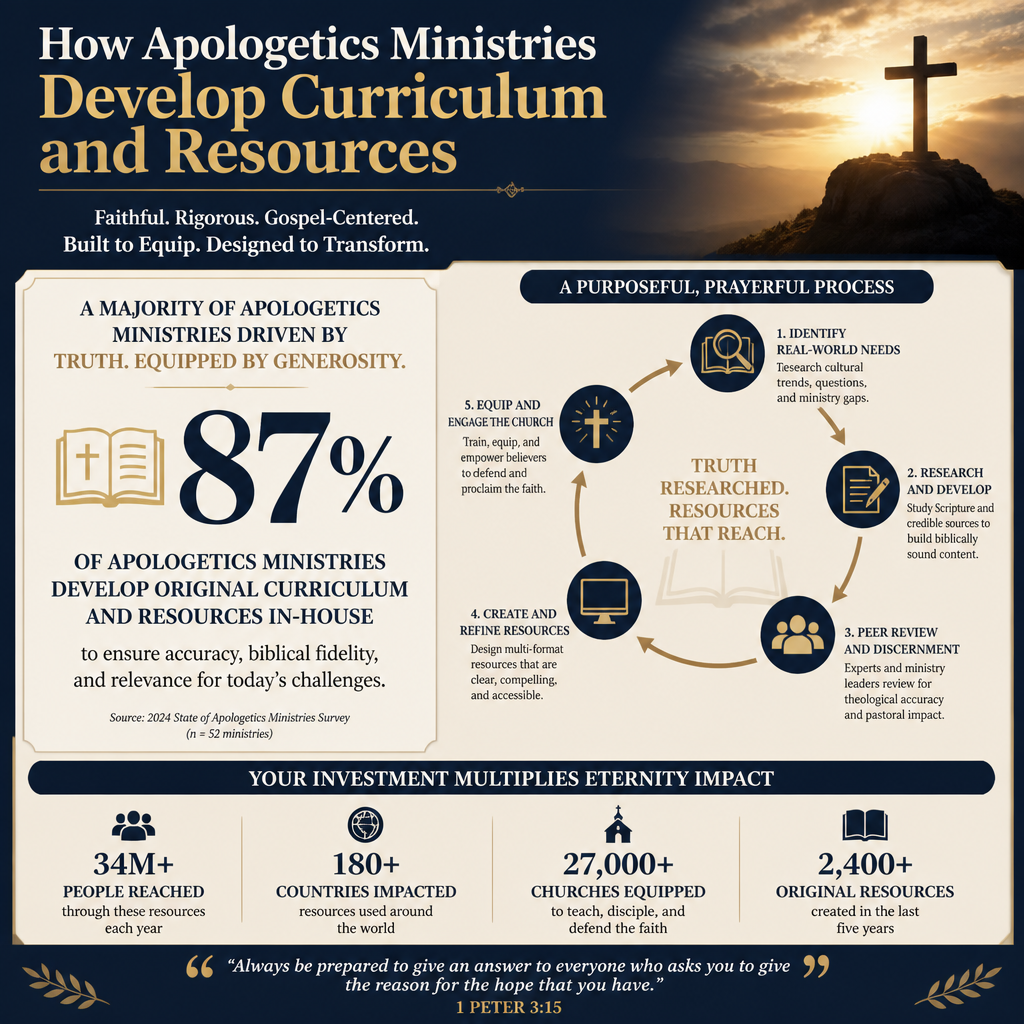
Peer review in a ministry context will not look identical to academic publishing, but it should still be real. At minimum, responsible ministries document who reviews content, what standards are applied, and how disagreements are resolved. They also distinguish between primary doctrinal commitments and secondary interpretive judgments, so that a student does not leave thinking Christianity stands or falls on a disputed claim about archaeology or a simplistic account of church history.
Updating content is part of intellectual honesty
Apologetics resources age. New scholarship emerges; popular arguments are shown to be overstated; cultural vocabulary changes. Mature ministries treat revision as a normal obligation. A willingness to update does not signal weakness; it signals commitment to truth. Donors should be wary of ministries that never correct anything and never acknowledge uncertainty where it exists.
What this means in practice is that curriculum teams often maintain living bibliographies, track common objections that arise in classrooms and small groups, and issue revised editions of printed materials. They also clarify what is settled doctrine versus prudential application. The most helpful resources are frequently those that help Christians think, not merely repeat lines.
Distribution channels shape what gets taught and what gets rewarded
Medium influences message
Curriculum is not only what a ministry believes; it is how a ministry teaches. A 30-second clip is structurally biased toward certainty, speed, and conflict. A course with reading, discussion prompts, and assessment is structurally biased toward depth and retention. Neither is automatically virtuous, but the choice of medium will shape the theology that audiences absorb.
We recommend that donors ask a simple question: what is the ministry’s primary formation pathway? Many organizations publish widely while lacking a coherent learning sequence. Others build courses but do not equip local leaders to implement them. The healthiest models typically integrate several channels—church-based cohorts, classroom curricula, pastoral training, and public-facing content—while keeping a clear center of gravity.
Translation for the church is different from content for the internet
Some apologetics organizations effectively “translate” scholarly work for ordinary believers. Others primarily produce reactive commentary. Both may have a place, but donors should distinguish them. Translation work tends to require slower production cycles, stronger editorial discipline, and deeper bibliographic accountability. It also tends to yield resources that remain useful beyond a news cycle.
Within Christian Apologetics Ministries, donors often find that the most durable impact comes from ministries that can serve pastors and parents without turning every controversy into a fundraising opportunity. The field has had to reckon with how quickly digital incentives can deform teaching; a disciplined curriculum process is one of the few reliable counterweights.
What donors can verify when evaluating apologetics curriculum
Evidence of effectiveness is more than testimonials
Apologetics ministries often report impact through stories: a student who returned to faith, a skeptic who began reading Scripture, a church that gained confidence. Those stories matter, but donors also need indicators that a curriculum is actually being used as intended and producing measurable learning outcomes. In educational terms, ministries can track completion rates, knowledge gains through pre- and post-assessments, and leader feedback about usability.
Not every ministry has the budget for formal evaluation, and donors should not demand academic studies for every program. Still, the absence of any learning assessment can be a warning sign. When ministries claim sweeping cultural influence without offering even modest evidence of adoption and outcomes, credibility suffers.
A donor-facing checklist for responsible curriculum development
Across our work at Most Trusted, the organizations that meet The Most Trusted Standard tend to make curriculum decisions in ways that can be examined. Donors can ask for documentation and look for patterns such as:
- Published doctrinal commitments and a clear statement of how apologetics serves evangelism and discipleship
- Named reviewers or advisory input for theology, history, science, and pastoral care
- Stated audience definitions and evidence the ministry listens to churches and educators
- Leader guides, discussion prompts, and training that support implementation in local settings
- A revision process that corrects errors and updates claims when scholarship changes
These are not box-checking exercises. They are signals of a ministry that fears the Lord more than it fears losing momentum.
Donors who want a deeper view of program design and outcomes across ministries can compare patterns within Programs and Outcomes in Christian Apologetics Ministries, where questions of effectiveness, transparency, and theological integrity intersect in practical ways.
FAQs for How apologetics ministries develop curriculum and resources
Should apologetics curriculum prioritize evangelism or discipleship?
In practice, strong curricula hold them together. Apologetics can remove obstacles to belief for seekers, but it also strengthens believers to endure doubt, suffering, and cultural pressure. Donors should look for curricula that consistently connect arguments to the gospel, the life of the church, and the formation of Christian character, rather than treating persuasion as the final aim.
What is a reasonable standard of evidence that curriculum is working?
Reasonable evidence usually includes more than anecdotes and less than a peer-reviewed academic study. Completion rates for courses, pre- and post-learning assessments, documented adoption by churches or schools, and structured feedback from trained leaders are credible indicators. The key is whether a ministry can show that resources are being used in real settings and that learners are growing in understanding and resilience.
Curriculum development is where apologetics becomes accountable
Apologetics ministries will always face pressure to respond quickly to new objections and new cultural flashpoints. The deeper test is whether the ministry can translate Christian truth into resources that form durable faith, serve pastors and parents, and withstand scrutiny. Donors should give toward ministries whose curriculum practices demonstrate theological seriousness, intellectual humility, and transparent stewardship, because those practices tend to outlast any single season of controversy.



