

How Christian anti-trafficking ministries support job training is not a secondary detail in survivor care; it is one of the most practical ways a ministry either protects long-term freedom or unintentionally leaves a person exposed to re-exploitation. Work is not salvation, but economic stability often becomes a thin wall between a survivor and the pressures that traffickers know how to weaponize.
The Christian donor’s question is not merely whether job training exists, but whether it is designed with a serious view of trauma, a sober understanding of labor markets, and a theological commitment to dignity. The work is complex: job readiness programs can become symbolic if they do not connect to actual wages, and employment pathways can become coercive if they are not survivor-led. We should name these tensions rather than gloss over them, because the stakes are measured in lives.
Job training is a protection strategy, not a program accessory
Economic coercion is part of the trafficking ecosystem
Trafficking is sustained by more than physical force. It often depends on debt, unstable housing, fractured relationships, addiction, and the absence of viable work. When a survivor exits exploitation, the immediate crisis can obscure the next crisis: rent is still due, children still need food, and a resume still carries gaps and stigma. Job training, when done well, is not a nice add-on; it is an evidence-based protection strategy that reduces the leverage traffickers use.
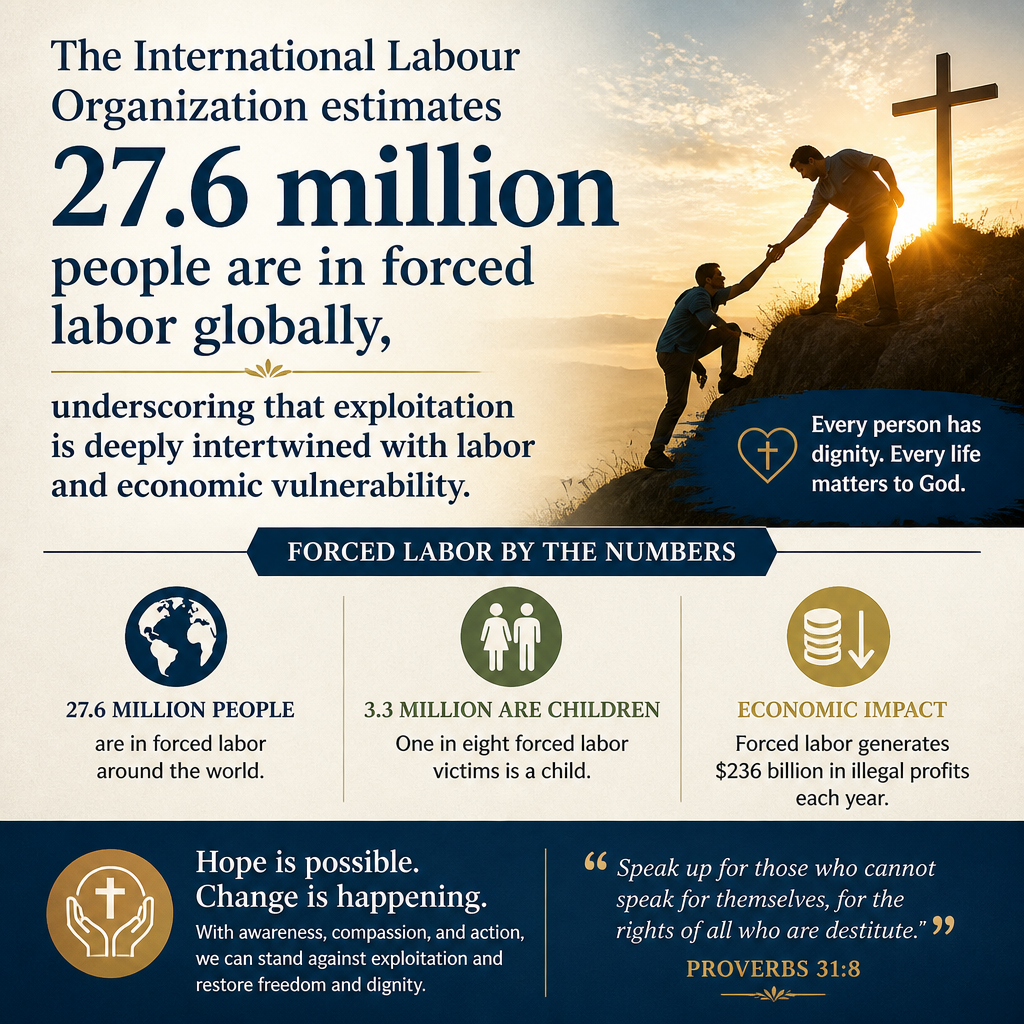
Verifiable evidence suggests the scale of trafficking is enormous, though any number must be handled with care because trafficking is underreported and definitions vary across jurisdictions. The International Labour Organization estimates 27.6 million people are in forced labor globally, underscoring that exploitation is deeply intertwined with labor and economic vulnerability. International Labour Organization
Christian theology gives work a distinct moral weight
Christian ministries approach job training with a theology of the imago Dei: survivors are not problems to be managed but people to be restored. Scripture frames work as part of human vocation, marked by dignity even after the Fall. This is why the best programs do not treat employment as a metric for donor reporting; they treat it as a component of restored agency.
At the same time, Christians genuinely disagree about how directly ministries should involve themselves in employment. Some argue that discipleship and pastoral care must remain central and that workforce development should be left to public systems. Others contend that leaving survivors to navigate fragmented systems is itself a pastoral failure. The field has had to reckon with both truths: the church cannot do everything, but the church also cannot outsource neighbor-love when the gaps are predictable.

What strong job training looks like in survivor care
Trauma-informed practice with measurable outcomes
Job training in survivor care is often most effective when it is staged: stabilization first, then readiness, then placement, then retention support. Ministries that rush to employment can unintentionally replicate coercion by creating pressure to “perform wellness” for access to housing, stipends, or community belonging. Trauma-informed practice recognizes that hypervigilance, dissociation, sleep disruption, and medical needs can affect punctuality, learning, and workplace dynamics.
Sound programs make room for this without lowering expectations into sentimentality. They set clear commitments, offer coaching, and build pathways for re-entry after setbacks. They also measure outcomes that matter: job retention at 90 and 180 days, wage progression, credential completion, and participant-defined goals. Metrics do not replace pastoral wisdom, but they do discipline it.
Training connected to real labor markets
Many well-intentioned efforts train survivors for work that does not exist at scale in their region or that pays wages that cannot sustain independent living. A credible ministry studies local labor demand, credential requirements, transportation barriers, childcare availability, and criminal-record constraints. It partners with employers who will actually hire, not merely “support the cause.”
The ministries that approach this well often build training around certifications with recognized market value, such as healthcare support roles, commercial driving where appropriate, administrative pathways, culinary credentials tied to actual employers, or apprenticeships in the skilled trades. They also address digital literacy, because basic competence with scheduling apps, email, and online onboarding is now a gatekeeper in many sectors.

How ministries integrate job training with housing, counseling, and discipleship
Survivor care works as a system, not a sequence
Employment outcomes are tightly linked to stability. A survivor who is couch-surfing, managing active legal proceedings, or navigating untreated trauma is being asked to carry a burden most stable adults would find difficult. Ministries therefore integrate job training with housing support, mental health services, and case management, not as competing priorities but as reinforcing ones.
This is why donors who care about results should resist simplistic program comparisons. A job placement number may look impressive, but if it is achieved by filtering out higher-need participants, the ministry may be shrinking its mission to protect its metrics. Conversely, a ministry serving high-complexity survivors may show slower employment outcomes while doing more honest work. The harder question is whether the ministry can articulate its model, track progress over time, and demonstrate that its interventions fit the needs of the people it serves.
Discipleship that safeguards agency
Christian ministries rightly want spiritual formation to be present in survivor care. The ethical line is whether spiritual practices are coerced or tied to services. Mature ministries protect agency: they invite participation, they never condition essential services on religious compliance, and they ensure that staff understand power dynamics in trauma recovery.
Many donors have seen Christian compassion compromised by paternalism. The When Helping Hurts framework, articulated by Steve Corbett and Brian Fikkert, has helped the church name how helping can drift into control or saviorism when it is not rooted in humility and local ownership. When Helping Hurts
What donors should verify before funding workforce programs
Accountability that goes beyond compelling stories
Anti-trafficking work attracts strong emotions, and survivors’ stories can be powerful. But donors who want to fund job training responsibly should ask for evidence that is respectful, ethical, and verifiable. Across our verification work at Most Trusted, we observe that strong ministries welcome scrutiny because it protects survivors and strengthens long-term credibility.
What this means in practice is that donors should examine whether a ministry can explain how it makes decisions, how it protects participants, and how it learns when outcomes fall short. The goal is not suspicion; it is stewardship.
- Clear eligibility and referral criteria that avoid cherry-picking low-need participants
- Written safeguarding policies, including trauma-informed boundaries and confidentiality
- Documented partnerships with employers, community colleges, or credentialing bodies
- Outcome tracking that includes retention and wage progression, not only placements
- Financial statements and governance practices that match the ministry’s stated scale
Verification as a service to donors and to survivors
Most Trusted exists because Christian donors need more than inspiration; they need confidence that a ministry is faithful, well-governed, financially responsible, and honest about outcomes. Our evaluations against The Most Trusted Standard examine a ministry’s Faith Foundation, Financial Integrity, Governance and Leadership, and Transparency and Effectiveness, because survivor care is too consequential to be funded on sentiment alone.
For donors seeking broader context on the field, we track patterns and risks across Christian Anti-Trafficking Ministries, including how employment programs fit within prevention, rescue, and long-term restoration. Serious giving requires a view of the whole ecosystem.
Common tensions in job training for survivors and how faithful ministries respond
Wages, not workshops
The field has had to reckon with a basic reality: classes do not pay rent. Some programs provide extensive “readiness” content but struggle to translate it into jobs with adequate wages, predictable hours, and advancement. Faithful ministries respond by building employer relationships, creating transitional employment where appropriate, and adjusting training pathways when placements do not hold.
Donors can help by funding the unglamorous infrastructure: career coaches, employer engagement staff, transportation solutions, and follow-up support that reduces early job loss. These are often the difference between a placement that looks good on paper and a job that becomes sustainable.
Survivor-led does not mean unsupported
Another tension is the phrase “survivor-led.” It can be used as a slogan, or it can describe a genuine posture of shared power. Survivors should have real voice in program design, but ministries also have a duty of care. Survivors may choose pathways that are understandable in light of trauma and immediate need but that carry long-term risk. Wise programs combine agency with counsel: clear information, options, and coaching that respects the person while refusing manipulation.
This is one reason the broader category of Survivor Care in Christian Anti-Trafficking Ministries matters to donors. Job training cannot be evaluated in isolation from counseling, housing stability, medical care, and legal advocacy, because the real question is whether the ministry is building durable freedom.
FAQs for How Christian anti-trafficking ministries support job training
What makes job training in anti-trafficking ministries different from standard workforce programs?
Effective programs are trauma-informed and stability-aware. They account for safety planning, court dates, medical recovery, and the psychological effects of coercion, while still maintaining clear expectations. They also include longer-term retention support, because keeping a job is often harder than getting one for someone rebuilding life after exploitation.
Should donors prefer social enterprises run by ministries, or job placement into external employers?
Either model can be faithful and effective, and either can fail. Social enterprises can offer protected environments and transitional employment, but they can also become permanent holding patterns if wages or advancement are limited. External placement can increase earning potential and normalcy, but it requires stronger employer partnerships and retention support. Donors should look for evidence that the ministry has defined the purpose of its model and can show outcomes consistent with that purpose.
A donor’s responsibility is to fund durable freedom
Job training is one of the clearest places where donor intent meets real-world constraints. Survivors need more than rescue; they need a pathway to stability that can withstand economic pressure, relational disruption, and the long work of healing. The ministries most worthy of support treat employment as dignity, not as branding, and they build programs that can be examined without fear. That is the kind of work Christian donors can fund with confidence and a clear conscience.



