
When Christian donors ask what share of donations funds Christian recovery programs, they are usually asking a deeper stewardship question: whether a ministry’s stated mission of healing and discipleship is visibly reflected in its spending. That is a faithful instinct. Scripture commends careful stewardship, not suspicion, and it warns against both naiveté and cynicism (Luke 16:10–12).
Yet the field has had to reckon with a persistent misconception: that a single percentage can tell the moral story of a recovery ministry. Many programs that appear “efficient” on paper underinvest in clinical oversight, staff formation, survivor safety, and outcome tracking. Other programs spend more on personnel and support functions precisely because addiction recovery is labor-intensive, long-term, and spiritually and psychologically complex.
Why the percentage question is harder than it looks
The desire for a clear ratio—programs versus overhead—is understandable. Donors want to know whether their giving reaches the men and women fighting for sobriety, stability, and renewed life in Christ. The difficulty is that “recovery program spending” is not a universally defined category. The same expense may be treated as program by one ministry and as administration by another, depending on accounting policy and how integrated the work is.
Program expense is real, but it is not self-evident
In residential recovery, for example, staff supervision, facilities, food service, transportation, and case management are not side costs. They are often the program. A discipleship-centered recovery home cannot run without trained leaders, appropriate boundaries, and consistent structure. The donor question, therefore, is not only “What percent is program?” but “What is actually happening in the program, and is it faithful, safe, and effective?”
Some spending that looks indirect is essential for protection
Christians genuinely disagree about how much infrastructure is appropriate for a ministry. But few disagree that ministries serving vulnerable people must be governed with sobriety and care. Background checks, safeguarding policies, financial controls, and responsible reporting take time and money. Reducing these to “overhead” can pressure ministries into underinvestment that later becomes moral and legal failure.

What trustworthy benchmarks can and cannot tell you
Donors often look for standard benchmarks such as a “good” program expense ratio. Those benchmarks can be a starting point, but they are not a theological or operational verdict. The nonprofit sector itself has publicly warned against treating overhead ratios as a proxy for impact.
The sector has rejected the overhead ratio as a shortcut for impact
In 2013, Charity Navigator, GuideStar, and the BBB Wise Giving Alliance issued an open letter commonly referred to as “The Overhead Myth,” urging donors to stop using overhead percentages as the primary measure of a nonprofit’s worth because it can distort incentives and hide what actually drives outcomes Charity Navigator. That warning applies with particular force to addiction recovery, where staff quality, consistency, and program design materially affect relapse risk and long-term stability.
Form 990 ratios help, but they are not the whole picture
For U.S. nonprofits that file an IRS Form 990, program, management, and fundraising expense categories are visible. This is valuable transparency, but it has limitations. Some Christian recovery ministries operate as churches or integrated auxiliaries and may not file a Form 990 at all. Others file, but the categories still require interpretation: a counseling director’s time may be split between client care, staff training, and compliance, and that split can be allocated differently depending on internal accounting methods.
When the filing exists, it should be read alongside audited financial statements when available, and alongside clear narrative explanations of what “program” entails. The more vulnerable the population, the more donors should press for this kind of clarity.
What share of donations typically funds Christian recovery work in practice
Because recovery ministries vary widely—residential homes, outpatient counseling, jail reentry, peer mentoring, congregational support groups—no single percentage can be responsibly declared as “the” norm. Even within residential programs, cost structures differ depending on local housing markets, licensing expectations, clinical partnerships, and the degree of wraparound care offered. The question becomes: what patterns tend to accompany faithful, competent work?
Healthy ministries usually show a clear majority directed to mission delivery
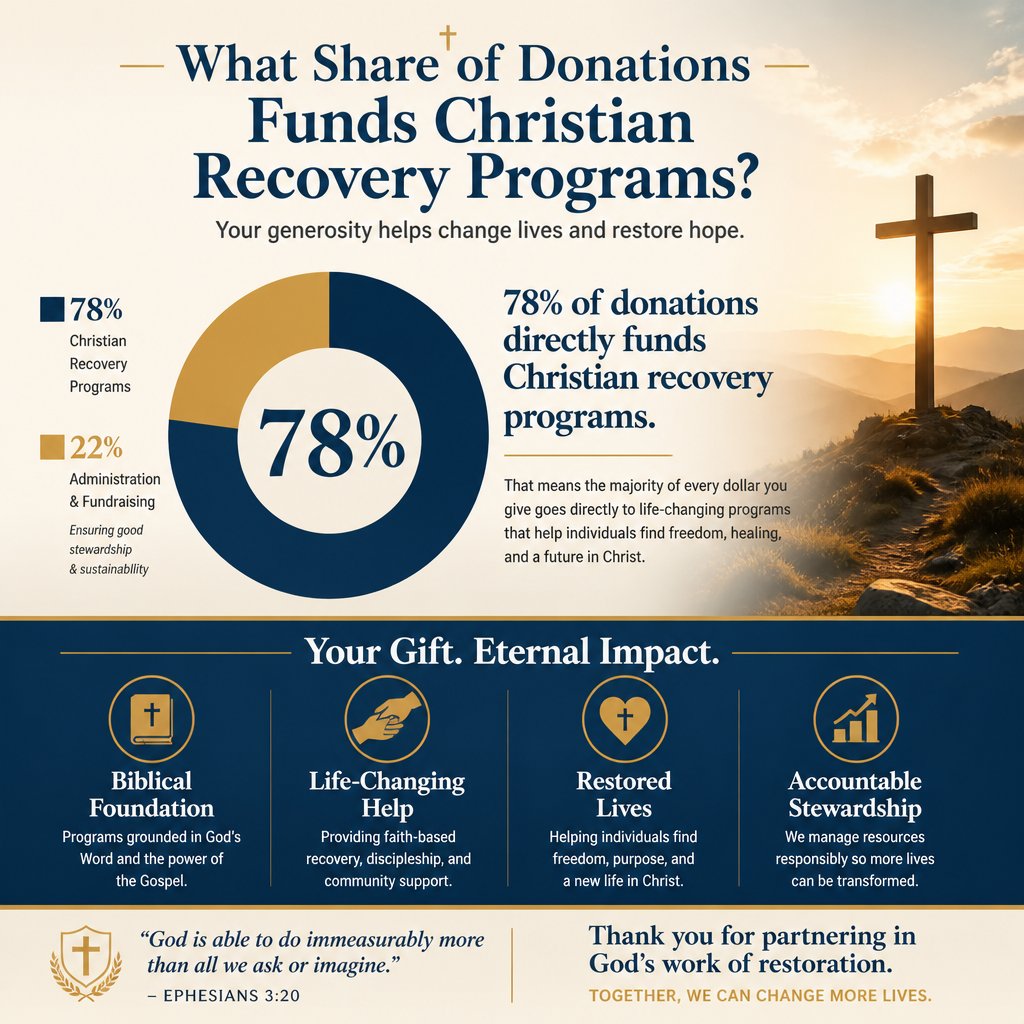
Across our verification work at Most Trusted, ministries that meet The Most Trusted Standard generally demonstrate that a clear majority of expenses are devoted to mission delivery as they define it, and they can explain that definition in plain language. Donors should not be satisfied with a number alone; they should expect coherence between (1) the ministry’s stated model of recovery, (2) its staffing and safeguards, and (3) its financial statements.
It is also worth naming a reality donors sometimes miss: a ministry can report a high program ratio and still do harm if the program itself is poorly supervised or spiritually manipulative. Conversely, a ministry can have higher administrative costs because it is investing in qualified oversight, financial controls, and measured improvement. The moral question is whether spending is ordered toward love of neighbor in truth, not toward appearances.
Recovery programs are unusually sensitive to underfunding
Addiction recovery is not a one-time intervention. It is formation: repairing patterns of desire, rebuilding community, developing vocational stability, and learning to live truthfully before God and neighbor. Underfunding tends to show up as staff burnout, inconsistent enforcement of boundaries, weak aftercare, and inadequate coordination with clinical and legal systems. These failures are not abstract. They can increase relapse risk and endanger residents, families, and staff.
For donors exploring the landscape of Christian Addiction Recovery Ministries, this means we should expect cost structures that reflect long-term, high-touch work rather than quick-fix interventions.
How to evaluate whether donations are funding real recovery
The central task is to connect financial reporting to program reality. For sophisticated donors, the most meaningful indicators are typically a blend of financial integrity, governance, and evidence of actual care.
Ask questions that tie dollars to a recovery model
Responsible ministries can answer concrete questions without defensiveness. The goal is not to interrogate but to understand. A donor’s questions can be an act of respect, especially when they are framed around stewardship and neighbor-love.
- How does the ministry define “recovery”—sobriety only, or sobriety plus discipleship, employment stability, and family repair?
- What is the staffing model for residents or participants, and what training is required for frontline leaders?
- What safeguards protect vulnerable adults, including grievance processes and boundary policies?
- What does aftercare include, and how long does follow-up last after program completion?
- How does the ministry handle relapse: dismissal, stepped care, clinical referral, or a structured restoration pathway?
Use financial documents as windows, not verdicts
If a Form 990 is available, use it to identify trends: rising fundraising costs, heavy reliance on a single revenue source, or unusual transactions. If audited statements exist, they can provide stronger assurance about internal controls. When ministries publish both financials and program information plainly, they remove unnecessary barriers to trust.
The harder question is whether outcomes are described with honesty rather than marketing. Christians should be the least pressured to exaggerate. Recovery work involves setbacks, and truthful reporting builds credibility with donors and protects participants from being treated as inspirational proofs.
What Most Trusted looks for under The Most Trusted Standard
Most Trusted exists because donors deserve more than slogans and ratios when giving to ministries working with high-risk, high-vulnerability populations. The Most Trusted Standard is a 15-criteria framework across four areas: Faith Foundation, Financial Integrity, Governance and Leadership, and Transparency and Effectiveness. Applied well, these criteria help donors see whether a recovery ministry is stable enough to carry the weight of its calling.
Financial integrity is necessary, but never isolated
We pay attention to financial controls, clarity of reporting, and whether the ministry demonstrates disciplined stewardship rather than reactive fundraising. We also examine governance: independent oversight, conflict-of-interest protections, and decision-making that is not concentrated in a single charismatic figure. These are not merely compliance concerns. They are protections for participants, staff, and the witness of the church.
Transparency and effectiveness should be shaped by Christian truthfulness
Recovery ministry is easily sentimentalized. Scripture requires something sturdier: truth spoken in love (Ephesians 4:15). A trustworthy ministry communicates what it does, what it does not do, and what it is learning. It can describe its theory of change and the practical steps by which participants are supported toward stability. Effectiveness is not reducible to a single relapse rate, and ministries should be cautious about simplistic claims. But they can still report meaningful measures: program completion, housing stability, employment outcomes, participation in Christian community, and aftercare engagement, explained with appropriate humility and context.
Donors who want to think carefully about these questions in a broader giving context can also consult How to Give Wisely to Christian Addiction Recovery Ministries, where the focus is on discernment rather than impulse.
FAQs for What share of donations funds Christian recovery programs
Is a higher program expense ratio always better for a Christian recovery ministry?
No. A higher program ratio can be consistent with faithful work, but it can also reflect underinvestment in governance, safeguarding, staff development, and measurement. The nonprofit sector has cautioned donors against treating overhead as the primary indicator of worth, because it can distort incentives and obscure what actually drives outcomes GuideStar. The better question is whether spending aligns with a responsible recovery model and whether the ministry can explain its numbers transparently.
What documents should donors ask for when evaluating where donations go?
If the ministry files one, ask for the most recent IRS Form 990 and review program, administration, and fundraising trends over multiple years. If available, ask for audited financial statements and the annual report. For ministries that do not file a 990 (such as some church-based entities), ask for a board-approved financial summary, clear governance information, and a plain description of program activities and safeguards. The goal is not bureaucracy; it is accountable stewardship consistent with Christian truthfulness.
Giving with clarity rather than suspicion
Christian donors are right to ask what share of donations funds Christian recovery programs, because money can either strengthen mercy or subsidize confusion. Yet percentage answers rarely carry enough meaning on their own. The sounder approach is to require coherence: a credible recovery model, appropriate safeguards, transparent financial reporting, and leadership that treats both participants and donors with truth. That combination is a more reliable indicator that giving is funding real healing rather than merely maintaining an institution.



