
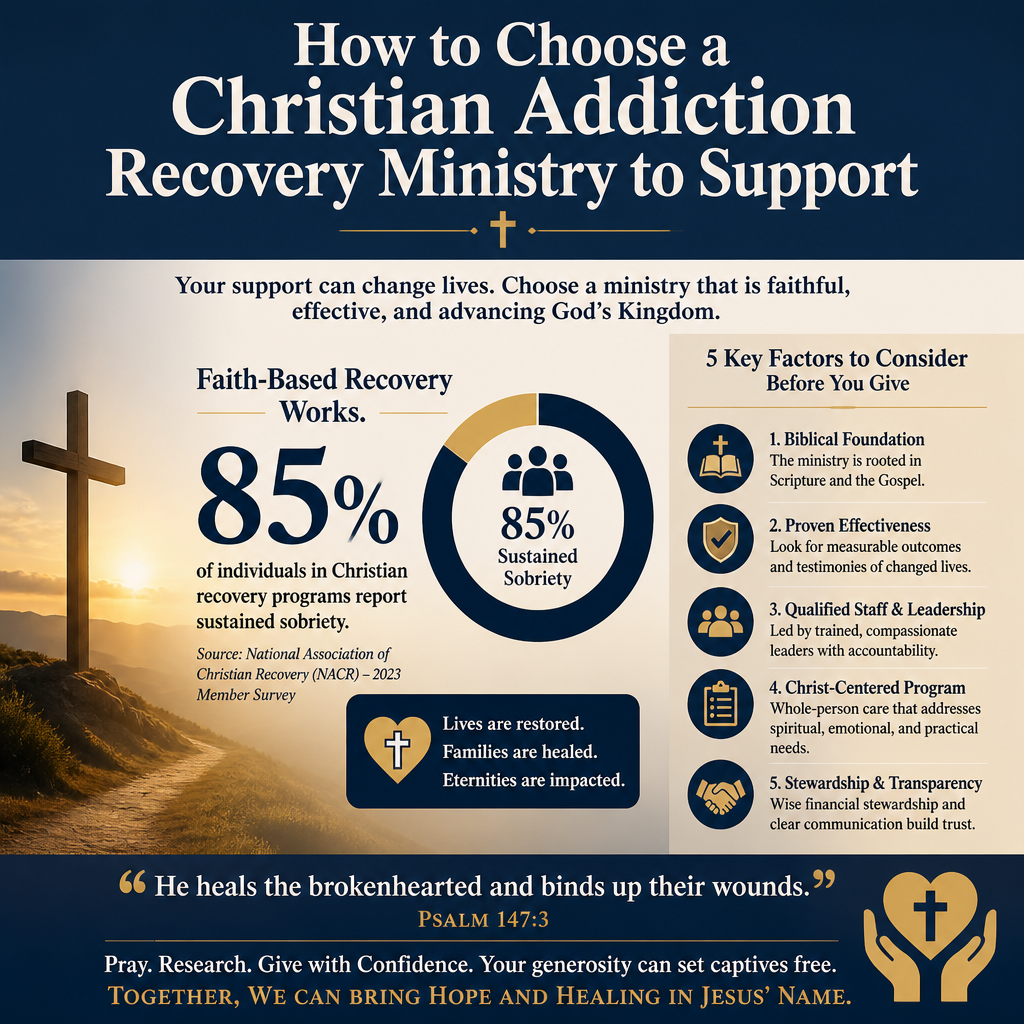
How to choose a Christian addiction recovery ministry to support is not primarily a branding question. It is a stewardship question with spiritual, clinical, and moral weight. Addiction is both a deeply personal bondage and, for many families, a long public unraveling; donors are right to ask whether a ministry offers more than inspiration, and whether it treats image-bearers with the dignity Scripture requires.
Christian donors also carry a particular burden here: we know that Christ is able to save to the uttermost, and we have watched sin and suffering compound in ways that require patience rather than spectacle. The harder work is identifying ministries that combine gospel clarity with practices that are verifiably safe, accountable, and effective for the people they serve.
Begin with the ministry and its theology of change
Look for repentance and restoration without simplistic causality
Christian recovery language can drift toward two errors. One treats addiction as merely a spiritual problem that yields quickly to the right Bible study. The other treats it as merely a medical condition that faith can decorate but not meaningfully address. Scripture gives a more demanding account: sin is real, suffering is real, and the human person is a unity of body and soul. Ministries worth supporting speak with that seriousness.
Practically, this means asking how the ministry understands sanctification in a relapse-prone context. Do leaders describe relapse as proof of spiritual failure, or as a signal that deeper formation, trauma work, and community accountability are needed? The New Testament’s pattern is neither denial nor despair: “If we confess our sins, he is faithful and just to forgive us our sins and to cleanse us from all unrighteousness” (1 John 1:9). That cleansing is real, and it is often contested over time.
Confirm that the gospel is central, not instrumental
Addiction recovery can become transactional: attend, comply, perform, and earn belonging. A Christian ministry should be able to articulate a different center—grace that produces obedience, not compliance that purchases grace. Donors should listen for whether Scripture is used as moral pressure or as the announcement of God’s saving work in Christ that creates new life and new loves.
Because language can be polished, we recommend reading what the ministry teaches in writing: statement of faith, discipleship materials, and any “rules” governing residents or participants. The question is not whether expectations exist—healthy programs have clear expectations—but whether expectations are ordered toward restoration rather than control.
Prioritize safety, competence, and appropriate clinical partnership
Discern what kind of program it actually is
Not every Christian recovery ministry should provide clinical treatment, and not every clinical program should present itself as a church. But donors should know what they are funding. A residential program, a sober living home, a peer-support community, and a counseling center have different obligations, risks, and evidence bases. Ask directly: Is this medical detox, licensed treatment, pastoral care with referrals, or peer-led recovery support? Clarity here protects participants and protects the integrity of the ministry’s claims.
When a program is offering treatment-level services, donors should expect licensure where required, appropriate supervision, and clear policies for emergencies. Where the program is not licensed, donors should expect explicit boundaries and referral pathways. The U.S. Department of Health and Human Services’ Substance Abuse and Mental Health Services Administration maintains national guidance and treatment locators that reflect broadly accepted standards of care for substance use disorders; donors can use that framework as a baseline for what responsible referral looks like (SAMHSA).
Assess the ministry’s posture toward co-occurring disorders
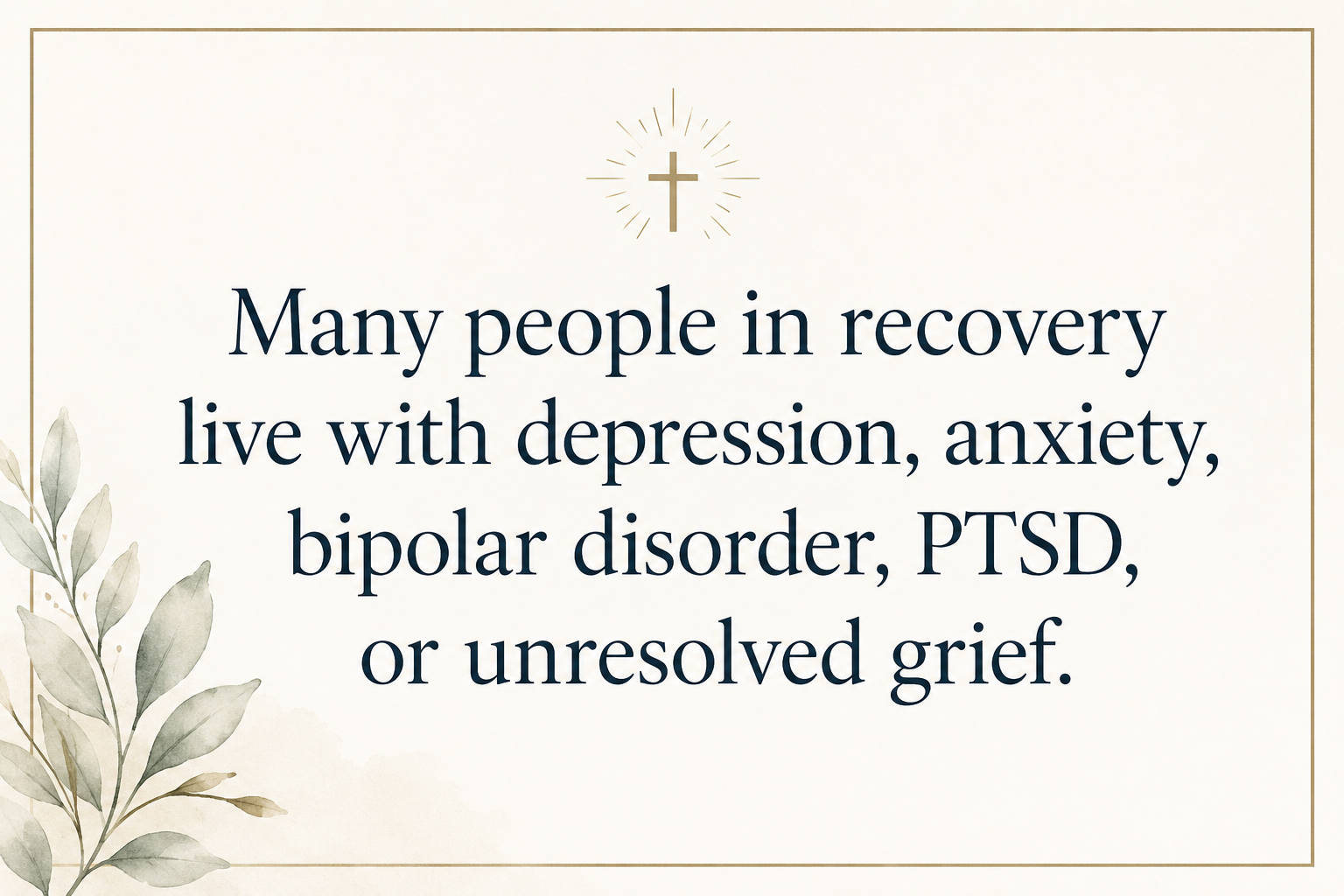
Many people in recovery live with depression, anxiety, bipolar disorder, PTSD, or unresolved grief. A ministry does not need to be a psychiatric clinic to serve faithfully, but it must be honest about complexity. Programs that demonize medication categorically, discourage legitimate clinical care, or treat mental illness as mere unbelief often create spiritual confusion and avoidable harm.
At the same time, donors should be wary of ministries that outsource the entirety of spiritual formation to clinicians. A faithful Christian approach can affirm common grace in evidence-based care while also insisting that the church’s life—worship, confession, accountability, and sacramental rhythms where applicable—addresses the deeper question of what the heart loves and trusts.
Evaluate governance and financial integrity as care for the vulnerable
Follow the accountability, not the charisma
Addiction recovery ministries often grow around a compelling founder or a powerful testimony. That can be a gift, but it can also become a governance risk. People in early recovery are uniquely susceptible to manipulation, and donors should treat institutional safeguards as part of the ministry’s pastoral responsibility. Healthy ministries have functioning boards, clear oversight of leadership, and documented processes for handling complaints.
Across our verification work at Most Trusted, we observe that ministries meeting The Most Trusted Standard tend to separate financial control from program leadership, document board decisions, and publish basic organizational facts that allow donors to verify what is claimed. These practices do not replace spiritual fruit, but they do protect it from predictable distortions.
Ask whether the financial model supports long-term formation
The economics of recovery ministry are difficult. Residential programs have high staffing needs; counseling and case management are costly; and a ministry serving the poor cannot simply raise fees. Donors should expect signs of sustainable stewardship rather than desperation. The field has had to reckon with the “Starvation Cycle” described by Ann Goggins Gregory and Don Howard, where underfunding overhead starves organizations of the capacity needed to deliver quality outcomes (Stanford Social Innovation Review).
Financial transparency matters because it is tied to real people: adequate staff-to-participant ratios, background checks, training, facilities maintenance, and responsible follow-up care. Donors should look for audited financials when appropriate, clear reporting on how funds are used, and a coherent plan for serving participants who cannot pay.
- Independent board oversight with documented meeting cadence
- Clear separation of duties for financial approvals and disbursements
- Written safeguarding policies, including for residents and volunteers
- Transparent reporting on major revenue sources and restricted funds
- A realistic budget that funds supervision, training, and follow-up care
Insist on transparency and effectiveness without reducing people to metrics
Expect honest definitions of success
Christian donors want to see changed lives, and Scripture itself speaks in the language of fruit. But addiction recovery is rarely a straight line, and simplistic success claims are often a warning sign. Ask what the ministry measures, how it defines outcomes, and how it accounts for people it cannot track. “Lives touched” is not an outcome. Neither is a vague “graduation” number without a definition.
Thoughtful programs distinguish between outputs (attendance, completions, housing placements), near-term outcomes (sustained sobriety over a defined period, employment, reunification steps), and longer-term outcomes (stable housing, community integration, reduced criminal justice involvement). The research community also recognizes that relapse risk and recovery duration vary by person and context, which is why donors should value ministries that are cautious and specific rather than sweeping and triumphant.
Look for transparent communication about limits and referrals
Some ministries serve men but not women. Some cannot safely serve people with active psychosis. Some are not equipped for fentanyl withdrawal or complex medical needs. A trustworthy ministry names these limits in advance, has clear referral relationships, and does not keep participants simply to protect fundraising narratives.
This is also where donors can widen their lens. Supporting recovery often means supporting the ecosystem: pastoral care, trauma-informed counseling referrals, job readiness partnerships, housing collaborations, and local church integration. For donors seeking a broader view of the field, we maintain a directory of Christian Addiction Recovery Ministries where the emphasis is on verifiable clarity rather than promotional claims.
Match your giving to the ministry’s model and your stewardship priorities
Choose what you can evaluate and sustain
Christians genuinely disagree about which recovery approaches should be primary: 12-step influenced models, explicitly discipleship-centered residential communities, medication-assisted treatment integrated with counseling, or hybrid approaches. Some of these debates are clinical; some are theological; many are both. Donors do not need to resolve every contested question to give faithfully, but we should fund what we can evaluate and sustain over time.
For some donors, that will mean supporting a local ministry where accountability is relational and reporting is direct. For others, it will mean supporting a larger organization with formal evaluation capacity. Either way, we recommend aligning expectations with the program’s design: a peer-support ministry should not be judged by the same metrics as a licensed treatment center, but it should be judged by appropriate standards for safety, integrity, and truthful representation.
Use a verification framework that reflects Christian obligations
Due diligence in this space should be more than scanning a website and a testimonial reel. The Most Trusted Standard is designed to help donors evaluate ministries across Faith Foundation, Financial Integrity, Governance and Leadership, and Transparency and Effectiveness. In recovery work, these domains converge: doctrinal clarity shapes practice; governance protects the vulnerable; financial integrity funds competent care; transparency honors the truth.
Donors who want a structured approach across multiple potential grantees often begin with the broader practices gathered under How to Give Wisely to Christian Addiction Recovery Ministries. The aim is not suspicion; it is faithful stewardship shaped by love of neighbor and reverence for God.
FAQs for How to choose a Christian addiction recovery ministry to support
Should we avoid ministries that talk about relapse?
No. A ministry that never acknowledges relapse risk is often describing an idealized version of recovery rather than the pastoral and clinical realities most families face. The more important question is how the ministry responds to relapse: whether it offers structured support, appropriate consequences that protect the community, and clear pathways back to care without humiliation or concealment.
Is faith-based recovery enough without professional treatment?
It depends on the person’s level of dependency, medical risk, and co-occurring conditions, as well as the program’s scope and competence. Some individuals benefit meaningfully from church-based peer support and discipleship when clinical treatment is not indicated; others require detox, medication, and licensed therapeutic care to remain alive and stable enough to engage spiritual formation. Donors should favor ministries that state their scope honestly and maintain responsible referral relationships rather than claiming to be sufficient for every case.
A faithful choice is both compassionate and verifiable
The ministries most worthy of donor support are rarely those with the loudest claims. They are those that join gospel conviction with careful practice: protecting the vulnerable, telling the truth about outcomes, partnering appropriately with clinical care, and submitting leaders and finances to accountable oversight. Choosing a Christian addiction recovery ministry to support is one way we enact love of neighbor with discipline, patience, and hope grounded in Christ’s power to redeem what addiction has damaged.



