
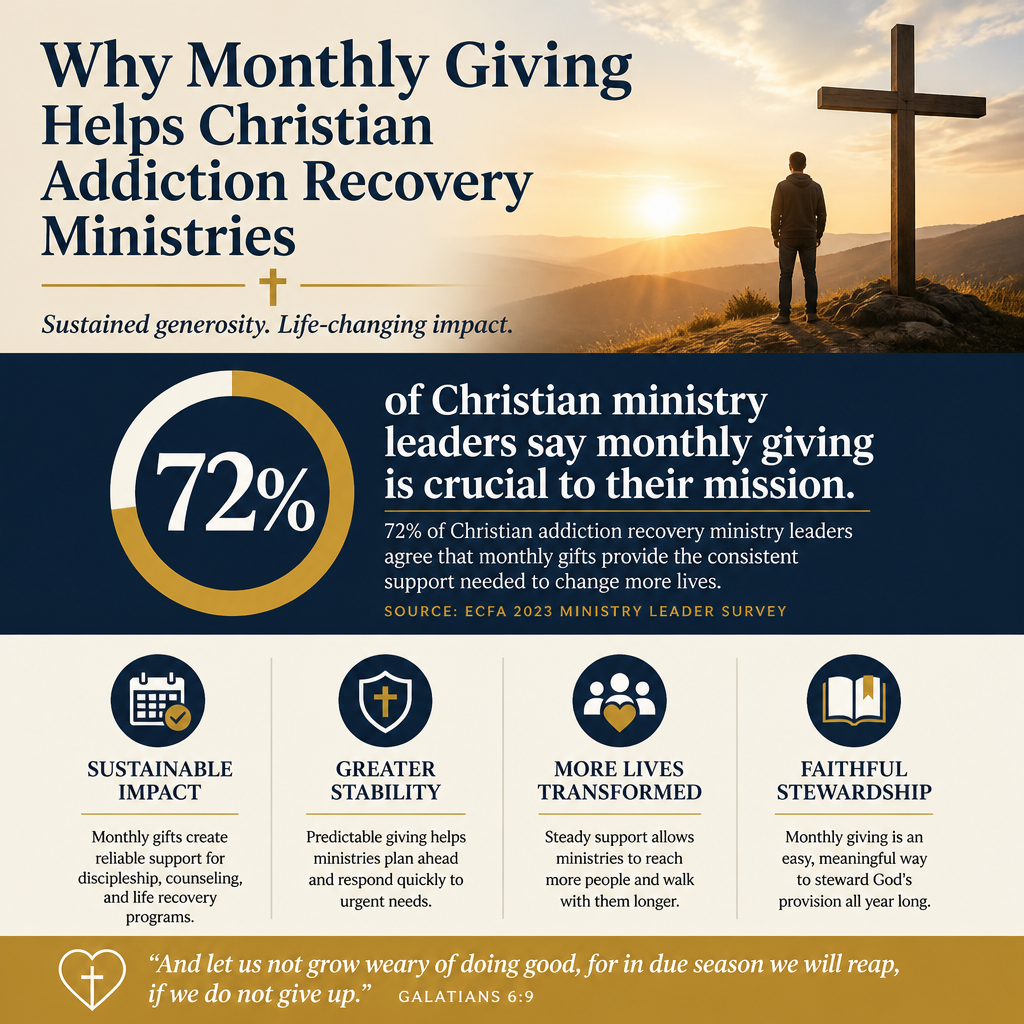
Monthly giving helps Christian addiction recovery ministries because recovery is rarely linear, and the ministries doing this work cannot disciple, staff, and sustain long-term care on unpredictable cash flow. Christian donors who care about spiritual formation, relapse prevention, and responsible stewardship should understand the operational difference between a one-time gift and a committed monthly partnership.
Addiction recovery ministry sits at the intersection of pastoral care, clinical wisdom, and practical mercy. The Church’s mandate to bear one another’s burdens is not abstract here; it involves relapse, trauma histories, housing instability, and complicated family systems. Funding patterns can either strengthen this work or quietly distort it, pushing ministries toward short-term activity instead of long obedience.
Recovery is long formation, not short crisis response
Addiction reshapes the person, and healing takes time
Christian addiction recovery is not merely the interruption of a destructive behavior. It is the slow rebuilding of worship, desire, relationships, and daily practices under the lordship of Christ. That is why many ministries organize around structured programs, mentoring, and community—often over months, not weeks. Monthly giving supports this reality by aligning donor support with the time horizon of discipleship.
Many programs also coordinate with medical and clinical care, especially where detox, medication-assisted treatment, or co-occurring mental health conditions are present. Christians genuinely disagree about certain modalities, and thoughtful donors should not pretend those debates are irrelevant. Even where methods differ, the practical truth remains: stability matters, and stability is expensive.
Relapse risk makes consistency more valuable than intensity
Relapse is common in the addiction landscape, and ministries that treat relapse as moral failure alone often do harm. A Christian ministry can uphold personal responsibility while also recognizing the ways trauma, neurobiology, and environment shape behavior. Funding that arrives steadily helps programs keep doors open when participants cycle in and out, rather than tightening services at precisely the moment vulnerability rises.
For donors seeking the most spiritually faithful use of resources, the question is not whether a ministry can produce impressive stories on an annual report timeline. It is whether the ministry can walk with people through the unglamorous middle: accountability, employment readiness, reunification efforts, and pastoral counsel.

Monthly support protects ministries from the starvation cycle
The pressure to chase revenue can deform ministry priorities
Nonprofits in many sectors fall into what researchers have described as the “starvation cycle,” where funders expect low overhead, organizations underinvest in capacity, and results suffer. The dynamic was articulated by Ann Goggins Gregory and Don Howard in Stanford Social Innovation Review. Recovery ministries are not immune. If cash flow is unstable, leaders may prioritize immediate fundraising over staff development, program evaluation, and healthy governance.
Monthly giving is not a cure-all, but it reduces the temptation to build ministry around donor volatility. A predictable base of support can allow a program director to plan staffing ratios, sustain counseling partnerships, and keep a waiting list from becoming a revolving door of disappointment.
Stable revenue supports healthier staffing and safer care
Addiction recovery work is emotionally demanding. Staff burnout, high turnover, and undertrained volunteers can create risk for participants, especially those with trauma histories. Monthly giving allows ministries to budget for training, supervision, and pastoral care for staff—investments that do not photograph well but often determine whether a program remains spiritually and operationally healthy.
This is where donors can practice mature stewardship. A ministry may be “busy” without being durable. Monthly support tends to strengthen durability.
Monthly giving strengthens accountability and measurable stewardship
Recurring donors can ask better questions over time
One-time gifts are often transactional; monthly giving invites a relationship of accountability. Over time, recurring donors can ask about admissions criteria, discipleship practices, relapse policies, staff qualifications, safeguarding, and financial controls. That posture fits the biblical idea of stewardship: resources entrusted by God for purposes that must be examined with sobriety.
Across our verification work at Most Trusted, we observe that ministries with a meaningful base of recurring support are often better positioned to report consistently and transparently, because they are not rebuilding their funding story every quarter. Donors who want confidence should still verify, but stable funding can make good accountability practices easier to maintain.
Donor expectations about overhead need Christian realism
Some donors still assume the holiest ministry is the one with the thinnest administrative line. That assumption has been challenged publicly by the “Overhead Myth” coalition, including Charity Navigator, Candid, and BBB Wise Giving Alliance, which argues that overhead ratios are a poor proxy for effectiveness (Charity Navigator). In recovery ministry, the “overhead” category often includes essential safeguards: compliance, background checks, clinical partnerships, financial controls, and outcome tracking.
Monthly giving, when paired with clear reporting, can help donors move from simplistic metrics to more faithful ones: Is the ministry spiritually grounded? Is it governed wisely? Are finances handled with integrity? Are outcomes described with humility and evidence?
Predictable giving improves care for the people donors most want to help
Recovery often requires wraparound support
Addiction rarely exists in isolation. Participants may need housing stability, transportation to counseling or work, legal advocacy, reunification support, and ongoing church community. Ministries vary in what they provide directly versus through partnerships, but the underlying need is consistent: wraparound care is hard to deliver when revenue spikes and crashes.
Monthly giving helps ministries keep practical supports available without constant emergency appeals. It can also reduce the quiet triage that occurs when a ministry cannot afford to keep a bed open, replace a broken vehicle, or retain a qualified staff member.
A disciplined monthly commitment can be spiritually formative for donors
Christian giving is not only about outcomes; it is also about worship. Regular generosity forms habits that resist the cultural catechesis of consumption. For some donors, a monthly commitment is the most realistic way to practice sustained generosity without waiting for a dramatic moment or year-end urgency.
For donors assessing where to direct that commitment within Christian Addiction Recovery Ministries, it is wise to consider whether a ministry has clear theological commitments, protects participants from harm, and has a credible plan for long-term care beyond a single program phase.
How to choose a monthly partner ministry with confidence
Monthly giving is most powerful when paired with verification
Recurring donations can unintentionally entrench poor practices if donors never re-evaluate. Mature stewardship requires more than loyalty; it requires scrutiny. At Most Trusted, we evaluate ministries against The Most Trusted Standard, a 15-criteria framework across Faith Foundation, Financial Integrity, Governance and Leadership, and Transparency and Effectiveness. The aim is not suspicion; it is clarity—so generosity can be both warm-hearted and well-anchored.
When donors evaluate a potential monthly partner, several indicators deserve attention:
- Clear theological commitments that shape programming, not merely fundraising language
- Defined safeguarding practices for participants, including boundaries and reporting pathways
- Financial statements and policies that demonstrate internal controls and responsible stewardship
- Governance that is active and independent enough to provide real oversight
- Transparent communication about outcomes, including limitations and challenges
What ministries should be willing to disclose
Serious ministries do not treat transparency as a threat. They understand that donors are not purchasing a story; they are entrusting resources. A ministry worthy of monthly partnership should be able to explain its model of care, the role of the local church, how it handles relapse, what staff training looks like, and how it measures progress without reducing people to numbers.
Donors weighing options within How to Give Wisely to Christian Addiction Recovery Ministries should also recognize that not every effective program will look the same. Some emphasize residential discipleship; others combine outpatient counseling with church-based community. The question is whether the approach is coherent, accountable, and aligned with biblical truth and wise practice.
FAQs for Why monthly giving helps Christian addiction recovery ministries
Is monthly giving better than a large one-time gift for recovery ministries?
Not always. A significant one-time gift can fund a vehicle, property repairs, scholarships, or program expansion. Monthly giving tends to be better for staffing, ongoing participant care, and predictable operating needs. Many donors choose a blended approach: a monthly commitment for core stability and occasional additional gifts for specific projects when the ministry can justify them transparently.
How can donors ensure monthly gifts are used with integrity and not wasted?
Donors should look for clear financial reporting, credible governance, and truthful communication about outcomes. Ministries should be able to describe internal controls, board oversight, and safeguarding practices in concrete terms. Independent verification can strengthen confidence by assessing whether a ministry meets consistent criteria, such as The Most Trusted Standard, rather than relying on impression or sentiment.
A durable form of partnership for a long work
Monthly giving helps Christian addiction recovery ministries because it funds the patient, structured work that recovery requires: stable staffing, accountable care, and resilient operations. For Christian donors, that steadiness is not merely a financial tactic. It is a way of aligning our stewardship with the slow, faithful labor of restoration—bearing burdens over time, not only in moments of crisis.



