
How to give wisely to Christian addiction recovery ministries is a stewardship question, not merely a charitable preference. Addiction entangles bodies, relationships, and souls; it also entangles donors in high-stakes decisions about what kind of care is being funded and what kind of formation is being offered.
Christian donors often carry two convictions at once. We want measurable help for people in crisis, and we want ministry that speaks truthfully about sin, suffering, repentance, and grace. Wisdom begins by refusing a false choice between compassionate care and spiritual seriousness. The ministries most worth supporting are usually the ones that can articulate both with clarity and prove that their practices match their claims.
Begin with the ministry model, not the appeal
Addiction recovery is not one uniform intervention, and donor confusion often starts here. A residential discipleship program, an outpatient counseling center, a church-based recovery group, and a ministry that focuses on reentry after incarceration can all be faithful expressions of Christian mercy, but they do not have the same cost structure, risk profile, or evidence base.
The field has had to reckon with a basic reality: relapse is common, and progress is rarely linear. The National Institute on Drug Abuse describes addiction as a chronic disease in which relapse rates can be comparable to other chronic illnesses, and relapse does not automatically mean treatment has “failed.” National Institute on Drug Abuse. That means donors should not treat a single outcome metric as the whole story, or assume that dramatic testimonies represent the typical pattern.
Clarify what the ministry is promising
Wise giving starts with asking what the ministry believes it is responsible to provide. Is it claiming sobriety, stable housing, trauma healing, job placement, church membership, reunified families, or long-term discipleship? Some of these are appropriate goals; some are aspirational; some are not fully within any ministry’s control. Sophisticated ministries describe their aims with moral clarity and operational humility.
We recommend looking for a stated theory of change that is recognizably Christian and operationally specific. “We help men walk with Christ” can be true, but without concrete practices—mentoring cadence, clinical partnerships, accountability structures, safeguarding policies, and aftercare—donors cannot evaluate whether the ministry is prepared for the complexity of addiction.
Distinguish clinical care from pastoral care and examine how they integrate
Christians genuinely disagree about how formal clinical treatment should relate to distinctly spiritual practices. Some programs are explicitly nonclinical and emphasize discipleship; others employ licensed clinicians; others partner with local providers. The donor’s task is not to enforce one template but to discern integrity: does the ministry accurately describe what it is and is not providing, and does it avoid implying clinical competence it does not have?
If a ministry offers counseling, donors should ask whether it uses licensed professionals where licensure is required, whether it refers participants for medication-assisted treatment when appropriate, and whether it has clear boundaries between spiritual direction and psychotherapy. If a ministry does not offer clinical services, it should show disciplined referral pathways rather than defaulting to “we do everything here.”
Pay attention to how the ministry treats family and community
Addiction rarely affects only one person. Wise ministries consider the spouse, the parents, and the children, and they avoid making the participant the sole unit of care. That often includes family education, visitation policies that are neither naïve nor punitive, and a plan for rebuilding relationships where reconciliation is possible and safe.
This is also where the local church matters. Programs that can connect participants to a stable church community—without treating church attendance as a box to check—tend to understand that long-term freedom requires belonging, accountability, and spiritual formation.

Evaluate faithfulness and safety in the same frame
Donors sometimes speak as if they must choose between “biblical” and “professional,” as though safeguarding and governance are secular concerns. Scripture will not allow that division. The pastoral epistles link doctrine and life, teaching and character, authority and restraint. In recovery ministry, the moral stakes are acute because participants are vulnerable and power imbalances are real.
Look for a coherent Christian anthropology
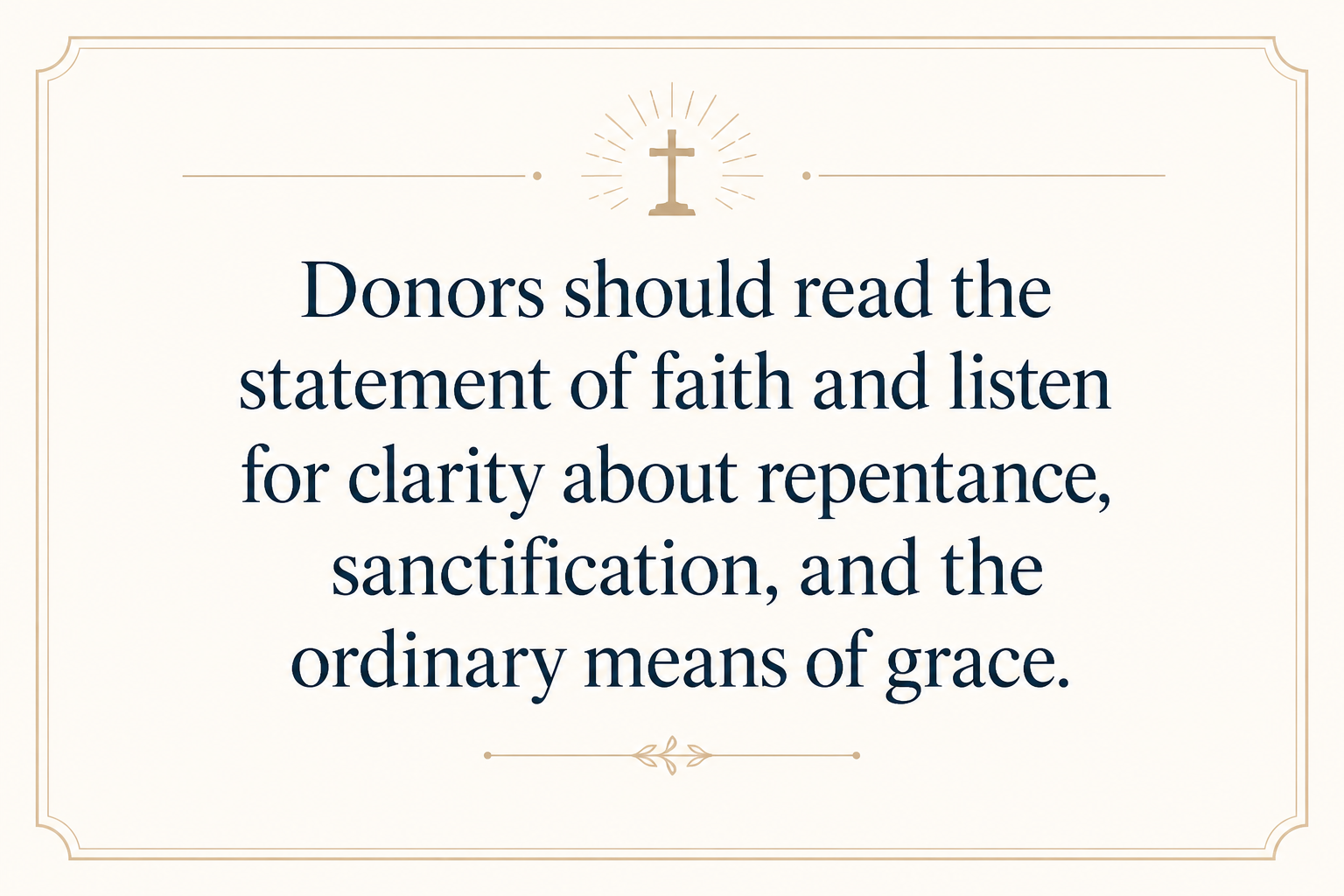
A ministry’s view of the human person shapes everything: whether it treats participants as projects or as image-bearers, whether it understands shame and guilt, whether it confuses trauma with sin or denies sin in the name of trauma, and whether it offers grace that is costly rather than sentimental. Donors should read the statement of faith and listen for clarity about repentance, sanctification, and the ordinary means of grace.
At the same time, faithful anthropology requires realism about embodied life. Many participants face co-occurring mental health conditions, medical complications, and legal constraints. A ministry can affirm that salvation is of the Lord and still acknowledge that recovery often involves disciplined habits, appropriate medical care, and a long obedience in the same direction.
Demand strong safeguarding and clear boundaries
Recovery settings can attract both predatory behavior and unhealthy dependence. Wise ministries have written safeguarding policies, reporting pathways, and training that is not improvised. This includes boundaries around counseling, appropriate supervision in residential settings, rules that protect women from coercion, and protocols for handling relapse, overdose risk, and self-harm threats.
Donors should not be impressed by intensity alone. A strict environment can be either protective or abusive depending on leadership character and accountability. What matters is whether the ministry can show how it protects participants from exploitation and how it responds when harm occurs.
Examine how leadership is held accountable
Charismatic founders are common in this space, and some have been used by God significantly. But founder-centric governance is also a recurring weakness. Healthy ministries have an independent board, documented decision-making, and checks that are more than ceremonial. If an organization cannot explain who can discipline the executive, who reviews related-party transactions, and how complaints are handled, donors should treat that as a material risk.
Across our verification work at Most Trusted, the ministries that meet The Most Trusted Standard tend to show consistent alignment between theological commitments and operational discipline. They do not treat governance and transparency as distractions from ministry; they treat them as part of faithful stewardship.
Give toward real capacity, not simplistic ratios
Christian donors often ask what “share of donations” goes to programs, hoping to ensure that their giving is not consumed by overhead. The desire is understandable, but the premise can mislead. The “Overhead Myth” critique, articulated by leading evaluators, argues that an obsession with low overhead can starve nonprofits of the systems that make programs safe and effective. Charity Navigator. In addiction recovery, underfunded infrastructure can become a direct participant-safety issue.
Understand the cost structure of recovery
Residential programs often carry high fixed costs: staffing coverage, facilities, meals, transportation, and compliance. Outpatient and mentoring models may have lower fixed costs but can require stronger coordination and more robust volunteer training to avoid inconsistency. A “high program percentage” does not automatically indicate excellence; it can indicate underinvestment in financial controls, staff development, clinical partnerships, or outcome tracking.
We recommend donors read the ministry’s Form 990 (for U.S. nonprofits) and audited financials when available, then ask whether spending patterns match the ministry model. A $5 million budget with no line for professional training or participant safeguarding should raise questions. A smaller ministry with a lean staff can be faithful, but it should also be candid about limits and referral practices.
Prefer monthly giving when stability improves care
Recovery ministry is labor-intensive and relationship-intensive. It is difficult to staff well when funding is episodic. Monthly giving can underwrite the unglamorous but essential parts of care: consistent supervision, case management, aftercare coordination, and staff retention. A donor who gives predictably often does more to improve program quality than a donor who gives once in response to a compelling story.
There is also a theological logic to steady support. Faithfulness is ordinarily formed over time. A stable base of recurring donors often allows a ministry to resist reactive fundraising and keep its attention on prudent care and spiritual formation.
Use designated giving with discernment
Designating a gift for scholarships, beds, or program expansion can be an act of love, but it can also unintentionally distort leadership decisions if it constrains the ministry’s ability to fund core operations. The best practice is to designate only when the organization can clearly explain the restricted fund, the policy for handling excess or shortfall, and the administrative reality of tracking restricted gifts.
We recommend asking one direct question: if we restrict this gift, what essential work becomes harder to fund? A wise ministry will answer candidly rather than simply agreeing. Donors should treat that candor as a mark of integrity, not a lack of gratitude.
Insist on transparent impact reporting without demanding false certainty
Christian donors rightly want to know whether a ministry is effective. Yet addiction recovery outcomes are difficult to measure, and simplistic metrics can create perverse incentives. Counting “decisions,” “graduations,” or “days sober at discharge” may be part of the picture, but they are not the whole picture. A ministry can manipulate easy metrics while neglecting aftercare, community reintegration, and long-term discipleship.
Verifiable evidence suggests that supportive relationships are a key predictor of sustained recovery, which means ministries should attend to community, mentoring, and post-program connection, not only in-program compliance. The Substance Abuse and Mental Health Services Administration emphasizes recovery as a process supported by relationships and social networks. SAMHSA.
Ask for outcomes that match the ministry’s responsibilities
Wise donors request a small set of outcomes that correspond to what the ministry actually does. For a residential program, this might include completion rates, post-exit housing stability, employment or training engagement, connection to a local church, and follow-up at 6 and 12 months. For a mentoring-based model, it might include meeting frequency, retention in community, and referrals successfully completed.
The harder question is how the ministry handles relapse and failure. Transparent ministries report attrition honestly, explain what they learned, and show how policies protect participants rather than hiding discouraging numbers. A donor should distrust perfection in a field marked by suffering.
Look for third-party accountability where appropriate
Not every organization can afford expensive evaluations, and donors should not demand research designs that are unrealistic for smaller ministries. But donors can ask whether the ministry uses any external oversight: audits, licensing (when applicable), advisory councils, clinical supervision partnerships, or independent board review of program incidents.
Most Trusted exists to serve donors precisely here. Our verification work evaluates ministries against The Most Trusted Standard, examining faith commitments alongside financial integrity, leadership accountability, and transparent effectiveness. When donors pair compassionate intent with verified diligence, giving becomes not only generous but also disciplined.
Fund the long arc of restoration
Scholarships are often a compelling way to give because the need is concrete and immediate. Donors can do this wisely by asking whether the scholarship includes aftercare, whether it is paired with realistic participant expectations, and whether the ministry avoids financial dependency or coercion. A scholarship that funds 90 days but leaves a participant isolated afterward may be less effective than a smaller scholarship tied to a longer continuum of support.
We recommend donors also consider funding the “unseen” parts of restoration: family support, transportation, legal advocacy partnerships, job readiness, and pastoral care coordination. These are rarely headline-worthy, but they are often decisive for whether a person can reenter ordinary life with stability.
Giving wisely is an act of love ordered by truth
Christian addiction recovery ministries operate in contested terrain: medical complexity, spiritual warfare, public policy constraints, and profound human suffering. Wise giving does not retreat from that complexity; it supports ministries that name it honestly and respond with disciplined compassion.
Donors who want to go deeper into the field can review our work on Christian Addiction Recovery Ministries. When giving is shaped by theological clarity, careful governance, and transparent impact, it becomes a form of neighbor-love that is both tender and strong.



