

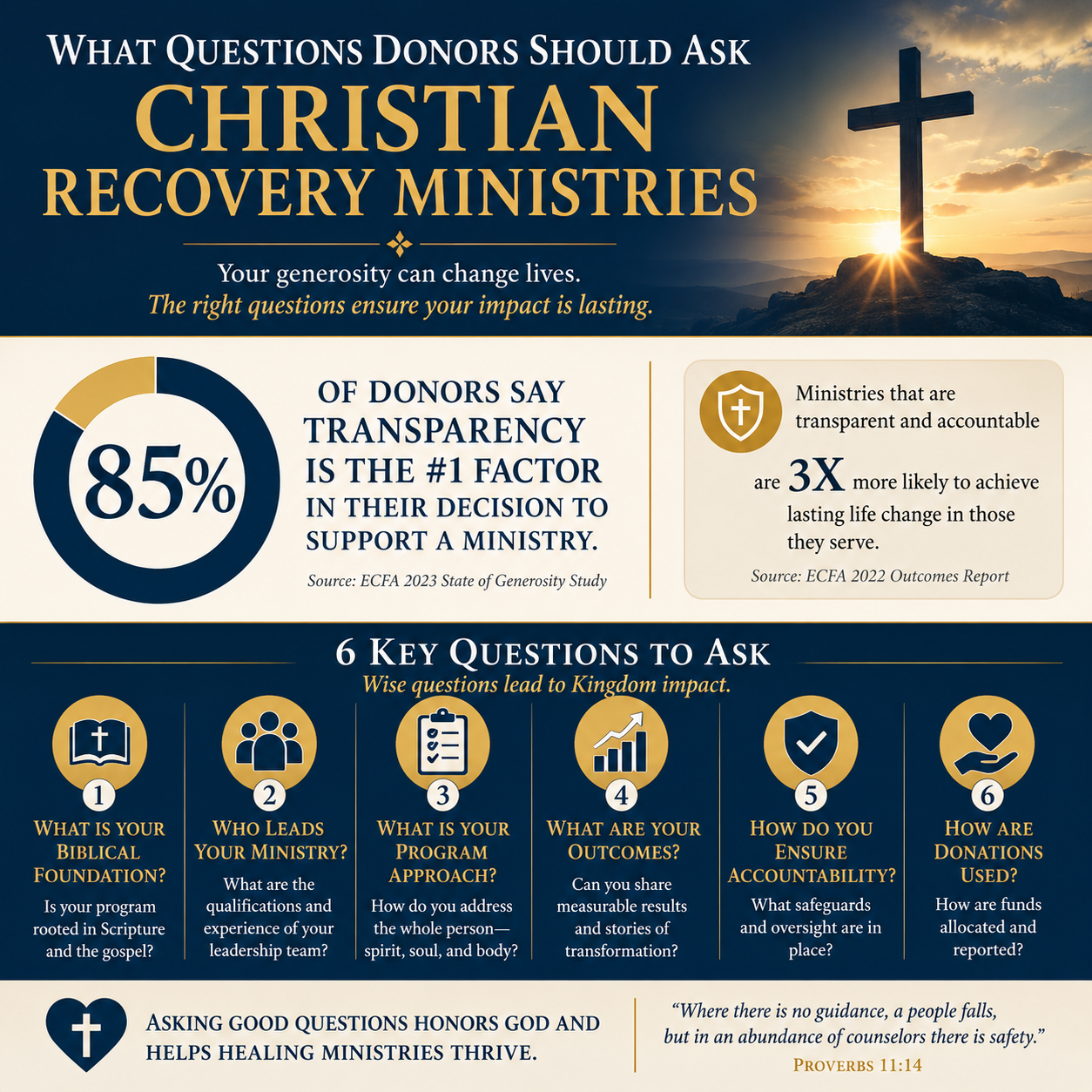
The questions donors should ask Christian recovery ministries are not peripheral questions. In addiction recovery, the line between genuine care and unintended harm can be thin, and Christian donors are accountable before God for how our giving shapes people and institutions.
Addiction is never merely a medical problem, and it is never merely a moral problem. It is entangled with trauma, mental health, family systems, despair, and spiritual bondage. Wise Christian generosity refuses simplistic stories while still insisting on clarity: ministries should be able to explain what they believe, what they do, how they measure faithfulness, and how they handle power and money.
1. What gospel do you preach, and how does it shape your recovery model
Ask for a clear theological center
Christian recovery ministries often share vocabulary—“freedom,” “healing,” “discipleship”—while operating from meaningfully different theological assumptions. Donors should ask ministries to articulate, plainly, the gospel they preach and how that gospel orders their approach to addiction: sin and suffering, repentance and lament, grace and responsibility, sanctification and relapse.
The New Testament holds together a serious view of sin and a serious view of suffering. Jesus does not excuse sin; neither does he treat the afflicted as problems to manage. A ministry’s theology should produce practices that are both truth-telling and patient, both morally serious and clinically realistic. “Bear one another’s burdens, and so fulfill the law of Christ” is not sentiment; it is a program of life together that requires structure, limits, and accountability.
Clarify how spiritual formation relates to clinical care
Some programs are explicitly church-based and primarily pastoral. Others integrate licensed clinical services, medication management, and referral networks. Christians genuinely disagree about the right balance, but donors can still ask whether a ministry has a coherent rationale. If the program rejects counseling, psychiatry, or medication as inherently faithless, donors should ask for doctrinal and pastoral reasoning that can withstand scrutiny, not slogans.
When a ministry does incorporate clinical care, donors should ask how they ensure it remains consistent with Christian anthropology rather than drifting into a purely therapeutic frame. The goal is not to baptize secular categories with Bible verses. The goal is to treat people as embodied souls who need both spiritual and practical help.

2. Who is served, and what safeguards protect the vulnerable
Define the population and the level of care
“Recovery ministry” can describe a weekly support group, a residential program, or a referral-focused outreach. Donors should ask who the ministry serves, what level of acuity they accept, and what they are not equipped to handle. A responsible ministry will not imply it can serve everyone. It will name its boundaries, referral relationships, and criteria for admission and discharge.
It is also appropriate to ask whether the ministry serves people with co-occurring diagnoses and how they respond to crisis. Substance use disorders frequently overlap with depression, anxiety, psychosis, and trauma. Ministries should be able to explain how they screen for risk, what happens when someone becomes suicidal, and how they coordinate with emergency services when necessary.
Ask about policies that prevent spiritual and relational abuse
Recovery settings concentrate power. Participants are often separated from familiar supports, are emotionally raw, and may carry shame that makes them easy to manipulate. Donors should ask what safeguards are in place to prevent spiritual abuse, sexual misconduct, coercive control, and financial exploitation.
Concrete questions matter: Is there a written code of conduct? Are there restrictions on private meetings between staff and participants? Is there a clear grievance process? Are background checks standard? A ministry that cannot describe basic safeguarding practices is asking donors to fund unnecessary risk.
We also recommend asking how the ministry handles family involvement. Family reunification can be a goal, but it is not always safe or wise, especially where domestic violence or enabling patterns are present. Responsible ministries are candid about the tensions and about how they weigh reconciliation alongside protection.
3. What methods are used, and how do you know they help
Distinguish testimony from evidence without devaluing either
Christian donors rightly value testimony. Scripture itself bears witness to lives changed. But testimony is not a measurement system. Donors should ask ministries to define what success means in their context and how they track it over time—while also acknowledging the limits of measurement in a complex, relapse-prone condition.
The clinical field treats addiction as a chronic condition for many people, with relapse risk shaped by environment, community, mental health, and time in sustained care. The National Institute on Drug Abuse describes relapse as common and comparable to other chronic illnesses, while still affirming that treatment works and recovery is possible National Institute on Drug Abuse. A Christian ministry does not need to mimic a hospital to learn from this realism.
Ask what is required of participants and what is freely given
Some recovery ministries require work program participation, strict schedules, or church attendance. Those expectations can be wise, but donors should ask what the requirements are and why. Are expectations aimed at discipleship and stability, or do they become a mechanism for control? Are “failures” handled with pastoral wisdom or with humiliation?
These questions are especially important when a ministry receives participant labor, sells products, or operates thrift stores and social enterprises. Work can be dignifying. It can also become exploitative when accountability is weak and financial incentives are misaligned.
- What is the ministry’s stated theory of change for recovery and discipleship?
- How long is the typical program, and what aftercare is offered?
- How are relapses addressed, and what restoration pathways exist?
- What outcomes are tracked at 6, 12, and 24 months, and how is data collected?
- What external partnerships exist for medical, psychiatric, or legal needs?
4. How are finances and governance structured to resist predictable temptations
Ask how money decisions are made and overseen
Recovery ministries handle donor funds in emotionally charged contexts. Stories are compelling, needs are urgent, and donors may be more trusting than they would be in other domains. That combination is fertile ground for poor controls, blurred boundaries, and, in some cases, fraud. Donors should ask whether the ministry has independent board oversight, whether the board reviews financial statements, and whether leadership compensation is set through a documented process.
It is also appropriate to ask for audited or reviewed financials when the size of the ministry warrants it, and for transparency about how restricted gifts are managed. Healthy ministries do not treat these questions as hostility. They treat them as stewardship.
Refuse simplistic overhead narratives
Christians sometimes ask, “How much goes to overhead?” as though a single ratio proves faithfulness. The sector has long argued against that reductionism, notably in the Overhead Myth letter signed by major evaluators, which cautions donors against using overhead percentages as the primary measure of nonprofit performance Charity Navigator. The harder question is whether spending decisions are aligned with mission, controls are sound, and outcomes are honestly reported.
For donors seeking that kind of clarity, Most Trusted evaluates Christian nonprofits against The Most Trusted Standard, a 15-criteria framework spanning faith foundation, financial integrity, governance and leadership, and transparency and effectiveness. Verification is not a replacement for discernment, but it can meaningfully reduce guesswork in high-trust giving environments.
5. What accountability exists to the church, to participants, and to the truth
Ask what happens when leadership fails
Every ministry has a doctrine of sin. Donors should ask whether their governance reflects it. Is there a plan for misconduct allegations? Are there external reporting pathways? Does the ministry have a relationship with a local church or a network that can provide meaningful correction, or is authority functionally concentrated in a founder with little constraint?
The credibility of Christian witness is not preserved by hiding failure. It is preserved by truth-telling, repentance, restitution where required, and a willingness to submit to discipline. Donors should ask ministries to describe, in general terms, how they have handled serious incidents in the past and what policy changes resulted.
Ask for transparency that is specific, not performative
Transparency is more than inspirational newsletters. Donors should expect ministries to publish clear leadership information, board lists, basic financial summaries, and program descriptions that do not rely on vague spiritual language. A mature ministry can tell the truth about complexity: about relapse, about participant conflict, about the slow work of rebuilding a life.
Those seeking a broader view of how programs function across the landscape of Christian recovery work may also find it useful to review How Christian Addiction Recovery Programs Work as a category, where the operational and pastoral differences between models become easier to compare.
And because many donors begin with the question of which kinds of ministries exist and how they relate to churches, clinical systems, and community supports, Christian Addiction Recovery Ministries remains a helpful reference point for framing the field before making specific grants.
FAQs for What questions donors should ask Christian recovery ministries
Should donors prioritize explicitly faith-based programs over clinically integrated programs?
Donors should prioritize faithfulness and competence rather than a single template. Some ministries are primarily pastoral and do so responsibly with strong referral networks and wise boundaries. Others integrate licensed counseling, medication management, and partnerships with treatment providers while remaining clearly Christian in their anthropology and discipleship. The central questions are whether the ministry can articulate a coherent theology of addiction and recovery, whether it operates within its competencies, and whether safeguards and accountability are strong.
Is relapse a sign that a Christian recovery ministry is failing?
Relapse is not automatically evidence of failure; it is a known feature of addiction for many people, and responsible ministries prepare for it without normalizing it. What donors should examine is how the ministry responds: whether relapse is handled with truth and care, whether safety is prioritized, whether participants are restored through a clear process, and whether the ministry tracks outcomes over time with honesty. A ministry that claims relapse never happens is not necessarily more spiritual; it may be less truthful.
Discernment that honors both compassion and stewardship
Christian donors give to recovery ministries because we believe Christ raises the dead and restores what sin has shattered. That conviction should not make us careless. It should make us more serious about governance, safeguarding, truthful reporting, and the long obedience of discipleship. The best questions are not suspicious questions; they are stewardship questions, asked in love for those who suffer and reverence for the God to whom every ministry ultimately answers.



