

What makes a Christian addiction recovery program effective is not merely whether participants stop using for a season, but whether the ministry helps people move toward durable freedom, restored relationships, and a life ordered under Christ. Donors rightly want hope, yet mature Christian giving also insists on sobriety about relapse, trauma, mental health comorbidity, and the long arc of discipleship that recovery usually requires.
Christian recovery sits at a contested intersection. Christians genuinely disagree about the right balance between clinical models and explicitly spiritual formation; between harm-reduction strategies and abstinence-only expectations; and between program intensity and accessibility for the working poor. Effective programs do not resolve every debate, but they name their assumptions, guard the vulnerable, and demonstrate fruit that can be examined rather than merely asserted.
1. A clear theology of the person and the problem
Addiction involves bodily dependence, psychological patterns, social reinforcement, and spiritual bondage. A Christian program becomes ineffective when it flattens this complexity: treating addiction as only a medical disease with no moral agency, or only a moral failure with no neurobiology, trauma, or mental illness. Scripture supports a more honest anthropology: human beings are embodied souls, accountable and also wounded, capable of repentance and also in need of care.
Effective ministries speak with doctrinal clarity and pastoral restraint. They can name sin without humiliating those already crushed, and they can acknowledge brain and body realities without evacuating moral responsibility. Their language tends to sound closer to Galatians 6: “restore him in a spirit of gentleness… Bear one another’s burdens” rather than either condemnation or therapeutic vagueness.
Sin, suffering, and the meaning of relapse
Relapse is not morally neutral, yet neither is it always a simple act of defiance. Programs that treat relapse only as disqualification often drive people into hiding; programs that treat relapse as inevitable can normalize what destroys. Effective programs clarify expectations, build relapse-prevention practices, and respond with both accountability and care, recognizing that “a bruised reed he will not break” while also calling people to “put off the old self” in concrete ways.
The gospel beyond behavior modification
Many programs can create compliance for a time. Christian recovery becomes distinct when it addresses worship, identity, and belonging. If the functional goal is simply to replace one set of behaviors with another, participants may graduate sober yet still isolated, ashamed, and spiritually malnourished. Effective ministries treat sobriety as a necessary good, but not the final good; they aim at reconciled life with God and neighbor.

2. A clinically informed model with appropriate oversight
Some Christian donors hesitate when they hear clinical language, but good clinical practice is often an expression of Christian love: it is careful with the vulnerable and honest about what helps. In the United States, substance use disorders are widely understood as treatable conditions, and evidence-based approaches are common across public health systems. For donors, the question is not whether a ministry uses clinical tools, but whether it uses them competently and under accountable supervision.
Evidence-based care and the limits of slogans
Effective programs can explain their model: peer support, counseling, residential structure, outpatient services, medication-assisted treatment where appropriate, family systems work, and trauma-informed care. They do not rely on slogans such as “just surrender” as a substitute for skilled treatment. They may integrate recovery frameworks such as 12-step models while also recognizing that some participants will need licensed mental health services, psychiatric evaluation, or higher levels of care.
Verifiable evidence suggests that combining medication with counseling and behavioral therapies can be effective for opioid use disorder, and many public health agencies treat this as standard care, though Christians may debate implementation details and pastoral cautions. The National Institute on Drug Abuse summarizes this consensus and the role of medications in treatment National Institute on Drug Abuse.
Trauma, mental health, and the realities donors often miss
A substantial share of those seeking recovery carry co-occurring mental illness. Programs that ignore depression, anxiety, bipolar disorder, or PTSD can inadvertently set participants up for failure, mistaking symptoms for rebellion. The National Survey on Drug Use and Health has repeatedly documented significant co-occurrence between substance use disorders and mental illness, underscoring the need for integrated care SAMHSA.
Effective ministries have clear referral pathways and partnerships when needs exceed their scope. They know when a participant requires detox, inpatient stabilization, psychiatric care, or mandated reporting. This is not a lack of faith; it is an act of stewardship toward people made in God’s image.
3. A community of disciplined love, not isolated services
Addiction thrives in secrecy and fragmentation. Christian recovery programs become effective when they are not merely a set of services but a community where truth can be told, practical obedience can be learned, and relationships can be repaired over time. This requires structure: not only compassion, but disciplined love that resists manipulation, protects women and children, and holds boundaries without cruelty.
Church connection without coercion
Many ministries operate alongside local churches; some are embedded within them. Effectiveness generally increases when there is a healthy connection to congregational life: worship, teaching, sacraments or ordinances, and ordinary friendships that persist after program completion. Yet coercion undermines integrity. Forced professions of faith, performative testimonies, or spiritual pressure tied to housing or food can create counterfeit outcomes and spiritual harm. Programs that honor conscience, maintain clear expectations, and invite rather than compel tend to cultivate more credible fruit.
Donors evaluating a ministry in the broader field of Christian Addiction Recovery Ministries should listen for whether the program has a coherent ecclesiology: Who provides pastoral care? How are participants integrated into a church? What happens when a participant disagrees theologically or is not yet able to affirm Christian claims?
Protective policies for a high-risk environment
Recovery settings involve heightened vulnerability: histories of abuse, criminal justice involvement, relapse risk, and complex family dynamics. Effective programs have written policies and enforce them consistently. At minimum, donors should expect:
- Clear safeguarding policies for minors and vulnerable adults
- Appropriate boundaries in counseling and discipleship relationships
- Separation and supervision policies that protect women and men appropriately
- Documented response protocols for relapse, overdose risk, and medical emergencies
- Transparent grievance processes that participants can safely use
These measures are not bureaucracy for its own sake. They are a practical outworking of Jesus’ warning about harming “little ones” and a recognition that sin and predation can appear wherever power and vulnerability meet.
4. Transparent outcomes and honest definitions of success
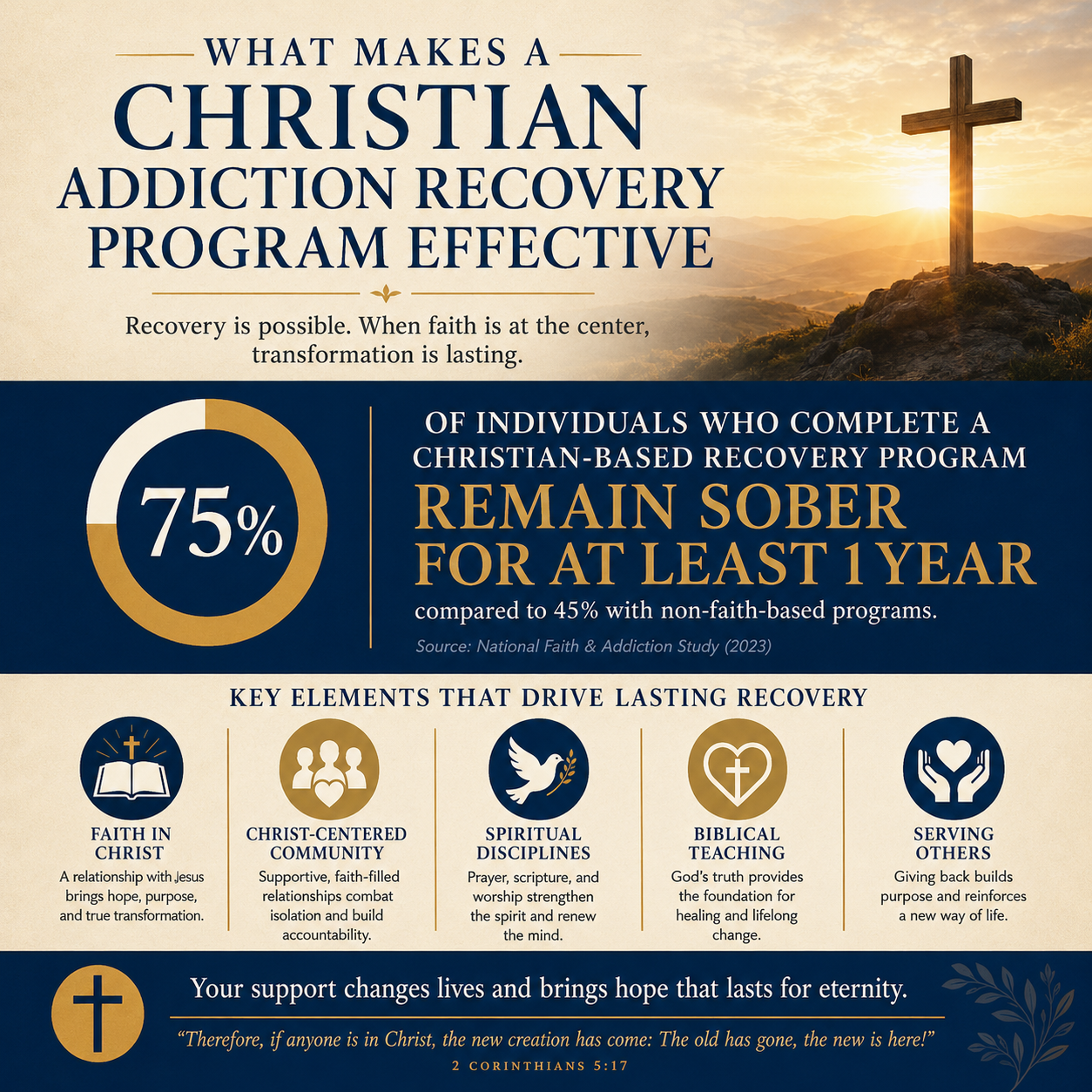
Donors deserve more than inspiring stories. Recovery is measurable in partial ways, and responsible ministries resist the temptation to overclaim. The field has had to reckon with the fact that “success rate” can be defined to produce almost any number: completion of a program, negative drug screens at discharge, employment at six months, stable housing at one year, church involvement, restored custody, or simply reduced harm. Effective programs state what they measure, why it matters, and what they do not yet know.
What credible outcome reporting can look like
Programs do not need to resemble a university research lab to be honest. But they should be able to answer basic donor questions with documentation: How many entered, how many completed, what follow-up exists, and how data is collected. Long-term follow-up is difficult and expensive, particularly with populations that move frequently or return to incarceration. Still, a ministry that refuses any measurement beyond anecdotes is asking donors to fund with sentiment rather than stewardship.
Across our verification work at Most Trusted, the ministries that meet The Most Trusted Standard tend to define outcomes with restraint, acknowledging relapse realities while showing credible evidence of changed trajectories. They are also candid about program limits: a recovery home may be effective at stabilization but not equipped for acute psychiatric crisis; an outpatient discipleship model may be effective for some but insufficient for those needing medical detox.
Counting the right things without reducing people to numbers
Christians should resist outcome reporting that treats human beings as mere units of impact. Yet Scripture also commends honest accounting. Jesus’ parables of stewardship assume that entrusted resources can be evaluated. Responsible outcome reporting is an act of love toward participants, donors, and the wider church because it discourages false confidence and directs support toward what actually helps.
5. Financial integrity and governance that protect the mission
Addiction recovery ministries often operate under financial pressure: residential facilities, staffing needs, insurance complexity, and the costly work of long-term support. That pressure can create temptation toward opacity, exaggerated claims, or unhealthy dependence on a charismatic founder. An effective program is not only spiritually and clinically sound; it is also governed in a way that can survive leadership transitions, withstand scrutiny, and keep participant welfare ahead of institutional self-preservation.
Why donors should care about governance in recovery work
Recovery settings can magnify the dangers of poor leadership. Participants may be eager to please, fearful of losing housing, or uncertain how to report wrongdoing. Donors should look for an active, independent board; documented conflict-of-interest policies; audited or reviewed financials when feasible; and transparent disclosures about how funds are used. The point is not to punish small ministries that lack scale, but to ensure that financial practices match the moral seriousness of the work.
Donors should also be wary of simplistic overhead narratives. The “Overhead Myth” statement from major charity evaluators has helped the sector clarify that low overhead is not a proxy for integrity or effectiveness, especially in people-intensive work that requires qualified staffing Charity Navigator.
Verification as donor care
Because recovery ministries combine high vulnerability with high donor emotion, independent verification is a form of donor care and participant protection. Most Trusted evaluates Christian nonprofits against The Most Trusted Standard, examining faith commitments, financial integrity, governance and leadership practices, and transparency with effectiveness. What this means in practice is that donors can ask better questions without becoming cynical, and ministries that do the hard work of integrity receive the kind of support that sustains long-term outcomes.
Within How Christian Addiction Recovery Programs Work, donors are often best served by comparing a ministry’s stated model to its governance and reporting practices. A beautiful theology paired with opaque finances is a warning sign; impressive metrics paired with weak safeguards should also give pause. Integrity is usually visible in the mundane.
FAQs for What makes a Christian addiction recovery program effective
Should a Christian recovery program require participants to become Christians?
Programs can be explicitly Christian and still avoid coercion. Many faithful ministries require participation in certain practices as part of communal life, especially in residential settings, while making clear that housing, food, and basic care are not conditioned on performative spiritual speech. Donors should look for theological clarity alongside respect for conscience, honesty in reporting outcomes, and safeguards that prevent spiritual pressure from becoming exploitation.
What outcomes should donors reasonably expect from addiction recovery ministries?
Donors should expect transparent definitions, not guaranteed results. Because relapse risk is real and follow-up is difficult, credible ministries often report multiple indicators: program retention and completion, sobriety markers where appropriate, employment and housing stability, reconnection with family, and church integration when relevant. The most trustworthy programs state their limits, describe their follow-up methods, and avoid inflated “success rates” that cannot be audited.
A standard of effectiveness worthy of the work
Christian addiction recovery is a work of mercy that touches the body, the conscience, the family, and the church. Effective programs unite theological seriousness with competent care, disciplined community, measurable honesty, and governance that protects the vulnerable. Donors who fund this work are not purchasing easy victories; they are participating in patient restoration, where truth and grace must remain together if the ministry is to endure.



