
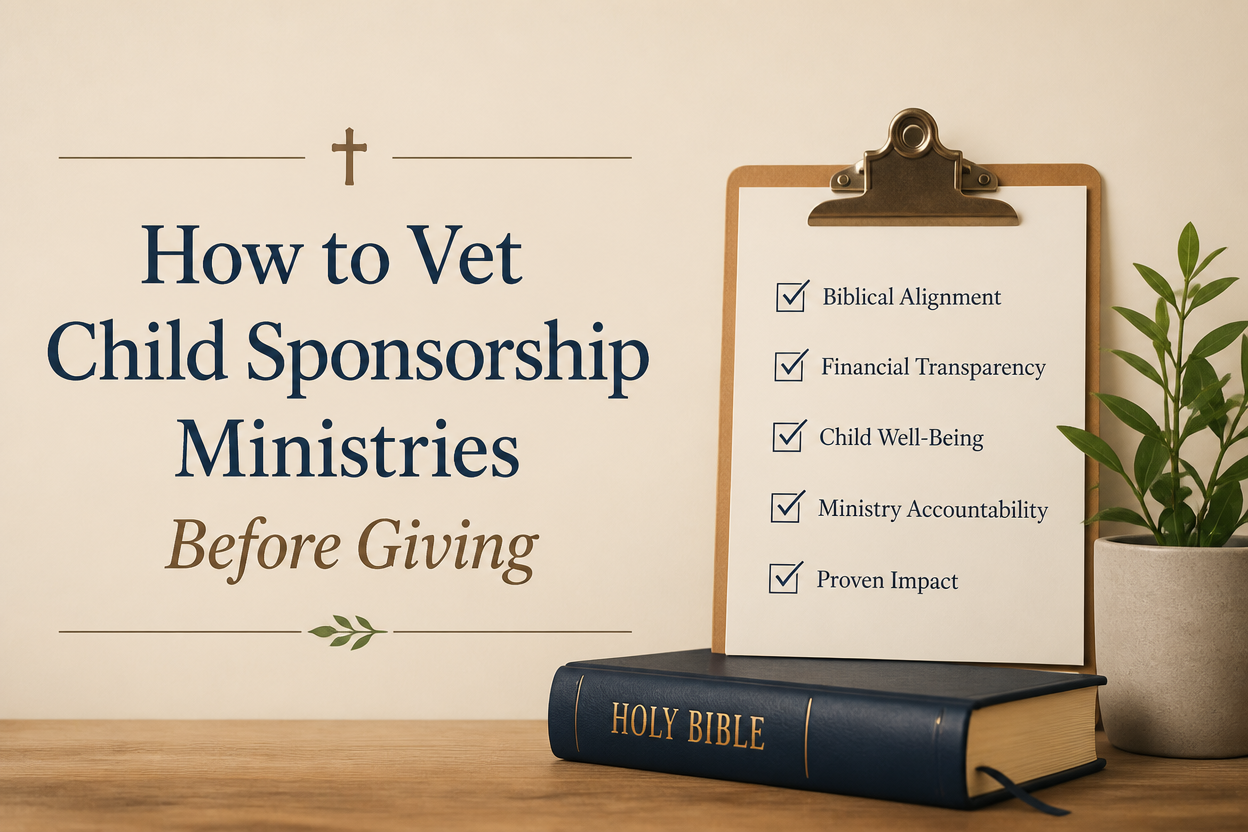
To vet child sponsorship ministries before giving is to take love seriously. Christian compassion does not excuse negligence; it requires truthful attention to what our money actually does in a child’s life, a family’s stability, and a community’s long-term flourishing.
Child sponsorship is also one of the most emotionally charged forms of Christian giving. The photographs are personal, the language is intimate, and the implied relationship is direct. That combination can fund faithful, effective work. It can also conceal weak governance, vague program claims, and models that unintentionally pressure families, churches, or local partners. Mature stewardship begins where sentiment ends: with verifiable evidence.
Begin with a theology of the child and a theology of the church
Christian donors do not sponsor “units.” We respond to image-bearers. Scripture grounds this work in more than empathy: God “executes justice for the fatherless” (Deuteronomy 10:18), and James describes care for the vulnerable as a mark of “pure and undefiled religion” (James 1:27). Child-focused ministry is not optional in biblical ethics, but it is also not immune from temptation.
One recurring temptation is to treat the child as a fundraising instrument rather than as a neighbor. Another is to treat Western donors as primary actors rather than as supporting members of the global church. When a sponsorship program is healthy, it tends to strengthen families, reinforce local churches, and respect local leadership. When it is unhealthy, it creates dependency, displaces local initiative, or teaches communities to perform need for foreign attention.
Clarify what the ministry believes it is doing
Before reviewing budgets and impact claims, ask for the ministry’s own stated aims. Is sponsorship framed as a relationship with one child, a way to fund community development, a discipleship pathway, or a mix? Clarity is not a marketing preference; it is a moral requirement. Ambiguity is where donor misunderstanding thrives.
Look for ecclesial accountability, not only program excellence
Many child sponsorship ministries are legally structured as nonprofits, but Christian donors should also ask what spiritual accountability exists. Is there meaningful connection to local churches? Is evangelism described with integrity rather than pressure? Is discipleship presented as a partnership with local believers rather than a foreign initiative? Christians genuinely disagree about how to describe evangelism in humanitarian contexts, but truthful ministries do not hide their commitments, and they do not manipulate vulnerable families with spiritual coercion.

Test whether sponsorship promises are truthful and understood
The central ethical question in child sponsorship is straightforward: does the ministry’s communication match how funds are actually used? Some programs legitimately direct a defined portion of a sponsor’s gift to a particular child’s services and support. Others pool sponsorship revenue for community-level programs. Both models can be defensible; the moral issue is whether the donor is led to believe something that is not true.
Ask direct questions about restricted and unrestricted use
Responsible ministries can explain, in plain terms, what happens when a sponsor gives $40 each month. If funds are pooled, they should say so prominently and consistently—not only in footnotes. If funds are sometimes redirected due to child transition, relocation, or safety concerns, that should be described before a donor discovers it later.
Evaluate marketing and child protection practices together
Child sponsorship often involves personal information, letters, and photographs. That is a child protection issue, not merely a communications choice. Vetting should include questions about consent, privacy, and safeguarding protocols.
- What information about a child is shared publicly, and why?
- How is caregiver consent obtained and documented?
- What safeguarding standards govern staff and partner organizations?
- What happens when a sponsor’s communication is inappropriate or manipulative?
- How does the ministry prevent “poverty pornography” in fundraising?
In the United States, child safety failures are not hypothetical. A U.S. Department of Health and Human Services analysis found an estimated 558,229 children were victims of abuse or neglect in 2022, underscoring how common vulnerability is and why safeguarding cannot be treated as a secondary issue (U.S. Administration for Children and Families).
Follow the money with discipline, not cynicism
Child sponsorship ministries frequently face two equal and opposite errors from donors: naïve trust and reflexive suspicion. Mature stewardship rejects both. Financial review is not about finding a perfect organization; it is about verifying that the ministry’s financial practices are consistent, governed, and transparently reported.
Start with audited statements and readable disclosures
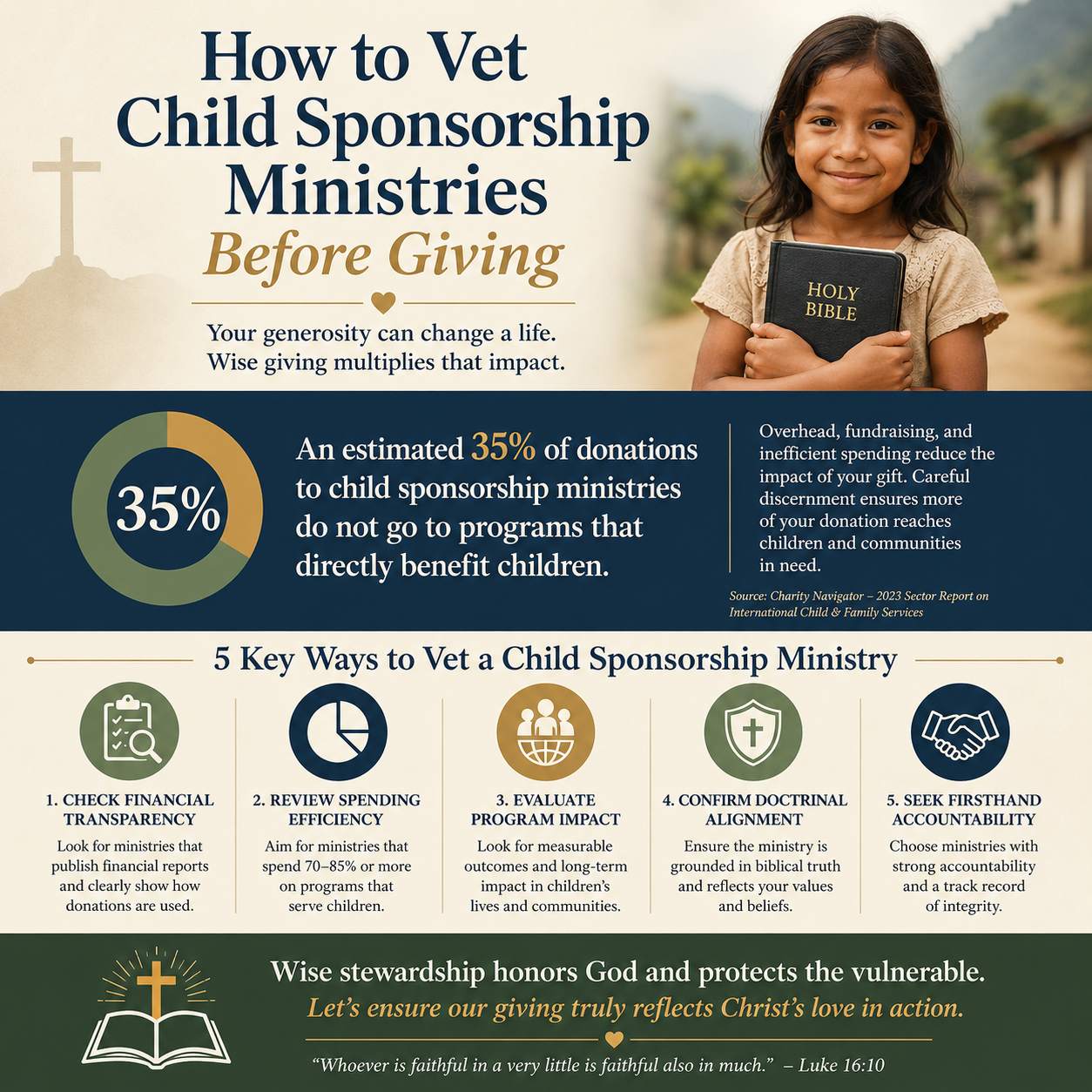
If a ministry is large enough to sustain a sponsorship program at scale, it is generally large enough to provide audited financial statements or, at minimum, reviewed statements with clear notes. The question is not only whether an audit exists, but whether it is available without friction and whether key revenue categories—especially sponsorship income—are intelligible.
Donors should also resist simplistic overhead judgments. The “Overhead Myth” statement, signed by GuideStar (now Candid), Charity Navigator, and the BBB Wise Giving Alliance, argues that overhead ratios alone are a poor measure of nonprofit performance and can push organizations toward underinvestment in systems that protect beneficiaries and improve outcomes (Candid).
Check whether incentives are aligned
Sponsorship programs can create incentives to maximize the number of sponsored children or maintain children in a program longer than necessary. Ask how the ministry defines success. Is success measured by the volume of sponsorships, or by durable changes such as school retention, health outcomes, family stability, and local church strengthening? The harder question is whether the organization’s internal metrics reward truthfulness and child wellbeing, even when those choices reduce fundraising appeal.
Most Trusted exists to serve donors precisely at this intersection of financial integrity and moral accountability. Across our verification work, we find that ministries that meet The Most Trusted Standard do not treat transparency as a public relations task. They treat it as stewardship before God and neighbor.
Evaluate governance and leadership as a spiritual and operational matter
Child sponsorship ministries handle sensitive data, operate across borders, and often work with children in high-vulnerability settings. That requires more than passion. It requires governance that can restrain impulse, correct errors, and insist on ethical consistency across headquarters, field offices, and partners.
Board independence and competence are non-negotiable
A credible ministry can explain who governs it, how leaders are evaluated, and how conflicts of interest are managed. In some Christian nonprofits, founders carry unusual authority. Founders can be gifts to the church; they can also become unaccountable. Donors should ask whether the board includes independent members with relevant expertise—child protection, finance, international operations—and whether the board is demonstrably active rather than ceremonial.
Local partnership models should be explicit
Many sponsorship programs work through local churches, schools, or community-based organizations. That can be a strength, but only if responsibilities are clear. Donors should ask who employs field staff, who sets program standards, who investigates safeguarding allegations, and who has authority to terminate a partner relationship. A ministry that cannot answer those questions is asking donors to fund governance by assumption.
For donors who want a broader view of this field, we maintain topic-level analysis and verification considerations for Child Sponsorship Ministries, including the patterns we see across models and regions.
Insist on evidence of effectiveness that honors complexity
Some sponsorship ministries promise outcomes that no responsible organization can guarantee: a child will “escape poverty,” “become a leader,” or “finish school” because a sponsor gave monthly. Those promises are emotionally compelling, but they are not always evidence-based, and they can obscure the real drivers of child development: family stability, quality of schooling, community safety, and public health conditions.
Prefer measurable indicators over testimonial certainty
Testimonies matter in Christian witness, but donor decisions require more than stories. Ask for outcomes that are measured, tracked over time, and reported with reasonable humility about limits. Depending on the program, that could include school attendance, grade completion, malnutrition screening results, vaccination coverage in partnership with local health systems, or documented improvements in household resilience.
When a ministry uses rigorous evaluation methods, it should describe them in understandable terms and acknowledge what cannot be attributed to sponsorship alone. The best reporting does not claim omniscience; it demonstrates disciplined learning.
Watch for dependency and displacement risks
Christians genuinely disagree about the best way to structure aid, but the field has learned to take dependency seriously. The When Helping Hurts framework, articulated by Steve Corbett and Brian Fikkert, has reshaped how many Christian ministries think about poverty alleviation by warning against approaches that inadvertently undermine local agency and dignity (When Helping Hurts).
In sponsorship contexts, dependency risk can appear when families feel pressure to remain “eligible,” when benefits are concentrated only on sponsored children, or when local churches become fundraising conduits rather than pastoral communities. Responsible ministries name these risks and design against them through community-based approaches, graduation pathways, and careful beneficiary selection criteria.
For donors evaluating specific giving decisions and common pitfalls, our editorial coverage of How to Give Wisely to Child Sponsorship Ministries addresses practical questions that arise when sponsorship appeals become urgent and emotionally personal.
FAQs for How to vet child sponsorship ministries before giving
Should a sponsor expect every dollar to go directly to their sponsored child?
Not necessarily. Some ministries allocate a defined portion of sponsorship gifts to child-specific services; others pool funds to support community programs that benefit sponsored children and their households. Either approach can be ethically sound if it is disclosed clearly and consistently. The decisive issue is whether the ministry’s public promises match its actual financial practice and whether the child’s wellbeing, privacy, and safety are protected throughout the program.
What is a responsible way to evaluate a ministry’s financial efficiency without fixating on overhead?
Begin with audited or reviewed financial statements, clear descriptions of how sponsorship revenue is used, and governance practices that prevent conflicts of interest. Efficiency should be considered alongside safeguarding, staff competence, and program systems—areas that require real investment. Sector leaders have warned that overhead ratios alone are an unreliable measure of performance and can encourage underinvestment in accountability and outcomes (Charity Navigator).
A sponsorship gift should be love governed by truth
Child sponsorship can be a faithful channel of Christian mercy when it is built on truthful communication, strong safeguarding, accountable governance, and measurable commitment to a child’s real good. Vetting is not suspicion dressed as prudence; it is stewardship shaped by the conviction that the vulnerable deserve more than our intentions. When donors insist on verifiable integrity, they do not merely protect their own consciences. They help strengthen the ministries that deserve the church’s trust.



