

How often child sponsorship ministries send updates is not a trivial operational question; it is a test of spiritual and fiduciary seriousness. Christian donors are not purchasing news about a child. We are entering a stewardship relationship in which communication should protect dignity, demonstrate integrity, and provide verifiable evidence that a child-centered program is actually functioning as described.
The field’s challenge is that donors legitimately want regular connection, while children deserve privacy, safety, and a stable local support system that is not organized around Western expectations. Mature ministries have learned that “more updates” is not automatically “better updates,” and that communication practices can either reinforce healthy accountability or subtly commodify a child’s story.
What update frequency is normal and what it is meant to accomplish
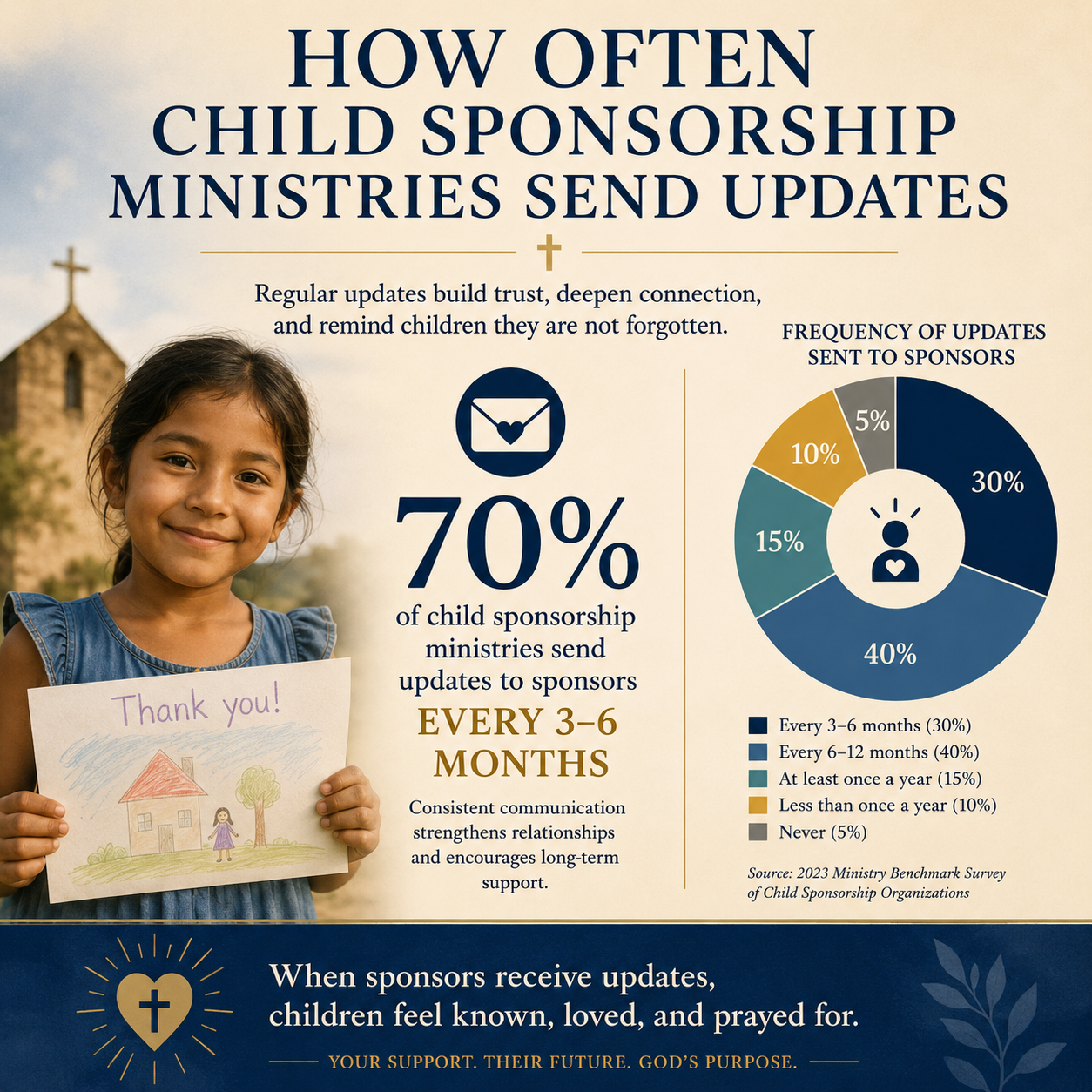
Across child sponsorship programs, the most common pattern is a few substantive touchpoints each year, supplemented by timely administrative notices. Frequency tends to cluster around an annual progress report plus one additional update, or quarterly brief updates with a more substantial yearly summary. The point is not to fill an inbox; the point is to document care in a way that is truthful, pastorally responsible, and auditable.
In our verification work at Most Trusted, we find that ministries meeting The Most Trusted Standard treat communication as part of transparency and effectiveness, not as marketing. They can explain, in plain terms, what information is gathered, who gathers it, how it is validated locally, and what safeguards exist to prevent exaggeration, scripting, or pressure on children to “perform gratitude.”
Updates should serve accountability before they serve sentiment
The New Testament’s language of stewardship assumes a moral obligation to give an account. Jesus’s parable of the talents is not a budgeting seminar, but it establishes the expectation that resources entrusted for the master’s purposes are not treated casually. In sponsorship, the “account” includes how funds are used, what services are delivered, and whether the child remains appropriately enrolled and served.
This is why a ministry’s update rhythm should be evaluated alongside the substance of what is reported. A monthly photo and a sentence can be emotionally potent while remaining informationally thin. A twice-yearly report that includes school attendance, health milestones, household stability indicators, and program participation—shared with appropriate privacy protections—can be more faithful to the donor’s duty of care.
Many ministries are communicating within real constraints
Communication is constrained by distance, infrastructure, child protection, translation, and the rhythms of local schools and clinics. Ministries serving in rural contexts may have unreliable connectivity, seasonal travel barriers, or limited staffing trained for documentation. The best programs acknowledge these realities without using them as a blanket excuse for vagueness.
Donors should also recognize that responsible safeguarding can reduce the amount of individualized material a ministry is willing to send. This is not inherently evasive. It can be the opposite: a refusal to expose a child’s identity, location, or vulnerabilities for the sake of donor satisfaction.

Why some ministries limit updates and why that can be ethically right
Christians genuinely disagree about how “relational” sponsorship communication should be. One model emphasizes personal connection through letters and photos. Another emphasizes community development and child protection, with limited individualized communication. Both can be motivated by love. Both can be mishandled.
The ethical question is whether the ministry’s practices treat the child as a bearer of God-given dignity rather than as a fundraising instrument. That question becomes acute when updates are frequent, highly curated, or emotionally manipulative.
Child protection and dignity are not secondary considerations
Frequent individualized updates create predictable risks: sharing identifiable details, publicizing trauma, and encouraging a dynamic where children feel responsible for donor retention. Responsible ministries follow safeguarding practices that limit personal data and control how images and narratives are captured, stored, and distributed. Many also adopt policies that avoid describing a child’s most painful experiences in donor-facing material.
Donors can ask for the safeguarding rationale behind the update cadence. Ministries with mature practice can explain their child protection policy, including how they secure consent, who is authorized to take photos, and what happens if a sponsor posts a child’s information online.
Translation, verification, and local ownership take time
High-frequency updates often pressure staff to produce content quickly. That pressure can weaken verification and increase the temptation to standardize narratives. When communication is slower, it can allow for better translation, local review, and factual confirmation that the child remains in program and the services described were actually delivered.
Donors should not confuse speed with transparency. The better question is whether the ministry can show a repeatable process for gathering information, reconciling it to program records, and correcting mistakes when they occur.
What high-quality updates include and what should raise concern
The quality of sponsorship updates is measurable. Mature ministries provide information that is specific enough to be meaningful but not so specific that it compromises privacy. They also align updates with how the program is funded. If sponsors are told their gifts support education, for example, updates should be able to describe education-related inputs and outcomes without resorting to generic statements.
For donors seeking a broader view of programs and accountability practices, the wider landscape of Child Sponsorship Ministries includes meaningful variation in philosophy, monitoring, and communication.
Markers of substance
Strong updates usually contain a limited set of consistent elements over time so that progress is comparable year to year. They may include the child’s grade progression, attendance patterns, participation in tutoring, basic health check milestones, and notes about household stability—shared carefully and without sensational detail.
A useful test is whether the update would still be persuasive if it were stripped of emotional language. Christian compassion is not the enemy of clarity, but clarity should stand on its own.
Common warning signs for sophisticated donors
- Highly frequent updates that are consistently generic, as though produced from a template
- Stories that escalate suffering to intensify urgency, without explaining the program response
- Promises that a sponsor “changes this child’s life” without describing the actual service model
- Requests to share a child’s name, photo, or location publicly as a recruitment tactic
- Deflection when asked how information is verified or who approves communications locally
These patterns do not automatically prove misconduct. They do signal a need for deeper inquiry, especially when combined with financial opacity or governance weaknesses.
How to evaluate update practices using The Most Trusted Standard
Most donors understandably start with the question, “How often will we hear?” The more discerning question is, “Is the ministry’s communication credible, protected, and accountable?” The Most Trusted Standard frames that question across faith commitments, financial integrity, governance, and transparency and effectiveness—because communication is rarely a standalone issue. Weak updates are often a symptom of weak measurement, weak safeguarding, or weak internal controls.
Transparency and effectiveness that can be demonstrated
Ministries should be able to articulate what success means for a sponsored child and how progress is tracked. Even when outcomes are complex and not linear, there should be a coherent theory of change and a measurement practice appropriate to the context. For donors, this matters because it prevents sponsorship from drifting into sentimental reporting untethered to real service delivery.
When ministries cite outcomes, they should distinguish between outputs (uniforms provided, tutoring sessions delivered, clinic visits facilitated) and outcomes (improved attendance, grade completion, health improvements). The latter are often slower, harder to attribute, and ethically dangerous to oversimplify.
Governance and internal controls behind the communication
Update cadence is also shaped by leadership decisions: staffing, training, translation budgets, and data systems. Boards that take oversight seriously insist on child safeguarding policies, documentation standards, and periodic audits of how sponsorship funds are restricted and reported. Donors rarely see these internal systems, but they directly affect whether updates can be trusted.
The best ministries do not treat donor communications as a protected zone where normal scrutiny is suspended. They allow reasonable questions, they correct errors, and they avoid “too-good-to-check” narratives.
Setting wise expectations as a Christian sponsor
Christian donors often carry two legitimate desires that can pull in opposite directions: a desire for personal connection and a desire to protect the vulnerable. Wise expectations keep both in view. Sponsorship is not a pen-pal program, and it is not a data dashboard. It is a form of discipleship expressed through faithful giving, grounded in truth and restrained by love.
For practical guidance on correspondence, boundaries, and the meaning of communication, many donors benefit from the wider discussion within Communicating with Your Sponsored Child, because the act of writing and receiving updates is itself a moral practice.
A frequency that often reflects maturity
As a general pattern, one to four meaningful updates per year is common for well-run programs, with additional contact when there is a significant change (relocation, graduation, program transition, or a safeguarding-related limitation on communication). More frequent updates can be appropriate when a ministry has the staff, verification processes, and child protection standards to support them. Less frequent updates can be appropriate when a ministry is transparent about constraints and provides a clear annual reporting process.
The decisive issue is whether the donor receives information that is consistent over time, accountable to records, and communicated in a way that honors the child. Where that is present, cadence becomes a secondary consideration.
Questions worth asking a ministry directly
Responsible ministries welcome sober questions, especially from donors who understand that truth is part of Christian love. Questions such as these often clarify whether update practices are grounded and mature:
- What is your standard update schedule, and what triggers an additional update?
- Who gathers child information, and how is it verified against program records?
- What is your child safeguarding policy for photos, names, and personal details?
- How do you handle letters and gifts to avoid coercion, favoritism, or dependency?
- If a child leaves the program, how and when are sponsors notified?
Clear answers do not guarantee excellence, but evasive answers should carry weight in a donor’s discernment.
FAQs for How often child sponsorship ministries send updates
Is monthly communication a sign a sponsorship ministry is more transparent?
Not necessarily. Monthly messages can be transparent if they are accurate, locally verified, and governed by strong safeguarding policies. They can also be a sign of donor-driven content production that prizes frequency over truthfulness or child dignity. We recommend evaluating the substance of what is reported, the protection of personal information, and whether the ministry can explain its verification process.
What should we do if updates stop or feel inconsistent?
Ask directly for the ministry’s stated update cadence and for the reason a specific update is delayed. Responsible ministries can explain operational constraints, staffing transitions, school calendar factors, or safeguarding limitations without becoming defensive. If the ministry cannot provide a clear explanation, cannot confirm the child’s enrollment status, or repeatedly substitutes generic messages for meaningful reporting, donors should consider whether the program’s transparency and governance are adequate for continued support.
A sober standard for sponsorship communication
How often child sponsorship ministries send updates matters because it reveals what a ministry believes communication is for: accountability or fundraising, dignity or exposure, truth or sentiment. Christian donors should expect a cadence that is realistic for the context and a content standard that can bear scrutiny. Where those are present, updates become what they ought to be—an honest account of care, offered with restraint, and received with gratitude and discernment.



