

Communicating with your sponsored child is not a sentimental add-on to child sponsorship. It is one of the few recurring moments when a donor’s spiritual intent meets a child’s daily reality, through a ministry’s systems, safeguarding policies, and theology of dignity. Done well, correspondence strengthens encouragement and accountability on both sides. Done poorly, it can create confusion, false expectations, or even risk to a child and family.
Christian donors often feel two pressures at once: the desire to be personally present, and the awareness that a letter is crossing languages, cultures, and ministry protocols. The tension is not a reason to withdraw. It is a reason to communicate with more care, and to choose ministries whose practices are verifiably aligned with Christian ethics. Across Child Sponsorship Ministries, the ministries that meet The Most Trusted Standard tend to treat sponsor correspondence as pastoral care and child protection, not as customer service.
Communication is discipleship and stewardship, not pen-pal entertainment
Christian sponsorship correspondence is best understood as a form of encouragement within the communion of saints, shaped by truthfulness, gentleness, and respect. Scripture’s insistence on truthful speech matters here. “Therefore, having put away falsehood, let each one of you speak the truth with his neighbor” (Ephesians 4:25). In sponsorship, truth includes the humility to recognize what a letter can and cannot carry across continents and life circumstances.
Many donors want to make a child feel “like family.” The instinct is tender; the application can be complicated. In some contexts, language of adoption or promises of future travel can be heard as binding commitments. The child’s caregivers may interpret it as an attempt to bypass local authority. A mature sponsor communicates affection without making claims that belong to a parent, guardian, or local church leader.
What a sponsor letter is and what it is not
A sponsor letter is a structured encouragement delivered through a ministry relationship. It is not direct private messaging, and it is not a negotiation for outcomes. The ministry is responsible to ensure the child’s safety, keep communications appropriate, and avoid coercive dynamics. A sponsor’s role is to write in a way that supports that responsibility rather than undermining it.
That clarity also protects donors. When sponsors assume a direct relationship without mediation, they can be manipulated by fraud, guilt tactics, or requests that violate policy. Responsible child sponsorship ministries refuse to make donors the child’s primary problem-solver. They keep the sponsor in a supportive, prayerful, and consistent posture.
The hope donors carry must be tethered to truth
Most Christian donors are not trying to buy outcomes, yet the emotional arc of sponsorship can drift into that logic: “If I write the right thing, give the right gift, fund the right project, this child will be safe from hardship.” The harder truth is that sponsorship is a support within a wider web—family, local church, school, health systems, and economic realities. Sponsorship can contribute meaningfully, but it does not grant control.
Good correspondence keeps hope grounded. It encourages diligence in school, honors caregivers, points a child toward Christ, and affirms the dignity of ordinary faithfulness. It avoids narrating the sponsor as savior or implying that Western life is the real measure of flourishing.

How responsible ministries manage letters, translation, and privacy
Donors sometimes feel disappointed when child sponsorship ministries translate sponsor letters, limit photos, restrict gifts, or batch communications in periodic updates. Those constraints can feel impersonal. In practice, they are often the clearest sign that a ministry is treating children as persons to be protected, not products to be marketed.
Why translation and review exist
Translation is not merely linguistic. It is cultural, pastoral, and protective. A literal translation of certain phrases (“I will come get you,” “I will take you to America,” “I’m sending you money”) can carry unintended weight. Ministries that translate and review letters are often trying to keep communication truthful and developmentally appropriate, especially for younger children.
Review also addresses a sobering reality: child protection risks are real, including grooming behavior and boundary violations. Ministries that take safeguarding seriously will require sponsor communications to go through monitored channels. UNICEF has long emphasized that child safeguarding depends on policies, training, and accountability systems, not good intentions alone; their child protection work underscores the need for structured protections around vulnerable children UNICEF.
Privacy is part of dignity
Sophisticated donors increasingly ask whether a ministry shares children’s full names, direct addresses, school locations, or detailed family vulnerabilities with sponsors. Limiting that information is not secrecy; it is often a necessary protection against exploitation, stigmatization, or local conflict. It also helps ministries comply with evolving privacy expectations and, in some settings, government requirements.
When a ministry’s communications are overly detailed, donors should pause. Transparency is essential, but transparency is not the same as exposure. Under The Most Trusted Standard, we look for ministries that can show how they balance donor reporting with child privacy, and how those decisions are governed and audited.
Why updates can be periodic rather than immediate
Some sponsors expect the speed of modern messaging. Many field programs operate with limited connectivity, school schedules, and staff capacity. More importantly, a child should not be pulled out of school or home responsibilities simply to meet donor expectations. Ministries that send updates on a predictable cadence are often doing so to protect the child’s routine and to prevent correspondence from becoming a performance.
That does not mean donors should accept vague reporting. A credible ministry can explain its update schedule, show how letters are collected and delivered, and outline what sponsors can expect when a child moves, changes schools, or leaves the program.
What to write, what not to write, and how to encourage without distorting power
The content of a sponsor letter carries spiritual and social weight. Sponsors hold disproportionate economic power relative to a child’s context. The goal is not to erase that reality, but to communicate in a way that refuses to exploit it. Christian love is not patronizing; it honors the image of God in the child and in the child’s family.
Write with warmth, clarity, and moral steadiness
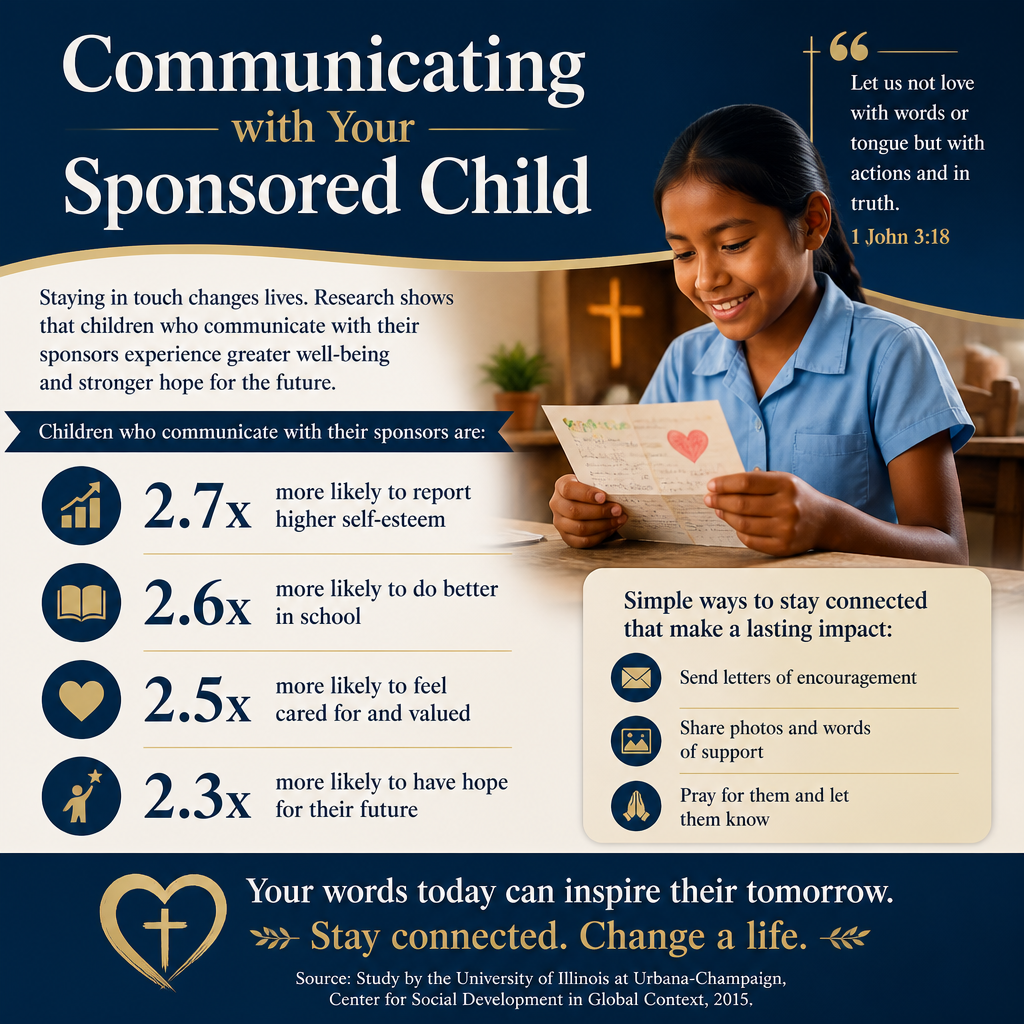
Effective letters tend to do a few things consistently. They ask simple questions a child can answer. They affirm effort rather than status. They share ordinary life without making it a comparison. They keep promises minimal and realistic. They communicate prayer as a genuine spiritual practice rather than a slogan.
Many donors want to speak explicitly about the gospel. That can be appropriate, especially in programs rooted in local church partnerships. At the same time, sponsors should respect the ministry’s discipleship approach and the child’s family context. In some areas, overt religious language in correspondence may expose a child to risk if the letter is seen by others. A responsible ministry can advise on what is safe, wise, and consistent with the local church.
Avoid statements that create false expectations
Several categories of statements regularly produce harm or confusion. Promises to visit, adopt, or bring a child to another country. Claims of sending cash directly. Personal disclosures that burden a child emotionally. Criticism of the child’s culture, parents, or community. Requests for secrecy. Even well-meant lines like “You can tell me anything” may be inappropriate if they invite disclosures the ministry is better equipped to handle through trained staff.
When donors feel compelled to offer more—more money, more gifts, more access—it is often a sign that the relationship is drifting away from its proper contours. The sponsor is not the child’s private benefactor; the sponsor is supporting a program accountable to governance, financial controls, and child protection policies.
Gifts, packages, and the ethics of material giving
Material gifts can be a blessing, but they can also inflame inequality within a classroom, a sibling group, or a village. Some ministries prohibit packages because they cannot be safely tracked, equitably distributed, or protected from theft and coercion. Others allow modest gifts through controlled channels, such as a birthday fund or community-based benefit.
Christians genuinely disagree about whether individual gifts are appropriate. The more important question is whether the ministry has a coherent policy grounded in child welfare and local dynamics, and whether it can demonstrate that the policy is followed. A mature sponsorship model usually prefers benefits that do not isolate one child socially, even when the sponsor’s affection is personal.
Donors who want to learn from the broader field often find the “asset-based” emphasis in the When Helping Hurts framework—articulated by Steve Corbett and Brian Fikkert—helpful for examining how aid can unintentionally displace local agency and reinforce dependency Chalmers Center.
How donors can evaluate a ministry’s communication practices with confidence
Communication policies are a window into a ministry’s theology and its operational maturity. They reveal whether a ministry prioritizes child dignity over donor experience, whether it has real safeguards, and whether it can sustain relationships over years without manufacturing emotional highs.
Ask questions that reveal systems, not slogans
Several questions consistently separate mature programs from fragile ones:
- How are letters translated, reviewed, and delivered, and what training do staff or partners receive?
- What information about the child is shared with sponsors, and what is withheld for privacy?
- What happens when a letter contains an inappropriate promise, request, or boundary violation?
- How does the ministry handle sponsor requests for direct contact, social media connection, or visits?
- What is the policy on gifts, cash, and packages, and how is equity within the community maintained?
A trustworthy ministry answers these questions without defensiveness. It will not treat policies as proprietary secrets. It will explain the rationale in terms of child protection, local partnership, and accountability.
Look for alignment with The Most Trusted Standard
At Most Trusted, we evaluate Christian nonprofits against The Most Trusted Standard, a 15-criteria framework spanning faith commitments, financial integrity, governance and leadership, and transparency and effectiveness. In sponsorship correspondence, that translates into verifiable questions: Are there written safeguarding policies? Are financial controls clear enough to prevent sponsors from being solicited for off-policy payments? Does the board provide oversight on child protection risk? Are communications representative rather than staged?
Many donors have been formed by the “overhead ratio” era and assume that tight staffing is always virtuous. For sponsorship communication, under-resourcing can be a warning sign. Translation, review, safeguarding, and monitoring require people and training. Ministries that refuse to fund those functions may expose children to risk. The BBB Wise Giving Alliance’s Standards for Charity Accountability emphasize governance and truthful representations as core expectations for responsible charities BBB Wise Giving Alliance.
Honor the relationship without demanding control
Sponsorship works best when donors commit to long obedience in the same direction: steady support, steady prayer, steady encouragement. The sponsor’s influence should feel like a reliable presence, not a periodic intervention. That posture also reduces pressure on the child to perform gratitude or produce spiritual language for the donor.
When donors feel spiritual discomfort about mediated communication, the discomfort may be pointing to a good question: Are we seeking intimacy we have not earned? Christian love is patient. It does not insist on its own way (1 Corinthians 13:5). In sponsorship, patience often looks like respecting boundaries designed to protect the child.
Correspondence that reflects Christ and protects the child
Communicating with your sponsored child is one of the simplest practices in child sponsorship, and one of the most morally consequential. A letter can dignify a child, reinforce faithfulness, and strengthen hope. It can also, without care, create expectations, expose private details, or confuse the moral authority structures that keep children safe.
The ministries most worthy of Christian trust treat communication as a protected channel of encouragement shaped by truth, prudence, and love. Donors serve children best when they embrace that discipline, and when they choose partners whose policies and governance make that discipline credible over time.



