

How child sponsorship ministries handle gifts and packages reveals far more than a customer-service policy. It is a test of whether a ministry can protect a child’s dignity, keep families intact, and steward donor generosity without creating favoritism, exploitation, or hidden financial burdens for the local church and staff who must implement what donors request.
Many Christian donors give because they want a relationship, not merely a transaction. That impulse can be deeply biblical: Paul thanked the Philippians for their partnership, and the early church exchanged material support across distance as an expression of fellowship (Philippians 4:15–17; 2 Corinthians 8–9). Yet child sponsorship operates in a complex social ecosystem. A package that feels small from an American perspective can destabilize a household economy, elevate one child above siblings, or become a target for theft on the way to a rural community.
Why gifts and packages are not a simple add on to sponsorship
Children are not projects and neither are their families
Scripture’s concern is not only that the poor receive help, but that help strengthens what God is building in families and communities. James condemns a compassion that stops at words (James 2:15–17), but Proverbs also warns that unwise generosity can deepen disorder. In child sponsorship, poorly handled gifts can inadvertently turn a child into a conduit for outside resources rather than a son or daughter within a household.
The harder tension is emotional. Many donors want to send something tangible because it feels personal and immediate. Ministries that serve children well usually try to preserve that personal desire while refusing forms of giving that predictably harm the child or the wider community.
The field has learned from adjacent mistakes
Child-focused ministries have watched the orphan care movement confront unintended consequences, including incentives that pull children away from families. UNICEF has summarized evidence that large numbers of children in residential care are not orphans, and that poverty and lack of services often drive separation rather than the absence of a living parent UNICEF. Responsible sponsorship programs do not assume that a Western donor’s good intention is sufficient protection against harm.
This is one reason many ministries place gifts and packages under stricter rules than donors expect. Their goal is not to restrict generosity but to safeguard the child’s best interest over time.
What responsible ministries typically do with money gifts
Most do not pass cash directly from sponsor to child
Across our verification work at Most Trusted, we observe that ministries aligned with The Most Trusted Standard rarely deliver cash directly from a sponsor to a sponsored child. Cash creates immediate risks: theft, extortion, and community resentment. It can also undermine caregivers by signaling that the child has an independent patron outside the family’s authority.
Instead, responsible programs channel sponsor giving through a defined assistance pathway: school fees paid to schools, medical support paid to clinics, food support provided through vouchers or distributions, or family livelihood support administered with oversight. When cash is used, it is usually part of a broader economic-strengthening program with controls, coaching, and documentation rather than an untraceable transfer prompted by a sponsor letter.
They separate compassion from exception making
Donors sometimes want to send “extra” money for birthdays, emergencies, or special needs. The ministry then faces a discernment question: is the need legitimate, and is the requested method wise? Mature programs often respond by offering pre-defined funds: a medical assistance fund, a crisis fund, or a community development fund. This can feel less intimate than a direct gift, but it reduces favoritism and allows needs to be evaluated consistently.
When donors understand that a local staff member may have to refuse one child’s “special gift” while standing before the child’s siblings, the rationale becomes clearer. Justice inside a household matters.
They keep the donor from becoming the case manager
It is natural to want specifics: receipts, photos, and detailed accounts of exactly how an extra gift was used. Yet the more a program treats the sponsor as the decision-maker for a child’s individual spending, the more the child’s life can be shaped by donor preference rather than by family leadership and local counsel. Many ministries therefore give reporting that is real and accountable without turning the relationship into a micro-grant managed by correspondence.
What happens to physical packages and why restrictions are common
Shipping is expensive and the burden often lands locally
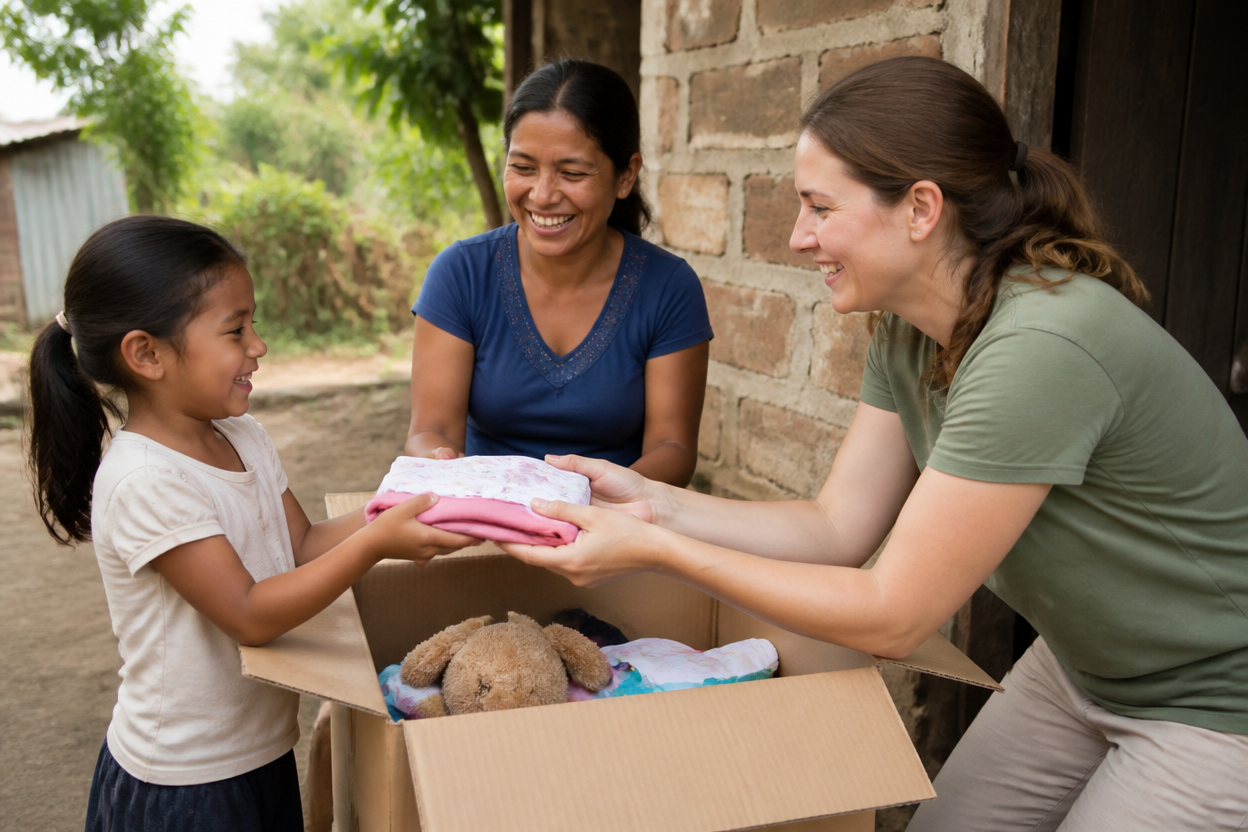
International shipping creates practical problems: customs fees, delays, damaged goods, and unpredictable delivery. Even when the package arrives, local staff may have to travel long distances, store goods securely, and manage distribution in ways that avoid public spectacle. In some contexts, receiving imported items can draw unwanted attention to a child’s home.
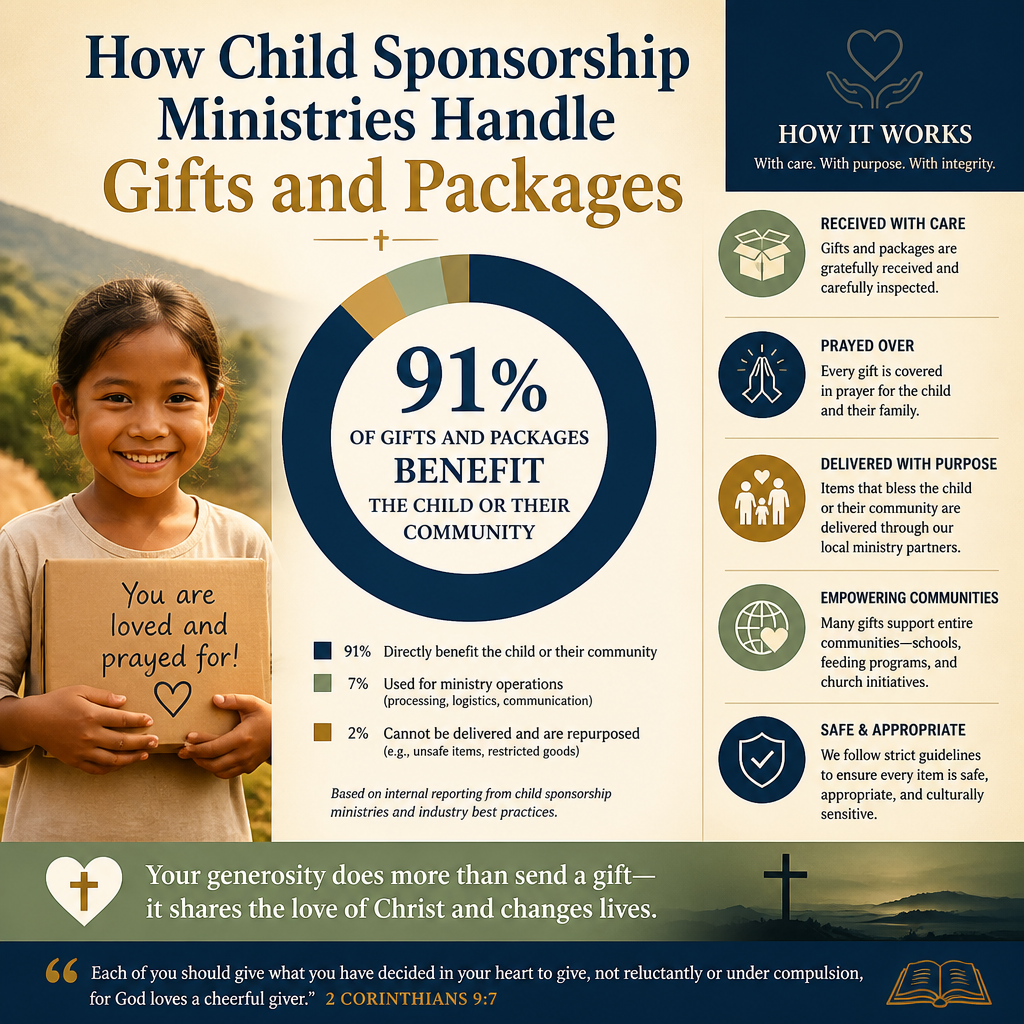
Ministries that allow packages generally do so with a stated list of approved items and a clear understanding that delivery is not guaranteed. Others prohibit packages entirely and ask donors to support a locally purchased gift instead, which often costs less and strengthens local markets.
Child protection and fraud are real concerns
Any system that moves goods to children can be exploited. Packages can be diverted, stolen, or used by adults to pressure families. Some ministries have discovered that the most dangerous moment in sponsorship is not the giving, but the moment when a vulnerable household is known to be receiving resources.
Responsible programs therefore treat package handling as part of child safeguarding. They control who touches the package, where it is opened, how distribution is documented, and how staff prevent a child from being isolated or coerced. Donors should interpret these restrictions as evidence that the ministry has faced reality rather than relying on sentiment.
Equity within the program must be preserved
When only some children receive packages, the ministry must manage the relational fallout: jealousy among peers, stigma for children whose sponsors are less engaged, and pressure on staff to “make it fair” by redistributing gifts. Some programs do redistribute certain items for fairness, but that can disappoint donors who expected a direct transfer. Better programs explain this upfront so that donor expectations do not force staff into quiet improvisation.
Communication policies that protect children and preserve integrity
Letters are spiritual and pastoral but also operational
Most donors cherish letters because they keep the relationship human. Yet correspondence is also a channel that can be manipulated. Children may be coached to ask for money. Donors may request personal contact information. Staff may feel pressure to produce rapid, emotionally compelling replies. A strong communication policy sets boundaries so that the relationship remains safe and truthful.
For donors trying to understand the broader landscape of sponsorship models and safeguards, our coverage of Child Sponsorship Ministries addresses the verification questions that matter most: governance, financial integrity, transparency, and program effectiveness.
Most ministries filter or translate communication for a reason
Translation is not merely linguistic; it is cultural and protective. A staff member may remove a sponsor’s email address, decline a request for unsupervised video calls, or redirect a donor who is trying to send large gifts. Donors sometimes fear censorship. The more accurate framing is that the ministry is acting as a guardian of a relationship that spans power differences.
Child safeguarding standards increasingly emphasize controlled communication with minors, especially across borders. Many Christian ministries align their practices with widely recognized safeguarding expectations, including those summarized by groups such as Keeping Children Safe Keeping Children Safe.
What donors can do that genuinely helps
Wise sponsorship relationships tend to share a few traits. Donors communicate encouragement without making promises they cannot keep, and they support the ministry’s rules even when those rules limit spontaneity. For donors seeking practical clarity on what is appropriate to send and say, Communicating with Your Sponsored Child is often where the most preventable misunderstandings can be addressed early.
- Write letters that affirm dignity and effort, not neediness.
- Avoid asking for personal addresses, phone numbers, or social media contact.
- Follow the ministry’s approved list for gifts, photos, and religious materials.
- When you want to give extra, use the program’s designated funds rather than cash in a letter.
- Let the ministry decide timing and distribution so siblings and caregivers are respected.
What to ask a sponsorship ministry before sending anything extra
Questions that reveal whether policies are principled
Donors often ask, “Does the gift reach my child?” A more searching question is, “Does the policy protect my child and strengthen their family?” Ministries that meet The Most Trusted Standard tend to answer with specific procedures: who receives the item, who documents it, how they manage fairness, and what they do when a request would harm the child.
Responsible ministries are also willing to say no. They will not tell donors what they want to hear in order to keep sponsorship revenue. They will explain trade-offs plainly: a direct gift may feel personal, but it can distort community dynamics; a pooled gift may feel indirect, but it can be delivered safely and equitably.
Verification is not suspicion it is stewardship
Jesus commended faithfulness with entrusted resources (Luke 16:10–12). For Christian donors, asking hard questions is not cynicism; it is stewardship. In our work at Most Trusted, we pay close attention to whether policies are published, consistently applied, and supported by documentation. We also look for evidence that staff are trained and that safeguarding is integrated into operations rather than appended to a website.
If a ministry cannot clearly explain how gifts and packages are handled, donors should treat that as a meaningful risk indicator. A program that is doing careful work can usually describe its process without evasion.
FAQs for How child sponsorship ministries handle gifts and packages
Can we send cash or gift cards in a letter to our sponsored child?
Most responsible ministries discourage or prohibit cash in letters because it increases risk to the child and creates inequity within the community. Many programs offer structured alternatives such as medical funds, emergency funds, or locally purchased gifts administered with oversight. Donors should ask for the ministry’s written policy and how it is enforced in-country.
Why would a ministry redistribute a package rather than give it directly to the sponsored child?
Redistribution is often an equity and child-protection measure. In some communities, a visible gift to one child can create jealousy, pressure, or even theft. Programs may share certain items among siblings or peer groups to reduce harm and preserve dignity. The best ministries explain these rules before a donor sends anything so expectations remain aligned with what protects children.
Conclusion
How child sponsorship ministries handle gifts and packages is a window into their theology of dignity and their operational maturity. The most trustworthy programs preserve the personal character of sponsorship while refusing practices that predictably harm children, families, or communities. Donors who align their generosity with these safeguards honor both the child they love and the Lord whose name the ministry bears.



