
How biblical museum tours strengthen faith formation is ultimately a question about how Christians learn to love God with the mind without reducing discipleship to information. When the church engages history, language, and archaeology with reverence and restraint, donors can help fund experiences that make Scripture more intelligible and obedience more concrete.
Serious Christians have long insisted that revelation is not an abstraction. God acted in time and space, in real places with real people. Museum collections, curated well, can serve that insistence: they do not replace the Word of God, but they can clarify the world in which the Word was given, and they can expose modern assumptions that quietly reshape how believers read the text.
Faith formation is embodied, not merely conceptual
Christian formation is not only a transfer of propositions; it is apprenticeship in worship, repentance, and hope. Biblical museum tours can contribute to this formation because they press learning into the body: standing before artifacts, inscriptions, and geographic reconstructions requires attention, patience, and humility. Those are not secondary virtues for disciples. They are part of how we become “doers of the word, and not hearers only” (James 1:22).
From a donor’s perspective, this matters because educational ministries are frequently evaluated as if their main output is content delivery. Tours can create a different kind of learning environment—one where participants are confronted with continuity and discontinuity between the biblical world and their own. That confrontation often produces deeper questions, which is where durable formation begins.
Material culture can sharpen biblical reading without claiming to prove faith
Christians genuinely disagree about how much apologetic weight archaeological evidence should carry. Responsible biblical museum ministries do not treat artifacts as an alternative foundation for faith. They treat them as witnesses that can illuminate context: weights and measures that make parables more precise, inscriptions that clarify political realities, or manuscript traditions that illustrate how carefully Scripture was transmitted.
The Christian tradition has always known the difference between faith grounded in God’s self-revelation and curiosity grounded in novelty. Tours strengthen formation when they keep that difference explicit: Scripture is primary; artifacts are secondary helps.
Place and memory train the imagination for prayer and obedience
The Psalms repeatedly rehearse God’s saving acts as a means of sustaining covenant fidelity. A well-designed tour participates in that biblical pattern of remembrance. It can train participants to imagine Scripture as a coherent story rather than a set of detached moral lessons, and it can strengthen confidence that the gospel is public truth, not private sentiment.
What museum tours can do that sermons and classes often cannot
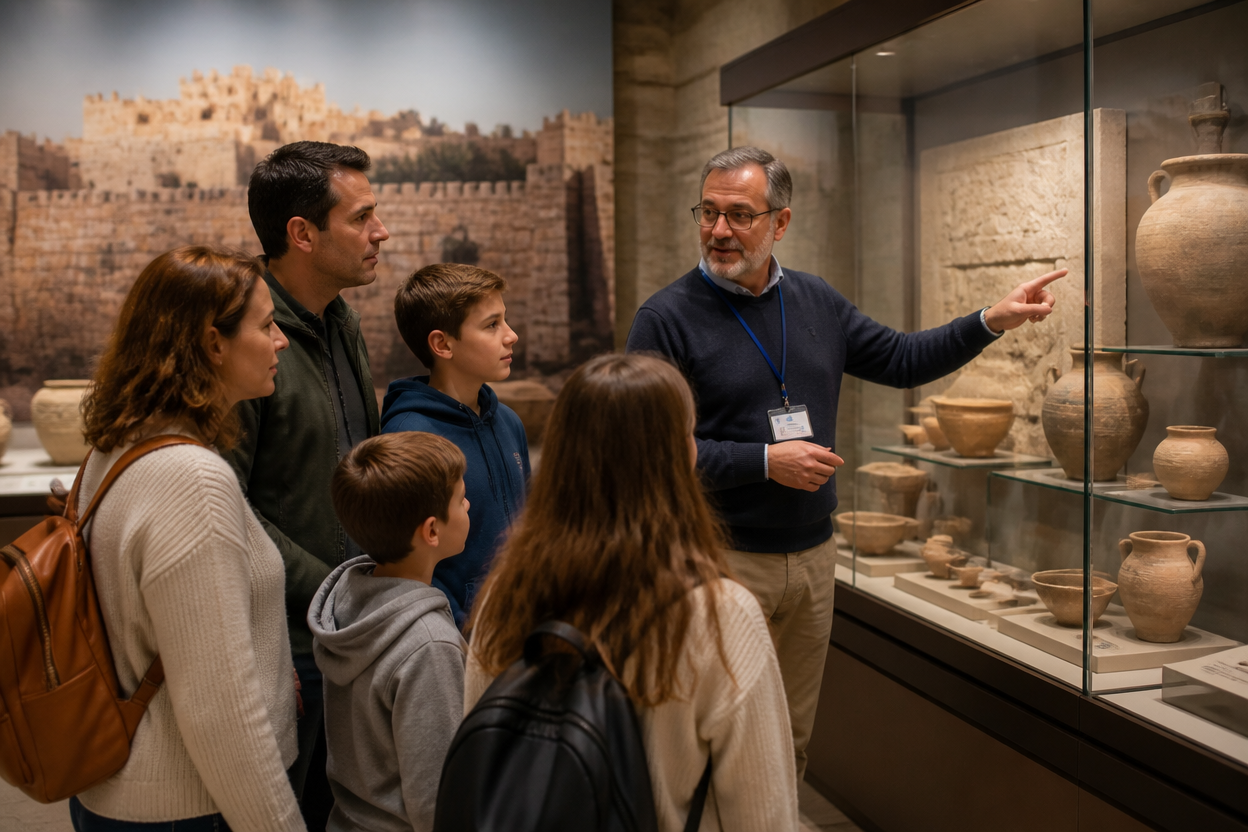
Preaching and classroom teaching are indispensable, but they carry predictable limitations. Many adult learners struggle to integrate historical context because they are hearing it in small fragments, usually abstracted from the physical realities that make it memorable. Museum learning is not inherently superior, but it is distinct: it often teaches through observation, comparison, and guided inquiry.
For donors funding faith formation, the question is not “museum tours or church teaching.” The question is whether a ministry’s programming complements the local church by strengthening biblical literacy and interpretive care.
Visual and tactile learning can reduce interpretive shortcuts
Some interpretive errors persist because readers unconsciously import modern categories into ancient texts. Seeing the tools, household objects, trade routes, and iconography of the ancient Near East can slow those instincts. The benefit is not trivia; it is discipline. Participants often become less confident in shallow readings and more receptive to careful exegesis.
This is one reason ministries connected to Biblical Museum Ministries can have outsize discipleship influence relative to their size. When they cultivate interpretive humility—rather than perform certainty—they serve the church.
Intergenerational formation is often stronger in shared experiences
Research on religious transmission consistently highlights the significance of parents and congregational relationships in the formation of children and teenagers. The research is more complex than a single lever, but it is not ambiguous about the importance of the home and close community. A widely cited synthesis of social science on religious transmission describes parents as the primary influence on children’s religious outcomes, with community reinforcement playing a meaningful secondary role (Journal for the Scientific Study of Religion).
What this means in practice is that tours can be powerful precisely because they are shared: grandparents, parents, and students hear the same narrative together, ask questions together, and often return home with shared reference points that become the raw material for ongoing discipleship.
The theological stakes are real, and the tensions should be named
Not every biblical museum experience strengthens faith formation. Some tours unintentionally catechize visitors into a thin rationalism, as though Christianity stands or falls on the next archaeological find. Others collapse into entertainment, where “Bible times” becomes a brand aesthetic rather than a summons to holiness. The point is not to disparage the field, but to acknowledge that donors are right to ask what theology of Scripture and discipleship a museum experience actually embodies.
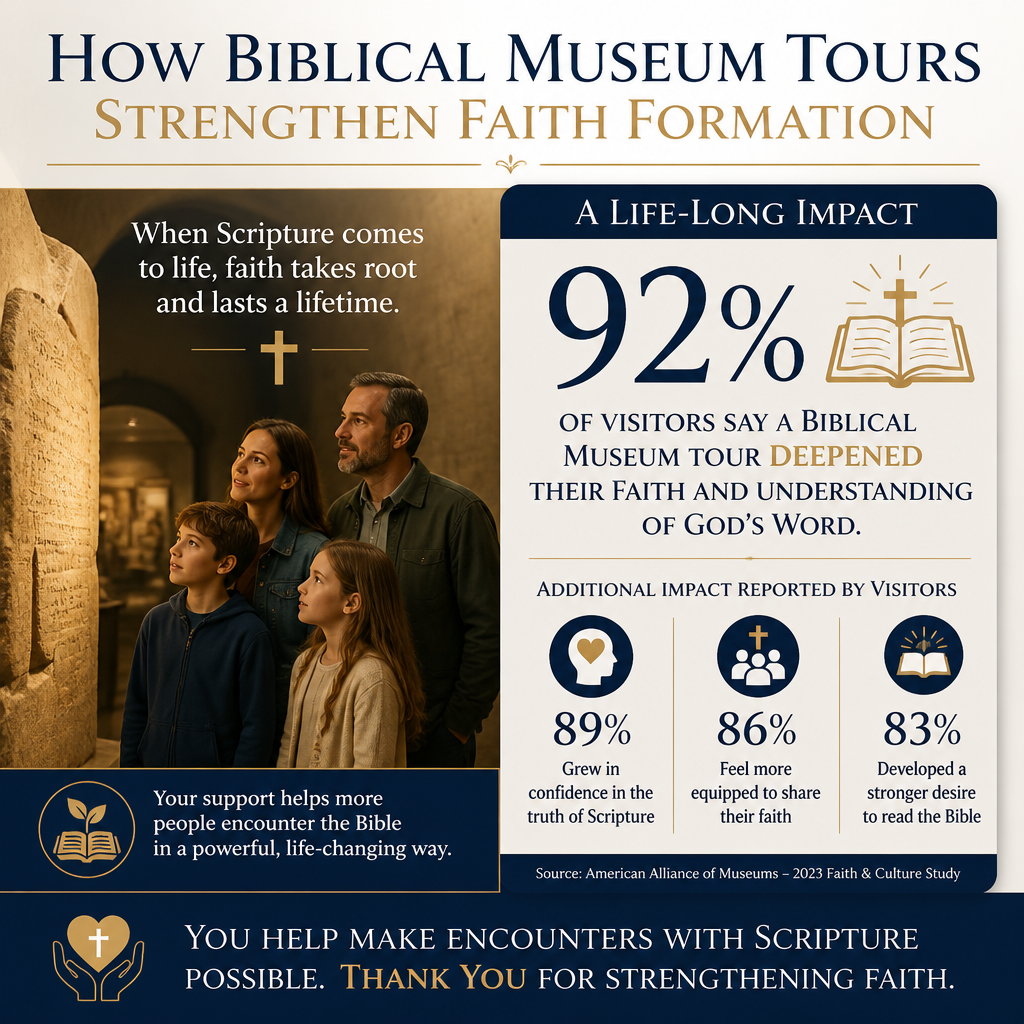
Responsible ministries name these tensions openly: archaeology has limits; provenance and acquisition ethics matter; and certain claims are debated among scholars, including Christian scholars. A tour that admits uncertainty where uncertainty exists can form a more durable faith than one that oversells certainty and later collapses under scrutiny.
How a ministry handles contested claims often reveals its discipleship posture
The harder question is not whether a museum has impressive objects. It is whether leaders model Christian intellectual virtues: honesty, restraint, and love of truth. When guides explain both what scholars broadly agree on and what is disputed, participants learn a posture they can carry into Scripture study, cultural engagement, and even vocational decision-making.
Ethics and stewardship are part of formation
Museums and collections operate within a global ecosystem where issues of looting, forged artifacts, and uncertain provenance are real. Donors should not treat these as niche concerns. They are discipleship concerns because they touch truthfulness, justice, and respect for neighbors. A ministry that is casual about documentation or acquisition ethics may be casual about other forms of accountability as well.
What donors should evaluate before funding a tour based ministry
Christian donors often fund experiences because they can picture the immediate outcome: a student inspired, a congregation energized, a family talking about Scripture on the drive home. Those outcomes are meaningful. The stewardship question is whether the ministry can demonstrate integrity and effectiveness over time, with leadership practices that protect participants and honor the church.
Across our verification work at Most Trusted, we observe that ministries worthy of long-term donor confidence tend to make their formation goals explicit, measure outcomes appropriately for their mission, and invite external scrutiny rather than resist it. This is the spirit behind The Most Trusted Standard, which evaluates ministries across faith commitments, financial integrity, governance, and public transparency.
Indicators of a formation-shaped tour model
- Clear doctrinal commitments and a stated approach to Scripture that avoids sensationalism
- Qualified interpretive leadership, including content review and scholarly accountability
- Participant safety practices, especially for minors and vulnerable adults
- Transparent financial reporting and reasonable pricing policies
- Documented educational objectives that align with local-church discipleship
Effectiveness requires more than attendance
Attendance counts are easy to report; formative impact is harder. The research literature on religious education suggests that formation is often gradual and relational rather than instantly measurable. Still, serious ministries can gather credible indicators: participant learning assessments, pastor feedback, follow-up engagement, and evidence that programming is grounded in sound pedagogy rather than novelty.
For donors who support educational ministries broadly, it is worth staying attentive to the broader ecosystem described in How Biblical Museum Ministries Support Education and Discipleship. The strongest organizations often collaborate with churches and schools rather than compete for authority.
How museum tours fit within a mature discipleship strategy
Museum tours are most fruitful when they are framed as a supplement to Word-centered ministry, not as a substitute for it. A tour can clarify context; it cannot supply conversion, sanctification, or spiritual power. Donors best serve the church when they fund tours that explicitly direct participants back to Scripture, prayer, and congregational life.
There is also a stewardship realism donors should not ignore. Educational trips can be expensive and therefore risk becoming accessible primarily to the resourced. Some ministries counter this by scholarships and church partnerships; others do not. A donor’s role may be precisely to widen access so that formation opportunities are not inadvertently restricted to those already advantaged.
Preparation and follow-through often determine spiritual fruit
When tours are embedded in a larger learning arc—pre-reading, guided reflection, and structured debrief—participants retain more and integrate better. This aligns with what educational research consistently shows about learning: spaced repetition and reflective processing deepen retention (American Psychological Association). The point is not to baptize secular pedagogy, but to recognize common grace insights about how humans learn.
Apologetics can serve discipleship when it remains pastoral
Some donors support museum tours because they want believers to be less intimidated by skeptical claims. That desire is understandable, especially given the public pressures faced by Christian students. Yet apologetics that is not pastoral can drift into pride or anxiety—either swaggering certainty or brittle defensiveness.
Tours strengthen faith formation when they treat apologetics as a servant of worship and witness: helping believers give reasons for hope (1 Peter 3:15) while also learning gentleness, patience, and truthfulness.
FAQs for How biblical museum tours strengthen faith formation
Do biblical museum tours risk turning faith into archaeology based certainty?
They can, if a ministry implies that artifacts are the foundation of Christian confidence. Healthy programs explicitly distinguish between the authority of Scripture and the secondary role of historical and archaeological aids. They treat museum evidence as illumination, not as the ground of salvation or the measure of God’s faithfulness.
What is the most responsible way for donors to support biblical museum ministries?
Support ministries that are clear about doctrine, cautious about contested claims, transparent about finances, and accountable in governance. Donors should also look for ministries that partner with local churches, provide equitable access through scholarships when possible, and can describe what formation looks like beyond attendance numbers. Independent evaluation, including alignment with The Most Trusted Standard, can reduce the risk of funding work that is impressive on the surface but unstable underneath.
A form of giving that can deepen the church’s biblical imagination
When biblical museum tours are designed with theological clarity, ethical seriousness, and educational discipline, they can strengthen faith formation by anchoring Scripture in its historical reality and returning participants to the text with greater reverence. Donors are not merely funding a trip. They are funding a set of formative practices—attention, humility, memory, and interpretive care—that can serve the church for decades.



